
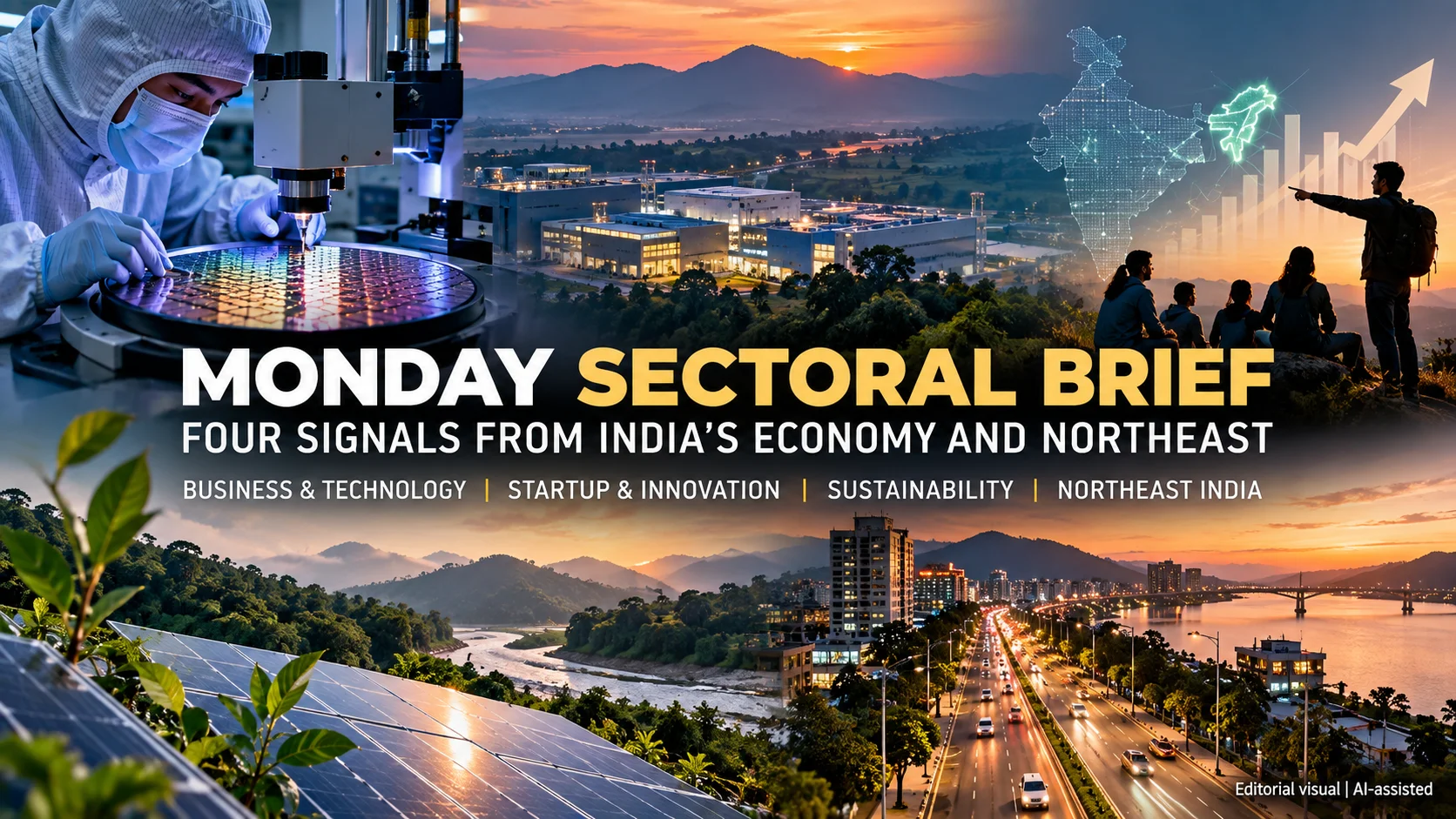
Monday Sectoral Brief: Four Signals From India’s Economy and Northeast
Business & Technology · Startup & Innovation · Sustainability · Northeast India
The week begins with an interesting contrast.
In Jagiroad, a semiconductor project is moving from construction into trial production. Across India, startup capital is flowing again, but the distribution of that capital remains uneven. Meanwhile, Climate Week India is deliberately decentralising the climate conversation, while Guwahati is spending ₹177 crore on an infrastructure layer most people rarely notice until it fails.
Here are four signals worth watching this week.
BUSINESS & TECHNOLOGY
Jagiroad Moves From Promise to Proof
For more than two years, Jagiroad has been one of Assam’s biggest industrial promises: a Tata Electronics semiconductor assembly and test facility involving an investment of about ₹27,000 crore and designed to eventually handle up to 48 million semiconductor packages a day.
Now there is a more tangible signal.
Trial production is underway at the Tata Electronics OSAT facility, with commercial operations expected around December-January, according to recent reporting citing Assam’s chief secretary. The facility is being developed around three core packaging technologies — Wire Bond, Flip Chip and Integrated System Packaging — and Tata has continued to add technology and supply-chain partnerships around the project.
That matters because semiconductor ecosystems are not built by announcements alone. They emerge when equipment, suppliers, technicians, logistics providers, customers and supporting businesses begin operating around an actual production facility.
The timing is significant. SEMICON India 2026 concluded in New Delhi with 56 MoUs, announcements and strategic initiatives across the semiconductor value chain, while the government said investment commitments had reached around ₹1 lakh crore.
For Assam, the question is therefore changing.
It is no longer simply whether Jagiroad will become a semiconductor location. The more consequential question is what grows around the plant — and whether Morigaon and the wider Northeast can capture a meaningful share of the jobs, suppliers, skills and new businesses that a functioning semiconductor ecosystem can create.
STARTUP & INNOVATION
The Week Capital Returned — But Northeast India Still Has a Question
Indian startup funding rebounded sharply during September 21–25.
According to various sources, startups raised $203.4 million across 21 disclosed deals, more than three times the $58.9 million recorded across 14 deals in the preceding week. AI was the most-funded sector in the tracker, with five startups raising a combined $89.3 million.
The headline, however, is less interesting than the distribution.
The disclosed rounds included large transactions involving Ultraviolette Automotive and enterprise AI company Ema, alongside funding for spacetech, fintech, ecommerce, gaming and other sectors. The list does not show a Northeast India-based startup among those 21 disclosed deals.
That does not prove that no Northeast founder received capital during the week. Startup funding databases can differ in what they count, disclose and attribute geographically. But it does provide another useful data point in a much larger conversation about where institutional risk capital is reaching.
For the Northeast, the challenge is increasingly difficult to describe simply as a shortage of ideas.
The more important question is whether promising companies in the region can build enough visibility, networks, institutional support and investable scale to enter the national flow of venture capital.
That is where the region’s next startup story may be decided.
SUSTAINABILITY
Climate Week India Is Happening Without a Single Centre
Climate Week India 2026 began on September 27 and runs through October 4.
But unlike a conventional national conference, it is not built around one city or one central stage. The organisers describe it as a community-led network of gatherings, walks, screenings, clean-ups and conversations taking place across India, with an event and partner map spanning cities and towns around the country.
More than 100 events and 200 organisations are involved, according to partner communications around the initiative, with activities extending across Tier 1, Tier 2 and Tier 3 locations.
That structure is more than an event-management choice.
Climate action increasingly depends on what happens outside the conference room — in farms, forests, cities, campuses, businesses and local communities. A decentralised climate week creates an opportunity to see which regions are actually participating in that transition rather than simply appearing in national climate narratives.
For Northeast India, that makes the event worth watching.
The region has significant forests, biodiversity, renewable-energy potential and carbon-sink ambitions. But the real test is whether those natural advantages translate into measurable projects, investable enterprises, local jobs and stronger climate institutions.
NORTHEAST INDIA
Guwahati Bets ₹177 Crore on the Infrastructure Beneath the Skyline
Guwahati’s next infrastructure upgrade will largely disappear from view.
The Assam government has approved an estimated ₹177 crore Guwahati Underground Cabling Project to move overhead electrical and communication wires underground across about 18 km and five identified corridors. The project was announced by Chief Minister Himanta Biswa Sarma on September 26.
At first glance, this looks like an urban beautification project. Look closer and it becomes a useful infrastructure signal.
Cities competing for investment need more than airports, offices and headline projects. They also need reliable utilities, organised rights-of-way, resilient networks and public infrastructure capable of supporting a growing commercial ecosystem.
That is particularly relevant for Guwahati as Assam simultaneously positions Jagiroad as a semiconductor manufacturing location and seeks to expand the state’s industrial and investment base.
The underground cabling project will not, by itself, make Guwahati an industrial hub. But it represents the kind of less glamorous infrastructure that cities need to get right if larger economic ambitions are to work.
The interesting question now is one of sequencing: can Guwahati’s basic urban infrastructure improve at the same pace as the ambitions being built around the city?





One Comment