
How to Build a Destination Brand: The Dima Hasao Blueprint
Dima Hasao has the landscapes, cultures and experiences to become a distinctive tourism destination. The bigger question is whether it can build its tourism economy on its own terms, with local communities sharing both the responsibility and the value.
On World Tourism Day, there is a question Dima Hasao should perhaps ask before it asks how to attract more tourists:
What kind of tourism economy does it actually want to build?
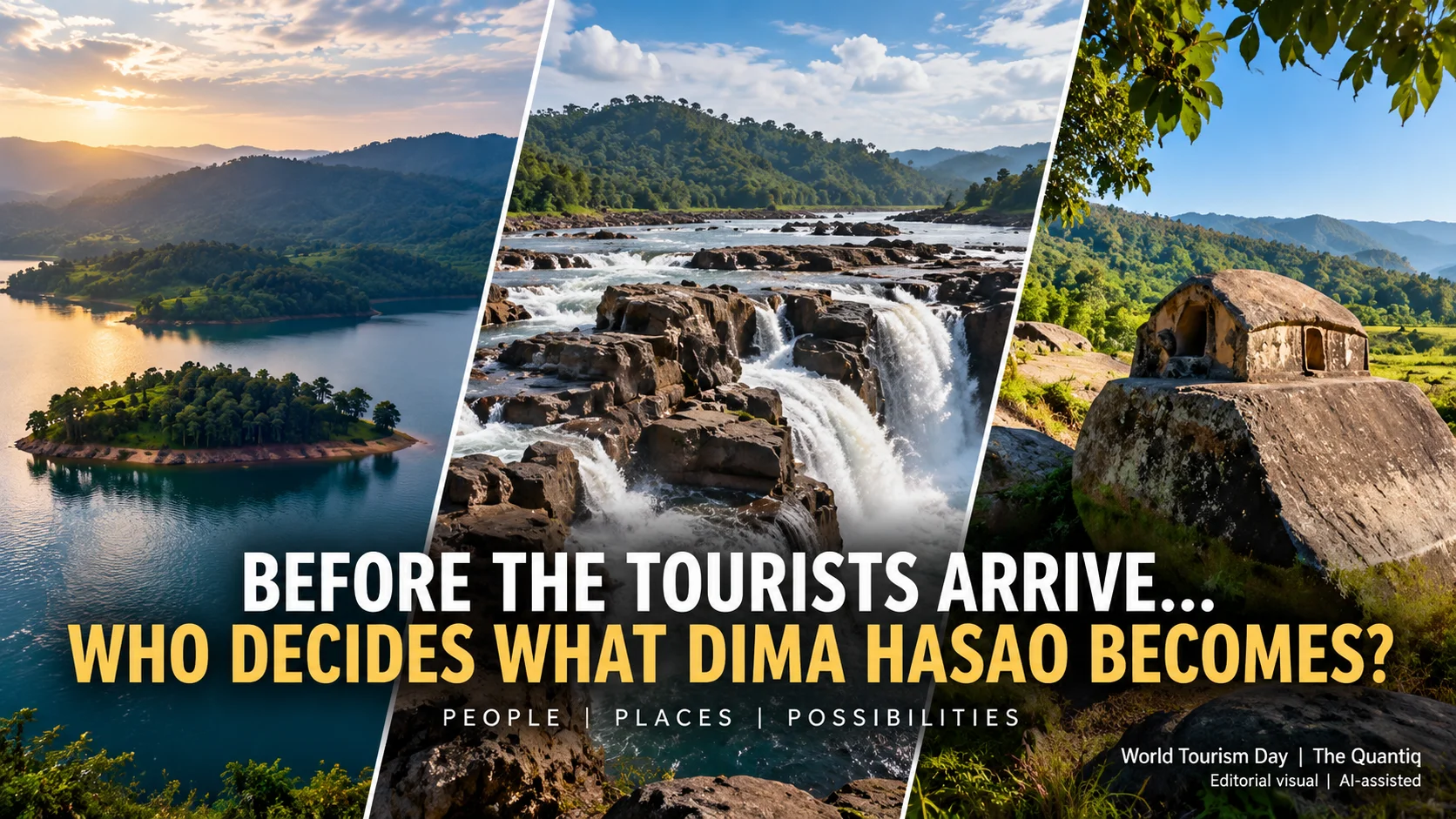
The question matters because Dima Hasao is not starting with an empty canvas. It already has mountains, forests, waterfalls, biodiversity, railway journeys, indigenous cultures, food traditions and a landscape distinctly different from the plains of Assam.
The district covers 4,888 square kilometres and has a diverse social and cultural landscape shaped by numerous tribal communities. The Borail Range defines much of its terrain, while Haflong serves as the district headquarters and Assam’s only hill station. Dimahasao District
Yet, compared with several better-known destinations in the Northeast, Dima Hasao remains relatively early in its mainstream tourism journey.
That is usually described as a gap.
Perhaps it should also be seen as an opportunity.
Dima Hasao still has room to decide what tourism should become before tourism becomes powerful enough to decide what Dima Hasao should become.
That is where destination branding begins.
A Destination Is More Than Its Attractions
Tourism planning often starts with an inventory.
There are waterfalls to visit, mountains to photograph, forests to explore, villages to discover, food to taste, festivals to experience and railway journeys to undertake. All of these assets matter, but collectively they answer only one question:
What does the destination have?
Promotion takes the next step. Tourism films, websites, photographs, brochures and social-media campaigns turn those attractions into reasons to visit.
Destination branding has to go further.
It asks why someone should choose Dima Hasao, what kind of experience they should expect and what they are likely to remember after returning home.
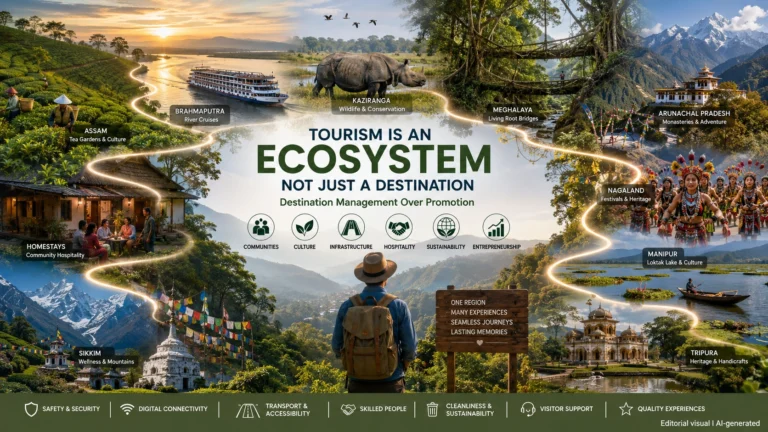
This distinction is important because a destination is not simply a collection of attractions. It is an ecosystem of places, experiences, businesses, communities, infrastructure and perceptions that collectively shape what a visitor encounters.
A waterfall is an attraction.
The reason someone chooses to travel to experience it is part of the destination proposition.
And when those propositions are consistently delivered and remembered, they begin to form a destination brand.
That is the challenge before Dima Hasao.
Dima Hasao’s Tourism Opportunity Is About Timing
There is an irony in modern tourism. Destinations spend years trying to attract visitors and then, once visitor numbers grow, spend considerable effort dealing with the consequences when tourism expands faster than the destination’s ability to absorb it.
Quiet villages become crowded. Natural sites become commercialised. Local food gets standardised for mass consumption. Cultural practices can gradually become performances shaped around what visitors expect to see.
Dima Hasao is not immune to these possibilities.
But it is still early enough in its tourism journey to make deliberate choices.
The district administration already identifies tourism infrastructure, connectivity, maintenance and development of tourist sites, discovery of lesser-known locations and promotion of indigenous festivals among its tourism priorities. Dimahasao District
That creates an unusual window of opportunity.
Instead of beginning with “How do we get more tourists?”, Dima Hasao could begin with a more fundamental question:
“What kind of tourism creates the greatest long-term value for the district?”
That changes the economics of the discussion.
The objective is no longer simply to increase arrivals. It becomes a question of how much value each visitor creates, where that value goes, how much remains locally and whether tourism strengthens the destination over time.
What If Communities Owned Part of the Tourism Economy?
This is where Dima Hasao could explore a model that goes beyond conventional destination promotion.
Imagine tourism developing village by village, with communities participating not merely as hosts or cultural representatives but as economic stakeholders.
A village tourism cooperative could bring together households providing homestays, local food, guiding, transport, crafts and nature-based experiences. One family might operate accommodation, another could supply food, a young person could work as a trained nature guide, while an artisan could create a hands-on craft experience for visitors.
The cooperative could coordinate bookings, establish service standards, maintain shared facilities and contribute a portion of its revenue towards waste management, conservation or community infrastructure.
The individual participants would earn from their own work, while the village would also benefit from the wider tourism ecosystem.
This addresses one of tourism’s most important economic questions:
Who captures the value created by the destination?
UN Tourism’s Best Tourism Villages programme explicitly places community participation, local value chains, sustainability, infrastructure, skills and rural economic development within its framework for tourism development. Its current work also highlights partnerships between communities, businesses, producers and public institutions as a way of strengthening local value chains and ensuring tourism benefits are more widely shared. Best Tourism Villages
For Dima Hasao, a cooperative approach could therefore connect tourism development with local economic development.
A visitor would not simply be spending money in Dima Hasao. A larger share of that spending could potentially circulate among homestays, farmers, guides, drivers, artisans, food producers and village enterprises.
That is a very different proposition from simply increasing tourist footfall.
Community Tourism Should Not Become Cultural Theatre
There is an important line that Dima Hasao would need to draw carefully.
Community tourism should not mean turning communities into performers for visitors. A traditional dance, a meal, a craft, a story or a cultural practice should not automatically become a tourism product simply because tourists are willing to pay for it.
The stronger model gives communities a say in what they want to share, how they want to share it and what should remain outside the tourism economy.
A visitor might learn about a traditional food from the person who actually prepares it. An artisan might explain a craft while continuing to practise it as part of everyday life. A local guide might interpret a forest not simply as scenery, but as a landscape connected to ecology, memory and community knowledge.
The experience becomes richer because it is not manufactured solely for the visitor. It also becomes more authentic.
For Dima Hasao, community participation should therefore be viewed not simply as a social responsibility but as part of the destination’s economic proposition.
The community should not merely be part of the scenery. The community should be part of the tourism economy.
From Tourism Attractions to Experiences
Dima Hasao does not necessarily need a much longer list of places to visit. It needs to think about what happens between the visitor and those places.
Take the railway journey through the hills. The railway itself is an attraction, but the experience could become considerably more memorable if it were connected with local history, landscape, food and stories along the route.
A waterfall can be photographed in five minutes. A guided journey to that waterfall, where a local person explains the landscape, ecology and stories associated with it, creates a very different relationship with the place.
A village can be a point on a tourism map. It can also become the setting for a homestay, a local meal, a walk, a craft experience and conversations that help a visitor understand something about life in the hills.
This is the movement from tourism inventory to destination experience.
And that is where Dima Hasao has an opportunity to think differently.
Assam Tourism already presents Dima Hasao through a broad mix of landscapes, cultural heritage, villages, waterfalls, lakes, hill experiences and places such as Haflong, Jatinga, Maibang and Panimur. The inventory is clearly there. Assam Tourism
The next question is how those individual assets can be connected into experiences that give visitors a reason to stay longer and understand the place more deeply.
One Destination, Many Stories
A strong destination brand does not require every experience to look the same.
In fact, Dima Hasao’s strength could lie in the variety of experiences that can exist beneath one larger identity.
Its indigenous cultures and contemporary community life could form one dimension. Forests, biodiversity, waterfalls and outdoor experiences could provide another. Slow journeys through the hills could add another layer, while food, crafts, history and storytelling could connect them all.
The important thing is that these experiences should reinforce one another rather than become a collection of unrelated tourism campaigns.
A visitor should gradually feel that they are discovering different sides of the same place.
This is particularly important for a destination as culturally diverse as Dima Hasao. The district administration identifies 13 tribal groups alongside several non-tribal communities, creating a social landscape that is itself part of the destination’s character.
The objective should not be to flatten that diversity into a single marketing image. It should be to create a destination identity broad enough to hold its different stories together.
The Brand Has to Be Lived Before It Can Be Marketed
There is an uncomfortable truth about destination branding:
You cannot advertise your way out of a poor visitor experience.
A tourism film can promise discovery, but the visitor still has to find the road.
A website can promise an authentic homestay, but somebody still has to answer the traveller’s call.
A brochure can celebrate pristine landscapes, but somebody has to manage the waste left behind.
The visitor does not experience a campaign.
The visitor experiences the destination.
Connectivity, accommodation, cleanliness, safety, signage, digital information, guides, food, transport and hospitality therefore become part of the brand.
So do the details that rarely appear in tourism strategies: whether information is easy to find, whether a visitor feels welcome, whether a guide understands the place and whether a homestay provides an experience that feels genuine rather than generic.
These may appear mundane compared with mountains and waterfalls, but they are precisely the details from which reputation is built.
A destination promise cannot be separated from the systems that deliver it.
Tourism Success Should Be Measured Beyond Visitor Numbers
This is where the discussion becomes distinctly economic.
A visitor who stays one night, takes photographs and leaves creates one kind of economic activity.
A visitor who stays four nights, hires a local guide, eats locally, buys from artisans, uses community-based services and recommends the destination to friends creates a broader economic footprint.
The second visitor may not contribute as much to the headline arrival number, but could generate considerably more value across the local tourism ecosystem.
That suggests that Dima Hasao should eventually look beyond visitor numbers when thinking about tourism performance.
Length of stay matters. Local spending matters. Visitor satisfaction matters. Repeat visits matter. So does the proportion of tourism revenue that remains within the local economy.
The objective, therefore, should not simply be to bring more people into Dima Hasao.
It should be to create more value from every visitor while ensuring that a meaningful share of that value stays within the destination.
That is how tourism starts becoming an economic development strategy rather than merely a promotional exercise.
Build the Destination Before Turning Up the Volume
Perhaps this is the most important lesson.
Tourism development often follows a familiar sequence. A destination is promoted, visitors arrive, infrastructure struggles to catch up, communities adapt to the new economy and only later does the conversation turn seriously towards sustainability.
Dima Hasao has the opportunity to reverse that order.
It can understand its assets first, listen to its communities, identify what should be protected, determine what visitors should experience and then build the enterprises, skills, infrastructure and community structures necessary to deliver those experiences.
Promotion can come afterwards.
This is not an argument against marketing. It is an argument for marketing something real.
UN Tourism’s rural tourism framework similarly brings governance, infrastructure, sustainability, community wellbeing and value-chain integration into the way rural destinations are developed and evaluated.
For Dima Hasao, that could mean avoiding a familiar trap: attracting visitors faster than the destination can responsibly absorb them.
Dima Hasao Can Choose Its Tourism Future
There is no reason why development and identity should be treated as opposing forces.
Dima Hasao needs better connectivity, better accommodation, better visitor facilities, digital visibility and opportunities for local entrepreneurs. Its young people need ways to build livelihoods around the strengths of their own region, while communities need a meaningful share in the economic value created by tourism.
None of that requires the district to become generic.
Dima Hasao can improve its connectivity without losing the character that makes it distinctive. It can welcome more visitors while respecting local cultures and traditions. At the same time, communities should have a meaningful say in what they share with visitors, what they choose to protect and what they prefer to keep private.
That is where a cooperative tourism model becomes particularly interesting.
It offers a potential bridge between tourism development and community ownership.
A village that earns from protecting its landscape has a stronger economic reason to protect it. A young person who can build a career as a guide, host, artisan or tourism entrepreneur has a stronger reason to see opportunity at home. A community that participates in shaping the visitor experience has a greater stake in ensuring that experience remains meaningful.
Tourism then begins to work differently. It becomes part of the local economy of the place itself.
The Biggest Tourism Asset May Be What Dima Hasao Has Not Yet Become
Dima Hasao already has the raw ingredients of a remarkable destination.
It has the mountains, forests, waterfalls, cultures, food, stories and journeys that tourism campaigns elsewhere spend enormous amounts of money trying to communicate.
The harder task is bringing all those elements together without turning them into a catalogue.
That requires a destination identity, but it also requires something more fundamental: a tourism economy in which local communities have a genuine stake in what happens next.
Dima Hasao is still relatively early in its mainstream tourism journey. That gives it room to learn from destinations that grew first and dealt with the consequences later.
It can choose experience over inventory, value over volume and local participation over passive inclusion. It can build tourism enterprises that allow more of the economic value created by visitors to remain within the district.
Most importantly, it can decide what it wants tourism to do for Dima Hasao before the tourism market becomes powerful enough to make those decisions on its behalf.
Because eventually, every destination gets a brand. Some destinations build theirs deliberately. Others acquire one accidentally.
Dima Hasao still has the opportunity to choose. And perhaps that is the most valuable tourism opportunity of all.
It does not need to become another Meghalaya. It has the chance to become unmistakably Dima Hasao.
The real question is not how quickly Dima Hasao can become a tourist destination.
It is whether it can become a destination on its own terms.




One Comment