
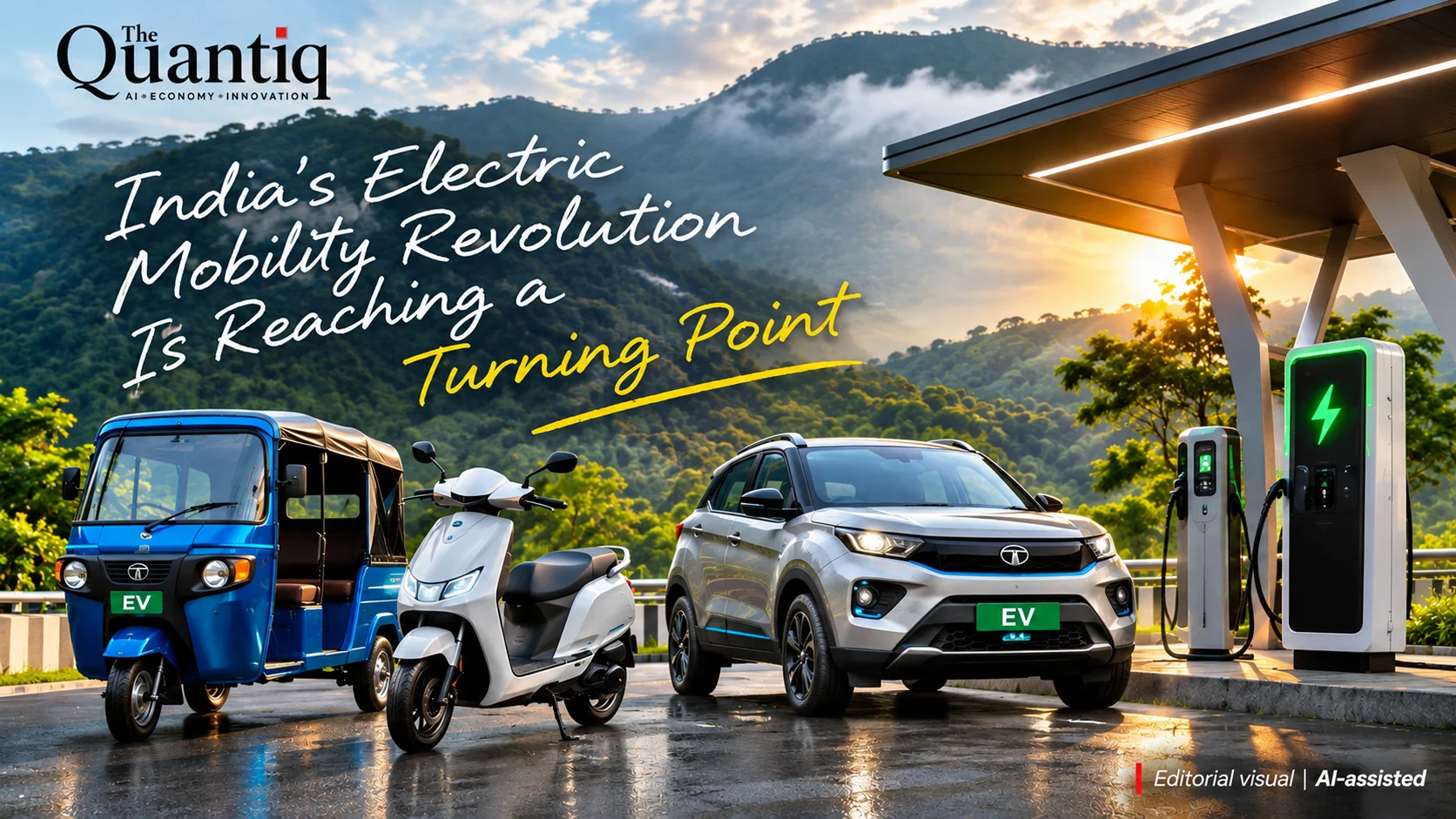
FADA October Report: India’s EV Registrations Hit a Record High
Total vehicle sales fell 23.8% in October 2026, yet electric vehicles set a new monthly record. The bigger opportunity may lie beyond the showroom.
The FADA October report opens with a gloomy headline. India’s total vehicle retail sales fell 23.80% year on year to 31,72,466 units. Beyond the headline, however, the data tells a more hopeful story.
The Federation of Automobile Dealers Associations (FADA) released the figures on 6 November 2026. Electric vehicles (EVs) reached an all-time high of 3,54,625 registrations, up 44.88% from October 2025. Demand also ran ahead of supply in several segments. As a result, one question stands out. Is India building an electric mobility ecosystem that reaches well beyond private cars?
What the FADA October report really shows
Total retail sales came in 23.80% lower than in October 2025. However, they rose 25.05% over September. October 2026 was still the second-highest October on record.
The calendar explains much of the gap in the FADA October report. October 2025 carried both Navratri and Diwali, and demand also got a lift from GST rate cuts. This year, Dhanteras and Diwali moved into November. Therefore, the annual decline overstates any weakness in underlying demand.
FADA President Sai Giridhar said the month-on-month rise is a more accurate guide to festive demand. Dealers also share that optimism. In FADA’s survey, 51.65% expect sales to grow in November, while 34.71% expect stable sales. Only 13.64% expect a decline.
Beyond the headline: where the market is strong and weak
The segments tell different stories. In the FADA October report, commercial vehicles hit a record 1,15,140 units, up 2.29% year on year. Heavy commercial vehicles led with a 28.95% jump. Passenger vehicles reached 5,07,768 units, the third-best October on record.
Two-wheelers, however, carried the heaviest drag. Retail sales reached 23,21,419 units, up 29.67% on September but down 28.35% on last year. Rural two-wheeler sales fell 33.97%, compared with a 20.77% fall in urban markets.
Dealer stock is also worth watching. Passenger vehicle inventory stayed high at 43 to 45 days, despite strong wholesale dispatches. Entry-level cars remained subdued, while utility vehicles and new launches supported demand. Giridhar expects the festive season to bring inventory down to about 30 days by year end.
October 2026 at a glance (source: FADA retail data)
| Segment | October 2026 retail | Year on year | Month on month |
| Total vehicles | 31,72,466 | −23.80% | +25.05% |
| Two-wheelers | 23,21,419 | −28.35% | +29.67% |
| Passenger vehicles | 5,07,768 | −14.23% | +18.86% |
| Commercial vehicles | 1,15,140 | +2.29% | +11.19% |
| Electric vehicles (all types) | 3,54,625 | +44.88% | n/a |
Electric two-wheelers lead the transition
Electric two-wheelers delivered the biggest share of the EV record in the FADA October report. In addition, registrations reached 2,24,064 units, up 48.49% from 1,50,890 a year earlier. Their share of two-wheeler sales rose from about 4.7% to 9.7%.
The share did dip from 11.6% in September. Autocar Professional attributed that mainly to the Diwali shift into November. Still, the year-on-year gain points to a structural change.
Established manufacturers are leading the charge. TVS Motor topped the segment with 60,490 registrations, nearly double last year’s figure. Bajaj Auto followed with about 49,000 units. Ather Energy recorded about 31,800, and Hero MotoCorp’s Vida about 29,900. Ola Electric slipped to about 12,100.
Therefore, competition now goes beyond building an electric scooter. It is about reliability, affordability and after-sales service. Dealer networks and brand trust give legacy makers a clear edge. EV-first companies, however, still drive much of the innovation in batteries, software and customer experience.
Electric three-wheelers change the economics of mobility
The three-wheeler segment may be the most commercially significant. Electric three-wheeler registrations reached 88,570 units, up 24.76%. About 62.6% of all three-wheelers registered in the month were electric.
Unlike private cars, commercial three-wheelers also earn money for their owners. Operators care about daily running costs and loan repayments. Therefore, the case for electrification rests on economics, not only on environmental concern.
The savings are not automatic, though. They depend on purchase price, financing cost, battery life, charging access and local electricity tariffs. For an operator covering long daily distances, these differences can decide profit or loss.
That opens room for more than vehicle makers. Fleet operators, charging providers, battery service firms and lenders can all build products for this market.
Electric cars and commercial vehicles grow from a small base
Electric passenger vehicle registrations rose to 37,049 units from 20,995 a year earlier, a gain of 76.47%. Their share of passenger vehicle sales climbed from about 3.5% to 7.3%. Tata Passenger Electric Mobility led with 14,669 units. Mahindra followed with 8,538, and JSW MG Motor India recorded 5,939.
For example, buyers still weigh upfront cost, range, charging access, battery warranty and resale value. Electric cars therefore remain a small part of the car market. The next phase depends on making them affordable for far more households.
Electric commercial vehicles are smaller still. Registrations reached 4,492 units, up from 1,884 in October 2025. Their economics rest on measurable factors such as daily kilometres, energy use and charging downtime. Urban deliveries and depot-based routes suit electrification first. Long-distance freight is harder, because of vehicle cost, battery weight and charging time.
What the FADA October report says about supply
One of the most important points in the report is supply. Giridhar said demand ran ahead of supply during the month. He linked the surge to elevated petrol and diesel prices, better driving ranges and narrowing price gaps with conventional vehicles.
This creates a new test for manufacturers. Until recently, the question was whether Indians would accept EVs. Now the question is whether the industry can build enough of them, with consistent quality. Battery cells, semiconductors, power electronics and charging equipment all matter here. FADA has also urged major two-wheeler makers to raise stocks.
Service capacity matters just as much. Electric vehicles have fewer mechanical parts. However, their batteries, motors and software need specialised skills and diagnostic tools. A fast-growing market without enough service centres can quickly turn buyers against the technology.
India’s fuel transition will be mixed, not a single switch
The powertrain mix is shifting as well. CNG, hybrid and electric cars together made up about 41.83% of passenger vehicle retail sales. Petrol and ethanol vehicles accounted for about 41.60%. The gap is small, but the signal is clear.
Indian buyers are now looking beyond petrol. However, this does not mean EVs will replace petrol and diesel soon. Electric options look strongest in two-wheelers, three-wheelers and selected commercial uses. Hybrids suit buyers who want better mileage without depending on chargers. CNG will keep serving cost-conscious operators wherever fuel networks exist.
Business opportunities beyond vehicle manufacturing
Building electric vehicles needs heavy capital and deep technology. Supporting businesses offer easier entry points for entrepreneurs and MSMEs. Several areas stand out:
- Charging infrastructure at commercial centres, housing complexes, transport hubs and fleet depots.
- Battery diagnostics, maintenance, recycling and second-life use.
- Fleet management that combines financing, charging, route planning and maintenance.
- Software, telematics, energy management and vehicle finance.
However, each idea must pass a commercial test. Charging points need enough daily use to recover their cost. Battery recycling needs reliable collection and environmental compliance. The strongest businesses will solve a clear customer need rather than follow the EV hype.
What the FADA October report means for Northeast India
The Northeast has varied transport needs. Cities, tourist circuits, farms and remote villages each call for different vehicles. Two-wheelers already dominate, since state transport statistics put them at nearly 70% of registered vehicles in Assam. That makes electric two-wheelers a natural starting point.
The rural picture needs care. Nationally, rural two-wheeler sales fell faster than urban sales in October, because rural cash flows are tighter. Dealers across the region will therefore watch rural incomes and financing costs closely.
Where electric vehicles could fit first
Assam’s urban and semi-urban centres could suit electric two-wheelers and three-wheelers. Local delivery fleets and passenger services are also candidates. In Meghalaya, Arunachal Pradesh and Sikkim, electric vehicles could eventually serve controlled tourism circuits.
Meanwhile, terrain will test these ideas. Steep gradients, road conditions and thin charging networks affect range and running costs. A model that works in a metro may fail on a mountain road. Local trials therefore matter more than national averages.
Look beyond vehicle purchases
The region can also build the supporting ecosystem. A charging and maintenance hub serving a cluster of electric commercial vehicles may earn more than isolated charging points. Trained technicians, battery servicing and vehicle finance are further openings. Tourism operators could also cut running costs on predictable local routes.
These are possibilities to test, not proven business models. The national figures cannot show how Assam or its neighbours performed in October. Vahan registration data and conversations with Guwahati and Dibrugarh dealers will fill that gap. The Quantiq’s auto-mobility intelligence coverage will follow that story closely.
The road ahead after the FADA October report
Record registrations do not mean the transition is complete. For example, supply gaps and service shortages remain. The next phase will test affordability, battery reliability, charging access and after-sales service. Manufacturers must match output with demand. Dealers must build EV skills. Lenders must learn to price battery risk.
November’s data, due in early December, will show whether the festive rebound arrives as dealers expect. October and November together will give a fairer picture than either month alone.
Still, the main lesson of the FADA October report is already clear. The most valuable opportunity may not lie in selling more electric vehicles. It may lie in building the ecosystem that makes them practical, affordable and reliable. For Northeast India, the goal should be to help build that ecosystem, not merely to consume it.