
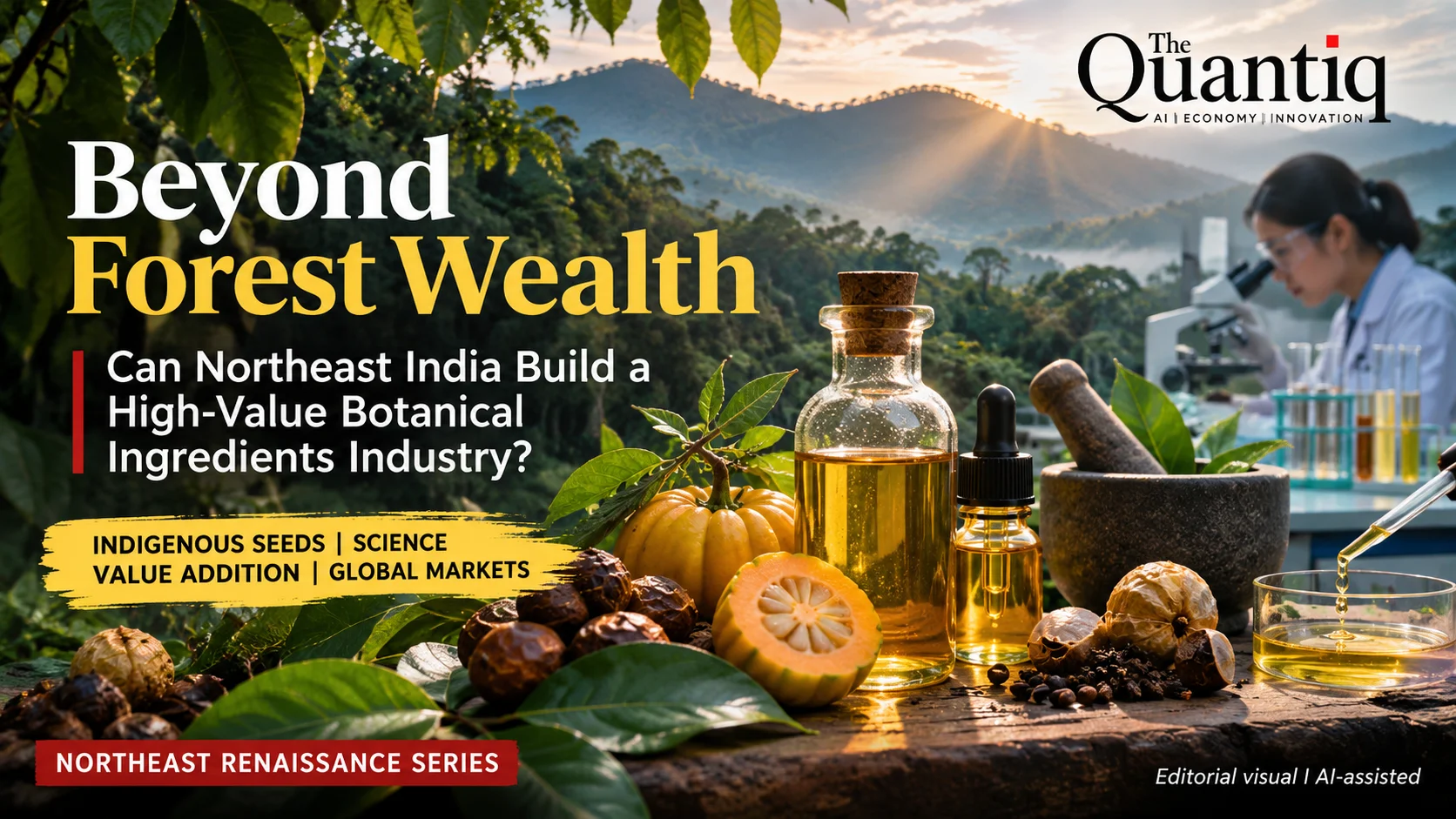
Beyond Forest Wealth: Can Northeast India Build a High-Value Botanical Ingredients Industry?
Indigenous seeds, lesser-known tree-borne oils and traditional plant knowledge could lay the foundation for a new regional industry. The opportunity lies in connecting biodiversity with science, technology and global markets.
The next industrial opportunity may be growing quietly in Northeast India’s forests
Imagine a seed collected from a tree in Assam. Or a fruit traditionally used by communities in Meghalaya. These familiar natural resources may contain valuable biological compounds.
Modern industries are increasingly interested in such compounds. They can potentially serve as ingredients in specialised products. However, discovering an interesting plant is only the beginning. Turning it into a commercial ingredient requires research, technology and reliable supply chains.
This is where Northeast India has an opportunity worth exploring. The region could move beyond selling raw agricultural and forest produce. Instead, it could develop enterprises that produce specialised oils, botanical extracts and personal-care ingredients.
The idea is not to commercialise every plant or turn forests into industrial plantations. Rather, we should identify promising resources and understand their scientific properties. We must then develop sustainable and commercially viable value chains around them.
The larger opportunity is simple: create more value from nature through science and technology.
The global opportunity: Beyond the natural beauty label
The global cosmetics and personal-care industries have created opportunities for plant-derived ingredients. These include botanical oils, specialty fats and natural extracts.
However, manufacturers are becoming more demanding. A natural-origin story is no longer enough. Buyers want consistent quality, documented composition and traceable sourcing. They also need evidence that an ingredient is suitable for its intended application.
For example, certain plant oils can serve as emollients in cosmetic products. Selected botanical extracts may also offer useful properties for specialised formulations. Nevertheless, their commercial suitability depends on safety, stability, composition and performance.
India already has an established herbal products and personal-care manufacturing ecosystem. This creates a potential domestic market for specialised botanical ingredients. However, actual demand and buyer requirements must be established through industry research.
For Northeast India, the opportunity may lie in becoming a specialised supplier. The region need not compete immediately with established global manufacturers. Instead, it can explore ingredients with distinctive regional origins and scientifically documented properties.
The important question is whether we can develop the capabilities needed to convert these resources into commercial products.
A scientific discovery from Jorhat that deserves another look
An important starting point comes from research associated with CSIR–North East Institute of Science and Technology (CSIR-NEIST), Jorhat.
In November 2017, researchers published a study in Prostaglandins, Leukotrienes and Essential Fatty Acids. The study examined 14 lesser-known tree-borne oilseed species from Northeast India.
The findings were interesting. Oil content ranged from 4.71% to 48.43% of dry seed weight. Nine of the 14 species contained higher proportions of unsaturated fatty acids.
Researchers also reported significant quantities of tocols in Alseodaphne andersonii. Meanwhile, Garcinia xanthochymus showed significant phytosterol content.
The study examined several other species, including Cinnamomum impressinervium, Garcinia morella, Litsea coriacea, Croton joufra, Albizia procera, Kayea assamica and Sapindus mukorossi.
These findings offer more than a list of unfamiliar plants. They provide a scientific starting point for identifying resources with potential industrial applications.
Another study appeared in the Journal of Oleo Science in February 2020. It examined six lesser-known tree-borne oilseeds from Assam.
Researchers reported approximately 50% oil content in Dysoxylum procerum. Oleic acid accounted for between 38.4% and 64% across the oils examined. The study also identified notable tocopherol content in Terminalia bellirica oil.
However, the research revealed an important concern. Researchers measured eleven elements in the oils. They reported lead and copper concentrations above the relevant Codex reference standards in the tested samples.
This finding deserves particular attention. Natural origin does not automatically guarantee safety. Any future industry must prioritise laboratory testing, contaminant monitoring and consistent quality standards.
Nearly a decade after the first study, one question deserves an answer: How much progress have these discoveries made towards commercial applications?
The overlooked opportunity in indigenous seeds and fruit-processing waste
One promising avenue involves recovering value from seeds and kernels discarded during fruit processing.
Consider Garcinia xanthochymus, commonly known as yellow mangosteen. Its seed oil attracted scientific interest because of its phytosterol content.
Further research could establish whether this oil has useful applications in specialty cosmetic fats and other industries. However, commercial suitability still requires proper testing.
This possibility also creates an interesting business proposition. Fruit processors could collect seeds instead of treating them as waste. They could then clean, dry and grade the material before supplying specialised extraction units.
Other regional oil-bearing species may offer similar opportunities. Each species, however, needs an independent assessment. Researchers must examine availability, extraction yield, composition, ecological status and market demand.
The underlying idea is worth considering. A fruit may have value as food, but its seeds and kernels could offer additional economic opportunities. Consequently, better processing could help enterprises earn more from the same biological resource.
From raw materials to a regional ingredient economy
The opportunity becomes more interesting when we examine the entire value chain.
Imagine farmers and local communities participating in cultivation or sustainable collection. Producer organisations could aggregate the materials. Small enterprises could then handle cleaning, drying and primary processing.
Specialised facilities could extract oils and prepare botanical fractions. Meanwhile, research laboratories could establish their composition, purity, stability and safety.
The final products need not be consumer-facing cosmetics. Instead, regional enterprises could supply standardised ingredients to established manufacturers in India and overseas.
This distinction is important. Building a consumer brand requires marketing investment and distribution networks. Ingredient manufacturing follows a different business model.
A B2B supplier must establish technical credibility and maintain consistent quality. It must also guarantee dependable volumes and specifications. Once these capabilities develop, the enterprise can participate in a much wider manufacturing value chain.
Such an ecosystem could create opportunities for rural entrepreneurs, women-led producer groups, agricultural startups and specialised processors.
Why has Northeast India not captured this value?
A 2023 review published in the Indian Journal of Natural Products and Resources identified 37 medicinal plant species from Northeast India with national and international trade significance.
However, the review also highlighted a major gap. The region’s herbal-drug market has not developed at the pace seen in other parts of India.
Researchers identified several reasons. These include inadequate quality-control infrastructure and limited access to GLP-compliant laboratories. They also highlighted unsustainable harvesting practices and gaps in organised cultivation.
These findings point towards a structural problem. Identifying a promising plant is only the first step. The region also needs institutions and infrastructure to convert scientific discoveries into commercial products.
Consider the challenges facing a local entrepreneur. Where can the raw material be tested? Who can establish its chemical profile? Can the business obtain consistent supplies throughout the year?
More importantly, are there manufacturers willing to test and purchase the ingredient?
Unless we answer these questions, promising research may remain confined to academic publications.
This is where regional research institutions could play a greater role. CSIR-NEIST, Assam Agricultural University and Central Agricultural University could help connect scientific research with entrepreneurship.
Northeast India’s strategic advantage: Biodiversity, communities and knowledge
The region’s advantage extends beyond the number of plant species found here. Its diverse ecosystems and traditional knowledge also offer valuable starting points.
However, commercialisation must not become another form of resource extraction. Communities should not supply raw materials while outside companies capture most of the economic value.
A better model would recognise local communities as partners. They could participate in cultivation, collection and primary processing. They could also develop producer organisations and community-owned enterprises.
India’s Biological Diversity Act, 2002, amended in 2023, provides a framework for conservation and sustainable utilisation. It also addresses fair and equitable sharing of benefits arising from biological resources.
The Biological Diversity Rules, 2024, subsequent amendments and the Access and Benefit Sharing Regulations, 2025, are also relevant.
Businesses must understand these requirements before entering the sector. The applicable rules can depend on the biological resource, the entity involved and the intended activity. Therefore, enterprises should obtain appropriate regulatory guidance.
Community participation must remain central to this opportunity. Traditional knowledge deserves recognition, appropriate consent and protection.
Equally important, commercial demand must not threaten natural populations. Uncontrolled wild harvesting could damage the very resources that support the industry. Cultivation, regeneration and sustainable collection must therefore form the foundation of any long-term business model.
Opportunity Snapshot: What could a Northeast botanical industry look like?
The region does not need to begin with a large manufacturing investment. Instead, it could start with a focused programme to identify and validate promising botanical resources.
Potential business opportunities include:
- Specialty seed oils for personal-care formulations.
- Standardised botanical extracts for cosmetic and wellness manufacturers.
- Recovery of valuable oils from fruit-processing by-products.
- Seed collection, aggregation and primary processing enterprises.
- Laboratory testing and quality-assurance services.
- Digital traceability and responsible sourcing solutions.
A practical starting point would be to screen 10–15 promising species. Researchers could then shortlist three to five candidates for detailed scientific and commercial evaluation.
The next step would involve pilot processing and discussions with prospective buyers. This would help establish whether the selected ingredients have genuine commercial potential.
Every candidate must undergo a thorough assessment. This should cover raw-material availability, ecological sustainability, extraction yield and chemical composition. Researchers must also examine contaminants, stability and processing costs.
Most importantly, businesses must establish whether actual buyers exist.
We cannot yet assign a credible market valuation to this proposed regional industry. Its commercial potential must emerge from supply-chain research and buyer discussions. The size of the global natural cosmetics market alone cannot establish the opportunity for Northeast India.
The role of AI: Turning biodiversity into process intelligence
An emerging botanical ingredients industry will require more than extraction machinery. It will also need reliable information about biological resources and their processing.
Consider the information involved. Businesses must understand species, sourcing locations, harvesting seasons and chemical composition. They must also maintain records of processing conditions, quality parameters and buyer requirements.
Artificial intelligence could help organise these different information streams.
For example, AI-assisted research systems could analyse scientific literature and compare published chemical profiles. They could also identify research gaps and help researchers prioritise promising species.
Meanwhile, machine learning could support quality monitoring by identifying variations between production batches. Digital traceability systems could record the origin of raw materials and their processing history.
These technologies cannot replace laboratory testing or botanical expertise. However, they could make the supply chain more transparent and efficient.
For Northeast India, this creates another opportunity. The region could develop an intelligent ingredient ecosystem that connects scientific knowledge, processing technology and market intelligence.
The competitive advantage may not lie simply in possessing a particular seed or plant. Rather, it may lie in knowing how to source it responsibly, process it consistently and deliver a verified product to the right buyer.
The strategic endgame: From biological resources to regional manufacturing
Northeast India has spent decades discussing the economic potential of its forests, agricultural resources and biodiversity. Yet, the region still captures limited value when raw materials move into more sophisticated manufacturing and consumer markets.
A botanical ingredients industry could offer a different pathway.
Instead of depending entirely on finished-product brands or unprocessed resource sales, the region could develop specialised B2B manufacturing capabilities. These enterprises could supply established industries within India and beyond.
However, this will require collaboration. Research institutions, entrepreneurs, investors, community organisations and manufacturers must work together.
The region must also avoid premature investment in large facilities. First, it should identify promising species and establish their sustainable supply potential. Next, researchers must validate their properties and test processing methods.
Only then should entrepreneurs commit substantial capital to manufacturing infrastructure.
If successful, this approach could create a network of specialised enterprises across Northeast India. Local communities could participate in the value chain, while regional institutions support research and technology development.
The Quantiq Assessment: An opportunity worth investigating
The opportunity: Northeast India has a scientific and biological foundation for exploring a specialised botanical ingredients industry. Research on lesser-known tree-borne oilseeds offers promising starting points. The region’s horticultural and forest-based resources provide further avenues for investigation.
The execution challenge: The biggest gaps lie in sustainable raw-material supply, scientific validation and processing infrastructure. Quality assurance, commercial standardisation and access to buyers are equally important. Without these capabilities, the region may continue selling raw materials while higher-value manufacturing happens elsewhere.
The strategic direction: Begin with research-led pilot projects. Build partnerships with established ingredient manufacturers and develop community-centred sourcing models. Focus on a few commercially promising ingredients rather than attempting to commercialise every indigenous plant.
The opportunity deserves serious investigation, but its commercial scale remains unproven. The next step is to connect Northeast India’s research institutions, entrepreneurs and policymakers.
Together, they must bridge the gap between biological wealth and industrial capability.
Perhaps the next chapter of the region’s economic transformation will depend on how much knowledge, technology and value it creates from the resources it responsibly protects.
The question Northeast India should now ask is not simply what grows in its forests, but what industries can responsibly grow from that knowledge.
This article is part of The Quantiq’s Northeast Renaissance Series, examining ideas, resources, technologies and enterprises that could shape a more diversified and economically resilient Northeast India.






One Comment