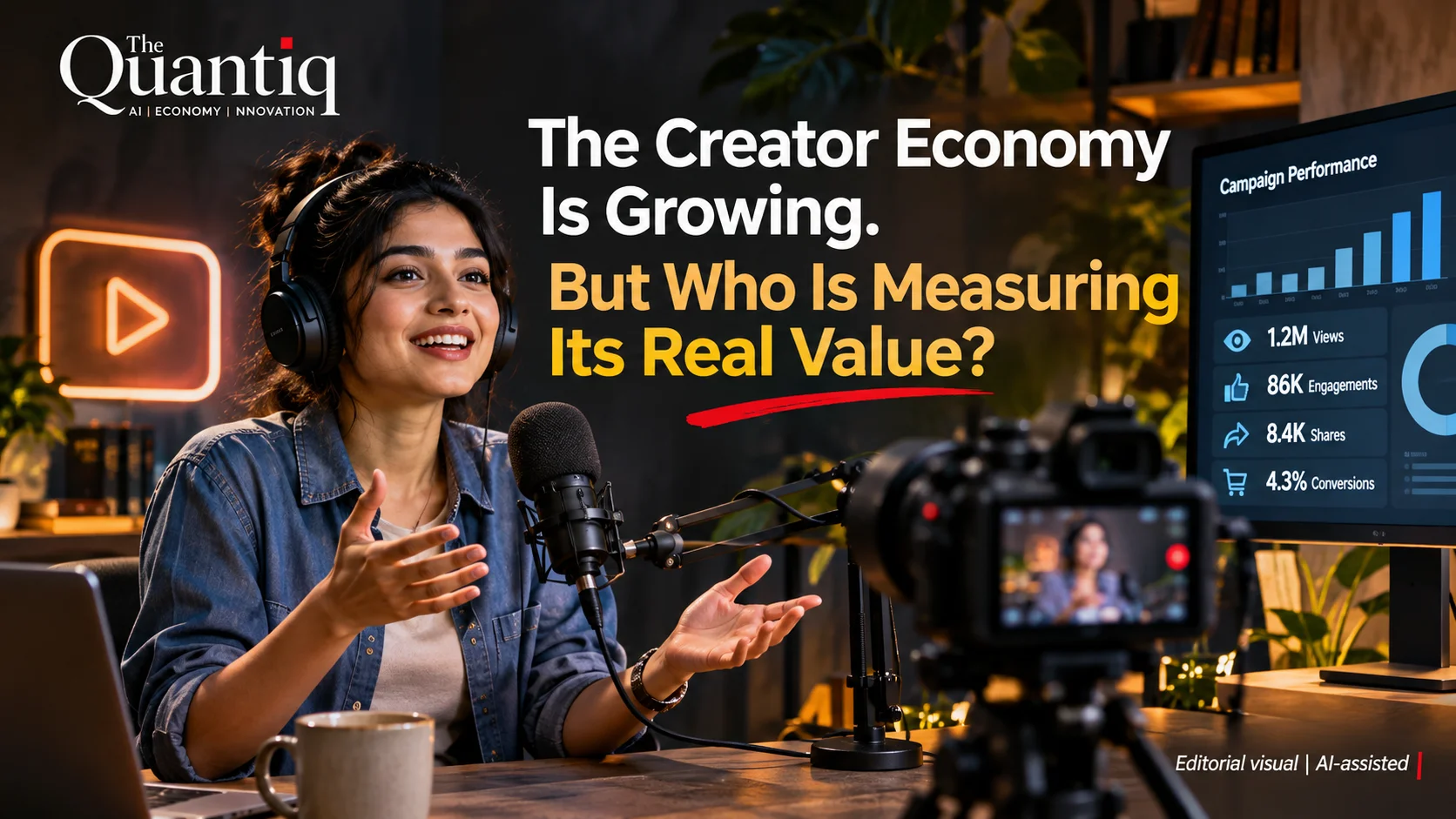
The Creator Economy Is Growing. But Who Is Measuring Its Real Value?
Brand & Media Intelligence Series
Creator advertising is attracting billions in investment, but inconsistent measurement, contract disputes and delayed payments expose a growing gap between the industry’s commercial ambitions and its business infrastructure.
A creator posts a video. It attracts a million views. A brand sees an opportunity, an agency records a successful campaign, and the creator sees proof of influence. But there is a question that often gets lost in the excitement: what does a million views actually mean?
How long did people watch? Did they engage with the content? Did it influence a purchase? And can those results be compared fairly with a campaign on another platform?
These questions are becoming increasingly important as creator-led content moves from the margins of digital marketing into mainstream advertising budgets. The creator economy has grown rapidly, but the systems used to measure its commercial value have not kept pace.
A $44 billion advertising opportunity
The scale of this shift is striking. According to the Interactive Advertising Bureau (IAB), US creator advertising expenditure is projected to reach $44 billion in 2026, up from $13.9 billion in 2021.
The growth has been substantial:
- 2021: $13.9 billion
- 2022: $18.4 billion
- 2023: $22.1 billion
- 2024: $29.5 billion
- 2025: $37.1 billion (estimate)
- 2026: $43.9 billion (estimate)
The figures come from IAB’s 2025 Creator Economy Ad Spend and Strategy Report. They cover advertising investment associated with creators, including direct brand partnerships, paid amplification of creator content and advertising placed alongside creator content. They represent the US market, not global creator-economy revenue.
The distinction is important. The wider creator economy also includes subscriptions, merchandise, platform earnings, events and other income streams. Nevertheless, the advertising numbers reveal how seriously brands are beginning to treat creators as a distinct media channel.
According to IAB, nearly half of creator advertising buyers already consider creators a must-buy category. The challenge now is to establish what brands are actually getting in return for their investment.
The measurement gap
A report released by IAB on 10 November 2026, titled The Creator Economy’s Next Chapter, identifies measurement as the industry’s biggest challenge.
67% of the industry leaders surveyed identified measurement as the top problem. A common definition of a “view” was the most requested standard, identified by 66% of respondents.
It sounds like a basic requirement, but the industry still lacks consistency. Platforms use different definitions, reporting methods and performance indicators. Consequently, a view on one platform may not represent the same level of attention as a view elsewhere.
This makes it difficult for advertisers to compare campaigns, assess performance and allocate budgets with confidence. Without comparable data, even a successful campaign can be difficult to evaluate against its actual business objectives.
IAB is now working towards common measurement standards with industry participants, including the Media Rating Council. The initiative recognises that creator advertising needs more reliable measurement if it is to mature into a fully accountable media channel.
The business relationship needs fixing too
Measurement is only one part of the problem. The IAB research highlights weaknesses in the commercial arrangements between creators, agencies and brands.
Usage rights emerged as the biggest contractual friction point, identified by 61% of respondents. A brand may pay a creator to produce a video, but the agreement may not clearly establish whether the content can be reused in advertisements, on websites or across other platforms. Duration, ownership and additional compensation can all become contentious.
Payment practices are another concern. 60% of respondents agreed that longer payment terms create cascading problems, while only 6% disagreed. For independent creators and small production teams, delayed payments can affect cash flow even after the work has been completed.
The research also found that 94% of respondents reported at least occasional disagreements with senior leadership over creator-related decisions, particularly around budgets. Meanwhile, 80% agreed that media buyers and creator buyers often work independently, limiting the overall value of campaigns.
Transparency is equally important. Some 58% said that withheld campaign results restrict shared learning, while 74% agreed that fee opacity persists partly because some participants benefit from it.
These findings point to a market that has attracted investment faster than it has developed consistent business practices. The survey involved 53 industry leaders, so its percentages should be treated as directional insights rather than representative estimates of the entire creator economy.
Creators are becoming media businesses
There is another important shift taking place. Creators are moving beyond individual social media posts to build podcasts, newsletters, recurring video programmes, live events, communities and original content properties.
In effect, some creators are becoming independent media businesses. Their value increasingly comes not just from their follower count but from their ability to build an identifiable audience, earn trust and sustain engagement over time.
This changes the way brands should evaluate partnerships. A specialist creator with a smaller but highly engaged audience may deliver more meaningful results than a large account with millions of followers but limited audience connection.
The commercial opportunity is therefore moving beyond influencer endorsements. It is increasingly about content, community, credibility and measurable outcomes.
What this means for India and the Northeast
India’s creator ecosystem has considerable potential, particularly in regional languages and specialist communities. Creators working in education, technology, entrepreneurship, culture, tourism and local business can connect brands with audiences that conventional advertising may struggle to reach meaningfully.
For businesses in Northeast India, this creates an interesting opportunity. A creator who understands a community’s language, culture and purchasing behaviour may offer a brand stronger audience relevance than a much larger national account.
However, regional creators and smaller businesses also need transparent agreements, fair compensation and credible ways to demonstrate campaign performance. Without these, the benefits of the expanding creator economy may remain concentrated among larger agencies, platforms and established influencers.
The next competitive advantage is credibility
The creator economy does not need to standardise creativity. It needs to improve the business systems that support it.
Reliable measurement, clear usage rights, transparent fees, timely payments and access to meaningful campaign data would benefit creators and advertisers alike. They would also make it easier for smaller businesses to participate with greater confidence.
The industry has already demonstrated that it can capture attention at scale. Its next challenge is to establish what that attention is worth.
The future of the creator economy may belong not simply to those who attract the largest audiences, but to those who can turn trust and influence into measurable value.