
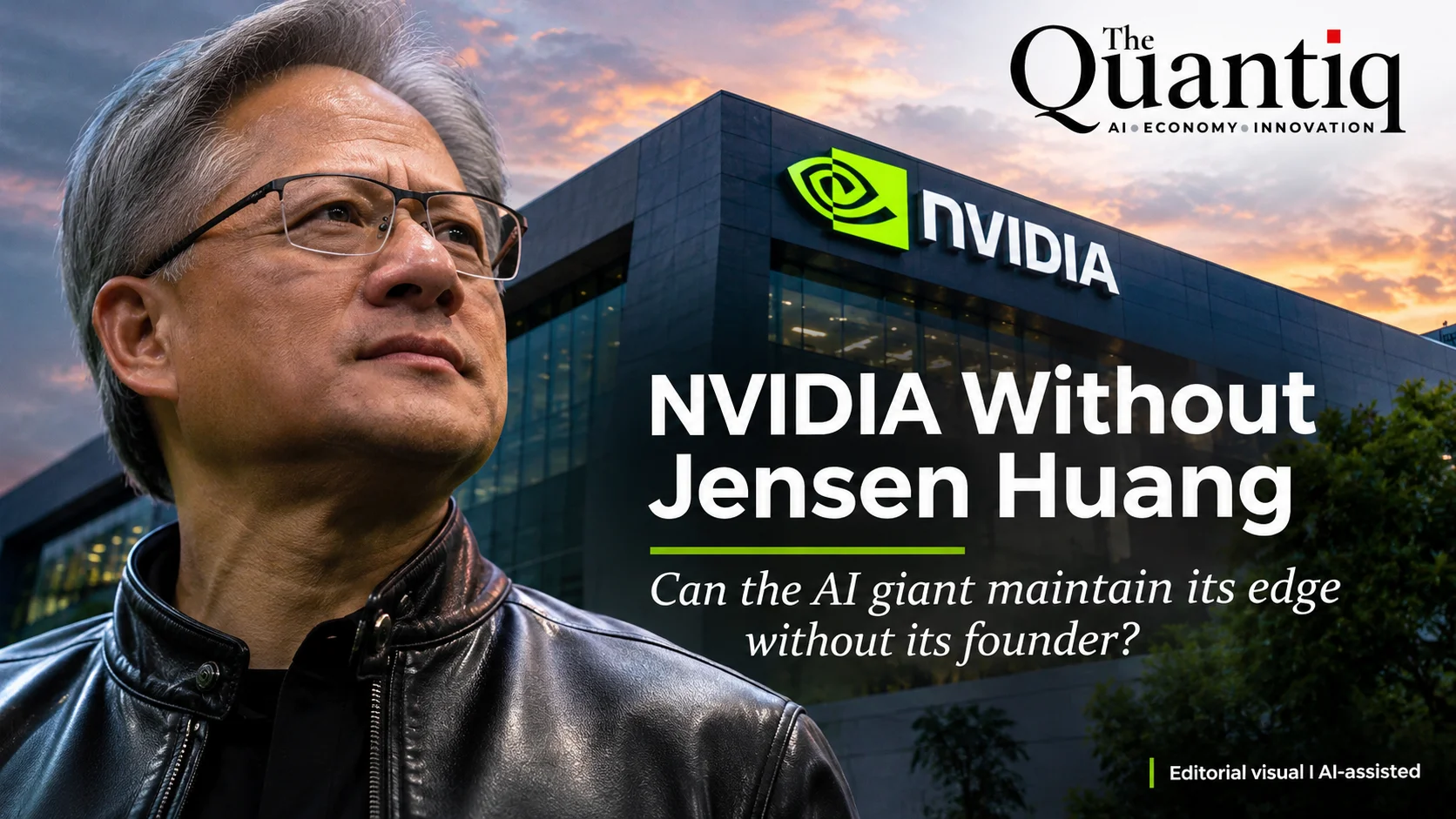
NVIDIA Without Jensen Huang: Is the AI Giant Bigger Than Its Founder?
The sudden departure of NVIDIA’s co-founder raises a question that extends far beyond Silicon Valley: can the world’s most influential AI infrastructure company maintain its momentum without the person who shaped its rise?
For more than three decades, Jensen Huang has been the face, voice and driving force behind NVIDIA. His signature black leather jacket became almost as recognisable as the company’s graphics processors. More importantly, his vision helped transform a graphics-chip manufacturer into the infrastructure backbone of the artificial intelligence revolution.
That association has now been tested in an extraordinary way.
On November 12, 2026, NVIDIA announced that Huang had resigned as president, CEO and board member with immediate effect. Colette Kress, the company’s long-serving chief financial officer, has taken over as interim CEO. The board has also appointed Harvey C. Jones as its first-ever chairman and begun searching for a permanent successor.
Huang’s departure follows intense scrutiny surrounding reported personal relationships and their potential corporate and national security implications. Reports involving Alice Huang, an executive associated with Singapore-based cloud company Megaspeed, have attracted particular attention because of US investigations into suspected diversions of restricted AI chips to China.
These reports have also raised questions about possible intelligence links. However, allegations of espionage should not be treated as established facts. NVIDIA’s public announcement confirms the leadership transition but does not establish the reported allegations as the formal reason for the resignation.
For the technology industry, the immediate question is no longer simply why Huang left. It is whether NVIDIA can continue executing its ambitious AI strategy without its most influential leader.
A Company Built Around More Than One Person
NVIDIA’s success is often associated with Huang’s extraordinary ability to anticipate technological shifts. He recognised the potential of graphics processing units beyond gaming and invested in accelerated computing long before generative AI became a global phenomenon.
However, NVIDIA’s competitive advantage does not rest on its founder alone.
Its CUDA software ecosystem, GPU architecture, NVLink networking technology and deep relationships with cloud providers have created substantial barriers for competitors. Developers, researchers and enterprises have built applications and infrastructure around these technologies over many years.
These capabilities cannot simply disappear with a change in leadership.
Nevertheless, Huang’s influence extended beyond product development. He was also a strategist, dealmaker and prominent advocate for NVIDIA in Washington and international markets. His famously flat management structure also concentrated considerable decision-making around him.
Replacing that combination of technical vision, commercial influence and leadership will not be straightforward.
Colette Kress Faces an Immediate Test
Kress is hardly an outsider brought in to manage a crisis. She joined NVIDIA in 2013 and has helped oversee its transformation into one of the world’s most valuable technology companies.
Her financial experience and familiarity with NVIDIA’s operations provide continuity. Yet leading a company’s financial operations is different from setting its long-term technological direction.
The market will get an early indication of the leadership transition on November 17, when NVIDIA announces its third-quarter fiscal 2027 results.
Investors will be looking beyond revenue and earnings. They will want reassurance about product execution, customer commitments, governance and the company’s ability to retain its technological advantage.
The board’s search for a permanent CEO will also be closely watched. Its decision will reveal whether NVIDIA prefers continuity through an internal candidate or a fresh leadership approach.
Governance Is Becoming Part of the AI Story
The implications of Huang’s departure now extend beyond succession planning.
Reports of proposed shareholder litigation have introduced another dimension to NVIDIA’s challenges. Investors are raising questions about corporate disclosures and governance, although the allegations remain subject to legal proceedings.
For a company operating at the centre of the global AI economy, governance is not a peripheral concern. Its relationships with customers, technology partners and governments involve enormous financial and strategic interests.
Export controls add another layer of complexity. Advanced AI processors have become instruments of economic competition and national security. Consequently, companies supplying this infrastructure face growing expectations around customer verification, distribution controls and compliance.
NVIDIA’s future will therefore depend not only on its ability to build faster processors but also on its ability to maintain trust among regulators, investors and customers.
Why This Matters Beyond NVIDIA
NVIDIA occupies a central position in the global AI infrastructure ecosystem. Its processors power data centres, cloud platforms and increasingly sophisticated AI applications. Any uncertainty surrounding its leadership can therefore influence investment decisions across the technology industry.
Competitors such as AMD, Intel and Broadcom may see opportunities as customers reconsider their supplier strategies. Meanwhile, cloud companies and governments have stronger reasons to explore alternative computing architectures.
For India, this development carries a particularly relevant lesson.
As the country expands its data-centre capacity, sovereign AI infrastructure and enterprise adoption, technological independence deserves greater attention. Access to advanced GPUs remains important, but so do domestic semiconductor capabilities, alternative computing architectures, open-weight AI models and skilled talent.
Indian enterprises should also avoid building their entire AI strategies around a single technology provider. Diversification, interoperability and the ability to move between computing platforms will become increasingly important.
The opportunity is not necessarily to replace NVIDIA. It is to build an ecosystem that can innovate and compete without becoming entirely dependent on one supplier.
The Real Test Is Institutional Resilience
Great companies eventually face a difficult transition: moving from founder-led success to institutional strength.
Huang leaves behind an extraordinary technological and commercial legacy. But NVIDIA’s next chapter will depend on whether its leadership team, engineering culture and governance structures can sustain that legacy without relying on one individual.
The question is not whether NVIDIA can survive without Jensen Huang. Its technological foundations suggest that it can.
The more important question is whether it can continue to lead the AI industry with the same strategic clarity, execution speed and influence.
That answer will take more than an earnings announcement to establish. It will depend on the quality of its next leadership, the strength of its institutional processes and its ability to maintain the trust of the global technology ecosystem.
The next competitive advantage in AI may not belong only to companies with the best technology, but to those capable of building institutions that remain strong beyond their founders.