
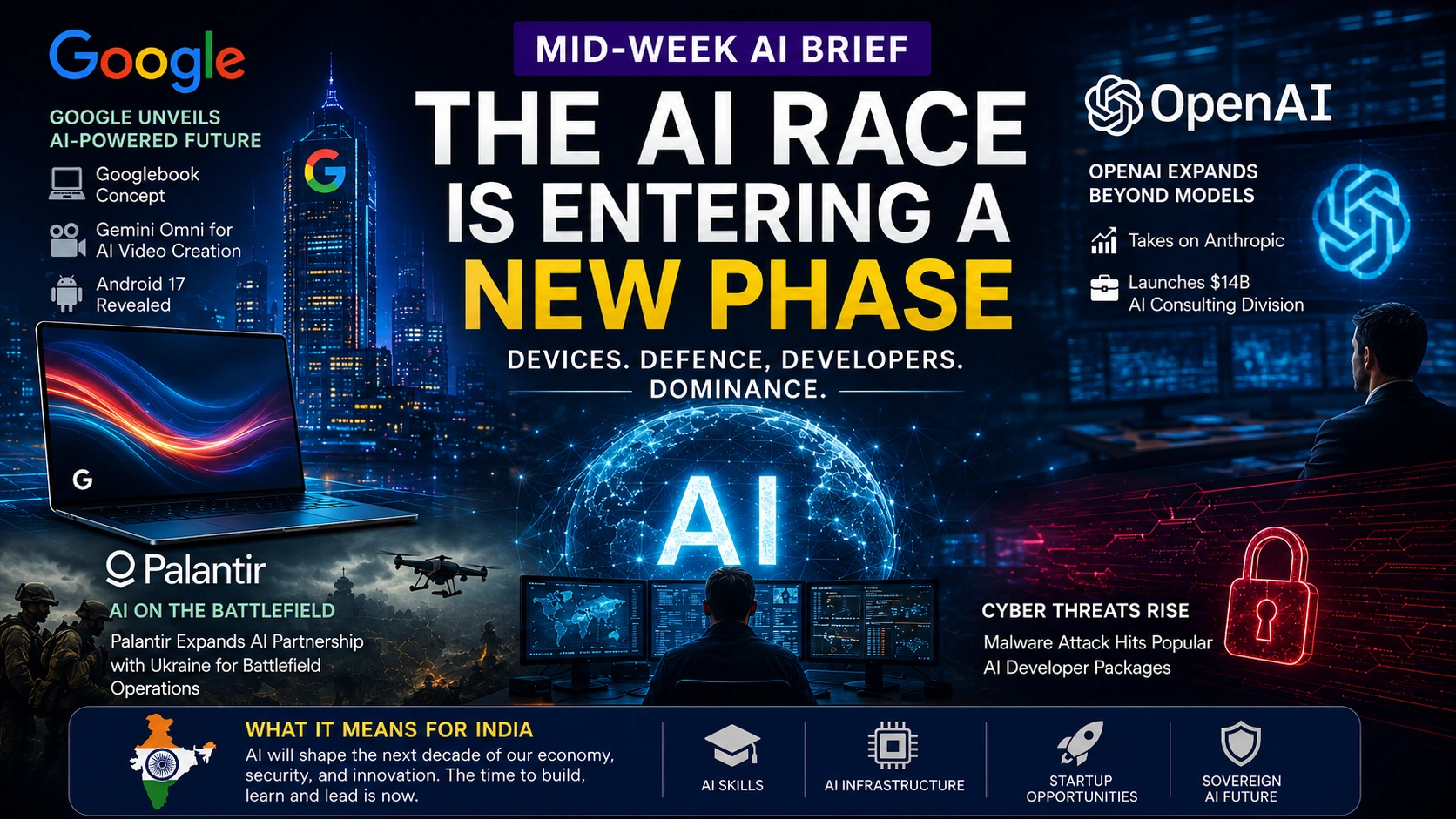
Mid-Week AI Brief: Google, OpenAI and Palantir Signal the Next Phase of the AI Power Race
From AI-native devices and video creation tools to battlefield intelligence and billion-dollar consulting ambitions, the global AI race is rapidly expanding far beyond chatbots.
Artificial intelligence is no longer evolving as a standalone technology sector. It is rapidly becoming the foundational layer shaping the future of business, defence, communication, productivity and even geopolitics.
This week’s developments from Google, OpenAI, Anthropic and Palantir suggest that the AI race is entering a far more aggressive and strategic phase. What began as a competition around chatbots and search engines is now expanding into operating systems, AI-native hardware, enterprise consulting, cybersecurity and military operations.
For businesses, governments and ordinary citizens alike, the message is becoming impossible to ignore: AI is moving from experimentation to infrastructure.
Google Pushes Deeper Into the AI Ecosystem Race
Google appears to be accelerating its attempt to build a fully integrated AI ecosystem that stretches across devices, operating systems and content creation tools.
Reports around a possible “Googlebook” concept and preparations for Gemini Omni’s AI video creation capabilities indicate that Google wants AI to become seamlessly embedded into everyday digital experiences. At the same time, developments surrounding Android 17 point towards deeper AI integration at the operating system level.
The strategy resembles a larger ecosystem play rather than isolated product launches. Instead of offering AI merely as an application, Google appears to be positioning it as the invisible layer powering search, productivity, communication, media generation and personal computing.
This matters because the next phase of the AI race may not be won solely through better models, but through stronger ecosystems.
OpenAI Expands Beyond Research Into a Business Empire
OpenAI continues to widen its ambitions beyond AI model development.
The growing rivalry with Anthropic reflects how competitive the frontier AI space has become, with companies now battling not just for technological superiority but also for enterprise dominance and developer loyalty.
Meanwhile, reports about OpenAI launching a massive AI consulting division reportedly valued around US$14 billion suggest a dramatic strategic shift. The company increasingly looks less like a research organisation and more like a future AI conglomerate aiming to influence how businesses deploy AI at scale.
This transition is significant. Over the next few years, the real economic value of AI may not come only from creating models, but from helping governments, corporations and industries integrate those systems into real-world operations.
The consulting war around AI implementation could become one of the largest business opportunities of the decade.
AI Is Rapidly Becoming a Battlefield Technology
One of the most consequential developments this week came from Palantir Technologies and its expanding AI partnership linked to battlefield operations in Ukraine.
Artificial intelligence is increasingly being integrated into defence intelligence, surveillance, logistics and tactical decision-making. What was once considered futuristic military technology is now becoming operational reality.
This signals a major geopolitical shift.
Countries around the world are beginning to recognise that AI capability may soon become as strategically important as energy security, semiconductor manufacturing or cyber warfare preparedness.
The implications extend far beyond military applications. Technologies developed for defence often reshape civilian industries later. GPS, drones and the internet itself followed similar paths.
The next generation of AI systems could fundamentally alter how nations approach security, crisis response and strategic competition.
Cybersecurity Threats Rise Alongside AI Growth
The AI boom is also creating new vulnerabilities.
Recent malware attacks targeting popular AI developer packages highlight the growing cybersecurity risks emerging around the AI ecosystem. As more businesses and developers rush to adopt AI tools, malicious actors are attempting to exploit weaknesses in software supply chains and open-source environments.
This is likely only the beginning.
The faster AI adoption accelerates globally, the greater the incentives for cybercriminals to attack platforms, datasets, developer communities and enterprise systems connected to AI infrastructure.
For startups and enterprises, cybersecurity can no longer remain an afterthought in the AI era.
What These Developments Mean for India
For India, these developments present both a challenge and an extraordinary opportunity.
The world is moving towards an AI-native economy where productivity, competitiveness and innovation will increasingly depend on AI adoption. Countries that successfully build AI talent, digital infrastructure and startup ecosystems may gain enormous strategic advantages during the next decade.https://thequantiq.com/india-ai-sustainable-civilization/
India already possesses several strengths:
- a massive digital user base,
- a fast-growing startup ecosystem,
- strong software talent,
- and one of the world’s youngest populations.
But the window of opportunity may not remain open forever.
India will need stronger investments in AI education, skilling, semiconductor ecosystems, AI research and sovereign digital capabilities if it hopes to emerge as a major player in the next technological era.
At the same time, AI also opens unprecedented opportunities for Indian entrepreneurs, creators, educators and small businesses. The barriers to innovation are falling rapidly, allowing individuals and startups to build global products with relatively modest resources.
The AI revolution may ultimately reward speed, adaptability and creativity more than size alone.
The Bigger Picture
The most important takeaway from this week’s developments is that artificial intelligence is no longer a future technology waiting quietly on the horizon.
It is already reshaping economies, workplaces, defence systems, software ecosystems and global power structures in real time.
The companies and countries moving fastest are no longer treating AI as an experimental feature. They are treating it as foundational infrastructure for the next era of human civilisation.
And that race is only beginning.https://thequantiq.com/indias-younger-generation-is-redesigning-the-meaning-of-work-risk-and-ambition/





One Comment