Insect Farming: Can Assam Turn Waste into a New Green Industry?
Northeast Renaissance Series
Ideas for a Circular Bioeconomy and a New Green Industry in Northeast India
There was a time when the back of the house was part of the household’s waste-management system.
In almost every home in Assam, including those of my childhood, there was usually a small pit somewhere in the backyard. Vegetable peels, rotten fruits, leftover food, and other biodegradable material found their way into it. Nobody called it a circular economy. It was simply the way waste returned to the soil.
In larger cities now, such as Guwahati, household waste collection has become much more organised, with door-to-door collection covering all 31 wards of the Guwahati Municipal Corporation. The city generates about 550 tonnes of solid waste a day, according to GMC.
Other towns across Assam are also moving towards more organised collection. Yet segregation, processing and disposal remain uneven across the state. Outside better-served urban areas, biodegradable waste can still end up mixed with other waste or discarded in informal locations.
The old backyard pit and the modern municipal collection system may look like two very different worlds. Biologically, however, they are dealing with the same fundamental material.
A vegetable peel is still a biological resource. A rotten fruit still contains nutrients. Agricultural and food-processing residues still contain organic matter that nature knows how to break down.
The question is whether modern science can help Assam extract more value from that process.
This is where one of the world’s least glamorous creatures enters the story.
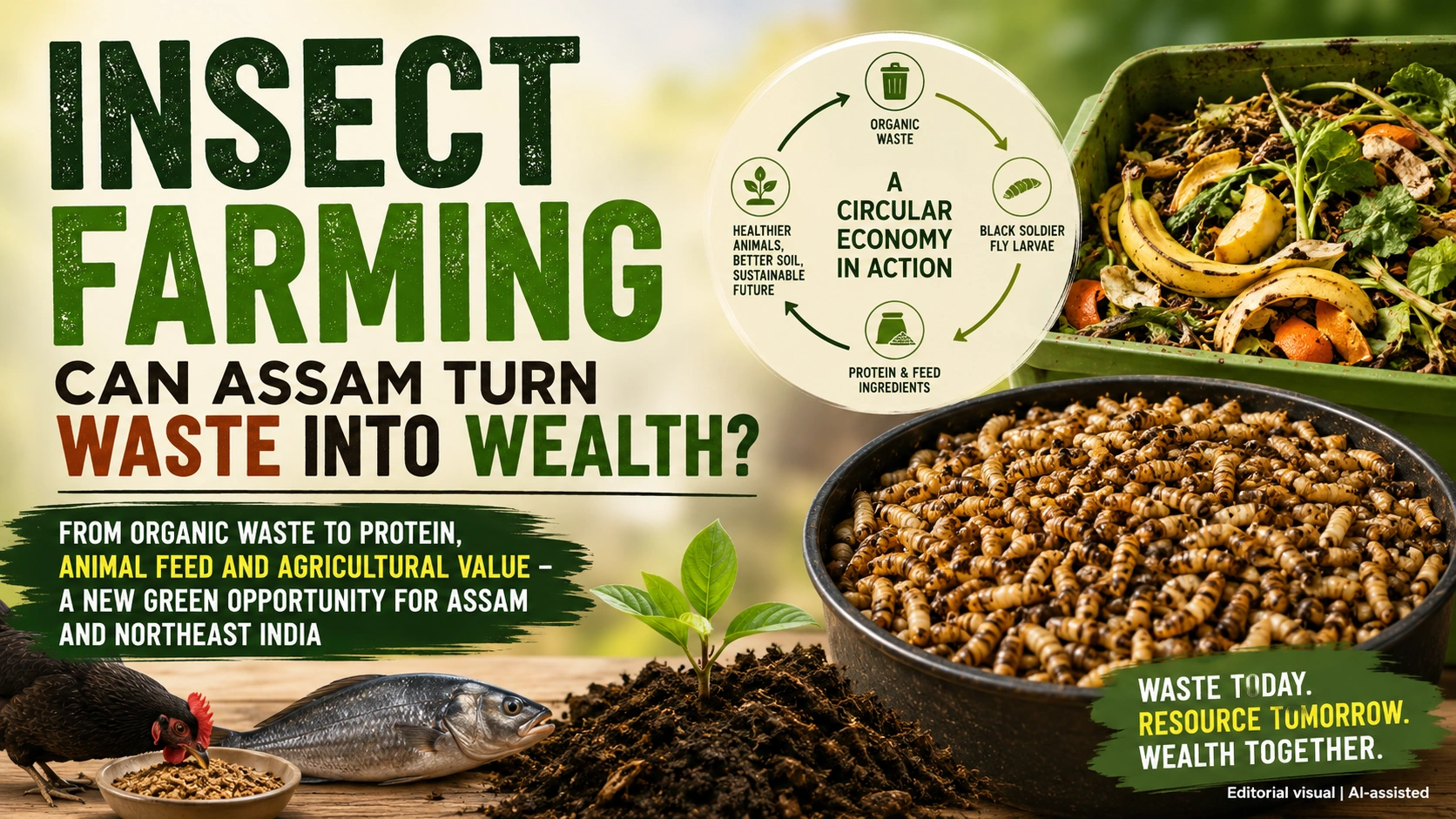
The black soldier fly, Hermetia illucens, can convert suitable organic substrates into insect biomass containing protein, fat and other nutrients. Its residual material, commonly called frass, can also have agricultural applications when appropriately processed.
For Assam and the wider Northeast, however, the insect is not the real story.
The larger story is whether a region that has historically exported raw materials can learn to create value from materials that are currently discarded.
And Assam has already begun generating the scientific evidence needed to explore that possibility.https://thequantiq.com/natural-colours-green-textile-chemistry-northeast-india/
Born from Waste
The black soldier fly has been performing its role in nature long before anyone thought of turning it into an industry.
Its larvae are efficient decomposers. Under controlled conditions, they can be reared on a range of organic substrates. Researchers are therefore studying them as biological conversion agents for waste and as a source of alternative protein for animal and aquaculture feed.
The industrial proposition, however, is more sophisticated than feeding insects with whatever waste is available.
Suitable organic material has to be collected separately. Its composition must be understood. Contamination has to be controlled. Temperature, moisture and other rearing conditions need careful management.
The larvae then convert part of the substrate into biomass that can be harvested and processed.
This makes black soldier fly farming less like conventional livestock production and more like biological manufacturing.
The raw material enters at one end. A range of potentially higher-value biological products can emerge at the other.
That distinction matters for the Northeast.
The region has never been short of natural resources. Its bigger challenge has been converting those resources into higher-value products, technologies, businesses and intellectual property.
Insect farming offers one small but intriguing example of how that transition could happen.
Assam Has Already Started Asking the Right Questions
The strongest reason to examine insect farming in Assam is not a global market projection.
It is research conducted here.
A peer-reviewed study published in Frontiers in Sustainable Food Systems in April 2026 examined the effect of different organic substrates on black soldier fly larvae at Assam Agricultural University in Jorhat. The experiments were conducted during 2023 and 2024. Researchers tested eight substrates, including vegetable waste, fruit waste, tea waste, vermicompost, papaya, maize and potato-based combinations.
The findings are significant.https://www.frontiersin.org/journals/sustainable-food-systems/articles/10.3389/fsufs.2026.1780559/full
Vegetable waste produced the strongest overall growth performance. Larvae reached the tested development stage in 15 days and achieved a maximum reported weight of 205.07 milligrams per larva. The same treatment recorded a 91.3% waste-reduction rate.
The study also found that substrate choice changed the nutritional characteristics of the larvae.
Potato and corn produced the highest reported protein content, at 649.51 milligrams per gram of dried larvae. Survivability was also highest with the potato-plus-corn treatment, reaching 84.43%.
These findings are important because they show that there is no universal recipe for insect farming.
Different waste streams produce different outcomes. Seasonal temperature also affected larval growth and substrate utilisation. The researchers therefore emphasised the importance of optimising substrate selection for sustainable waste valorisation and feed production.
For Assam, that creates an opportunity beyond farming insects.
It creates an opportunity to develop local knowledge about biological conversion.
Why This Matters
For decades, the Northeast’s economic-development conversation has focused on agriculture, infrastructure, tourism, natural resources and industrial investment.
All of these remain important.
Another question deserves attention, however.
Can the region create industries around the materials that existing industries currently discard?
That is where the circular economy becomes relevant.
A vegetable that cannot be sold becomes waste in a linear economic system. In a circular system, it can become a feedstock for another biological process. The resulting biomass can then enter another industry.
Black soldier fly farming can potentially connect several such systems.
Organic waste becomes insect biomass. Insect biomass can become an ingredient in animal or aquaculture feed. Residual nutrients can potentially return to agriculture.
The insect therefore acts as a biological bridge between waste management, animal nutrition, aquaculture and agriculture.
That is a much bigger idea than insect farming itself.
From Waste to Protein
The most interesting commercial application may ultimately be animal and aquaculture feed.
Protein is a major component of feed costs. Fishmeal remains an important ingredient in aquaculture, but concerns around the sustainability of wild-caught fish used for fishmeal have encouraged research into alternatives.
India’s public research institutions are already testing those alternatives.
In January 2025, ICAR-Central Marine Fisheries Research Institute transferred technology for producing fish feed using black soldier fly larvae to Bhairav Renderers in Tamil Nadu. The company planned to begin industrial-scale production, initially targeting the Tamil Nadu market.
ICAR-CIFRI has also developed fish-feed products using black soldier fly larvae as part of its broader Waste to Wealth programme. Its work covers a wider range of agro-industrial by-products as well, so its reported feed-cost and production results should not be attributed to BSF alone.
That distinction is important.https://icar.org.in/en/icar-cmfri-transfers-insect-protein-based-fish-feed-technology-ms-bhairav-renderers
The evidence does not yet suggest that insect protein will replace conventional feed ingredients across India’s aquaculture industry.
It does show, however, that insect-based feed has moved beyond an academic idea and into applied research, technology transfer and commercial experimentation.
For the Northeast, that development deserves attention.
Assam’s Aquaculture Connection
Assam has a natural reason to watch the development of alternative fish-feed technologies closely.
The state’s fish production reached 5.29 lakh metric tonnes in 2024–25, according to the Directorate of Fisheries, Government of Assam. The state also reports more than 2.70 lakh hectares of fishery resources, including ponds, tanks, wetlands and other water bodies.
The numbers point to a substantial local market.
Assam already produces fish on a large scale. It also has a significant network of farmers, ponds and related enterprises. If part of the protein used in that system could eventually be produced from suitable local organic waste, the economic connection would be compelling.
The potential chain is straightforward.
Organic material is collected and segregated. Black soldier fly larvae convert suitable substrates into biomass. That biomass is processed into appropriate feed ingredients. Fish farmers use scientifically validated formulations. Residual nutrients can potentially return to agriculture.
The complete chain does not yet exist at scale.
That is precisely why the opportunity deserves research and experimentation.
Guwahati Shows Where the Opportunity Could Begin
Guwahati provides an interesting starting point.
The Guwahati Municipal Corporation has a formal primary-collection system covering its 31 wards. NGOs are assigned to collect household and commercial waste and transport it to secondary collection points. GMC estimates that the city generates approximately 550 tonnes of solid waste every day.
This represents considerable progress from the informal disposal practices of the past.
Yet collection alone does not create a circular economy.
The composition of the waste matters.
Mixed municipal waste can contain plastics, chemicals and other contaminants. Such material cannot simply be diverted into a black soldier fly system intended to produce animal feed.
The next opportunity is therefore source segregation.
Vegetable markets, hotels, restaurants, food processors and institutional kitchens can generate relatively concentrated organic waste streams. If suitable material is separated before it becomes contaminated, it becomes much more useful as a biological feedstock.
This creates an interesting possibility for Guwahati.
The city could eventually have a network in which selected organic waste streams are channelled towards decentralised biological-processing facilities rather than being treated only as disposal burdens.
That would connect urban waste management with rural and peri-urban agriculture.
A New Kind of Industrial Cluster
Industrial clusters have traditionally been built around large factories.
Steel creates engineering suppliers. Automobile plants create component ecosystems. Electronics manufacturing creates specialised supply chains.
Insect farming could create something different.
One enterprise could breed black soldier flies. Another could collect and preprocess suitable organic substrates. Specialised facilities could rear larvae. Processing units could dry and convert the biomass into feed ingredients.
Laboratories would be needed to test nutritional composition and safety. Feed companies could develop formulations for different fish and livestock species. Agricultural enterprises could explore appropriate uses for residual biomass.
The resulting ecosystem could be distributed across several locations.
That model may suit parts of Northeast India particularly well.
Instead of concentrating all the value in one large industrial facility, smaller enterprises could operate close to markets, farms, food processors and sources of organic material.
The opportunity is therefore not simply to establish insect farms.
It is to build a distributed biological value chain
The Northeast Advantage
Every successful industry begins with some form of strategic advantage.
For Assam, the advantage is not simply that black soldier flies can be reared here.
The bigger opportunity comes from the combination of organic resources, agriculture, aquaculture and scientific capability.
Assam Agricultural University’s research provides an important starting point. The researchers have already demonstrated that locally available substrates can produce significantly different outcomes in larval growth, survival and nutritional characteristics.
That makes local research particularly valuable.
Which agricultural residues work best in different parts of Assam? How does seasonal temperature affect production? Which organic waste streams can be safely processed? What feed formulations work best for local aquaculture systems?
These are not merely academic questions.
They are potential sources of commercial knowledge.
If Assam develops answers that work reliably under its own conditions, that knowledge could eventually be useful across other parts of Northeast India.
From Waste Management to Bioeconomy
The deeper opportunity lies in changing how we define waste.
A linear economy follows a familiar path: extract, manufacture, consume and discard.
A circular bioeconomy attempts to close some of those loops.
For the Northeast, the idea is particularly relevant because agriculture and food production already generate large quantities of biological material. The challenge is to connect those materials with science, processing, markets and entrepreneurship.
Black soldier fly farming provides one possible connection.
It does not mean that every organic waste stream should become insect feed. Nor does it mean that conventional protein sources will disappear.
Safety, economics, regulation and nutritional performance will determine where insect-derived ingredients make commercial sense.
The important point is different.
Biology itself can become a manufacturing technology.
That idea has implications far beyond insects.
The Global Experience Offers a Clue
Assam is not alone in exploring this model.
FAO-supported projects have demonstrated systems that connect organic waste with black soldier fly production, animal feed and agricultural inputs. Such initiatives show that the technology can be designed as an ecosystem rather than as an isolated farm.
India is also building its own knowledge base.
ICAR-CMFRI has moved BSF-based fish-feed technology towards industrial production through technology transfer. ICAR-CIFRI is incorporating BSF larvae into its broader Waste to Wealth programme, alongside other agro-industrial by-products.
The lesson for Assam is not to copy another country’s model.
It is to identify what can work under local conditions.
That means starting with local waste streams, local climate, local agriculture and local markets.
Why Process Intelligence Will Be the Real Competitive Moat
As with many opportunities explored through the Northeast Renaissance Series, possessing the raw material will not be enough.
The competitive advantage will come from mastering the process.
Two insect farms can use the same species and still produce very different results.
Substrate preparation, moisture, temperature, larval density, harvesting and processing can all affect productivity and product quality. The Assam study demonstrates this clearly by showing substantial differences between substrates.
This is where process intelligence becomes important.
A future insect-farming operation could record the composition of every substrate batch. Sensors could monitor temperature and humidity. Digital systems could track larval growth. Laboratories could measure protein, fat and other nutritional characteristics.
Over time, those datasets could reveal which combinations consistently produce the best results.
The insect may be biological.
The production system can be highly technological.
The AI Era Could Make Biological Manufacturing Smarter
Artificial intelligence is already transforming agriculture, manufacturing and scientific research.
Biological production will increasingly become part of that transformation.
Imagine a future insect-rearing facility where sensors continuously monitor environmental conditions. Cameras could track larval development across multiple production batches. Software could compare growth rates against substrate composition and temperature.
AI could eventually help identify the combinations that produce the most consistent biomass at the lowest cost.
The intelligence could also extend beyond the farm.
A city could map the availability of suitable organic waste from markets, hotels and food processors. Digital systems could match those streams with nearby processing facilities. Collection routes could be optimised according to volume, quality and distance.
The result would be more than an insect farm.
It would be a data-enabled biological production network.
For the Northeast, that creates an interesting opportunity to combine biological resources with technology.
The Quantiq Assessment
The conversation around insect farming should not be reduced to an unusual agricultural experiment.
The larger question is whether Northeast India can learn to turn biological waste into economic value.
A conventional economy sees an unsold vegetable as waste.
A circular economy sees a potential feedstock.
A knowledge economy goes one step further. It asks whether the science, technology, processing systems and intellectual property required to convert that feedstock can themselves become sources of competitive advantage.
Assam already possesses several ingredients needed to explore that possibility.
The state has a large agricultural base, a substantial aquaculture economy, significant organic material streams and research institutions capable of generating local knowledge. Fish production reached 5.29 lakh metric tonnes in 2024–25, while more than 2.70 lakh hectares of fishery resources have been identified by the state.
At the same time, Assam Agricultural University researchers have demonstrated that locally available substrates can support black soldier fly production under controlled conditions. Their findings also show that substrate choice and seasonal conditions matter greatly.
That is why the future should not be built by simply importing an insect-farming model from somewhere else.
Assam needs its own data.
It needs its own production protocols. It needs feed trials, safety standards, processing expertise and reliable business models.
The Northeast can then move from being a supplier of biological resources to becoming a developer of biological processes.
Universities can generate the science. Entrepreneurs can build the enterprises. Fisheries and agriculture institutions can validate applications. Waste-management systems can create reliable feedstock streams. Laboratories can establish standards. Technology companies can provide the intelligence layer.
If those pieces begin working together, insect farming could become much more than an alternative source of protein.
It could become a new model of distributed green manufacturing.
The insect is tiny.
The economic idea is much larger.
The Northeast Renaissance may not require the region to find more resources. It may require us to look at the resources we already have—and learn to see value where the old economy saw only waste.https://thequantiq.com/algae-assam-blue-bioeconomy/


2 Comments