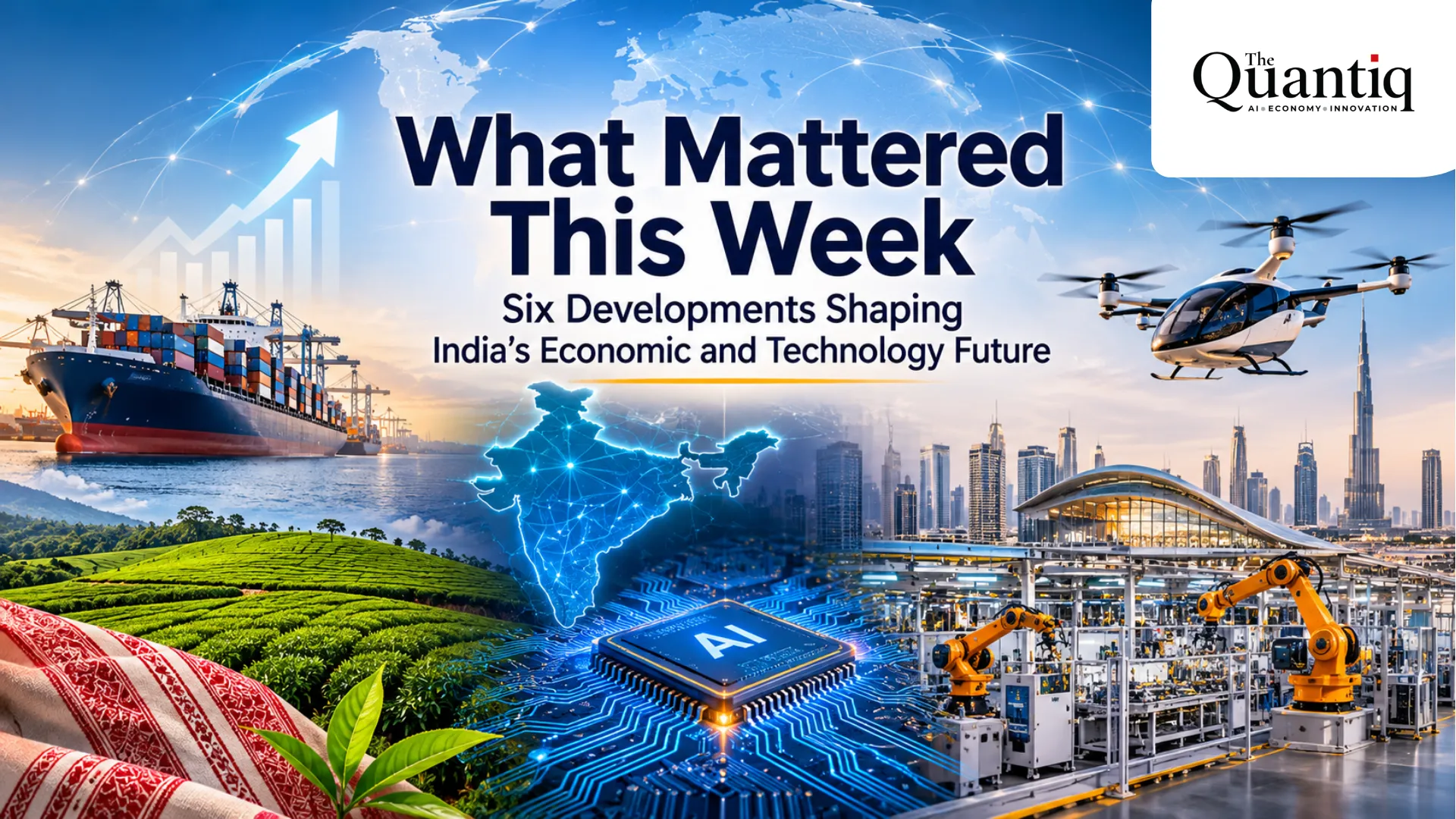
What Mattered This Week: Six Developments Shaping India’s Economic and Technology Future
This week brought developments across trade, investment, technology, manufacturing and mobility. Some point to immediate opportunities; others reveal the capabilities India will need to build over the coming years.
For the Northeast, the engagement with Europe is particularly significant. For the wider economy, the message is equally clear: resources and ambition create potential, but technology, capital, infrastructure and execution turn that potential into lasting value.
1. India’s exports surge in October, but the trade picture needs perspective
India’s total exports of merchandise and services are estimated at US$89.99 billion in October 2026, registering 29.9% growth over the same month last year, according to figures released by the Ministry of Commerce and Industry on 13 November.
Merchandise exports rose 45.06% to US$49.47 billion. Services exports were estimated at US$40.51 billion, up approximately 15.2%. The distinction is important: October’s services figure is an estimate, as the latest available RBI data at the time covered September.
Merchandise imports stood at US$89.35 billion, leaving a merchandise trade deficit of US$39.88 billion. The combined merchandise-and-services deficit was approximately US$20.09 billion. Engineering goods, gems and jewellery, and chemicals were among the sectors recording strong export growth. Engineering goods exports, for instance, increased 36.01% to US$12.74 billion.
The numbers are encouraging, but a single month’s performance should not be mistaken for a lasting structural change.
The Quantiq Perspective: India’s next export challenge is to sustain growth through stronger domestic manufacturing and a wider range of competitive products. Electronics and engineering exports are important indicators, but long-term progress will depend on domestic component ecosystems, technology capabilities, productivity and reliable supply chains. Export growth becomes more durable when it reflects a stronger productive economy.
2. Assam and the EU: turning diplomatic engagement into business opportunities
European Union Ambassador to India Jean-Eric Paquet visited Assam on 16 November and met Chief Minister Himanta Biswa Sarma. Discussions covered investment, skills, innovation, research and opportunities for stronger economic cooperation between Europe, Assam and the Northeast.
The Ambassador also highlighted the Assam Blue Valley initiative as an initial platform for wider collaboration. During the visit, he expressed interest in the work being undertaken at IIT Guwahati and the National Institute of Pharmaceutical Education and Research.
The Blue Valley Cluster itself was launched earlier, on 9 June 2026, through cooperation between the Assam government and the EU Delegation under the tenure of the previous EU Ambassador, Hervé Delphin. The initiative focuses on flavours, fragrances and AYUSH, with the wider objective of building sustainable value chains and connecting regional enterprises with European partners.
There is also an important trade-policy context. India and the EU concluded negotiations for a Free Trade Agreement on 27 January 2026. However, the agreement has not yet entered into force. Its final legal and approval processes must be completed before businesses can rely on its provisions.
The Quantiq Perspective: Assam’s opportunity lies in moving beyond the export of raw materials. Tea, agarwood, medicinal plants and other natural resources can support higher-value products, including ingredients, fragrances, formulations and wellness products. But that requires research, processing technology, quality standards, sustainable sourcing, branding and dependable market connections. The real measure of this engagement will be the partnerships and commercial value chains it creates within the region.
3. Oister Global launches deep-tech fund targeting ₹400 crore
Oister Global has launched a growth-stage deep-tech fund targeting ₹400 crore, with a ₹200-crore greenshoe option that could take its potential size to ₹600 crore.
The Oister Deep Tech Fund is registered as a SEBI Category II Alternative Investment Fund. It plans to invest in eight to ten mature companies across sectors including semiconductors, defence, aerospace, space technology, quantum technologies, advanced mobility, advanced materials and energy storage.
The proposed investment range is approximately ₹70–100 crore per company. The fund is looking beyond early-stage research and product development, focusing on businesses that have developed working technologies and are ready to expand production, fulfil orders and grow their commercial operations.
The distinction between the fund’s target and its potential size is important: ₹600 crore is not confirmation that the entire amount has already been raised.
The Quantiq Perspective: India’s deep-tech ecosystem needs more than early-stage startup funding. Technology companies often face their biggest financial challenge after developing a working product, when they must invest in manufacturing, certification, production capacity and market expansion. This is where growth-stage capital can make a difference. The real test will be whether such funds help Indian companies convert proprietary technology into commercially sustainable businesses.
4. Nvidia’s China chip halt highlights the geopolitics of artificial intelligence
Nvidia reported third-quarter fiscal 2027 revenue of US$115.8 billion, up 103% from a year earlier. Its Data Centre business generated US$107.6 billion, reflecting the extraordinary demand for computing infrastructure powering artificial intelligence.
But the company’s latest results also revealed the continuing complications of doing business in China. Nvidia’s interim CEO and CFO, Colette Kress, said the company was no longer shipping US-licensed Hopper-generation data-centre products to China. Its current revenue outlook does not include further China data-centre compute revenue.
Reuters reported that Nvidia had recorded US$2.4 billion in licensed Hopper product sales, including H200 processors, during the quarter ended 25 October. The company did not explain whether the suspension would be permanent.
The development reflects the difficult intersection of US export controls, China’s efforts to strengthen its domestic semiconductor industry and the strategic importance of advanced computing.
The Quantiq Perspective: The AI race is not simply about who develops the most capable models. It also depends on semiconductors, computing infrastructure, energy, manufacturing and supply chains. Access to advanced chips has become a geopolitical issue, not merely a commercial one. For India, the lesson is to build deeper capabilities across the semiconductor and electronics ecosystem rather than depend indefinitely on external suppliers.
5. India’s manufacturing ambition: 25% of GDP by 2047
India should increase manufacturing’s share of GDP from an estimated 16–17% to 25% by 2047, according to S. Mahendra Dev, Chairman of the Economic Advisory Council to the Prime Minister.
Speaking at the CII Financing Summit in Mumbai on 19 November, he said India would need sustained annual real GDP growth of around 8% over the next two decades to achieve its developed-economy ambition. Higher private investment, stronger domestic savings and an expansion in productive capacity would be important to sustaining that growth.
The 25% target is ambitious. Achieving it will require more than setting up factories or increasing industrial output. Manufacturing competitiveness depends on technology, skilled workers, research, infrastructure, efficient logistics and the ability to produce goods that can compete internationally.
The Quantiq Perspective: India’s manufacturing ambition should be measured not only by the number of factories built, but also by the value and competitiveness of what they produce. Process innovation, proprietary technology and productivity improvements will be essential. For the Northeast, the opportunity is to develop industries around regional resources while investing in processing, quality, technology and market access. The region must gradually move from supplying raw materials to producing higher-value goods.
6. Dubai’s certified vertiport brings electric air taxis closer to commercial service
Dubai has completed its Marina vertiport and secured certification from the UAE’s General Civil Aviation Authority for commercial electric vertical take-off and landing (eVTOL) operations.
Announced on 18 November by Skyports Infrastructure and Dubai’s Roads and Transport Authority, the facility is designated VMR. It will connect with VDX, the network’s vertiport near Dubai International Airport. Joby Aviation is expected to operate the proposed electric air-taxi service.
The planned journey between the two locations could take less than ten minutes, compared with approximately 35 minutes by road, according to the announcement.
However, the certification of the vertiport does not mean commercial passenger services have started. The RTA has said that operations remain subject to the necessary operational approvals and readiness requirements.
The Quantiq Perspective: Electric air mobility is not just an aircraft technology story. It requires certified landing infrastructure, regulatory approval, safety systems, charging arrangements and integration with existing transport networks. The commercial question will be whether operators can deliver a reliable service at a cost passengers are prepared to pay. Dubai’s progress is worth watching as the global mobility industry explores new forms of urban transport.
The real advantage lies in execution
These six developments point to a larger economic shift. Export growth requires stronger production capabilities. Regional resources need research and value addition. Deep-tech innovation needs capital to reach commercial scale. AI leadership depends on hardware and strategic supply chains. Manufacturing ambitions require productivity and process innovation. New mobility systems need infrastructure and regulation as much as technological breakthroughs.
The next phase of economic growth will belong to businesses and regions that can combine human intelligence, technology, capital and execution to create lasting value.