
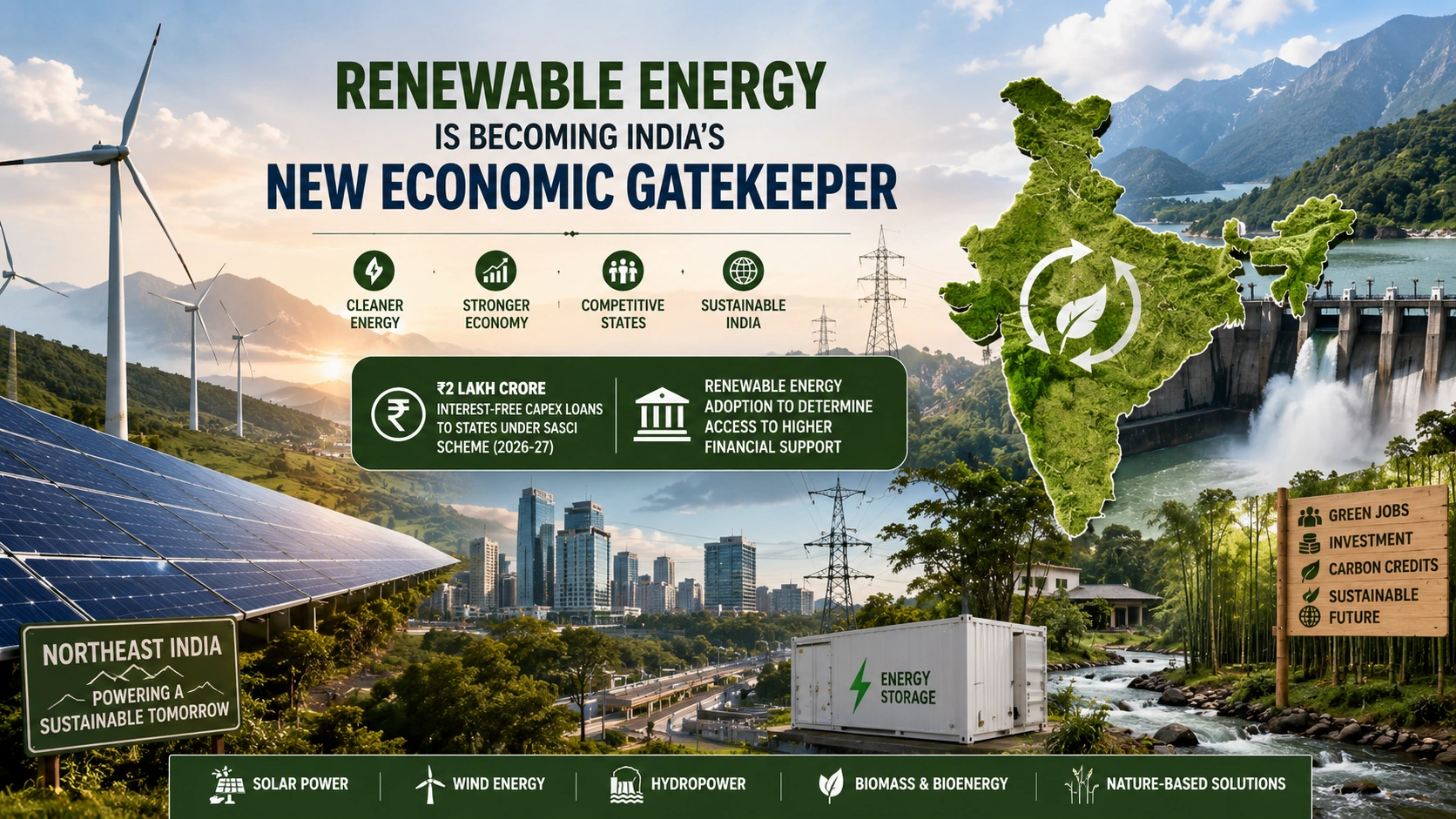
Renewable Energy Is Becoming India’s New Economic Gatekeeper
India’s transition toward renewable energy is no longer only an environmental conversation. It is steadily becoming an economic strategy, an industrial policy framework, and perhaps even a new instrument of competitive federalism.
A significant signal of this shift emerged during the CII Annual Business Summit 2026, where Union Minister for New and Renewable Energy Pralhad Joshi indicated that the Centre plans to link renewable energy adoption with long-term, interest-free capital expenditure loans provided to states under the Special Assistance to States for Capital Investment (SASCI) scheme.
At first glance, the announcement may appear technical and bureaucratic. But beneath the policy language lies a potentially transformative shift in how India may shape economic growth in the coming decade.
The Union Budget for 2026–27 has allocated nearly ₹2 lakh crore as 50-year interest-free capex loans for states under the SASCI programme. According to the policy direction outlined at the summit, while ₹75,000 crore of this allocation remains untied, a substantial portion of the remaining funds will increasingly depend on states meeting reform-linked performance criteria — including renewable energy adoption.
In simple terms, the message is becoming clear: states that move faster toward cleaner energy transitions may receive greater fiscal flexibility and stronger financial support from the Centre.
This changes the nature of renewable energy itself.
For years, green energy discussions in India largely revolved around climate commitments, pollution control, and sustainability narratives. Those concerns remain important, but the policy conversation is now expanding toward economic competitiveness.
The world economy is changing rapidly. Global supply chains are increasingly under pressure to reduce carbon footprints. Export markets, especially in Europe, are introducing stricter environmental compliance mechanisms, including carbon border taxes. International investors are prioritizing ESG-linked investments, while multinational corporations are searching for manufacturing ecosystems powered by cleaner energy.
In such an environment, access to renewable energy may soon become an economic advantage rather than merely an environmental preference.
States capable of building strong renewable ecosystems could become more attractive destinations for future manufacturing, industrial investment, and global supply-chain integration. Those lagging behind may gradually face disadvantages in attracting long-term capital.
This is where the Centre’s policy direction becomes strategically important.https://thequantiq.com/gelephu-mindfulness-city-the-100-billion-opportunity-northeast-india-cannot-afford-to-miss/
India appears to be entering an era where fiscal incentives are increasingly tied to governance outcomes and reform performance. Renewable energy adoption is now joining a growing list of metrics through which the Union government is attempting to shape state-level economic priorities.
This marks the rise of what may be called “green federalism.”
Instead of imposing direct mandates, the Centre is using financial incentives to encourage behavioural shifts among states. Better-performing states stand to access larger tied allocations beyond their standard borrowing ceilings, which are otherwise capped under fiscal responsibility norms.
Supporters may argue that this approach rewards efficiency, accelerates national climate goals, and improves infrastructure quality. Critics, however, may raise concerns about whether such conditional financing gradually reduces the policy autonomy of states with weaker fiscal or infrastructural capacities.
That debate is likely to intensify in the years ahead.
For Northeast India, the implications are especially significant.
The region possesses immense untapped potential in renewable energy, hydropower, biomass, and nature-linked economic systems. States like Arunachal Pradesh already hold enormous hydropower possibilities, while Assam and other northeastern states have growing opportunities in solar energy, bioenergy, bamboo-linked carbon ecosystems, and sustainable rural enterprises.
This is where the renewable energy transition intersects with another emerging global opportunity — the carbon economy.
As the world moves toward decarbonization, regions rich in ecological assets may gain new strategic importance. Bamboo plantations, agroforestry systems, biomass utilization, and carbon sequestration projects could eventually become part of larger green financing and carbon-credit ecosystems.
For a region historically viewed through the lens of connectivity challenges and geographical isolation, the green transition may create an opportunity to reposition itself as a sustainability-driven economic frontier.
Yet India’s renewable-energy ambitions also face serious challenges.https://thequantiq.com/india-ev-market-q1-2026-analysis/
Grid infrastructure remains uneven. Energy storage capabilities are still developing. Several states continue depending heavily on coal-based power systems. Land acquisition challenges, transmission bottlenecks, financing gaps, and policy inconsistencies continue to affect project execution.
There is also the risk of widening inequalities between states.
Economically stronger states with better infrastructure and administrative capacities may adapt more quickly to green-transition requirements, while financially weaker states could struggle to meet reform-linked benchmarks despite possessing long-term potential.
This raises a larger policy question: can India design a renewable transition that remains both competitive and equitable?
The answer will shape not only the country’s energy future, but also its industrial geography.
What is becoming increasingly evident is that renewable energy is no longer a side conversation in economic planning. It is gradually moving toward the centre of India’s future development model.
The states that understand this transition early may gain long-term strategic advantages in attracting investment, building industries, generating employment, and integrating into the evolving global economy.
And in the years ahead, economic competitiveness may increasingly depend not only on roads, factories, and industrial parks, but also on how effectively regions adapt to the realities of a low-carbon world.https://thequantiq.com/india-ai-sustainable-civilization/






2 Comments