
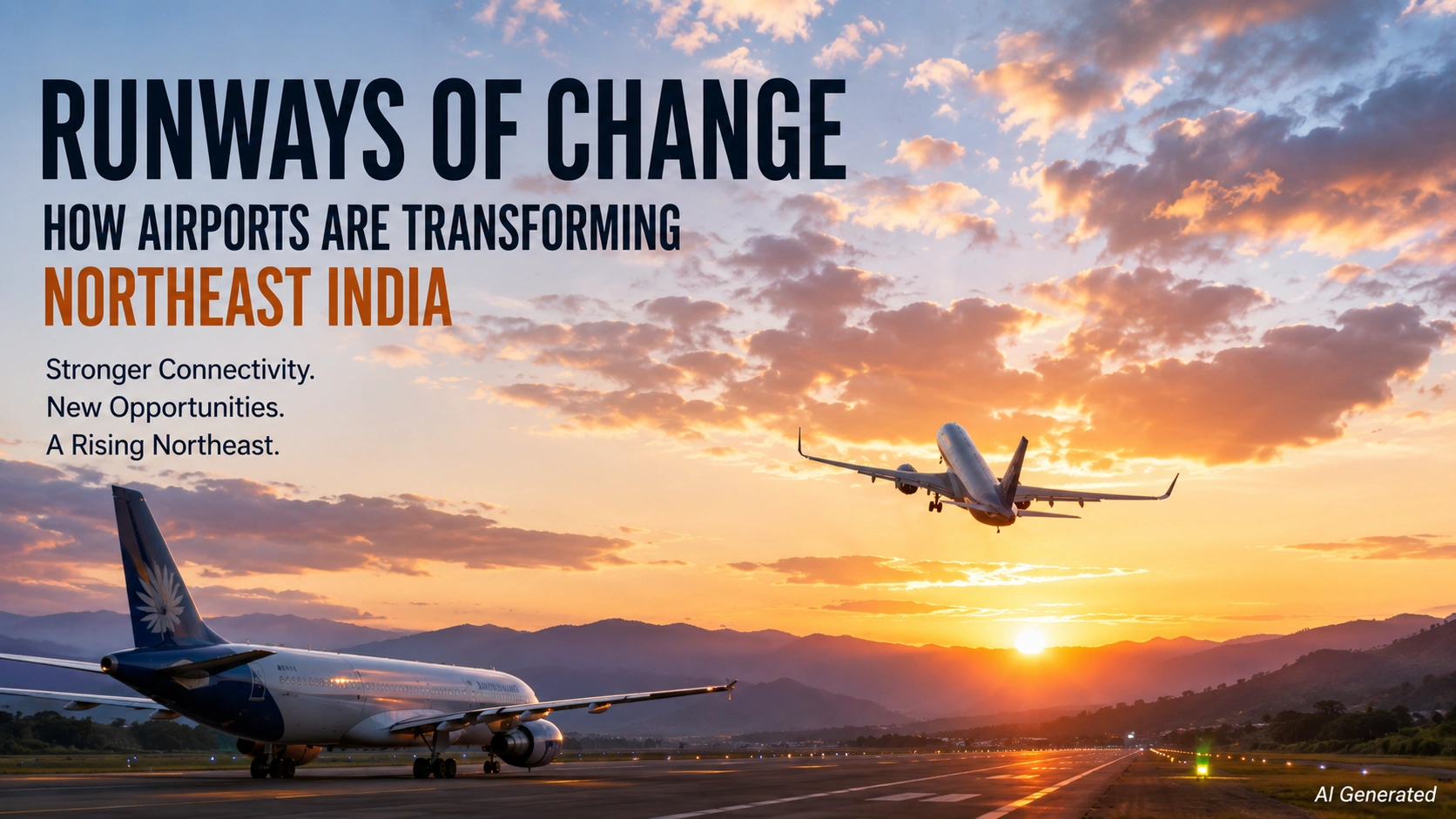
Runways of Change: The Airports Quietly Transforming Northeast India
From Guwahati’s mega hub dominance to Agartala’s strategic rise and Arunachal Pradesh’s aviation boom, a new economic geography is slowly emerging across Northeast India.
or generations, Northeast India lived under the burden of distance.
The region’s rivers, mountains, forests, and difficult terrain shaped not only its geography, but also its economic destiny. Journeys that appeared ordinary elsewhere in India often became exhausting expeditions here. Entire communities evolved around isolation. Businesses learned to operate within limitations. Young people grew up measuring opportunity against the difficulty of leaving home.
Connectivity was never merely an infrastructure issue in the Northeast. It was psychology. It shaped confidence, investment, mobility, and aspiration itself.
But quietly, almost invisibly, that reality has begun to change.
Above the hills and valleys of the region, a silent transformation is unfolding through aviation. Airports that once handled modest daily traffic are now witnessing steady passenger growth. Regional terminals are expanding. Airlines are increasing frequencies. New routes are emerging. Smaller cities are beginning to feel less distant from the rest of India.
And hidden inside those passenger statistics lies a much larger story — one about economic transition, regional integration, strategic geography, and the Northeast’s gradual emergence into India’s mainstream growth narrative.
Because in frontier economies, airports are never just airports. They become indicators of confidence.
Guwahati: The Mega Hub Rewiring the Northeast
At the center of this transformation stands Lokpriya Gopinath Bordoloi International Airport.
If the Northeast today possesses an aviation capital, it is unquestionably Guwahati.
Over the last decade, the city has evolved from a regional transit point into the Northeast’s undisputed aviation nerve center. Passenger traffic at Guwahati has crossed the 6 million mark in recent years, placing it dramatically ahead of every other airport in the region combined.
But Guwahati’s importance cannot be understood merely through numbers.
The airport has become the Northeast’s great connector — the place through which students, entrepreneurs, medical travelers, tourists, government officials, migrant workers, and businesses increasingly move between the region and the rest of India.
Economic gravity naturally follows connectivity.
As route networks deepen and frequencies increase, businesses begin clustering around better-connected cities. Investors feel more confident. Hospitality infrastructure expands. Warehousing grows. Startup ecosystems strengthen. Tourism scales faster.
Guwahati is now experiencing that very cycle.
Its rise as an aviation hub is quietly reshaping Assam’s broader economic geography while simultaneously reinforcing the city’s dominance over the wider Northeast.
Yet Guwahati’s growing strength also reveals something deeper about the region’s evolving aviation structure.
The Northeast is no longer dependent on a single airport ecosystem. A secondary network of strategic and specialized airports is gradually taking shape across the region. And nowhere is that more visible than in Assam itself.
Dibrugarh: The Aviation Spine of Upper Assam
While Guwahati dominates western Assam and the wider Northeast, Dibrugarh Airport has quietly emerged as the aviation backbone of Upper Assam.
Unlike Guwahati’s broad regional dominance, Dibrugarh functions as a highly specialized economic connector deeply tied to the industrial and strategic realities of eastern Northeast India.
Its passenger traffic has remained consistently strong over recent years, generally hovering between 700,000 and 800,000 annual travelers, making it one of the busiest airports in the Northeast outside Guwahati and Agartala.
But the airport’s importance extends far beyond passenger volume.
Dibrugarh serves as a gateway to:
- Upper Assam’s tea industry,
- the region’s oil and gas economy,
- eastern Arunachal Pradesh,
- healthcare travel,
- educational mobility,
- and frontier tourism circuits.
Corporate movement linked to Assam’s energy sector relies heavily on Dibrugarh’s connectivity. So do thousands of students and professionals traveling between Upper Assam and major Indian cities.
Without Dibrugarh, vast stretches of eastern Northeast India would remain economically and psychologically more distant from India’s mainstream urban centers.
And perhaps that is the larger significance of the airport. It proves that Assam’s aviation ecosystem is no longer singularly dependent on Guwahati. A second aviation spine is steadily strengthening in the east.
Silchar: Where Aviation Becomes Essential Infrastructure
If Dibrugarh reflects industrial mobility, Silchar Airport reveals something even more profound.
In regions like the Barak Valley, aviation is not merely convenient infrastructure.
It is essential infrastructure.
Silchar serves a geography shaped by terrain vulnerabilities, flood disruptions, long road journeys, and logistical isolation. For thousands of people across southern Assam and neighboring areas, air connectivity is often the fastest and most reliable link to major economic and healthcare centers.
Passenger traffic at Silchar has remained robust and steadily expanding, generally crossing the 400,000 to 500,000 annual passenger range in recent years.
Yet the deeper story lies in why people travel.
Unlike tourism-heavy airport ecosystems elsewhere, Silchar’s traffic reflects a more human reality:
students leaving for education, families seeking medical care, professionals traveling for employment, government movement, business connectivity, and emotional ties spread across distant cities.
Silchar demonstrates something many infrastructure debates often overlook. In frontier regions, airports are not luxury assets. They are lifeline infrastructure.
And as the Barak Valley’s economic aspirations continue evolving, the airport’s strategic importance is likely to deepen further.
Agartala’s Quiet Rise as a Strategic Aviation Hub
For years, Maharaja Bir Bikram Airport existed outside mainstream national aviation conversations.
That is rapidly changing.
Agartala has quietly emerged as the second busiest airport in Northeast India, handling traffic volumes that increasingly resemble those of a serious Tier-2 aviation hub rather than a peripheral regional airport.
Passenger movement rose from approximately 1.32 million in FY 2023-24 to nearly 1.41 million in FY 2024-25, with projections for FY 2025-26 approaching 1.45 million passengers.
Yet the real significance of Agartala lies in geography.
Tripura sits extraordinarily close to Bangladesh’s major commercial centers, including Dhaka and Chittagong. In practical terms, parts of Bangladesh are geographically more accessible from Agartala than several Indian metropolitan cities.
That creates enormous untapped potential.
If international immigration clearance and cross-border route activation eventually materialize, Agartala could evolve into one of India’s most strategically significant regional airports.
Trade corridors could deepen. Hospitality investment could accelerate. Medical tourism could grow rapidly. Border commerce could expand dramatically.
The airport already possesses the traffic strength. What remains is geopolitical and policy activation.
Arunachal Pradesh and the Runway Effect
Few infrastructure stories in India illustrate the transformative power of connectivity more dramatically than Donyi Polo Airport.
For decades, Arunachal Pradesh’s economic potential remained constrained by difficult accessibility despite its immense tourism and strategic value.
The launch of Donyi Polo Airport changed that equation almost immediately.
Passenger traffic surged from approximately 154,000 in FY 2023-24 to nearly 218,000 in FY 2024-25 — an explosive growth jump of more than 41 percent. Current projections suggest traffic could touch 250,000 passengers in FY 2025-26.
The numbers reveal a powerful truth. Demand already existed. The runway simply unlocked it.
Every new flight into Arunachal carries wider economic implications. Tourism becomes easier. Investments appear more realistic. Hotel infrastructure gains confidence. Students travel faster. Healthcare access improves.
And perhaps most importantly, psychological isolation begins fading. Infrastructure changes movement. But it also changes imagination.https://thequantiq.com/tezpur-kaziranga-nameri-corridor-assam-tourism/
Imphal and the Fragility of Momentum
The story of Bir Tikendrajit International Airport reflects another side of Northeast India’s aviation reality — the fragility of economic momentum in politically sensitive regions.
Imphal remains one of the Northeast’s most strategically important airports despite periods of instability affecting traffic growth.
Passenger movement declined from approximately 980,000 travelers in FY 2023-24 to around 860,113 in FY 2024-25 before showing signs of recovery toward the 900,000 mark.
Yet the airport continues functioning as a vital regional lifeline connecting Manipur with India’s broader economic system.
And like Agartala, Imphal’s future importance may ultimately extend beyond domestic aviation.
Its geography places it naturally within India’s larger Act East ambitions toward Myanmar and ASEAN connectivity.
Its runway already points toward Southeast Asia.
Shillong and the Strange Economics of Better Roads
One of the most fascinating stories emerging from the region’s aviation data comes from Shillong Airport.
At first glance, Shillong’s traffic growth appears healthy enough, rising steadily toward the 190,000 passenger mark.
Yet beneath those numbers lies a remarkable infrastructure paradox.
A significant share of Meghalaya’s travelers still prefer driving to Guwahati rather than flying directly from Shillong.
Why?
Because improved highways and Guwahati’s stronger connectivity often outweigh the convenience of smaller airports.
In simple terms, better roads can sometimes weaken regional aviation ecosystems.
Shillong’s story reveals the complicated relationship between highways, passenger economics, regional hubs, and aviation infrastructure — a dynamic rarely discussed in India’s connectivity debates.
Pakyong and the Limits of Geography
If Donyi Polo symbolizes optimism, Pakyong Airport symbolizes geography’s enduring authority.
Few airports in India are as engineering-intensive or terrain-sensitive as Pakyong. Passenger traffic dropped sharply from around 32,000 to approximately 18,000 before stabilizing near 20,000 amid weather disruptions and operational suspensions.
Its story reveals a difficult truth.
Infrastructure investment alone cannot always overpower terrain.
In mountain economies, nature still negotiates the terms of connectivity.
The Quiet Strength of Dimapur and Lengpui
Airports like Dimapur Airport and Lengpui Airport may not dominate national headlines, yet they remain critical to the Northeast’s broader aviation ecosystem.
Dimapur continues serving as Nagaland’s principal business and defense-linked airport, while Lengpui’s unique status as a state-operated airport reflects Mizoram’s increasing dependence on aviation connectivity.
Together, these airports reinforce an important reality:
The Northeast’s aviation rise is no longer confined to one or two major cities.
A wider regional network is slowly taking shape.
The Northeast’s New Economic Geography
What makes this aviation transformation so significant is that airports often function as mirrors of deeper economic change.
Passenger growth usually reflects rising confidence. More tourism. Greater business mobility. Stronger investor interest. Faster movement of ideas, people, and capital.
In the Northeast, these shifts carry extraordinary importance because connectivity has historically shaped economic opportunity more dramatically than in many other parts of India.
An airport here is never just a terminal.
It becomes a tourism gateway, a business corridor, a healthcare bridge, and increasingly, a symbol that the region no longer wishes to remain distant from India’s economic mainstream.
And perhaps that is the larger story hidden within these numbers.
The Northeast is not merely building airports.
It is slowly rebuilding its relationship with distance itself.
Can Northeast India Become India’s Eastern Aviation Corridor?
The question no longer feels unrealistic.
Geographically, the Northeast sits at one of Asia’s most strategic intersections — between Bangladesh, Bhutan, Myanmar, ASEAN trade routes, and India’s broader Act East ambitions.
If international and regional connectivity deepens over the coming decade, airports like Guwahati, Agartala, Dibrugarh, and Imphal could evolve into far more than domestic aviation hubs.
They could become economic corridors.
Tourism could surge. Border trade could deepen. Logistics ecosystems could emerge. Cross-border mobility could reshape urban economies.
The runways are already being built.
What they may eventually transform could redefine Northeast India’s economic future for decades to come.https://thequantiq.com/the-72-hour-rule-northeast-india-tourism/
Northeast India Airport Traffic Snapshot
| Airport | FY 2023-24 | FY 2024-25 | FY 2025-26 (Projected) | Growth Narrative |
|---|---|---|---|---|
| Guwahati | 6M+ | 6M+ | Growing | Regional Mega Hub |
| Agartala | 1.32M | 1.41M | 1.45M | High, stable growth |
| Imphal | 980K | 860K | 900K+ | Recovery phase |
| Dibrugarh | 700K+ | Strong | Growing | Upper Assam economic spine |
| Silchar | 400K+ | Strong | Growing | Lifeline aviation corridor |
| Dimapur | 380K | 405K | 420K | Steady expansion |
| Lengpui | 290K | 312K | 325K | Consistent growth |
| Donyi Polo | 154K | 218K | 250K | Hyper-growth |
| Shillong | 160K | 182K | 190K | Moderate growth |
| Pakyong | 32K | 18K | 20K | Volatile |