
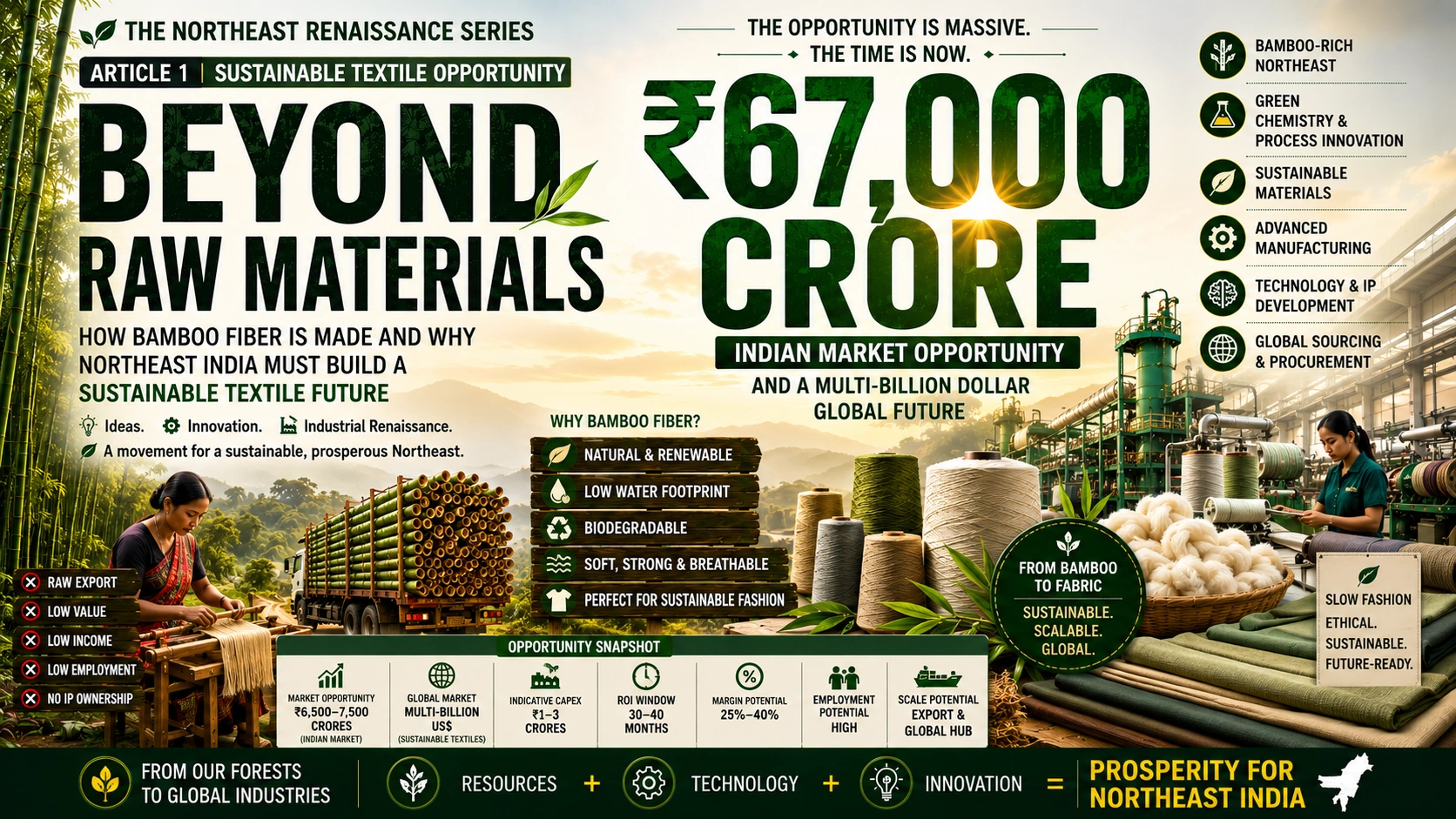
How Bamboo Fiber Is Made — And Why Northeast India Must Build a Sustainable Textile Future
The Northeast Renaissance Series
Ideas for a ₹67,000 Crore Indian Market and a Multi-Billion Dollar Global Future
The textile story of Northeast India is one of beauty, skill, and paradox. Across Assam, Nagaland, Manipur, Meghalaya, Mizoram, Tripura, Arunachal Pradesh, and beyond, weaving is not merely a livelihood. It is memory carried through looms, identity passed across generations, and cultural intelligence expressed in every motif. Handwoven textiles and indigenous craftsmanship have long distinguished this region from much of the subcontinent.https://yarnglory.com/
Yet beneath this cultural richness lies an economic contradiction that deserves urgent attention. The Northeast weaves, but does not control its most important textile input. Cotton — the dominant fibre feeding much of the regional weaving economy — is not cultivated locally at meaningful scale. As a result, cotton yarn must travel from distant production centres. Transportation costs, procurement layers, and external dependency steadily increase input expenses, making many handwoven products costlier and less competitive. The region possesses weaving skill, but not fibre sovereignty.
The Question That Changes Everything
This structural vulnerability raises a difficult but transformative question. Must the Northeast continue building its textile future on imported cotton economics, or can it create a different model rooted in its own ecological strengths? The question is especially relevant today because the Government of India has increasingly identified textiles as a strategic growth sector. At the same time, global fashion is undergoing profound change.
Across Europe, North America, and parts of Asia, consumers and brands are questioning the ecological cost of fast fashion and chemically intensive textile systems. Concepts such as sustainable fashion, ethical sourcing, regenerative materials, and slow fashion are moving steadily from niche conversations to mainstream procurement strategies. Every major transition creates new winners. For Northeast India, one of those opportunities may already be growing across its landscapes — in bamboo.
Why Bamboo Changes the Industrial Conversation
For decades, bamboo has been viewed through relatively narrow economic lenses, supplying construction, handicrafts, fencing, baskets, and paper mills. Every night, trucks loaded with raw bamboo leave the region toward industrial destinations elsewhere, carrying away not only biomass but opportunities for local value creation. However, the global material economy now sees bamboo very differently.
No longer merely a pole or a rural resource, bamboo increasingly participates in advanced construction materials, carbon systems, green chemistry, engineered composites, and sustainable textiles. Furthermore, bamboo grows abundantly across Northeast India without requiring the extensive land, irrigation, and agricultural ecosystems that cotton demands. Fast-growing, regenerative, and capable of repeated harvesting, it represents a renewable biomass system with unusual industrial flexibility. Consequently, the most intriguing opportunity may lie not in bamboo products but in bamboo fibre.
The Critical Distinction: Viscose Versus Mechanical Fibre
Before examining bamboo fibre’s potential, an important distinction must be made. Most garments marketed internationally as “bamboo fabric” are not true bamboo fibre in the mechanical sense. They are generally bamboo viscose or rayon — produced by dissolving bamboo through aggressive industrial chemistry before regenerating it into fibre. While commercially successful, these processes attract growing environmental scrutiny and face tightening regulatory pressure in export markets.
This creates a significant opening for a different approach. Mechanically extracted bamboo fibre — produced through physical and biological processes rather than chemical dissolution — occupies a far more credible position in the sustainable textile market. Moreover, it represents a process-technology opportunity, not merely a textile activity. And process technology, increasingly, is where the real industrial moat resides.
How Bamboo Fibre Is Actually Made
The journey from bamboo grove to textile fibre involves several distinct and technically demanding stages. Understanding each stage is essential for any entrepreneur or investor considering this opportunity seriously.
Stage 1 — Plantation and Raw Material Selection. Not all bamboo species perform equally for fibre extraction. Species possessing favourable fibre density, long internodes, and suitable cellulose composition offer stronger potential. Additionally, the quality of fibre depends less upon machinery alone and more upon disciplined raw material preparation. Mature culms are harvested, cleaned, split, and moisture-managed before processing begins.
Stage 2 — Mechanical Decortication. The bamboo is first split into narrow strips. Mechanical crushing systems then fracture the rigid lignocellulosic matrix surrounding the structural fibres without destroying the fibres themselves. This process separates soft tissues from the stronger bast fibre bundles embedded within the plant. Although the process may appear straightforward, it is in reality sophisticated materials engineering — because unlike cotton, which emerges naturally as soft fibre, bamboo stores its structural strength inside dense cellular architecture.
Stage 3 — Enzyme-Assisted Refinement. After decortication, the fibres still contain residual lignin, gums, and non-cellulosic compounds. Rather than depending upon harsh chemical pathways, controlled enzyme-assisted systems dissolve unwanted materials while preserving structural integrity. This stage influences softness, flexibility, tensile strength, and eventual spinning behaviour — making it arguably the most critical in the entire process.
Stage 4 — Washing, Drying, and Alignment. After enzymatic refinement, the fibres undergo washing and drying before hackling and alignment processes comb and organise them into uniform strands suitable for spinning or blending. What finally emerges is genuine bamboo fibre — breathable, naturally textured, strong, and aligned with the ecological values that contemporary textile markets increasingly demand.
The Opportunity in Numbers
| Indicator | Estimate |
| Indian Sustainable Textile & Natural Fibre Opportunity | ₹6,500–7,500 Crores |
| Global Sustainable Textile & Slow Fashion Economy | Multi-Billion USD Market |
| Indicative Capital Investment | ₹1–3 Crores |
| Estimated ROI Window | 30–40 Months |
| Potential Margin Range | 25–40% |
| Employment Potential | High |
| Scale Potential | Export & Global Procurement Hub |
Credibility Note: The financial indicators presented are directional estimates based on prevailing sectoral trends, industry benchmarks, and emerging sustainable-textile markets. Commercial outcomes may vary depending on technology, process efficiency, scale, sourcing systems, quality standards, and market access. Readers are encouraged to undertake independent technical and financial due diligence before making investment decisions.
From Fibre to Industrial Strategy
The significance of bamboo fibre, however, extends far beyond the mechanics of production. The deeper opportunity lies in what this fibre enables for the Northeast as a region. Consider the possibility: instead of endlessly importing cotton yarn, the region gradually develops its own natural-fibre ecosystems. Instead of exporting bamboo as raw biomass, it exports fibre, yarn, fabric, and premium textile identity. Instead of depending on distant supply chains, it builds localised procurement networks rooted in ecology and technology.
This shift is not merely commercial. It is strategic. The international slow-fashion movement increasingly seeks materials with traceability, ecological legitimacy, and authentic sourcing narratives. Brands now ask: where did this fibre originate? How sustainable is the supply chain? What communities participated in its production? The Northeast already has unusually strong answers — weaving heritage, biodiversity, cultural identity, and environmental storytelling capital. What remains to be built is industrial fibre capability.
The Warning Against Industrial Shortcuts
An important caution must be offered here. Far too often, manufacturing conversations in the Northeast reduce themselves to importing ready-made machinery and copying external models. Machines matter, but machines are rarely the real competitive moat. Therefore, the deeper advantage in bamboo fibre technology lies in understanding and designing the process itself.
Decortication systems, fibre refinement pathways, enzyme formulations, drying architecture, spinning compatibility, and textile finishing all present opportunities for local engineering, adaptation, and potentially patentable process innovation. Designing such systems is no longer the exclusive privilege of giant industrial laboratories. Artificial intelligence, computational modelling, rapid prototyping, and open scientific access are increasingly democratising innovation. As a result, the Northeast does not merely need factories — it needs textile intelligence.
A Different Kind of Textile Future
The Northeast may never become a conventional cotton belt. However, it does not need to. Sometimes competitive advantage emerges not from copying existing industrial geographies but from building alternative ones. The future textile economy need not revolve exclusively around imported cotton yarn. Through bamboo fibre, Eri and Muga silk, banana fibre, nettle systems, natural blends, and regenerative textiles, the region possesses the raw material for something more distinctive.
The Northeast could become a global procurement and sourcing hub for sustainable textiles and slow fashion. The world is increasingly searching for cleaner fibres, ethical materials, and regenerative supply systems. The question is therefore not whether this opportunity exists. The question is whether Northeast India will supply merely the raw bamboo — or help supply the future of fabric itself.
The Quantiq’s Assessment: The Northeast does not need to imitate cotton economies to build textile strength. Its real opportunity lies in developing natural-fibre technologies, bamboo-based textile systems, and slow-fashion ecosystems capable of transforming ecological abundance into globally relevant manufacturing and premium value creation. The industrial direction is clear. What is needed now is the decision to follow it.https://thequantiq.com/northeast-india-green-industrialisation-bamboo-manufacturing/



4 Comments