
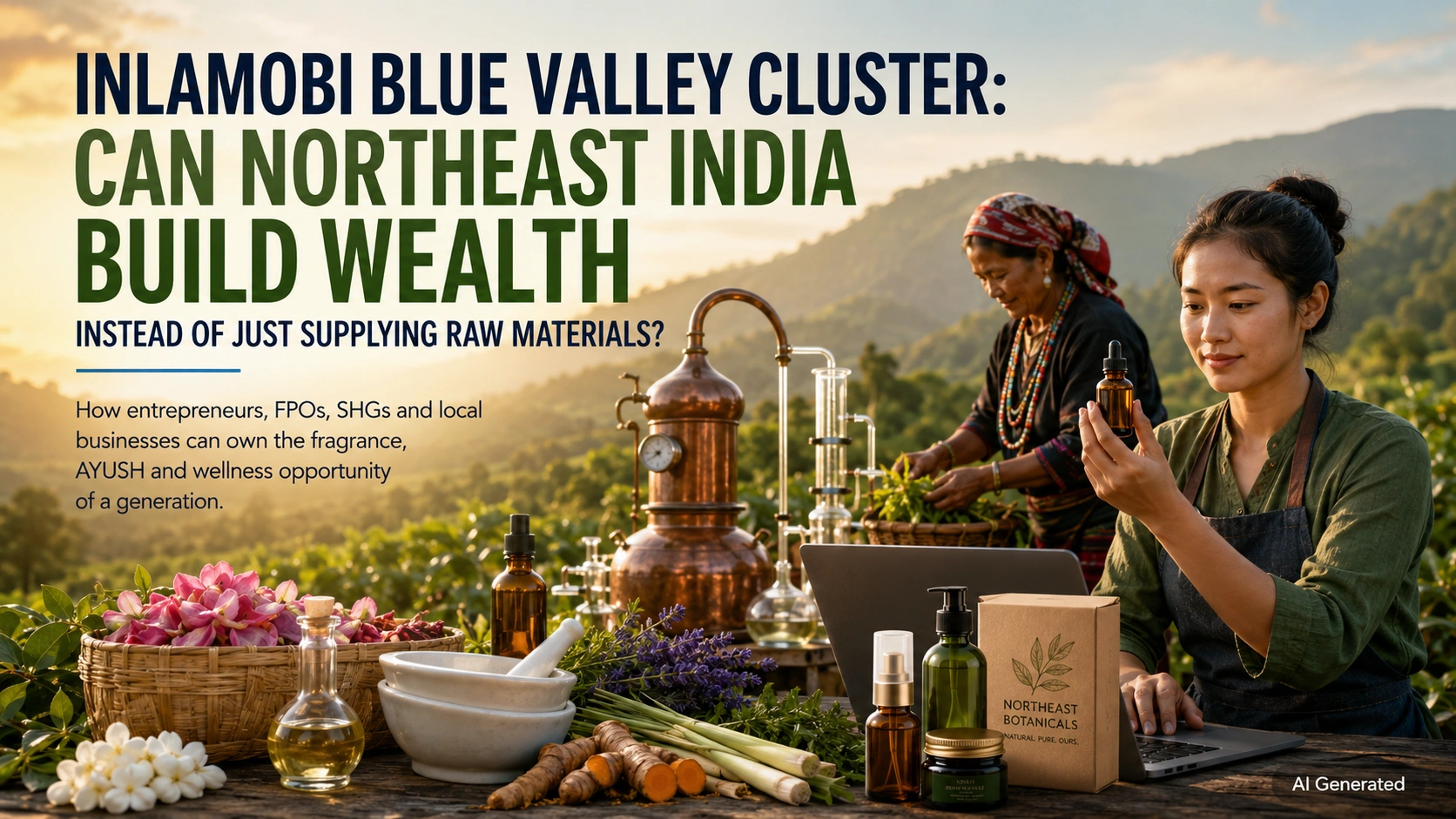
INLAMOBI Blue Valley Cluster: Can Northeast India Build Wealth Instead of Just Supplying Raw Materials?
On June 8 and 9, something unusual happened in Guwahati.
It was not another investment summit. It was not another memorandum of understanding destined to gather dust in official files. It was the physical beginning of a project that could reshape how Northeast India participates in the global natural ingredients economy.
The Bhoomi Poojan of the INLAMOBI Fragrances & Cosmetics Pilot Project, attended by Assam Chief Minister Himanta Biswa Sarma, marked the launch of what its promoters describe as a Blue Valley ecosystem for flavours, fragrances, botanical extracts, AYUSH products, wellness ingredients, and natural cosmetics.
For many observers, this may appear to be just another industrial project.
For entrepreneurs, Farmer Producer Organisations (FPOs), Self-Help Groups (SHGs), tribal cooperatives, and local startups across Northeast India, it could represent something much bigger.
It raises a simple but powerful question:
Will Northeast India merely supply raw materials to global companies, or will it build brands, intellectual property, and long-term wealth of its own?
The answer will not be determined by investors alone. It will depend largely on what local entrepreneurs do over the next few years.
Why the Blue Valley Cluster Matters
Northeast India possesses one of the richest biodiversity reserves in Asia.
From Assam’s aromatic grasses and essential oil crops to Arunachal Pradesh’s medicinal plant diversity, from Meghalaya’s renowned Lakadong turmeric to Nagaland’s King chilly, and Sikkim’s cardamom ecosystem, the region holds resources that global fragrance, wellness, cosmetic, and nutraceutical industries increasingly seek.
Historically, however, the region has mostly exported raw materials while value addition happened elsewhere.
Tea leaves travelled out.
Medicinal plants travelled out.
Agricultural produce travelled out.
The premium products, global brands, and higher margins often emerged somewhere else.
The Blue Valley concept seeks to change that pattern by connecting Northeast India’s biodiversity to domestic and international value chains in sectors such as:
- Flavours and fragrances
- AYUSH products
- Botanical extracts
- Natural cosmetics
- Wellness ingredients
- Functional foods
If executed effectively, it could create a structured pathway from farm to finished product.
Yet infrastructure alone does not create prosperity.
History repeatedly shows that regions rich in natural resources often earn the least while processors, formulators, brand owners, and distributors capture the highest profits.
That is why the real opportunity lies not at the cultivation stage, but further up the value chain.
“The future belongs not only to those who grow the ingredient, but to those who own the process, the intellectual property, and the brand.”
The Real Opportunity Is Not Farming
Farmers remain the foundation of the ecosystem. Without cultivation, there is no value chain.
But the largest wealth-building opportunities are likely to emerge in four areas.
Botanical Processing and Extraction
The first layer of value addition happens after harvesting.
Distillation units, extraction facilities, ingredient standardisation centres, and processing hubs can retain significantly more value within the region than raw crop sales alone.
Entrepreneurs who invest in these capabilities position themselves closer to the market and further from commodity pricing pressures.
Intellectual Property Ownership
Many of the region’s greatest assets are invisible.
Traditional knowledge.
Local formulations.
Indigenous medicinal practices.
Unique cultivation methods.
Geographical characteristics.
When properly documented and protected, these can become commercially valuable intellectual property.
AYUSH and Wellness Products
India’s AYUSH sector has grown rapidly over the last decade.
Consumers are increasingly seeking plant-based wellness products, herbal formulations, natural ingredients, and preventive healthcare solutions.
This creates opportunities for Northeast entrepreneurs to move beyond supplying ingredients and begin creating finished products.
Brand Creation
The highest margins in global markets rarely belong to growers.
They belong to brands.
A litre of essential oil sells for one price.
A premium wellness product built around that same ingredient may sell for many times more.
That distinction is where long-term regional prosperity will be won or lost.
Why Intellectual Property May Become the Biggest Battleground
One of the most overlooked aspects of the Blue Valley opportunity is intellectual property.
The global fragrance, wellness, and botanical ingredients industries do not value plants alone.
They value stories.
They value provenance.
They value documented traditional knowledge.
They value authenticity.
This is where Northeast India possesses a unique advantage.
The region’s communities have accumulated generations of knowledge about medicinal plants, aromatic crops, natural remedies, and cultivation practices.
That knowledge is not merely cultural heritage.
It is also a potential economic asset.
Protecting that asset should become a priority.
The Importance of GI Tags
Geographical Indications (GI) provide one of the strongest mechanisms for protecting product identity.
Northeast India has already demonstrated the power of GI protection through products such as Bhut Jolokia, Kaji Nemu, Muga Silk, and Assam Orthodox Tea.
The Blue Valley ecosystem creates an opportunity to expand that approach.
Several botanical and aromatic products could potentially benefit from stronger identity protection, quality certification, and provenance-based branding.
Among them, Lakadong turmeric stands out as a notable example.
Various studies have reported curcumin levels ranging between 6% and 9%, significantly higher than many conventional turmeric varieties. This measurable distinction has helped position Lakadong as a premium ingredient in wellness, nutraceutical, and natural product markets.
The lesson is clear.
Scientific validation combined with geographical identity creates stronger commercial positioning than geography alone.https://thequantiq.com/bamboo-biochar-carbon-economy-northeast-india/
Arunachal Pradesh’s Hidden Advantage
If Assam provides industrial scale, Arunachal Pradesh may provide something even more difficult to replicate.
Knowledge.
The state possesses extraordinary botanical diversity and centuries of indigenous understanding regarding medicinal plants and natural resources.
For global wellness and botanical industries, that knowledge is becoming increasingly valuable.
No overseas company can recreate centuries of local experience.
No laboratory can instantly replicate community wisdom accumulated over generations.
This gives local communities bargaining power that many may not fully appreciate today.
The challenge is converting that knowledge into structured economic value through documentation, legal protection, organised producer entities, and entrepreneurship.
Why Producer Companies Matter
One of the biggest mistakes communities often make is entering emerging industries as individual suppliers.
Individual suppliers possess limited bargaining power.
Organised producer entities do not.
This is why Producer Companies could become one of the most important institutional tools in the Blue Valley ecosystem.
A well-structured Producer Company can:
- Aggregate production
- Improve market access
- Facilitate certification
- Negotiate better contracts
- Participate in processing activities
- Protect community interests
- Retain greater value locally
Most importantly, it creates a pathway from participation to ownership.
The distinction matters.
Employment generates income.
Ownership generates wealth.
The Women’s Enterprise Opportunity
Much attention has been given to the role of women within the emerging ecosystem.
The real opportunity, however, goes beyond participation.
It lies in ownership.
Women’s SHGs across Northeast India already possess experience in cultivation, processing, herbal products, and community-based enterprise.
The Blue Valley ecosystem provides a chance to transform those activities into scalable businesses.
A women-led enterprise producing branded botanical products can potentially capture far greater value than one supplying bulk raw materials.
The objective should not simply be inclusion.
The objective should be enterprise creation.
What Entrepreneurs Should Do Now
The most important lesson is this:
Do not wait until the factories are operational.
By then, supply chains, partnerships, and market relationships may already be established.
The next 12 to 24 months represent the preparation phase.
Entrepreneurs should focus on five priorities.
Formalise Organisations
Register Producer Companies, cooperatives, or legally recognised business entities.
Markets engage with institutions, not informal groups.
Document Traditional Knowledge
Work with biodiversity boards, research institutions, and relevant agencies to record local knowledge and practices.
Undocumented knowledge is difficult to protect.
Build Processing Capacity
Explore opportunities in distillation, extraction, drying, grading, packaging, and ingredient standardisation.
These activities create significantly higher value than raw commodity sales.
Pursue Quality Certifications
Future export markets will increasingly demand quality, traceability, and compliance.
Preparing early creates competitive advantage.
Think Beyond Supply
The ultimate objective should not be becoming a supplier.
It should be becoming a brand owner.
Northeast India’s Defining Choice
The Blue Valley Cluster is ultimately about far more than fragrances or cosmetics.
It represents a test of Northeast India’s economic imagination.
For decades, the region has supplied resources while others built brands.
It has supplied raw materials while others captured premium margins.
It has exported value while importing finished products.
The emerging ecosystem presents an opportunity to change that equation.
Whether that opportunity translates into lasting prosperity depends on choices being made today.
Will local entrepreneurs organise?
Will communities protect their knowledge?
Will producer groups move into processing?
Will startups build brands?
Will institutions focus on ownership instead of mere participation?
Those are the questions that matter.
The infrastructure can be built.
The investments can arrive.
The partnerships can be signed.
But the future of the Blue Valley economy will ultimately belong to those who position themselves not merely as suppliers to the value chain, but as owners within it.
Northeast India has never lacked resources.
What it has often lacked is the institutional architecture to convert those resources into durable, locally owned wealth.
The Blue Valley initiative may provide that opportunity.
The question now is whether the region is prepared to seize it.https://thequantiq.com/northeast-india-exports-global-opportunity/





2 Comments