
The World Came to Guwahati. Is Northeast India Ready to Go Back with It?
A high-level European delegation is in Assam. The world is paying attention. The bigger question is whether Northeast India is prepared to convert that attention into globally competitive products, brands, and businesses.
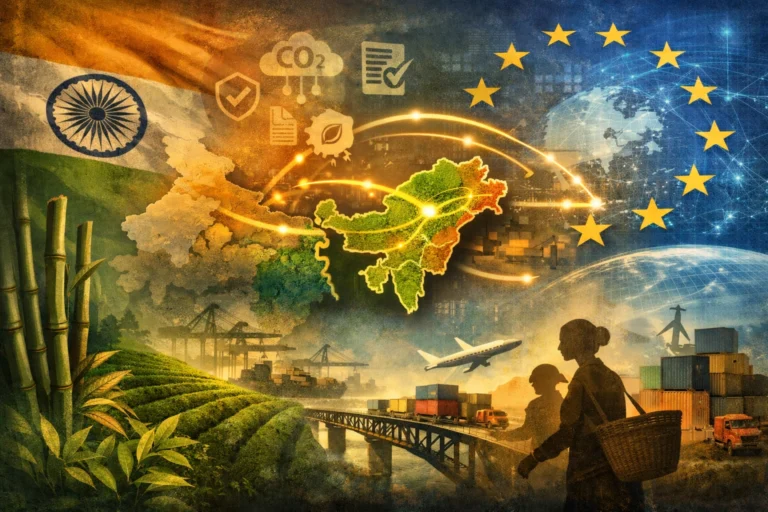
Having arrived in Assam on 8 June, the European Union’s Ambassador to India, Hervé Delphin, along with a high-level Team Europe delegation of ambassadors, business leaders, policymakers, and institutional representatives, spent two days engaging with government officials, entrepreneurs, industry stakeholders, and development partners across Northeast India.
This was not a ceremonial visit.
It was a signal.
The delegation’s agenda centred on strengthening trade, investment, sustainability, and value-chain partnerships between the European Union and the eight states of Northeast India.
At the heart of the engagement was the launch of Assam’s first Blue Valley Cluster—an industrial ecosystem focused on fragrances, flavours, AYUSH, food processing, and natural ingredients.
The Bhoomi Poojan of the INLAMOBI Fragrances and Cosmetics Pilot Project marked the first visible step in what could become a larger architecture linking European markets, Northeast Indian producers, and emerging sustainable value chains.
Europe has noticed something that much of India is only beginning to recognise.
Northeast India is no longer a peripheral geography.
It is becoming an increasingly important economic geography. The question is whether the region is ready to respond.
What This Article Covers
- Why the European Union delegation’s visit matters for Northeast India
- The significance of Assam’s Blue Valley Cluster
- Northeast India’s emerging role in global value chains
- Why geography alone cannot create economic prosperity
- The region’s strongest export opportunities
- The importance of trade literacy and export readiness
- Why The Quantiq is launching Export Northeast
A Region Standing Beside Opportunity
India today participates in a growing network of trade agreements that connect Indian businesses to major markets across Asia, the Middle East, and Oceania.
These agreements are not merely diplomatic instruments. They are practical frameworks that can reduce tariffs, improve market access, and create competitive advantages for businesses capable of meeting international requirements.
Yet a striking paradox sits at the heart of Northeast India’s economic story.
Few regions of India are as strategically positioned as Northeast India.
ASEAN economies such as Myanmar, Thailand, Vietnam, Malaysia, Singapore, and Indonesia lie within the broader geography that India’s Act East Policy seeks to connect.
Meanwhile, Bangladesh shares borders with several northeastern states and remains one of India’s most important trading partners. Bhutan and Nepal also form part of the wider neighbourhood shaping the region’s economic future.
Geography, in other words, has given Northeast India a natural advantage. However, geography alone does not create prosperity.
Trade Agreements Create Opportunity—Not Exports
Trade agreements do not create exports.
Products do.
Brands do.
Quality does.
Trust does.
A tariff concession can lower the cost of entering a market. However, it cannot persuade a buyer in Tokyo, Berlin, Dubai, or Singapore to choose one supplier over another.
That distinction matters because Northeast India’s challenge is not simply one of market access. The deeper challenge is converting local strengths into globally competitive products, internationally recognised standards, and trusted brands.
The Resources Exist. The Systems Must Follow.
The common assumption is that Northeast India lacks exportable products.
The evidence points in the opposite direction.
The region produces Muga silk, one of the rarest natural fibres in the world. It grows Eri silk, Lakadong turmeric, Assam Orthodox Tea, Naga Mircha, Manipuri Black Rice, agarwood, medicinal plants, aromatic crops, essential oils, and a remarkable range of bamboo-based products.
Many of these already possess strong stories of origin, cultural heritage, and natural differentiation that global consumers increasingly value.
The Blue Valley initiative itself reflects this reality.
Fragrances, flavours, wellness products, natural ingredients, sustainable textiles, and bio-based manufacturing are not sectors being explored out of charity or sentiment.
They are sectors where global markets are actively searching for reliable, sustainable, and diversified supply chains.
Northeast India possesses many of the raw ingredients required to participate. The challenge is building the systems that transform those ingredients into sustained economic value.https://thequantiq.com/industrial-hemp-northeast-india-slow-fashion/
The Age of Process Intelligence
For generations, development conversations in resource-rich regions have focused primarily on what a place possesses.
The twenty-first century rewards something different.
In an era defined by artificial intelligence, advanced logistics, global certification systems, and increasingly sophisticated consumers, the real competitive advantage lies in process intelligence.
A region may possess exceptional raw materials.
However, value is created when those materials are transformed into products that are consistent, certified, traceable, and trusted.
Two regions may grow the same crop.
One exports a commodity.
The other exports a premium brand.
The difference is not the resource itself.
The difference is the system built around it.
This is where Northeast India’s next economic chapter may be written.
The region’s future will not be determined solely by what it grows, mines, harvests, or produces. Instead, it will increasingly be determined by how effectively it converts those strengths into globally competitive enterprises.
Understanding the Rules of Trade
One of the least discussed barriers facing aspiring exporters is not finance, infrastructure, or even market demand.
It is knowledge.
Across Northeast India, countless entrepreneurs, cooperatives, self-help groups, farmer-producer organisations, and small businesses produce goods with genuine export potential.
Yet many remain unfamiliar with the basic language of international trade.
Terms such as Free Trade Agreements, Rules of Origin, and Certificates of Origin rarely feature in everyday business conversations.
Yet these concepts can determine whether an exporter gains preferential market access or pays the full cost of entry.
Rules of Origin, for example, determine whether a product genuinely qualifies for preferential treatment under a trade agreement.
Certificates of Origin provide documentary proof of that eligibility.
Without the necessary documentation, even products that qualify may lose access to available benefits.
The gap between India signing a trade agreement and a producer in Sualkuchi, Dimapur, Aizawl, Imphal, Shillong, Gangtok, or Itanagar successfully exporting under that agreement is often a gap of awareness, institutions, and access.
In many cases, it is not a policy problem.
It is a knowledge problem.
The Corridor Waiting to Be Activated
More than a decade after the launch of the Act East Policy, Northeast India’s position as a gateway to Southeast Asia remains a work in progress.
Connectivity projects continue to advance.
Border trade points continue to evolve.
New economic corridors continue to be discussed.
Progress has been visible.
However, the full potential of the region’s location has yet to be realised.
What makes the European engagement significant is that it introduces another layer to this conversation.
Europe is not looking at Northeast India merely as a frontier market.
It is examining the region as a potential participant in future value chains linked to sustainability, natural ingredients, wellness products, food processing, green manufacturing, and bio-based industries.
Those happen to be areas where Northeast India already possesses distinctive strengths. The challenge is ensuring that the region participates as a creator of value rather than simply a supplier of raw materials.
Introducing Export Northeast
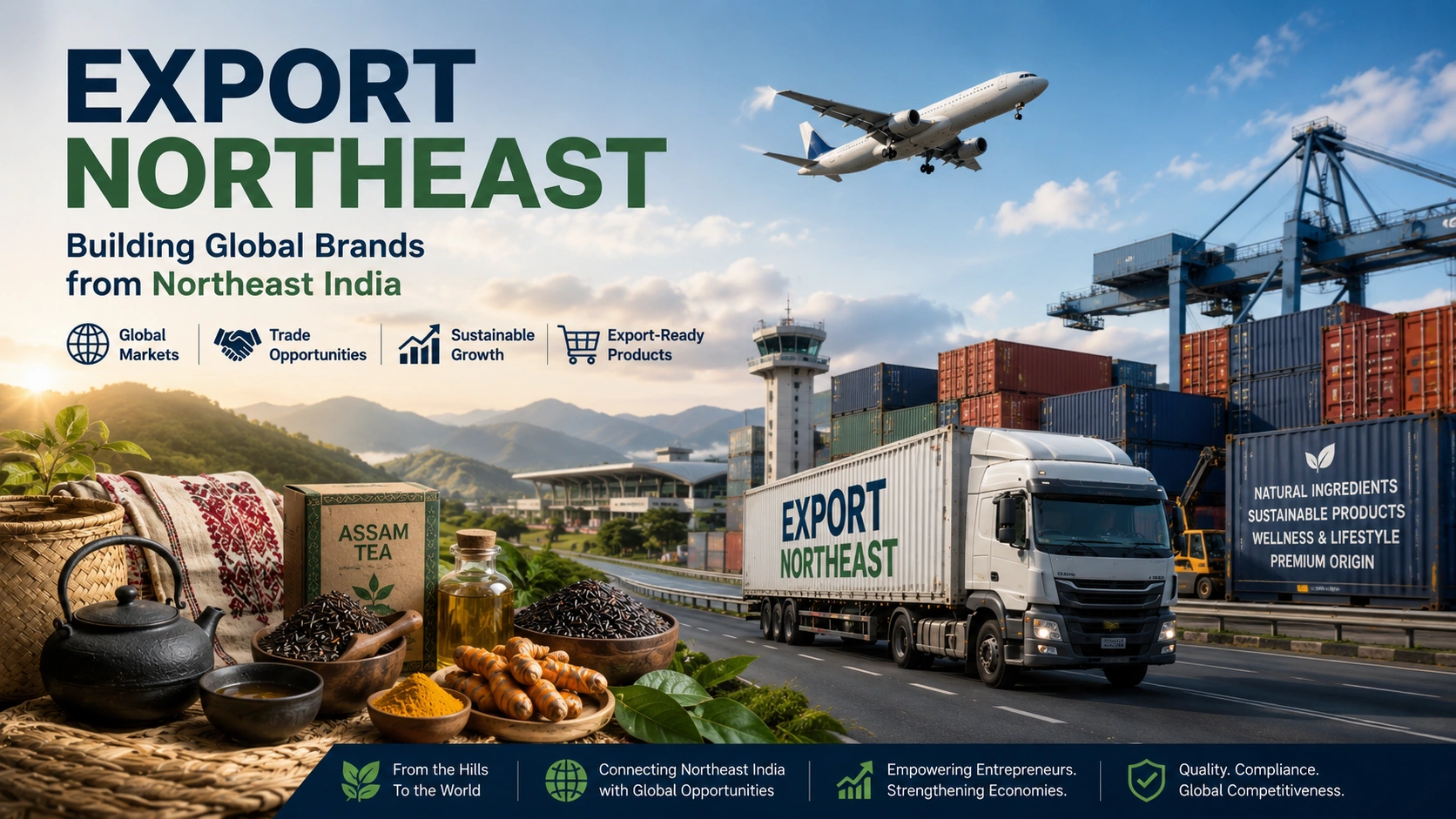
Today, The Quantiq formally launches Export Northeast, a new editorial initiative within our broader Northeast Renaissance framework.
This initiative begins with a simple belief.
The future of Northeast India will not be shaped solely by public investment, infrastructure projects, or policy announcements.
It will increasingly be shaped by entrepreneurs, producers, innovators, cooperatives, and businesses capable of building products and brands that can compete beyond the region’s borders.
Over the coming months, this series will explore:
- The fundamentals of international trade
- Export opportunities emerging across global markets
- The role of trade agreements
- Compliance and certification requirements
- Border infrastructure and logistics
- Export readiness for MSMEs and startups
- Global branding strategies
- Building internationally recognised origin-based brands
The series will also accompany The Quantiq’s exploration of TradeIQ NE, a proposed trade intelligence platform designed to simplify export information for MSMEs, startups, self-help groups, farmer-producer organisations, and first-generation entrepreneurs across the region.
The objective is straightforward.
To make international trade more understandable, more accessible, and ultimately more useful for the people who create value on the ground.
The Signal From Today
Europe is not engaging with Northeast India because it is fashionable.
It is engaging because it sees opportunity.
The region offers natural ingredients that global industries increasingly require, sustainable supply chains, growing manufacturing potential, and a combination of biodiversity, cultural capital, and strategic geography that few regions can match.
Above all, Europe sees a region whose strengths are becoming increasingly relevant in a world searching for resilience, sustainability, and diversification. https://thequantiq.com/bamboo-biochar-carbon-economy-northeast-india/
Frequently Asked Questions
Why did the EU delegation visit Assam?
The delegation visited Assam and Northeast India to explore opportunities in trade, investment, sustainability, industrial collaboration, and emerging value chains linked to natural ingredients, wellness products, and green manufacturing.
What is the Blue Valley Cluster?
The Blue Valley Cluster is a new industrial ecosystem focused on fragrances, flavours, AYUSH products, food processing, natural ingredients, and sustainable manufacturing.
What products from Northeast India have export potential?
Muga silk, Eri silk, Lakadong turmeric, Assam Orthodox Tea, Naga Mircha, Manipuri Black Rice, agarwood products, medicinal plants, essential oils, bamboo products, and wellness-oriented natural ingredients all possess significant export potential.
What is Export Northeast?
Export Northeast is The Quantiq’s editorial initiative dedicated to trade literacy, export readiness, market access, international trade, and global business opportunities for Northeast India.
Why is export readiness important?
Export readiness helps businesses meet international quality standards, certification requirements, compliance regulations, and buyer expectations necessary to compete successfully in global markets.

3 Comments