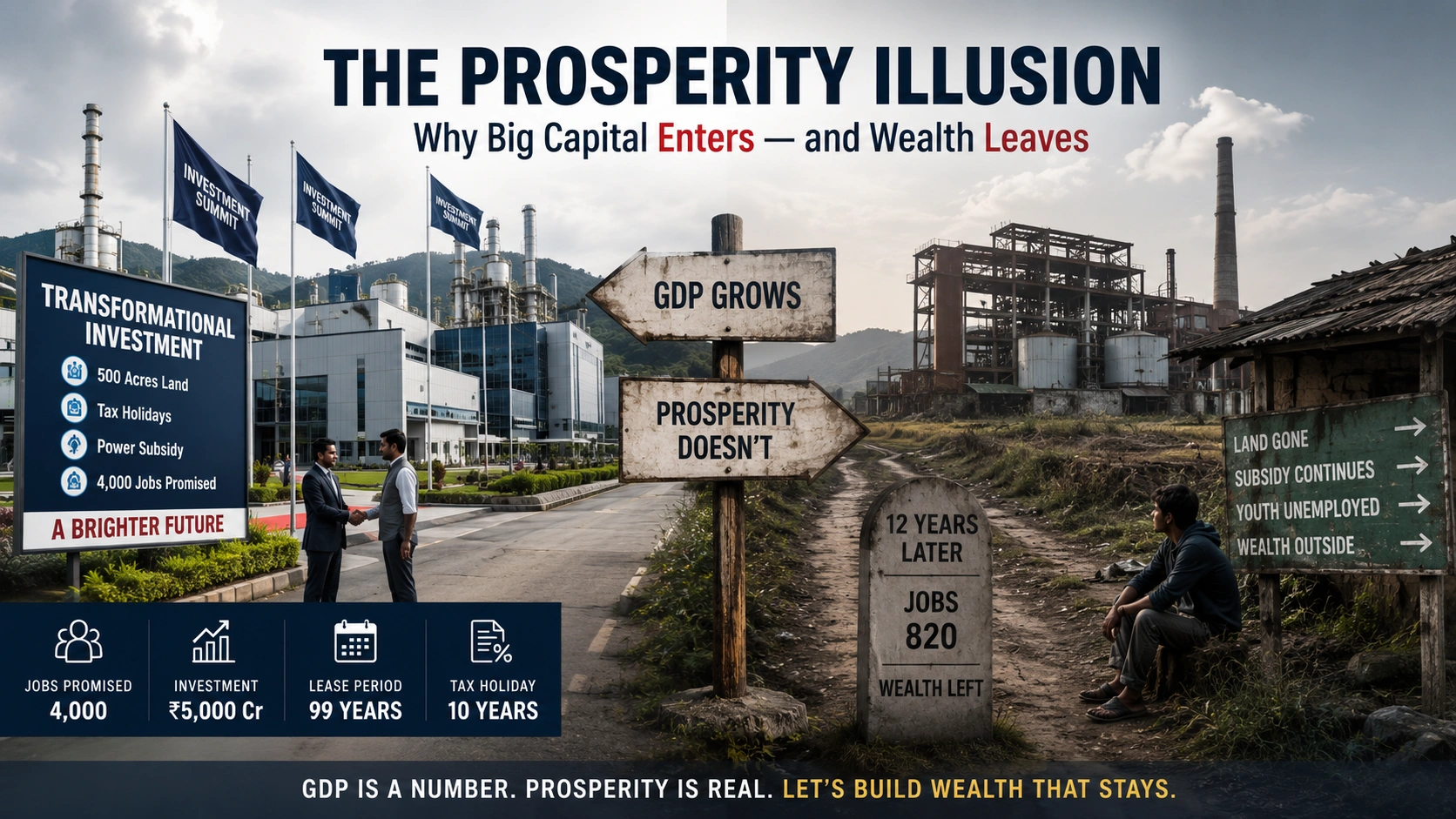
The Prosperity Illusion: Why Big Capital Enters — and Wealth Leaves
Across developing economies, a familiar story plays out repeatedly.
A government announces a major investment partnership with a large corporation. Land is allocated at concessional rates. Tax incentives are extended. Infrastructure support is prioritised. Subsidised power and regulatory clearances are often built into the larger package. Public messaging quickly frames the development as a transformational economic milestone.
The promise is usually compelling.
Large-scale employment will be created. Industrial growth will accelerate. Regional prosperity will improve. A new development era, citizens are told, has finally arrived.
Yet the long-term outcomes often reveal a more complex reality.
Years later, the number of actual jobs may fall far short of original projections. Automation reduces labour demand faster than expected. Highly skilled positions are frequently filled by professionals from outside the region. Profits generated by the enterprise move to corporate headquarters located elsewhere. Meanwhile, long-term concessions involving land, subsidies, and public infrastructure commitments remain in place.
And yet, on paper, everything still appears successful.
Investment figures look impressive. GDP rises. Growth statistics create the appearance of economic progress.
This is where one of the most misunderstood questions in development economics begins.
Economic growth does not automatically translate into broad-based local prosperity.
For emerging regions such as Northeast India, understanding this distinction is increasingly important. The difference between economic activity and actual wealth retention may determine whether development strengthens local communities or gradually transfers value away from them over time.https://thequantiq.com/inlamobi-blue-valley-cluster-northeast-entrepreneurs/
Why GDP Alone Does Not Tell the Full Story
Across the world, Gross Domestic Product remains one of the most widely used indicators of economic success. At the state level in India, Gross State Domestic Product serves the same purpose.
The logic seems straightforward.
If economic activity rises, prosperity should naturally improve.
However, this assumption deserves closer examination.
GDP measures the value of economic activity occurring within a geographical boundary. What it does not fully capture is who controls the economic value being created and where that value ultimately flows after the activity has been recorded.
This distinction becomes particularly important for regions that depend heavily on external capital.
Consider the arrival of a large industrial project in an economically developing region. Governments may provide land on concessional terms, offer tax exemptions, subsidise electricity, and build supporting infrastructure such as roads, water systems, and power connectivity.
At first glance, this appears to represent successful development planning.
However, the underlying economic structure can produce very different outcomes.
Senior management positions often go to professionals recruited externally. Critical procurement systems may remain linked to supply chains located outside the host region. Corporate profits are generally accounted for at headquarters situated in entirely different economic centres.
The region hosting the investment supports the infrastructure.
The corporation frequently retains a significant portion of long-term economic value.
That distinction matters enormously.
A rising GDP figure may indicate growing economic activity, but it does not necessarily guarantee that wealth remains within the local economy.
Economic activity is visible.
Long-term wealth retention is far less visible.
Yet both determine the real quality of development.
The Economic Balance Sheet That Deserves Greater Attention
Large investment announcements usually focus on projected benefits.
Employment generation receives major attention. Investment size dominates headlines. Public communication often highlights economic transformation and future prosperity.
However, long-term evaluation rarely receives equal attention.
Over time, several important questions naturally emerge.
What level of tax revenue has been forgone through long-duration incentive packages? How much public capital has been invested in infrastructure support surrounding the project? What is the cumulative cost of electricity subsidies, land concessions, and administrative support extended over several years?
Most importantly, how much of the economic value created by the project remains within the local economy after operations stabilise?
These questions deserve careful examination because investment incentives are never cost-free.
Every concession involves opportunity cost.
Public resources allocated to industrial support could also strengthen education systems, healthcare infrastructure, entrepreneurship support mechanisms, research institutions, or local business ecosystems.
The objective here is not to question industrial investment itself.
Rather, it is to encourage a broader understanding of development economics.
As regions compete more aggressively for external capital, it becomes increasingly important to examine not only how much investment enters a region, but also how effectively long-term value remains embedded within local communities.
This distinction may shape future development outcomes more than headline investment figures alone.
Why Existing Development Models May Need Recalibration
For several decades, regions such as Northeast India have largely pursued development through a familiar framework.
The strategy has been relatively consistent.
Attract outside capital. Build industrial infrastructure. Offer incentive packages. Encourage large-scale investment and allow growth momentum to drive prosperity.
In many situations, this model has generated visible economic activity.
However, development economics is becoming more nuanced.
A region may experience rising GDP while significant portions of the wealth created continue flowing outward through corporate structures, external supply chains, and ownership systems located elsewhere. Industrial activity may expand while local economic resilience remains weaker than expected.
This creates an important question for the future.
Should development be measured only by the amount of capital entering a region, or should equal attention be given to how much long-term value remains within local communities?
This is not an argument against industrial investment.
Large-scale investment remains important for economic growth, employment generation, and infrastructure expansion.
However, future development frameworks may benefit from broader evaluation metrics.
The quality of development cannot depend solely on investment volume.
It must also consider ownership patterns, local wealth creation, community participation, and long-term economic resilience.
Without measuring both sides of that equation carefully, regions may eventually discover that economic growth and sustainable prosperity are not always identical outcomes.
And sometimes, prosperity can appear stronger on paper than it actually becomes on the ground.
Why Distributed Entrepreneurship Often Creates Deeper Prosperity
Large investment projects are frequently associated with large prosperity outcomes. At first glance, this assumption appears reasonable. A corporation invests hundreds or even thousands of crores, large facilities are built, production expands, and economic activity increases significantly.
However, economic output and wealth distribution do not always follow the same pattern.
Consider a simple comparison.
Imagine a large industrial plant generating annual revenue of ₹500 crore. It may create several hundred direct jobs and contribute meaningfully to regional economic activity. The contribution to GDP would certainly be visible and measurable.
Now compare this with a very different model.
Imagine five hundred locally owned enterprises, each generating annual revenue of ₹1 crore. The total economic output remains the same, yet the underlying economic structure changes dramatically.
In a distributed enterprise model, ownership remains local. Supply chains tend to remain local. Consumption patterns strengthen local markets. Profits are more likely to be reinvested within the same economy, creating secondary businesses, employment opportunities, and stronger long-term wealth circulation.
The difference becomes more visible over time.
A region supported by distributed entrepreneurship gradually builds economic resilience because wealth continues circulating internally. By contrast, economies that depend heavily on concentrated external capital often remain vulnerable to decisions made outside the region.
The distinction is important.
One model creates economic activity.
The other helps create economic strength.
And the difference between those two outcomes deserves far greater attention in future development planning.
Why Capital Access May Be Northeast India’s Most Important Missing Infrastructure
Infrastructure is usually understood in physical terms.
Road networks, airports, industrial parks, electricity systems, logistics corridors, and digital connectivity are widely recognised as development priorities.
All of them matter.
However, entrepreneurship-led development depends on another form of infrastructure that often receives far less attention.
That infrastructure is capital.
More specifically, early-stage growth capital.
Across Northeast India, thousands of young entrepreneurs possess promising ideas and deep understanding of local markets. Many are building businesses connected to agriculture, food processing, handloom, tourism, design, logistics, regional products, and emerging digital services.
Yet a recurring pattern remains visible.
Many promising enterprises struggle long before reaching sustainable scale.
In many cases, the problem is not talent or market understanding.
The challenge is capital access during the most vulnerable growth stage.
Traditional bank financing often requires collateral that first-generation entrepreneurs cannot provide. Government-backed loan schemes support micro-enterprises, but scaling businesses frequently require capital structures that extend beyond conventional lending systems.
Private venture capital, meanwhile, remains concentrated largely in metropolitan startup ecosystems.
This creates an important imbalance.
Large external investments often receive substantial institutional support because they promise visible economic activity. At the same time, many local entrepreneurs continue facing significant challenges while seeking comparatively smaller amounts of capital that could generate long-term local value.
This suggests an important opportunity for policy innovation.
Regions serious about entrepreneurship-led growth may benefit from building stronger early-stage capital ecosystems designed specifically for local enterprise creation.
Because in a healthy economy, access to entrepreneurial capital is not simply financial support.
It is development infrastructure.
Building Better Entrepreneurship Ecosystems Requires Structural Thinking
Entrepreneurship ecosystems across India have evolved significantly over the past decade. Startup missions, incubation centres, innovation challenges, mentorship platforms, and institutional support systems have expanded rapidly.
This progress is encouraging.
However, one important question deserves continued reflection.
What kind of ecosystem design produces durable businesses rather than temporary activity?
Entrepreneurship is fundamentally different from conventional institutional management. Building a business requires navigating uncertainty continuously. Customer behaviour changes unexpectedly. Products fail without warning. Revenue projections shift. Competitive pressure intensifies. Operational challenges emerge suddenly and demand immediate adaptation.
Successful entrepreneurs learn to operate under constant uncertainty.
This experience creates a very different understanding of risk, resilience, and business survival.
As entrepreneurship ecosystems mature further, one opportunity lies in ensuring that experienced founders, operators, and business builders play a larger role in shaping mentorship systems, capital allocation frameworks, and institutional support mechanisms.
The objective should move beyond activity measurement alone.
The focus should increasingly shift toward enterprise durability, long-term revenue generation, employment creation, and sustainable business survival.
Strong ecosystems do not merely produce startup events.
They help create enduring companies.
And for emerging regions, that distinction matters enormously.
What a More Resilient Prosperity Model Could Look Like
If future development models are evolving, then economic frameworks must evolve alongside them.
For regions such as Northeast India, the central challenge may no longer be attracting investment alone.
The larger challenge is designing systems that ensure long-term prosperity remains embedded within local communities.
This may require rethinking development architecture in several important ways.
The first priority is improving long-term economic evaluation.
Large investment agreements could increasingly benefit from periodic review mechanisms that examine employment generation, local supply-chain participation, fiscal impact, infrastructure burden, and long-term wealth retention.
The second priority is strengthening capital access for local entrepreneurs.
Dedicated early-stage funding ecosystems, blended finance structures, micro-equity mechanisms, and patient capital models could significantly improve survival rates for promising enterprises during their most vulnerable growth stage.
The third priority involves strengthening entrepreneurship support systems themselves.
Innovation ecosystems may create stronger outcomes when experienced founders and business builders play a larger role in mentoring, institutional design, and long-term strategic guidance.
Finally, the broader development conversation itself may need expansion.
For many years, economic policy discussions have focused primarily on one question.
How do we attract more external capital?
Perhaps an equally important question now deserves greater attention.
How do regions build stronger internal capacity to generate, retain, and compound wealth over time?
The difference between these two approaches is profound.
One focuses primarily on economic activity.
The other focuses on long-term economic sovereignty.
And both deserve balanced consideration.
Northeast India Already Possesses Extraordinary Economic Potential
Northeast India is often described primarily through the language of economic underdevelopment.
This perspective misses a larger reality.
The region possesses remarkable long-term economic strengths. Its biodiversity is globally significant. Agricultural diversity remains exceptional. Traditional craftsmanship and handloom ecosystems carry enormous value. Tourism potential remains substantial. Cultural capital is uniquely rich. Young entrepreneurial talent is increasingly visible across multiple sectors.
The challenge is not the absence of opportunity.
The challenge lies in building systems capable of converting this potential into sustained economic value.
Future development strategies may therefore benefit from balancing external capital attraction with stronger internal capability building.
Overdependence on imported capital can gradually weaken local economic resilience if entrepreneurship ecosystems remain underdeveloped.
Long-term prosperity becomes stronger when communities themselves begin owning a larger share of economic value creation.
That transition requires patience, institutional innovation, and a willingness to refine development frameworks continuously.
But the long-term benefits can be transformative.https://thequantiq.com/northeast-india-exports-global-opportunity/
The Larger Truth About Development
Economic development should not be measured only by the amount of capital entering a region.
That measure remains important, but it is incomplete on its own.
A more meaningful question may be whether communities themselves become stronger because of economic activity taking place around them.
Do local businesses expand sustainably?
Are young entrepreneurs able to build durable enterprises?
Does ownership remain within the regional economy?
Does wealth circulate locally for long periods rather than moving outward immediately?
Do communities become economically more resilient over time?
These questions reveal a deeper understanding of prosperity.
For regions such as Northeast India, this distinction may become increasingly important in the decades ahead.
The future cannot depend exclusively on attracting external capital while assuming prosperity will automatically follow.
Real prosperity becomes stronger when local economies begin owning larger portions of their own growth engines.
When businesses are built locally, profits circulate locally. Communities reinvest in themselves. Economic resilience strengthens gradually and compounds over time.
This is how durable prosperity is created.
GDP growth may signal economic momentum.
But long-term prosperity depends on whether that growth leaves lasting value behind.
And unless that distinction is understood clearly, prosperity itself can sometimes become an illusion.
Perhaps one of the most important economic illusions developing regions must now begin examining more carefully.https://thequantiq.com/bamboo-biochar-carbon-economy-northeast-india/