
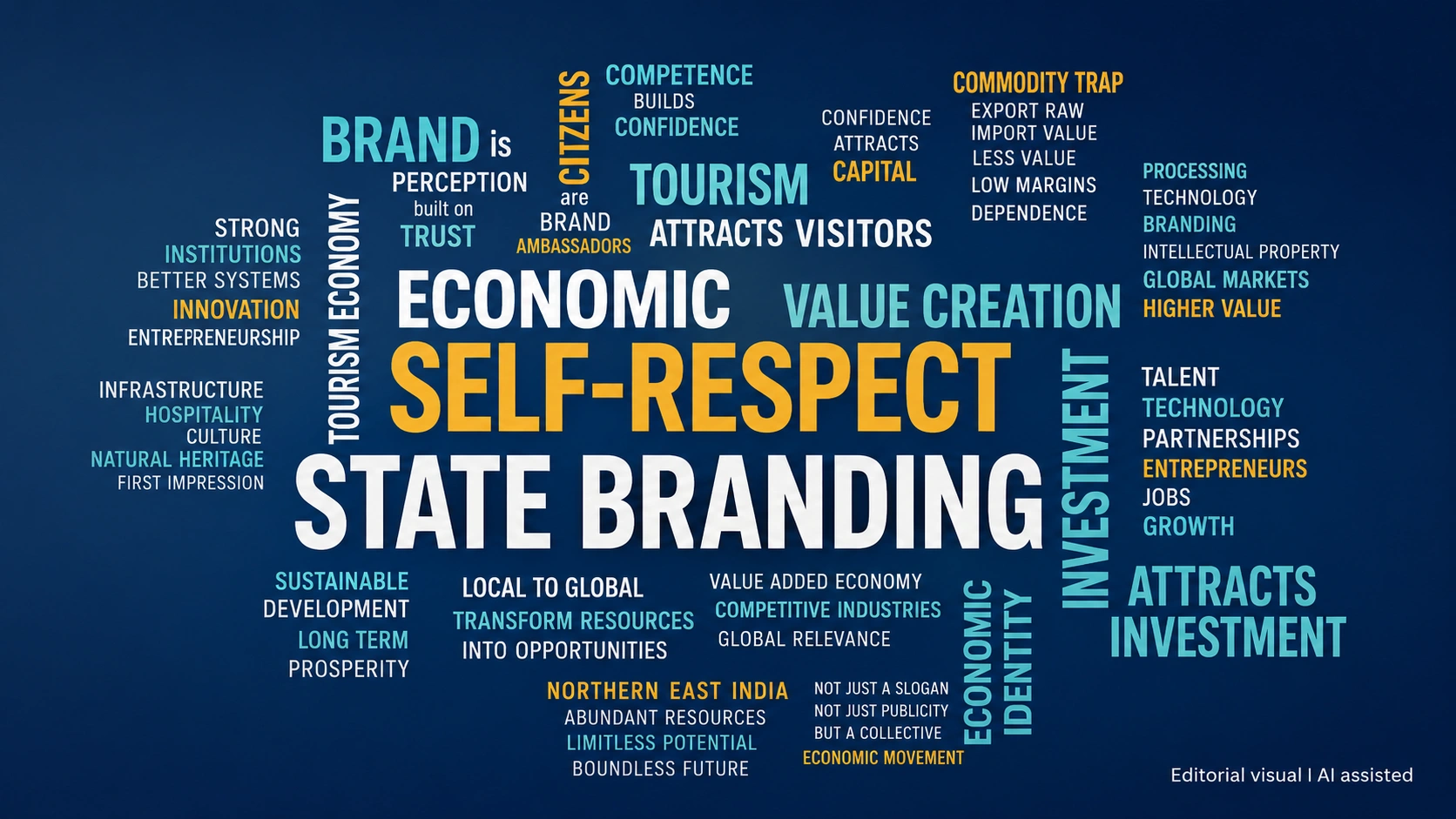
A State Is a Brand: Why Tourism May Bring Visitors, But Economic Self-Respect Builds the Future
What a Brand Really Means
Conversations around branding often begin at the wrong place. We tend to assume that a brand is a logo, a slogan, an attractive package, or perhaps a visually appealing marketing campaign designed to create instant recognition. In reality, branding runs far deeper than design language or promotional creativity.
A brand is essentially perception accumulated over time. It is the trust people develop after repeatedly experiencing the quality, values, reliability, and identity associated with an institution, a company, a product. Or increasingly, even a place. The same principle that governs corporate branding applies equally to nations, cities, and perhaps more importantly, states.
Rethinking the State as a Brand
When we begin looking at a state as a brand, the entire conversation changes. The question is no longer whether a tourism department has created a catchy campaign. Or whether promotional materials successfully highlight scenic beauty and cultural heritage. The more important question is far more strategic and deserves deeper reflection: what comes to people’s minds when they hear the name of a place?
The Assam Example
Take Assam as an example. For decades, the external identity of Assam has largely revolved around tea gardens, the one-horned rhinoceros, the mighty Brahmaputra, cultural festivals, biodiversity, and scenic landscapes. These undoubtedly remain powerful assets and deserve recognition. Yet the uncomfortable question worth asking is whether these alone define the future economic identity of the state.
A modern state cannot build a globally respected brand solely around what nature has gifted it. The true brand of a state is ultimately determined by the systems it builds, the enterprises it nurtures, the confidence it inspires among investors, the innovation it encourages. And the quality of institutions capable of creating long-term value. In an era increasingly shaped by artificial intelligence, technology disruption, and borderless competition, historical identity alone cannot guarantee future relevance.
Branding Cannot Be Outsourced
Unlike corporate branding, state branding cannot be outsourced to advertising agencies or communication consultants. Every citizen contributes to building the reputation of a place. Every entrepreneur building a successful enterprise strengthens that identity. Every teacher shaping future talent, every researcher expanding knowledge, every artist carrying cultural influence, every bureaucrat ensuring efficient governance. And every worker contributing productively to the economy becomes a brand ambassador, whether consciously or unconsciously. A state’s brand is therefore nothing less than the cumulative outcome of millions of everyday actions.
Tourism as the First Gateway
Among all sectors capable of influencing perception, tourism occupies a uniquely powerful position. Because tourism often becomes the first gateway through which the outside world experiences a region. Visitors do not simply observe landscapes or consume hospitality services. They experience public infrastructure, transportation systems, service standards, cleanliness, safety, entrepreneurial energy, governance efficiency. And the overall confidence with which a society functions. Tourism, therefore, becomes the first real-world demonstration of how a state actually performs beyond its brochures.https://thequantiq.com/assam-europe-tourism-opportunity-sustainable-tourism/
Tourism vs. Branding
This distinction becomes economically significant. Because tourism and branding, though connected, are not identical. Tourism attracts visitors. But a strong state brand attracts investment. Every visitor who leaves with confidence in the systems and capabilities of a region unconsciously begins validating that region’s economic credibility. Investors rarely study opportunities through balance sheets alone. They observe ecosystems, institutional maturity, and the signals that indicate whether a place possesses long-term economic seriousness.
The Commodity Trap
Unfortunately, many developing economies continue ignoring a structural problem that has quietly trapped them for decades. Economists often describe this as the commodity trap. Regions rich in natural resources continue exporting raw materials. While importing finished products at significantly higher value. Agricultural abundance is celebrated, mineral extraction becomes a source of pride. And resource ownership is mistaken for economic strength. Yet the larger profits consistently flow toward those controlling processing, manufacturing, technology, branding, intellectual property, and global distribution networks.
No Global Respect Without Value Creation
This is precisely where the conversation around branding begins to reveal deeper contradictions. No region can command long-term global respect if its economic identity remains centered around supplying raw materials. While others capture the greater share of value. A place cannot aspire to become globally relevant. While remaining satisfied exporting unprocessed produce and celebrating extraction-based economics as a symbol of success. The world rarely rewards suppliers of commodities. It consistently rewards creators of value.
Natural Abundance Is Not Enough
At times, we seem to assume that repeatedly showcasing what naturally grows within our borders automatically communicates economic strength to the outside world. Yet serious investors rarely evaluate a region based on what it produces naturally. They pay far closer attention to what that region is capable of transforming through enterprise, innovation, manufacturing capability, technological sophistication. And value addition. Economic potential is not communicated through repetition alone.
Sometimes, a thoughtfully crafted sentence backed by visible industrial capability communicates far more than excessive attempts to repeatedly showcase natural abundance. The world does not judge a region merely by what grows in its soil. It judges whether that region has developed the confidence, competence, and ambition to transform those resources into globally competitive industries capable of generating sustained economic value.
What Determines Economic Relevance
This leads to an uncomfortable but necessary truth. Nobody takes a region seriously if its long-term economic identity remains dependent on exporting fresh agricultural produce, raw materials, and unprocessed resources. While others build industries around processing technology, design systems, branding architecture, intellectual property, and integrated supply chains. Economic relevance is rarely determined by what a region possesses naturally. It is determined by what a region chooses to build.https://thequantiq.com/japan-investment-northeast-india-analysis/
Tourism as an Entry Point
This is precisely why tourism deserves to be viewed differently. Tourism is not merely an industry contributing to employment generation or visitor spending. Tourism can become the entry point for a much larger state branding strategy. Because it allows a region to demonstrate competence. Competence builds trust. And trust eventually attracts capital. Places such as Singapore and the United Arab Emirates did not become globally respected economic centers merely because they marketed attractions successfully. They built systems that consistently inspired confidence among investors, entrepreneurs, businesses, and global institutions.
The Northeast India Question
This conversation becomes even more relevant for Northeast India. For decades, the region has successfully marketed beauty, culture, biodiversity, and tourism potential. Yet beauty alone does not create economic transformation. The larger question before the region is no longer how to attract more visitors. The more urgent question is how to move from being resource suppliers to becoming creators of globally respected value. The future of the Northeast will not be determined by how effectively it markets natural abundance. It will be determined by whether it builds industries capable of transforming that abundance into innovation-driven economic power.https://www.mdoner.gov.in/
Self-Reliance or Self-Respect?
Perhaps this also forces us to rethink another phrase frequently used in development conversations. Governments often speak about economic self-reliance as though producing more within domestic boundaries automatically guarantees progress. Yet perhaps the deeper issue is not economic self-reliance. The more important question may actually be one of economic self-respect. A society begins losing economic self-respect when it becomes comfortable allowing others to capture disproportionate value from resources it naturally possesses. The day a region accepts that its role is merely to extract, export, and remain positioned at the bottom of global value chains, it quietly begins surrendering control over its own economic destiny. Dependence is not always externally imposed. Sometimes it becomes psychologically normalized. And that normalization slowly weakens collective confidence.
The Lesson of History
History repeatedly teaches a simple lesson. The moment societies lose self-respect, they eventually lose far more than economic opportunity. They lose bargaining power, confidence, relevance, and ultimately the ability to shape their own future on their own terms. Economic dignity, therefore, must precede economic prosperity
Competing for the Future
In the decades ahead, states will compete not merely for tourists. But for talent, capital, technology partnerships, entrepreneurs, manufacturing ecosystems, and global relevance. The future winners will not necessarily be regions possessing the largest natural resources. They will be regions possessing the strongest economic identity and the courage to build value rather than merely supply resources.
State Branding as a Collective Movement
In that sense, state branding is not a marketing exercise. It is not about slogans, publicity campaigns, or promotional visibility. State branding is a collective economic movement where every citizen becomes a contributor to the reputation of the place they belong to. The future belongs to societies that understand a simple but uncomfortable truth: tourism may introduce a region to the world, investment determines whether the world takes that region seriously. But only innovation, value creation, and economic self-respect can build a brand powerful enough to command lasting relevance.
Because when societies lose economic self-respect, they eventually lose everything else that truly matters.




One Comment