
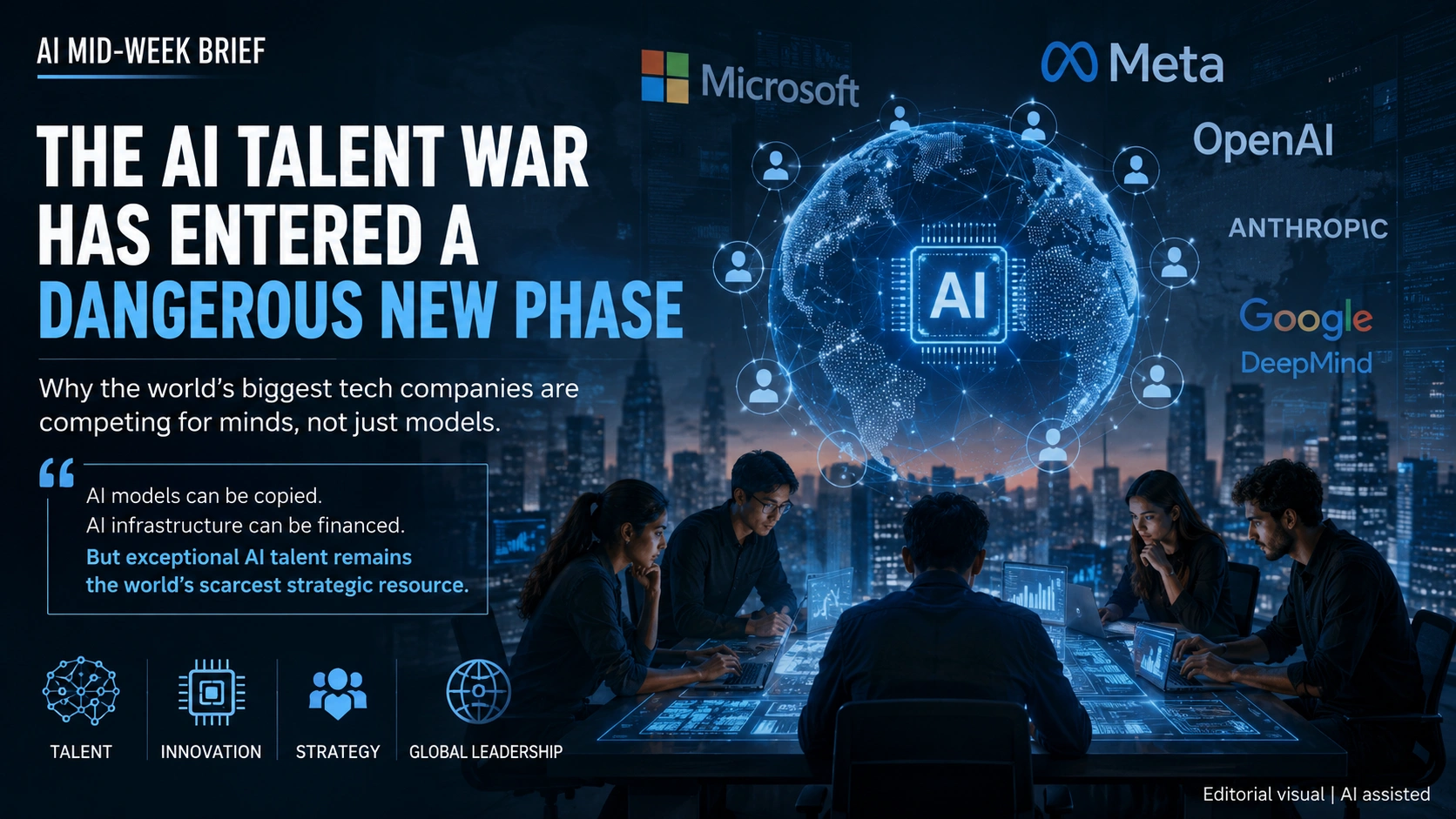
AI Mid-Week Brief: The AI Talent War Has Entered a Dangerous New Phase
AI models can be copied. AI infrastructure can be financed. But exceptional AI talent remains the world’s scarcest strategic resource.
When ChatGPT captured the world’s imagination in late 2022, artificial intelligence suddenly became part of everyday conversation. Every few weeks seemed to bring another breakthrough, whether it was a larger language model, a faster image generator or a more capable AI assistant. Success was largely measured by benchmark scores, model sizes and an ever-expanding list of new features.
Less than four years later, the conversation is beginning to change. The biggest story in artificial intelligence is no longer confined to technology itself. Behind every new model announcement lies a much quieter but far more significant battle for the people capable of building the next generation of AI.
Today, the world’s leading technology companies are competing not only for customers but also for exceptional scientists, engineers and researchers. These are the individuals designing new model architectures, improving reasoning capabilities, developing safer AI systems and solving problems that cannot yet be automated. In many respects, they have become the most valuable asset in the global AI economy.
Recent developments illustrate this shift. Microsoft has continued restructuring parts of its workforce while sustaining enormous investments in artificial intelligence. Meta is reorganising around AI and committing unprecedented resources to research and infrastructure. Anthropic continues strengthening its research teams, while several leading AI companies are increasingly deploying elite engineers directly inside customer organisations to accelerate enterprise adoption.
Taken together, these developments point to a larger transformation. The global AI race is no longer defined solely by who builds the most powerful model. It is increasingly being shaped by who can attract, develop and retain the world’s brightest minds.
The first phase of the AI revolution rewarded companies that built remarkable models. The next phase will reward those that build remarkable teams—and that distinction could determine which companies, and even which nations, lead the AI economy over the coming decade
The New Gold Rush Isn’t for Data—It’s for Minds
Every industrial revolution has been shaped by a resource that determined who would lead and who would follow. Coal powered the Industrial Revolution, oil transformed the twentieth century, and data became the fuel of the digital economy. Each era rewarded those who controlled its most valuable asset.
Artificial intelligence is creating a different reality. Data, computing power and advanced chips remain indispensable, but they are no longer the only scarce resources. Increasingly, the greatest constraint on AI innovation is the availability of people capable of pushing the boundaries of machine intelligence.
That scarcity explains why elite AI researchers have become some of the most sought-after professionals in the world. These specialists are far more than software engineers. Their expertise spans mathematics, computer science, optimisation, neuroscience and large-scale systems engineering. Their research shapes everything from model architecture and training efficiency to AI safety, reasoning capabilities and multimodal intelligence.
As a result, technology companies are no longer recruiting simply to expand their workforce. They are competing for individuals who can fundamentally change the direction of an organisation’s AI strategy. Recent movement of senior researchers between Google DeepMind, OpenAI and Anthropic demonstrates just how competitive this market has become.
The global AI race, therefore, is no longer only a contest between companies with deeper pockets or better infrastructure. Increasingly, it is becoming a contest between teams capable of producing breakthrough ideas that cannot easily be replicated.https://thequantiq.com/un-warns-ai-risks-india-ai-semiconductor-push/
Why Elite AI Talent Has Become a Strategic Asset
Artificial intelligence has dramatically reduced the time required to write software, analyse information and generate content. Ironically, however, the same technology is making exceptional human expertise even more valuable.
Once a breakthrough AI model or algorithm becomes public, competitors often find ways to reproduce or improve upon it within months. Computing infrastructure can be expanded with sufficient investment, cloud capacity can be leased from hyperscale providers, and semiconductor supply chains gradually evolve to meet demand. Exceptional AI researchers, however, cannot be created at the same pace.
Developing world-class AI talent requires years of academic research, experimentation and collaboration across multiple disciplines. More importantly, transformative innovation rarely emerges from isolated brilliance. It grows within research environments where talented individuals constantly challenge one another, test new ideas and solve increasingly complex scientific problems.
This explains why leading AI companies are investing as much in research culture as they are in recruitment. Competitive salaries may attract talent, but an environment that encourages curiosity, collaboration and long-term innovation is far more likely to retain it.
Ultimately, the AI talent war is not simply about hiring the brightest people. It is about creating the conditions in which exceptional people can consistently produce exceptional innovation.https://thequantiq.com/global-ai-race-infrastructure-not-chatbots/
AI Is Rewriting Corporate Strategy, Not Just Products
Artificial intelligence is no longer just another technology investment. It is reshaping how global companies allocate capital, organise teams and define long-term competitive advantage.
Microsoft’s latest restructuring provides a good example of this transition. While headlines naturally focused on workforce reductions, the broader strategy reflected a continued commitment to artificial intelligence through sustained investment in infrastructure, research and future growth areas. Across the technology industry, AI is increasingly influencing decisions that extend well beyond product development.
Meta’s strategy tells a similar story. As the company accelerates investment in AI models and computing infrastructure, it is also reorganising internal teams to support long-term AI ambitions. The objective is not simply to launch better products, but to build an organisation capable of sustaining innovation over many years.
Another important trend is emerging alongside these changes. Rather than limiting AI to software platforms, companies such as Microsoft, OpenAI, Anthropic and Amazon are increasingly deploying specialised engineers within customer organisations. Their role is to help businesses integrate AI into everyday operations, demonstrating that successful AI transformation depends as much on human expertise as it does on technology.
The message is becoming increasingly clear. Companies that combine outstanding research, engineering excellence and deep customer understanding will enjoy a competitive advantage that is far more difficult to imitate than software features alone.
What This Means for India
India enters this new phase of the AI revolution with several important advantages. It has one of the world’s largest technology workforces, a thriving start-up ecosystem and a digital economy that continues to expand rapidly. Indian engineers are already helping develop AI products and conduct research at many of the world’s leading technology companies.
These strengths, however, tell only part of the story.
The next challenge is no longer about adopting artificial intelligence faster than everyone else. Instead, it is about creating the knowledge and innovation that shape the future of AI. A country can deploy thousands of AI applications and still depend heavily on technologies developed elsewhere.
That is why India needs to look beyond adoption. The greater opportunity lies in nurturing world-class AI researchers, strengthening collaboration between universities and industry, investing in globally competitive research institutions and encouraging deep-tech entrepreneurship that creates original intellectual property rather than simply building applications on existing models.
The same principle applies to businesses. Many organisations are investing heavily in AI tools because they promise immediate improvements in productivity. Far fewer, however, are investing in developing AI talent within their own workforce. Over time, that imbalance could become a strategic weakness rather than a competitive advantage.
The businesses that lead the next decade are unlikely to be those using the largest number of AI applications. Instead, they will be the organisations that combine deep industry knowledge, proprietary data and exceptional AI talent to solve problems that competitors cannot easily replicate.
For India, therefore, the opportunity extends well beyond becoming one of the world’s largest AI markets. The real ambition should be to become one of the world’s most respected creators of AI knowledge, innovation, and talent.https://thequantiq.com/zoho-ai-server-india-infrastructure-revolution/
The Quantiq Assessment
The global AI race is entering a decisive new chapter. During the first wave of generative AI, public attention naturally focused on language models, benchmark scores and product launches. Those innovations remain important, but they no longer tell the whole story.
The deeper transformation is taking place behind the scenes. Governments are investing in AI infrastructure, investors are financing hyperscale data centres and companies are expanding semiconductor capabilities. Yet none of these investments, by themselves, guarantees technological leadership.
Innovation has always been created by people.
The nations that shape the future of artificial intelligence will not necessarily be those with the largest budgets. They will be those capable of attracting exceptional researchers, nurturing multidisciplinary talent and building institutions where scientific curiosity evolves into globally competitive innovation.
For India, this represents both an extraordinary opportunity and a defining strategic challenge. The country has already demonstrated that it can scale digital technologies at remarkable speed. The next milestone is to become equally recognised for producing frontier AI research, globally respected entrepreneurs and institutions that contribute to the world’s AI knowledge base.
There is also an important lesson for businesses. Technology can be acquired, infrastructure can be financed and data can be accumulated. What remains genuinely difficult to build is an organisational culture that consistently attracts exceptional people, encourages original thinking and transforms knowledge into lasting competitive advantage.
AI models can be copied. AI infrastructure can be financed. But exceptional AI talent remains the world’s scarcest strategic resource.
That single reality may prove to be the defining competitive advantage of the AI economy—not only for technology companies, but also for businesses, institutions and nations seeking to lead the next era of innovation.https://thequantiq.com/40-percent-jobs-ai-disruption-india/



One Comment