
Can A-SEMI Turn Assam into India’s Next Semiconductor Ecosystem?
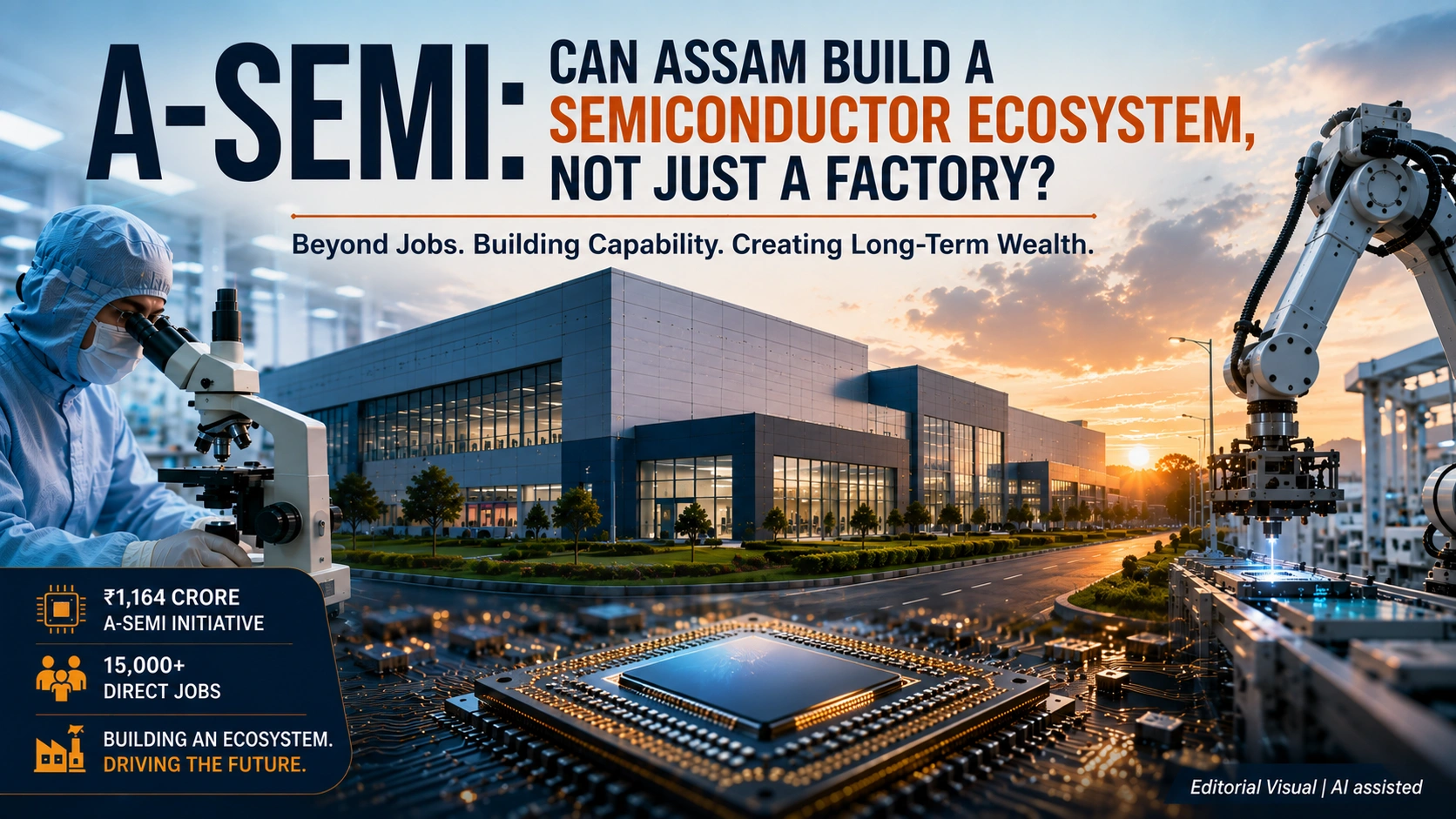
Assam’s ₹1,164-crore A-SEMI initiative aims to build far more than a skilled workforce around Tata Electronics’ Jagiroad semiconductor facility. Can the state transform a landmark investment into a thriving semiconductor ecosystem owned and shaped by local enterprises?
A Semiconductor Plant Can Create Jobs. An Ecosystem Can Create Prosperity.
Economic history repeatedly shows that landmark industrial investments often become symbols of transformation. Yet the factories themselves rarely tell the entire story. The regions that ultimately prosper are not those that merely host large industries, but those that nurture thousands of businesses around them. Every successful industrial revolution has depended as much on local suppliers, entrepreneurs and innovators as on the anchor companies that first arrived.
Against this backdrop, Assam’s latest budget announcement deserves attention beyond its headline figures. Through the Assam Semiconductor Ecosystem on Manufacturing and Innovation Project (A-SEMI), the state has signalled that its ambition extends beyond attracting investment. It now seeks to build an ecosystem capable of supporting one of the world’s most strategically important industries.
Whether this vision ultimately transforms Assam’s economy, however, will depend less on the amount of money committed today and more on how effectively the ecosystem evolves over the coming decade.https://www.tataelectronics.com/
Assam’s Next Big Industrial Bet
In the Assam Budget 2026–27, presented on July 10, Finance Minister Jayanta Mallabaruah announced A-SEMI, a five-year initiative with an outlay of ₹1,164 crore, developed with support from the Japan International Cooperation Agency (JICA). The programme aims to strengthen infrastructure, develop industry linkages, encourage technology partnerships and create a skilled workforce for Assam’s emerging semiconductor sector.
The announcement comes at a significant moment. According to statements by the Assam Government, Tata Electronics’ semiconductor assembly and test facility at Jagiroad is expected to commence commercial production as early as November 2026. The project has already attracted national attention as one of the most significant industrial investments ever announced in Northeast India.
For a state historically associated with tea, oil, paper, and traditional industries, the arrival of semiconductor manufacturing represents more than economic diversification. It signals Assam’s entry into one of the most sophisticated global manufacturing value chains.
Why Semiconductor Ecosystems Matter More Than Semiconductor Plants
Around the world, successful semiconductor clusters did not emerge because a single factory was built. They evolved because thousands of interconnected businesses gradually formed around those anchor investments.
Taiwan’s Hsinchu Science Park and Malaysia’s Penang are often cited as global examples. Their success was driven not only by semiconductor companies but also by precision engineering firms, packaging suppliers, testing laboratories, logistics providers, automation specialists, equipment manufacturers and research institutions. Over time, these supporting industries became as valuable as the original investments themselves.
This distinction is particularly relevant for Assam.
Hosting a major semiconductor facility undoubtedly creates employment and attracts investment. Building an ecosystem, however, creates entrepreneurship, technological capability and long-term industrial resilience.
India’s Semiconductor Mission Is Gathering Pace
India’s semiconductor ambitions have accelerated rapidly over the past few years. Under the Semicon India Programme, the Government of India has approved multiple semiconductor manufacturing and packaging projects worth approximately ₹1.64 lakh crore, including semiconductor fabrication units, compound semiconductor facilities and advanced packaging plants. Jagiroad’s ₹27,000-crore Tata Electronics investment is widely regarded as the largest private industrial investment announced in Northeast India and occupies a strategically important position within this national vision.https://thequantiq.com/indias-semiconductor-moment-dholera-assam-odisha/
The Jagiroad facility itself is designed to assemble and test up to 48 million semiconductor chips every day using advanced packaging technologies such as wire bond, flip chip and integrated systems packaging. The project is expected to generate approximately 15,000 direct jobs, while government estimates suggest an additional 11,000 to 13,000 indirect employment opportunities across supporting industries and services.
Those numbers are impressive. Yet they raise an even more important question.
Will Assam simply become a location where chips are assembled, or will it gradually become a place where semiconductor businesses are created?https://www.pib.gov.in/PressReleasePage.aspx?PRID=2198056&lang=2®=48&utm_source=chatgpt.com
The AI Revolution Makes This Opportunity Even Bigger
Semiconductors have become the foundation of the global artificial intelligence revolution. Every AI application, whether it powers autonomous vehicles, cloud computing, robotics or large language models, ultimately depends on increasingly sophisticated semiconductor technologies.
While Assam is not entering the highly capital-intensive semiconductor fabrication segment, it is positioning itself within the OSAT (Outsourced Semiconductor Assembly and Test) industry, one of the fastest-growing components of the global semiconductor value chain. As AI adoption accelerates worldwide, demand for advanced semiconductor packaging and testing is expected to increase significantly.
This broader technological context makes A-SEMI more than an industrial policy initiative. It positions Assam within one of the defining technologies of the twenty-first century.
The Real Strength of A-SEMI
The public information available so far indicates that A-SEMI focuses on building workforce capabilities, strengthening infrastructure, promoting technology partnerships, and facilitating collaboration between industry and educational institutions. The Assam Government has also allocated ₹496 crore separately for skilling, employment and entrepreneurship initiatives, reinforcing its commitment to developing the talent pipeline required for advanced manufacturing.
These investments are necessary because semiconductor manufacturing demands highly trained engineers, technicians, quality-control specialists, logistics professionals and supply-chain experts.
Developing this workforce is an essential first step. It is unlikely, however, to be sufficient on its own.
The Question Worth Watching
The next phase of Assam’s semiconductor journey will depend on whether local enterprises become active participants in the supply chain.
International experience suggests that successful semiconductor ecosystems evolve when local companies begin supplying precision components, specialised packaging materials, calibration services, industrial automation solutions, clean-room equipment, logistics, maintenance services and testing technologies.
This is where the most important policy question emerges.
How much of A-SEMI’s investment will eventually help Assamese entrepreneurs build businesses that supply the semiconductor industry rather than simply preparing workers to be employed by it?
That distinction could determine whether Assam merely hosts a semiconductor plant or gradually owns part of the value chain surrounding it.
Where Assam’s Entrepreneurs Could Find Opportunity
Contrary to popular perception, semiconductor ecosystems are not built solely by multinational corporations. They depend on hundreds of specialised small and medium-sized enterprises that solve highly specific industrial problems.
For Assam’s MSMEs and first-generation entrepreneurs, opportunities may emerge in precision engineering, industrial fabrication, clean-room services, packaging materials, specialised logistics, calibration laboratories, industrial software, equipment maintenance and semiconductor-support services.
Industrial parks proposed across Assam could play a decisive role if they are designed to attract semiconductor-adjacent manufacturing rather than functioning as generic industrial estates.
If implemented thoughtfully, today’s skilling programmes could become tomorrow’s supplier ecosystem.
From Supplying Labour to Building Local Enterprises
Developing skilled workers is essential. Developing entrepreneurs is transformational.
Every industrial ecosystem reaches a point where local businesses begin replacing imported suppliers. That transition does not happen automatically. It requires deliberate policies, easier access to finance, vendor-development programmes, incubation support and procurement opportunities for local enterprises.
The long-term objective should therefore extend beyond creating employment. It should focus on creating Assamese companies capable of competing within national and global semiconductor supply chains.
That is where lasting economic value is created.
What Policy Watchers Should Monitor
As implementation guidelines are released over the coming months, several questions deserve close attention.
Will dedicated funding or credit support be created specifically for Assamese-owned supplier companies? Will vendor-development programmes encourage local MSMEs to participate in semiconductor supply chains? How will the government measure success—by the number of people employed, or by the number of local enterprises that emerge around the Jagiroad ecosystem?
The answers to these questions may ultimately matter more than the initial budget allocation itself.
The Quantiq Assessment
A-SEMI represents an important shift in Assam’s industrial thinking. Rather than focusing exclusively on attracting a landmark investment, the state has begun discussing the ecosystem required to sustain it. That is an encouraging evolution in policy.
Yet ecosystems are not built through budget announcements alone. They emerge when governments, educational institutions, entrepreneurs, investors and industry work together over many years to create a dense network of local capabilities.
The semiconductor plant at Jagiroad may become Assam’s industrial anchor. Whether A-SEMI transforms that anchor into a globally competitive semiconductor ecosystem remains the far more important story.
The ultimate measure of success will not simply be the number of engineers employed or chips assembled. It will be the number of Assamese enterprises that become suppliers, innovators and technology creators within the semiconductor value chain.
Because in the end, economic prosperity is rarely created by factories alone. It is created by the ecosystems that grow around them.





One Comment