
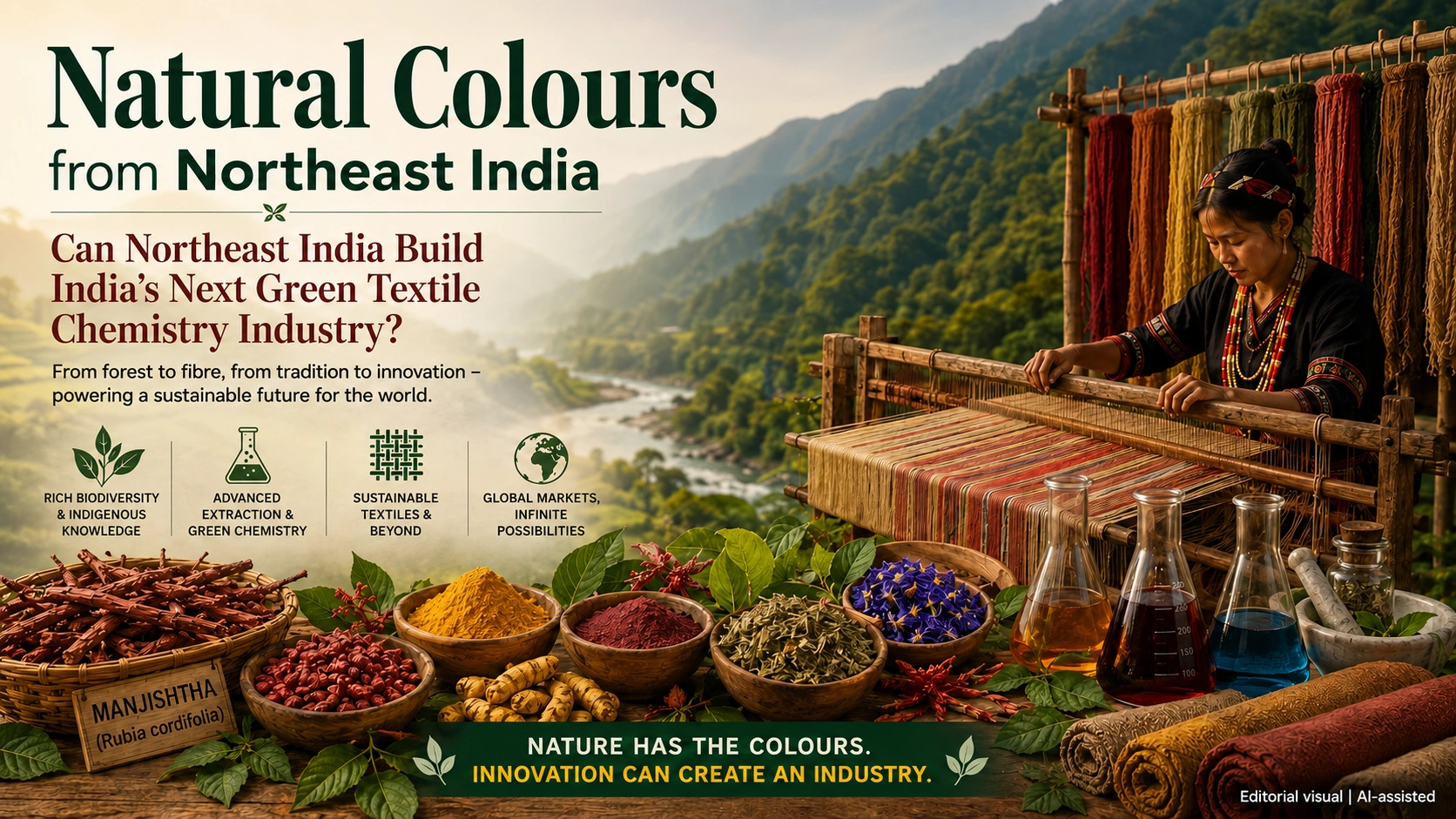
Natural Colours: Can Northeast India Build India’s Next Green Textile Chemistry Industry?
The Northeast Renaissance Series
Ideas for a ₹10,000–12,000 Crore Indian Market and a Multi-Billion Dollar Global Future
The future textile industry may not compete on colour alone. It may compete on how sustainably that colour is created.
Every morning, billions of people wear colours without asking where they come from. For more than a century, the answer has stayed the same: synthetic chemistry derived from petroleum. Those vibrant reds, deep blues and brilliant blacks built a global textile industry worth hundreds of billions of dollars. But they also polluted rivers, generated chemical waste and deepened environmental concerns.
Meanwhile, in the forests and villages of Northeast India, nature has quietly been producing remarkable colours for centuries.
Long before synthetic dyes existed, indigenous communities across Arunachal Pradesh, Assam, Nagaland, Manipur, Mizoram, Meghalaya, Tripura and Sikkim were already extracting rich reds, yellows, browns, blacks and greens. Their source: roots, bark, leaves, flowers and fruits. These colours were not laboratory inventions. They emerged from generations of observation, experimentation and an intimate understanding of local biodiversity.
Today, that traditional knowledge is beginning to acquire an entirely new significance.
Global fashion brands, textile manufacturers and specialty chemical companies face growing pressure to cut pollution, replace hazardous chemicals and build sustainable supply chains. Consequently, scientists and manufacturers are turning back to nature — not just for inspiration, but as a source of industrial chemistry.
Against this backdrop, Northeast India finds itself at an unusual crossroads.
The region possesses extraordinary biological diversity, centuries-old textile traditions and a growing ecosystem of entrepreneurs. Yet much of its botanical wealth still leaves as raw material. The real economic value is captured elsewhere, through scientific extraction, formulation, advanced manufacturing and global branding.
The opportunity before Northeast India is therefore much larger than preserving a traditional craft.
It is about building a globally competitive green textile chemistry industry rooted in biodiversity, powered by science and strengthened by innovation.https://www.texmin.gov.in/
Why This Matters
The textile industry is undergoing one of the most significant transformations in its modern history. Public attention often focuses on recycled fabrics, circular fashion and sustainable fibres. But another revolution is quietly unfolding inside textile manufacturing itself.
Increasingly, the world’s largest apparel brands are rethinking one of the most fundamental elements of every garment: the colour.
This shift is driven by both environmental necessity and commercial reality. Conventional textile dyeing is one of the most resource-intensive stages of fabric production. It consumes enormous quantities of water and chemicals, and generates significant wastewater. As governments strengthen environmental regulations and consumers grow more sustainability-conscious, manufacturers are investing heavily in cleaner alternatives that don’t compromise product quality.
Natural colourants are emerging as one of those alternatives.
However, the future market is unlikely to be driven by handcrafted dyes alone. Instead, demand is growing for scientifically characterised botanical pigments, bio-based colourants and plant-derived molecules. These must meet the consistency, durability and performance standards that modern industrial manufacturing demands.
This transformation is expanding the role of natural colours far beyond traditional textiles — into cosmetics, food ingredients, specialty papers, leather finishing, eco-friendly packaging, printing inks and advanced biomaterials.
India is uniquely positioned to participate in this transition, thanks to its rich botanical diversity and globally respected textile heritage. Within India, Northeast India enjoys an even stronger strategic advantage: remarkable biodiversity, plus the living knowledge preserved by indigenous communities across the region.
The challenge now is not discovering new plants.
The challenge is discovering new industries hidden inside those plants.
From Traditional Knowledge to Industrial Chemistry
Across Northeast India, natural dyeing is more than a traditional craft. It is a living knowledge system, preserved by indigenous communities, weaving families and artisans for generations.
Long before synthetic dyes entered the market, local people had already discovered how roots, bark, leaves, flowers and fruits could produce vibrant, lasting colours.
This knowledge was not developed in research laboratories. It evolved through centuries of observation, experimentation and daily practice. Over time, communities learned which plants produced deep reds, soft greens, earthy browns and brilliant yellows. In many ways, they were practising applied plant chemistry long before the term entered modern science.
One plant tells this story particularly well.
Manjistha (Rubia cordifolia), which grows abundantly across Arunachal Pradesh and the Eastern Himalayas, has been valued for centuries as a natural source of rich red pigments. It also holds an important place in traditional medicine.
Yet every year, truckloads of raw Manjistha leave the region for processing elsewhere. That is where the real economic value gets created — through extraction, formulation, quality testing and branding.
The same pattern can be seen across many other biological resources.
Turmeric produces brilliant yellow pigments. Annatto seeds yield warm orange-red shades. Onion skins create beautiful golden and brown colours. Numerous indigenous plants are still used by local communities to dye handloom fabrics, bamboo products and natural fibres.
Despite this remarkable diversity, only a small fraction of these resources has been scientifically studied for commercial applications.
That is where the real opportunity begins.
The challenge is no longer identifying plants that produce natural colours — Northeast India already possesses an extraordinary biological library. The larger challenge is building the laboratories, extraction facilities, testing centres and manufacturing capabilities needed to transform these resources into globally competitive industrial products.
This shift also demands a new way of thinking.
Natural colours should no longer be viewed only as cultural heritage or artisan products. They should also be recognised as valuable industrial ingredients, with applications in textiles, cosmetics, food processing, sustainable packaging and specialty chemicals.
Instead of exporting roots, bark and leaves, the region can export high-value botanical pigments, proprietary technologies and advanced green chemistry.
That is where the Northeast Renaissance takes on a deeper meaning. The future will not belong to regions that merely possess biodiversity. It will belong to those that convert biodiversity into science, science into technology and technology into globally competitive industries
How Green Textile Chemistry Creates Value
The commercial journey of a natural colour begins long before it reaches a loom or a garment factory. It starts with identifying plant species that contain stable pigments, capable of meeting modern industrial requirements.
Researchers then analyse these botanical resources for chemical composition, colour stability, extraction efficiency and compatibility with different natural and synthetic fibres.
Once suitable plants are identified, the harvested material is cleaned, dried and prepared for processing. Depending on the target pigment, manufacturers may use steam distillation, solvent extraction, enzyme-assisted extraction or supercritical carbon dioxide technologies to isolate valuable colouring compounds.
These advanced processes improve pigment purity, maximise extraction efficiency and reduce waste.
The extracted compounds are then purified, standardised and put through rigorous quality testing. Manufacturers evaluate colour consistency, light fastness, wash resistance, toxicity and compatibility with industrial dyeing systems before supplying finished ingredients to textile mills, fashion brands and specialty chemical companies.
Every stage of scientific processing enhances product quality while adding measurable economic value.
In practical terms, this transforms the entire business model. Instead of exporting roots, bark or leaves at modest margins, companies can produce premium botanical colourants that serve multiple high-value industries at once.
The same biological resource that once generated income only as a raw commodity can become the foundation of a diversified manufacturing ecosystem.
The opportunity extends even further.
Many natural pigments have antioxidant, antimicrobial and ultraviolet-resistant properties, making them valuable well beyond textiles. Consequently, the same extraction facility may eventually serve cosmetics, personal care products, natural food ingredients, biodegradable packaging, specialty coatings and eco-friendly printing inks. This multi-industry approach improves commercial viability and reduces dependence on any single market.
An Emerging Global Industry
Natural colours are no longer confined to artisan workshops or heritage textiles. Around the world, they are becoming part of a much broader industrial transition towards green chemistry, where biological resources increasingly replace petroleum-derived chemicals in manufacturing.
This transition is being accelerated by several global trends. Fashion brands are adopting ambitious sustainability commitments. Consumers are demanding greater transparency. Regulators are tightening restrictions on hazardous chemicals. Investors are directing capital towards environmentally responsible technologies.
Together, these forces are pushing manufacturers to rethink how colour itself is produced.
Meanwhile, scientific innovation is overcoming many of the limitations traditionally associated with natural dyes. Researchers are developing improved extraction methods, eco-friendly mordants, enzyme-assisted dyeing technologies and nano-encapsulation techniques — all of which enhance colour stability, durability and production efficiency.
These advances are helping natural pigments move beyond niche markets into mainstream industrial applications.
Equally important is the growing convergence between biotechnology, material science and textile engineering. Rather than treating natural colours as handcrafted alternatives, researchers increasingly view them as sophisticated biomaterials capable of supporting next-generation manufacturing. This shift in perspective is opening entirely new commercial possibilities.
For Northeast India, this global transformation presents an extraordinary opportunity.
The region already possesses many of the biological resources that future industries are seeking. What remains is building the scientific capability, industrial infrastructure and entrepreneurial ecosystem required to transform those resources into internationally competitive products.
Opportunity Snapshot
| Indicator | Indicative estimate |
| Global Natural Colorants Market | US$ 2.5 – 3.5 Billion |
| India Natural Dye & Botanical Pigment Market | ₹10,000–12,000 Crores |
| Initial CapEx | ₹75 Lakhs–₹3 Crores |
| Potential Gross Margin | 30–55% |
| Employment Potential | High |
| Export Opportunity | Significant |
Important Note: The above estimates are indicative industry approximations based on publicly available industry reports, market assessments and sector analyses. Actual investment requirements, margins and commercial opportunities may vary depending on technology, scale of operations, product mix, certifications and market conditions.
Why Northeast India Has a Strategic Advantage
Few regions in Asia possess the biological richness found across Northeast India. From the Eastern Himalayan forests of Arunachal Pradesh to the river valleys of Assam and the hill ecosystems of Nagaland, Mizoram, Meghalaya, Manipur, Tripura and Sikkim, the region supports an extraordinary diversity of dye-producing plants.
Equally important, many indigenous communities have preserved traditional knowledge of extracting colours from local biological resources for generations.
However, biodiversity alone does not create prosperity.
Many regions around the world possess abundant natural resources yet capture only a small share of the final economic value. Why? Because processing, formulation, research and branding happen elsewhere.
Northeast India faces a similar challenge today. Whether it is Manjistha, turmeric or other dye-producing plants, raw materials frequently leave the region while the higher-value activities happen outside its borders.
This imbalance presents both a challenge and an opportunity.
Instead of remaining a supplier of biological raw materials, Northeast India can position itself as a centre for botanical extraction, green textile chemistry, pigment research and sustainable material innovation. Such an ecosystem would support not only textile manufacturers but also startups, biotechnology companies, research institutions, fashion designers and export-oriented enterprises.
Moreover, the region already possesses another strategic advantage that is often overlooked. Northeast India is internationally recognised for its handloom traditions, natural fibres and indigenous textile heritage.
Integrating these strengths with modern botanical chemistry could create entirely new categories of premium products — ones that combine sustainability, scientific innovation and cultural authenticity.
The conversation, therefore, extends far beyond replacing synthetic dyes with natural alternatives.
It is about creating a globally competitive industrial ecosystem, where biodiversity, traditional knowledge, scientific research and advanced manufacturing reinforce one another. Such an approach could generate skilled employment, strengthen rural value chains and establish Northeast India as a leader in one of the world’s fastest-evolving sustainable manufacturing sectors.https://thequantiq.com/kaji-nemu-citrus-bioeconomy-northeast-india/
Process Intelligence Is the Real Moat
For decades, discussions around natural dyes have centred on biodiversity. But biodiversity, while the starting point, is unlikely to become the defining competitive advantage in the years ahead. Several countries around the world possess rich botanical resources.
What will distinguish future industry leaders is not simply access to plants, but the ability to turn those plants into consistent, high-performance industrial ingredients.
That transformation depends on process intelligence.
Producing commercially viable botanical colourants requires far more than harvesting roots, bark or leaves. Manufacturers must develop efficient extraction technologies, achieve consistent pigment concentrations, improve colour fastness, optimise shelf life and ensure compatibility with modern industrial dyeing systems.
These scientific capabilities determine whether a natural pigment remains an artisan product — or becomes an ingredient trusted by global textile manufacturers.
Intellectual property will become equally important. Companies that develop proprietary extraction methods, bio-based mordants, eco-friendly fixation processes or advanced pigment formulations will hold stronger competitive positions than businesses relying solely on raw material supply.
In the coming decade, patents, proprietary processes and scientific validation may prove more valuable than the biological resource itself.
This is perhaps the most important lesson for Northeast India.
A forest can produce colour.
Only process intelligence can produce an industry.
The AI Era and Intelligent Green Chemistry
Artificial intelligence is beginning to reshape material science at an extraordinary pace, and natural colour research is no exception. Instead of relying only on years of laboratory experimentation, researchers can now analyse thousands of botanical compounds using machine learning.
This helps predict which molecules are most likely to produce stable pigments, withstand repeated washing and remain colourfast under varying environmental conditions.
This represents a fundamental shift in how innovation takes place.
Inside manufacturing facilities, AI-powered systems help optimise extraction temperatures, solvent use and production parameters — maximising pigment yield while reducing energy consumption and waste.
Computer vision technologies can identify microscopic colour variations with remarkable precision, helping manufacturers achieve the consistency that international fashion brands and industrial buyers demand.
Meanwhile, digital traceability platforms are becoming increasingly important. From cultivation and harvesting to extraction, formulation and finished products, every stage of the value chain can now be digitally documented.
Such transparency strengthens quality assurance, supports sustainability certifications and builds trust with environmentally conscious consumers.
Artificial intelligence is also opening new possibilities for discovery. By analysing enormous botanical databases, AI can identify previously overlooked plant species with promising pigment properties, dramatically accelerating research that once depended almost entirely on trial and error.
The future of natural colours, therefore, will not be shaped by technology alone or tradition alone.
It will be shaped by the intelligent convergence of indigenous knowledge, modern chemistry and artificial intelligence.
From Biodiversity to Green Industrial Leadership
For generations, natural colours have been valued mainly for their cultural significance and aesthetic appeal. Across Northeast India, they have coloured ceremonial textiles, traditional garments and handcrafted products that reflect the region’s remarkable cultural diversity.
That heritage remains invaluable. But the global economy is beginning to assign a very different kind of value to these biological resources.
Around the world, industries are actively searching for renewable alternatives to fossil-based chemicals. Textile manufacturing, cosmetics, packaging, specialty coatings and even advanced biomaterials are increasingly incorporating plant-derived ingredients into their product development.
As a result, natural colourants are no longer viewed simply as traditional dyes. They are emerging as strategic industrial inputs for a new generation of sustainable manufacturing.
This changing landscape creates an unprecedented opportunity for Northeast India.
The region already possesses biodiversity, traditional knowledge and internationally recognised handloom traditions. The next step is to build scientific institutions, botanical extraction facilities, testing laboratories, startup incubators and collaborative research ecosystems capable of converting biological wealth into globally competitive industries.
The future may not belong to the regions that simply grow dye-producing plants.
It may belong to those that master the chemistry hidden inside them.
The Quantiq Assessment
Natural colours represent far more than an opportunity to revive traditional textile practices. They represent an opportunity to reposition Northeast India within one of the world’s fastest-growing transitions towards sustainable industrial manufacturing.
By combining biodiversity with scientific research, green chemistry and modern manufacturing, the region can participate in global value chains that extend far beyond the sale of raw botanical materials.
However, realising this opportunity will require coordinated action, not isolated initiatives. Universities, research institutions, textile technologists, entrepreneurs, fashion designers, biotechnology companies and policymakers must work together to build an ecosystem that supports innovation at every stage of the value chain.
Investments in extraction technology, quality testing, certification, product development and intellectual property will matter just as much as investments in cultivation.
Equally important: commercial success must never come at the expense of ecological sustainability. Many dye-producing species grow within fragile ecosystems that need responsible management. Scientific cultivation, community participation and sustainable harvesting practices must become integral to any future industrial strategy.
Protecting biodiversity is not merely an environmental responsibility. It is also essential for preserving the industry’s long-term competitiveness.
The opportunity before Northeast India is therefore both economic and strategic.
The region can continue exporting biological resources for others to process, or it can build the scientific capability to manufacture premium botanical colourants, develop proprietary technologies and establish itself as a global centre for green textile chemistry.
That choice will shape far more than the future of natural dyes.
It may shape the future of sustainable manufacturing in Northeast India.
Conclusion
Every civilisation has been remembered for the materials that defined its age. Stone gave way to bronze, bronze yielded to iron, and the industrial era was transformed by steel, plastics and petrochemicals.
The twenty-first century, however, is increasingly becoming an age of biological innovation — where nature is no longer just a resource to be extracted, but a partner in scientific discovery.
Natural colours illustrate this transformation beautifully.
A humble root beneath the forests of Arunachal Pradesh, or a flowering plant growing quietly in a village landscape, can eventually become a premium ingredient used by global fashion brands, cosmetic manufacturers and sustainable industries. Between those two realities lies a journey powered by chemistry, technology, entrepreneurship and vision.
For generations, Northeast India coloured its own textiles with nature.
The opportunity before it today is far greater.
It has the potential to help colour the world’s sustainable future.https://thequantiq.com/medicinal-plants-botanical-extract-industry-northeast-india/




One Comment