
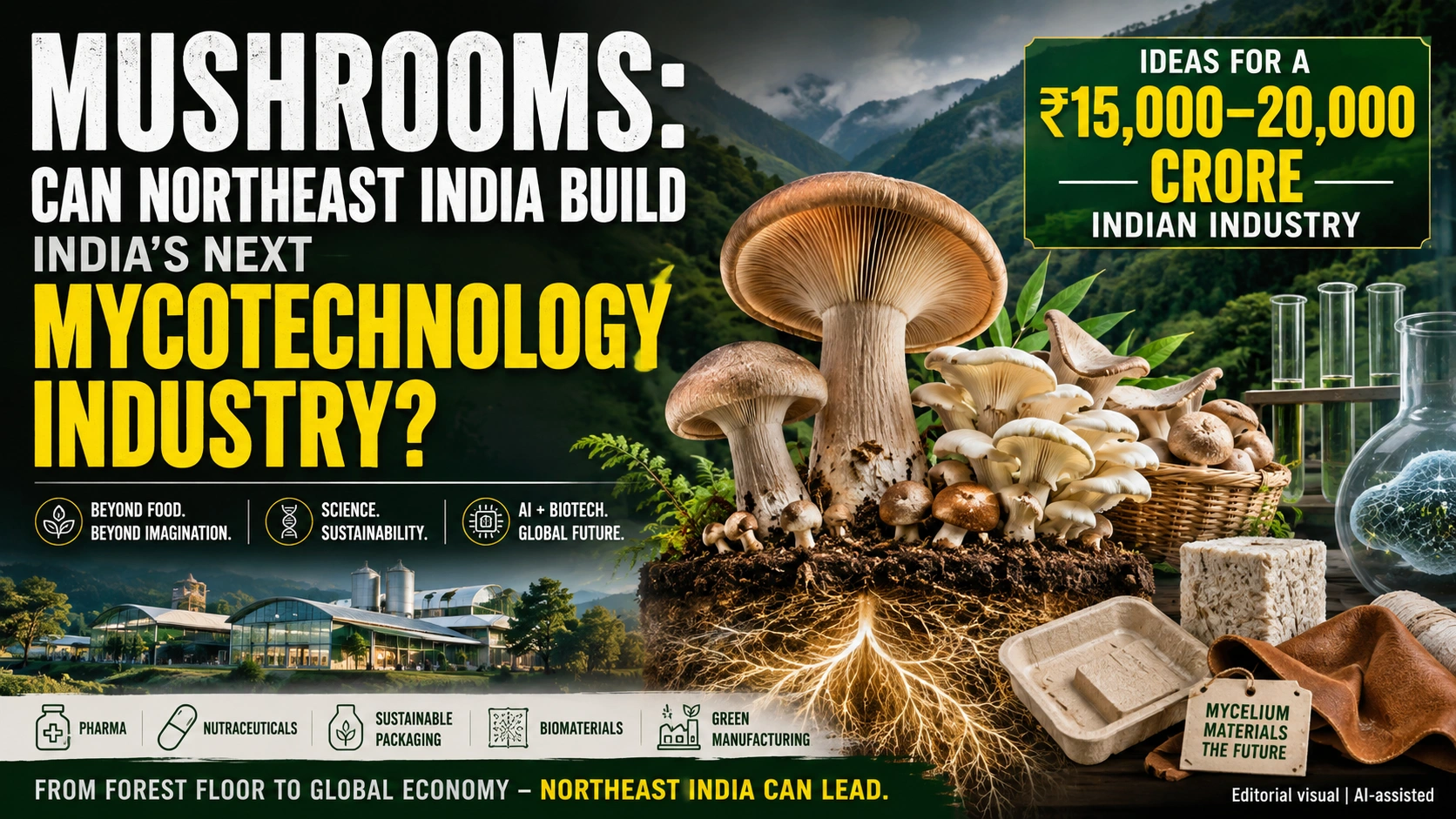
Mushrooms: Can Northeast India Build India’s Next Mycotechnology Industry?
The Northeast Renaissance Series
Ideas for a ₹15,000–20,000 Crore Indian Industry and a Multi-Billion Dollar Global Future
Key Highlights
- The future of mushrooms extends far beyond food. They are emerging as the building blocks of pharmaceuticals, functional foods, biomaterials, sustainable packaging and the circular bioeconomy.
- With its biodiversity, entrepreneurial ecosystem and growing international interest, Northeast India has the opportunity to become India’s leading hub for mycotechnology and fungal innovation.
When most people think about mushrooms, they think about food.
Some associate them with healthy eating, while others see them as a profitable crop that can supplement farm income. For decades, governments, researchers and entrepreneurs have promoted mushroom cultivation primarily as a livelihood opportunity for rural households.
However, the world has quietly moved much further ahead.
Today, mushrooms are no longer viewed merely as edible fungi. Scientists are discovering new medicinal compounds, engineers are growing biodegradable packaging from fungal mycelium, fashion companies are experimenting with mushroom-based leather, and biotechnology firms are exploring applications that were unimaginable only a decade ago.
In other words, the world’s most exciting mushroom story is no longer about cultivation.
It is about mycotechnology—the science and technology of using fungi to create high-value products that support healthcare, sustainable manufacturing, environmental protection and the emerging bioeconomy.
For Northeast India, this represents a remarkable opportunity.
The region has spent decades discussing how to produce more agricultural commodities. Perhaps the more important question now is whether it can build entirely new industries around the extraordinary biological resources it already possesses.
That is the question this article seeks to answer.https://thequantiq.com/medicinal-plants-botanical-extract-industry-northeast-india/
Why This Matters
Throughout history, economic transformation has rarely been driven by discovering new resources. More often, it has been driven by discovering new ways to use familiar ones.
Sand became semiconductors.
Silica became fibre optics.
Bamboo is evolving from a construction material into advanced textiles and engineered composites.
Similarly, mushrooms are beginning to move far beyond kitchens and farms.
Across the world, governments, universities and private companies are investing in fungi because they recognise their remarkable ability to solve some of the twenty-first century’s biggest challenges. From biodegradable packaging and sustainable construction materials to functional foods, pharmaceuticals and next-generation biomaterials, mushrooms are rapidly becoming an important pillar of the global bioeconomy.
This transformation is particularly significant for Northeast India.
The region already possesses exceptional biodiversity, abundant agricultural biomass and generations of indigenous knowledge about edible and medicinal mushrooms. Combined with scientific research and entrepreneurship, these natural advantages could position the region at the forefront of India’s emerging mycotechnology ecosystem.
The opportunity, therefore, is no longer limited to producing mushrooms.
It is about producing knowledge, innovation and globally competitive industries.
From Forest Floor to Future Industry
Every monsoon, forests across Northeast India come alive with mushrooms.
Families venture into nearby woodlands carrying baskets, carefully collecting edible varieties that have been part of indigenous cuisine for generations. Local markets across Assam, Nagaland, Meghalaya, Arunachal Pradesh, Mizoram and Manipur display an astonishing diversity of mushrooms, reflecting centuries of traditional ecological knowledge passed from one generation to the next.
For most people, these mushrooms represent seasonal food.
Scientists, however, see something much more profound.
The visible mushroom is only a small part of a much larger living organism. Hidden beneath the forest floor lies an intricate network of microscopic fungal threads known as mycelium. This underground network continuously recycles nutrients, decomposes organic matter and supports healthy ecosystems, making fungi among nature’s most efficient biological engineers.
Researchers are now harnessing these remarkable properties for entirely new industrial applications.
Mycelium can be grown into biodegradable packaging that replaces plastic, transformed into leather-like materials for the fashion industry, developed into lightweight construction panels and explored as a source of pharmaceutical compounds and functional food ingredients. Unlike many conventional manufacturing processes, these products are grown using renewable biological systems that consume relatively little energy and generate minimal waste.
Nature, in effect, has spent millions of years perfecting a manufacturing platform that modern industry is only beginning to understand.
That insight changes everything.
The future value of mushrooms may lie not only in the food they provide but also in the biological intelligence hidden beneath the soil.
Beyond Food: The Rise of Mycotechnology
The word mycotechnology remains unfamiliar to many people in India.
Yet internationally, it is becoming one of the most exciting frontiers in biotechnology.
At its core, mycotechnology refers to the application of fungi and fungal biology to develop innovative products and industrial solutions. It brings together microbiology, biotechnology, materials science, food technology, environmental engineering and artificial intelligence to unlock the remarkable capabilities of fungi.
Around the world, start-ups and multinational companies are investing heavily in mushroom-derived innovations.
Some are producing biodegradable packaging capable of replacing petroleum-based plastics. Others are developing sustainable leather alternatives for luxury fashion brands. Pharmaceutical researchers continue investigating bioactive compounds with therapeutic potential, while food companies are creating functional ingredients that support nutrition and wellness.
This rapid diversification is transforming mushrooms from an agricultural commodity into a platform technology.
The question facing Northeast India is therefore much larger than whether mushroom cultivation can expand.
The real question is whether the region can participate in one of the fastest-growing biological industries of the twenty-first century.
A Global Industry Looking for Sustainable Solutions
The global economy is undergoing a profound transition.
Governments are encouraging industries to reduce plastic waste, lower carbon emissions and embrace renewable materials. Consumers are increasingly choosing products that are biodegradable, sustainably produced and environmentally responsible. Meanwhile, manufacturers are searching for alternatives to petroleum-based materials without compromising quality or performance.
Mycotechnology aligns naturally with each of these global trends.
As the world moves towards cleaner production systems and circular manufacturing, fungi are emerging as an unlikely but powerful solution. Their ability to transform agricultural waste into high-value products offers economic as well as environmental benefits.
For Northeast India, this is an opportunity that extends well beyond agriculture.
It is an opportunity to build a knowledge-driven bioeconomy where biodiversity, scientific research, entrepreneurship and innovation work together to create globally competitive industries.
That journey has already begun in different parts of the world.
The question is whether Northeast India can become one of its next destinations.
Why Northeast India Holds a Strategic Advantage
Every globally competitive industry begins with a unique advantage.
The Netherlands transformed horticulture through research and technology. Finland converted its forests into a sophisticated bioeconomy by investing in innovation rather than simply exporting timber. Likewise, Silicon Valley demonstrated that knowledge creates far greater wealth than natural resources alone.
Northeast India possesses a similarly compelling advantage for the emerging mycotechnology industry.
The region’s high rainfall, humid climate and rich forest ecosystems support an extraordinary diversity of fungi. For generations, indigenous communities have identified edible and medicinal mushrooms using traditional ecological knowledge that has been refined through centuries of observation. Meanwhile, abundant agricultural residues such as paddy straw, bamboo leaves, maize stalks and sawdust provide sustainable raw materials for commercial mushroom cultivation.
These strengths offer far more than favourable growing conditions.
They provide the biological foundation upon which an entirely new knowledge-driven industry can be built.
However, biodiversity alone has never guaranteed economic leadership. The regions that lead tomorrow’s bioeconomy will be those that combine natural resources with scientific research, entrepreneurship, skilled professionals and globally recognised quality standards. That is precisely where Northeast India has an opportunity to distinguish itself.https://thequantiq.com/agarwood-industry-assam-global-fragrance-opportunity/
A Pioneer Who Saw the Opportunity Three Decades Ago
Long before mushrooms became part of conversations on biotechnology and the circular economy, one entrepreneur in Assam recognised their potential.
More than thirty years ago, Pranjal Baruah, a Guwahati-based entrepreneur, began promoting organised mushroom cultivation at a time when the sector received little public attention. What started as a pioneering entrepreneurial initiative gradually evolved into a wider ecosystem involving spawn production, farmer training, technical support and commercial cultivation.
His contribution extends beyond building a successful enterprise.
He demonstrated that mushrooms could become a viable business capable of generating rural livelihoods, supporting women entrepreneurs and creating sustainable income opportunities. Over the years, his work has inspired thousands of farmers and aspiring entrepreneurs, helping establish Assam as one of India’s recognised centres for organised mushroom cultivation.
Every emerging industry needs pioneers.
Just as Ajmal helped demonstrate Assam’s potential in the fragrance industry, Pranjal Baruah showed that mushrooms could become much more than a seasonal crop. His journey also illustrates an important lesson for the next generation.
The future belongs to entrepreneurs who recognise tomorrow’s opportunities long before they become obvious to everyone else.
Today, the conversation is evolving once again.
The next chapter is no longer about mushroom cultivation alone.
It is about building a mycotechnology ecosystem.
International Interest Signals a New Phase
The transformation is no longer confined to Northeast India.
Around the world, governments, research institutions and technology companies are investing heavily in fungi because they recognise their potential to reshape multiple industries. Consequently, international collaborations are beginning to emerge around mushroom research, smart farming and value-added processing.
Assam has already begun attracting that attention.
Recently, a Japanese delegation visited the state to explore collaboration opportunities with the Mushroom Development Foundation and other stakeholders. The discussions reportedly focused on technology transfer, intelligent cultivation systems, digital monitoring and opportunities to strengthen the mushroom value chain through innovation and international cooperation.
The visit carries significance beyond the possibility of technical collaboration.
It reflects growing global recognition that Northeast India possesses favourable conditions for developing a modern mushroom ecosystem. Moreover, it highlights how traditional agricultural activities can evolve into knowledge-intensive industries supported by advanced technologies.
Such collaborations also reinforce an important message.
The future of mushroom enterprises will depend not only on biological resources but equally on partnerships, innovation and continuous learning.
Opportunity Snapshot
| Indicator | Indicative Estimate |
|---|---|
| Global Mushroom & Mycotechnology Market | US$ 65–75 Billion |
| India Mushroom & Functional Mushroom Industry | ₹15,000–20,000 Crores |
| Indicative Initial CapEx | ₹50 Lakhs–₹2.5 Crores |
| Potential Gross Margin | 30–55% (Higher for value-added products) |
| Employment Potential | Very High |
| Export Opportunity | Significant (Food, nutraceuticals, biomaterials and sustainable manufacturing) |
Important Note: The above estimates are indicative industry approximations based on prevailing global market trends, comparable biotechnology industries, published sectoral studies and potential business models. Actual investment requirements, market size, profitability and return on investment may vary depending on technology selection, product portfolio, regulatory approvals and evolving market conditions.
Why Process Intelligence Is the Real Moat
Growing mushrooms successfully requires knowledge.
Building a globally competitive mycotechnology enterprise requires something much more.
It requires process intelligence.
Every stage of the production cycle influences quality. Selecting superior mushroom strains, producing contamination-free spawn, maintaining precise environmental conditions, harvesting at the right stage, ensuring hygienic processing and preserving product quality all demand scientific discipline rather than routine farming practices.
This becomes even more important as businesses move into functional foods, pharmaceutical ingredients and biomaterials.
International buyers increasingly expect complete documentation, laboratory testing, quality certifications and transparent production systems. They are not simply purchasing mushrooms. They are investing in consistency, reliability and confidence.
Consequently, the enterprises that master process intelligence will command greater trust and higher market value.
In the emerging bioeconomy, trust is built not through advertising but through systems that consistently deliver excellence.
The AI Era: Growing Intelligence Alongside Mushrooms
Artificial intelligence is rapidly transforming agriculture, and mushroom cultivation is particularly well suited to this technological revolution.
Unlike many field crops, mushrooms are grown in carefully controlled environments where temperature, humidity, carbon dioxide levels and airflow directly influence productivity. AI-powered systems can continuously monitor these parameters, identify subtle changes and recommend corrective actions before production is affected.
Computer vision technologies are already helping growers assess mushroom size, colour and maturity with remarkable precision. Predictive analytics can optimise harvesting schedules, reduce post-harvest losses and forecast market demand more accurately. Meanwhile, digital traceability systems supported by blockchain technology can document every stage of production, providing international buyers with confidence regarding quality and origin.
These innovations demonstrate that the future of mushroom cultivation will not be determined solely by biological expertise.
It will also depend upon digital intelligence.
For Northeast India, this creates an opportunity to leapfrog conventional agricultural models and build an industry that combines biodiversity, biotechnology and artificial intelligence from the very beginning.
That combination could become one of the region’s strongest competitive advantages in the decades ahead.
From Mushroom Farming to Mycotechnology
For many years, mushrooms have been promoted primarily as an agricultural enterprise.
That perspective is changing rapidly.
The industries likely to generate the greatest value tomorrow will be those capable of transforming mushrooms into pharmaceuticals, nutraceuticals, functional food ingredients, biomaterials, biodegradable packaging, sustainable textiles and advanced manufacturing solutions.
The opportunity before Northeast India is therefore much larger than increasing mushroom production.
It is to become one of India’s leading centres for mycotechnology, where science, entrepreneurship, sustainability and innovation come together to build industries designed for the twenty-first century.
For Students and Young Professionals: The Next Bioeconomy Needs Mycologists, Not Just Mushroom Growers
Every industrial revolution creates professions that were almost unknown a generation earlier.
The digital revolution created software engineers, data scientists and cybersecurity specialists. Similarly, the emerging bioeconomy is creating opportunities for microbiologists, fermentation scientists, biomaterials engineers, food technologists and specialists in fungal biotechnology. These are professions that combine science, innovation and sustainability to solve some of the world’s most pressing environmental and industrial challenges.
Mycotechnology is rapidly becoming one of those frontier disciplines.
For many young people in Northeast India, mushrooms are still associated primarily with farming or food. However, the future offers far broader possibilities. Scientists are developing mushroom-derived pharmaceuticals, engineers are creating biodegradable packaging from mycelium, designers are experimenting with sustainable textiles, while researchers continue exploring fungal compounds for healthcare, nutrition and environmental restoration.
These developments open exciting career pathways.
Students pursuing biotechnology, microbiology, agriculture, pharmacy, chemistry, environmental science, food technology and engineering can all find opportunities within the expanding mycotechnology ecosystem. Those with entrepreneurial ambitions can establish businesses in spawn production, premium mushroom foods, nutraceuticals, sustainable packaging, biomaterials or specialised mushroom-based consumer products.
Artificial intelligence will further reshape these careers.
Tomorrow’s mushroom enterprises are likely to employ professionals who combine biological sciences with data analytics, climate-controlled farming systems, computer vision, automation and digital traceability. The industry will increasingly reward interdisciplinary knowledge rather than expertise in a single subject.
The next breakthrough in mycotechnology may not emerge from a multinational laboratory.
It could come from a young innovator in Northeast India who chooses to look beyond cultivation and embrace the wider possibilities of fungal science.
Learn More: Where Your Journey Can Begin
Every successful industry invests in knowledge before it invests in factories.
Students and entrepreneurs interested in mycotechnology already have access to excellent institutions that can provide both technical knowledge and entrepreneurial skills.
The ICAR–Directorate of Mushroom Research (DMR), Solan, is India’s premier institution dedicated to mushroom science. It conducts advanced research, develops improved cultivation technologies and regularly organises training programmes for farmers, researchers and entrepreneurs.https://dmrsolan.res.in/
The National Institute of Food Technology Entrepreneurship and Management (NIFTEM) offers programmes in food processing, functional foods and value-added product development, making it an excellent destination for those interested in commercial mushroom enterprises.https://www.niftem.ac.in/
Internationally, Wageningen University & Research in the Netherlands is recognised as one of the world’s leading centres for agricultural innovation and biotechnology. Its research publications and online learning resources provide valuable insights into sustainable food systems and emerging biological industries.https://www.wur.nl/en/education/master/masters-food-technology
Aspiring entrepreneurs should also follow global developments in mycelium-based biomaterials, biofabrication, precision fermentation and functional food innovation. These fields are evolving rapidly and are expected to shape the next generation of sustainable manufacturing.
The world is entering an era where biology increasingly complements engineering.
The best time to begin learning about that future is now.
The Quantiq Assessment
The mushroom story in Northeast India should no longer be viewed solely through the lens of agriculture.
The region has already demonstrated that organised mushroom cultivation is commercially viable. Entrepreneurs such as Pranjal Baruah helped establish that foundation decades ago by proving that mushrooms could generate sustainable livelihoods and inspire a new generation of rural enterprises. Today, growing international interest—including exploratory collaboration with Japanese institutions—suggests that the industry is entering a new phase driven by technology, innovation and global partnerships.
The challenge now is to think beyond production.
Northeast India has the opportunity to build an integrated mycotechnology ecosystem that connects research laboratories, universities, start-ups, organised farms, food processors, biomaterial manufacturers and biotechnology companies. Such an ecosystem would create far greater economic value than simply increasing mushroom output.
This transformation will also require investment in institutions.
Advanced spawn laboratories, biotechnology incubation centres, quality-testing facilities, specialised academic programmes and innovation clusters will all play a critical role. Equally important will be closer collaboration between researchers, entrepreneurs, policymakers and investors, ensuring that scientific discoveries move efficiently from laboratories to commercial markets.
The Quantiq believes that the region’s greatest competitive advantage lies in combining its exceptional biodiversity with process intelligence. Every improvement in quality assurance, every investment in scientific research and every step towards digital traceability strengthens international confidence in products originating from Northeast India.
The future bioeconomy will not reward those who merely cultivate more mushrooms. It will reward those who build globally trusted technologies, products and brands around them.
Conclusion
Walk through the forests of Northeast India after the monsoon, and mushrooms appear almost effortlessly.
For generations, they have nourished communities, enriched local cuisines and reflected the region’s remarkable biodiversity. Yet beneath every mushroom lies a vast network of mycelium—a living system that quietly recycles nutrients, supports ecosystems and demonstrates nature’s extraordinary ability to innovate.
Modern science is now revealing that this hidden network may also hold the key to some of tomorrow’s most sustainable industries.
From pharmaceuticals and functional foods to biodegradable packaging, advanced biomaterials and green manufacturing, fungi are beginning to reshape the global bioeconomy. Regions that recognise this transformation early will create industries that generate skilled employment, encourage scientific innovation and build globally competitive enterprises.
Northeast India possesses many of the ingredients required for that journey.
It has biodiversity. It has entrepreneurial pioneers. It has traditional knowledge. It is also attracting international attention.
The next step is to transform these individual strengths into a coherent ecosystem that nurtures research, technology, education and innovation.
The Northeast Renaissance has always been about discovering extraordinary opportunities hidden within familiar resources.
Perhaps no resource illustrates that philosophy more clearly than mushrooms. They may begin on the forest floor.
However, their future could very well be built in research laboratories, technology parks, design studios, and advanced manufacturing facilities




3 Comments