
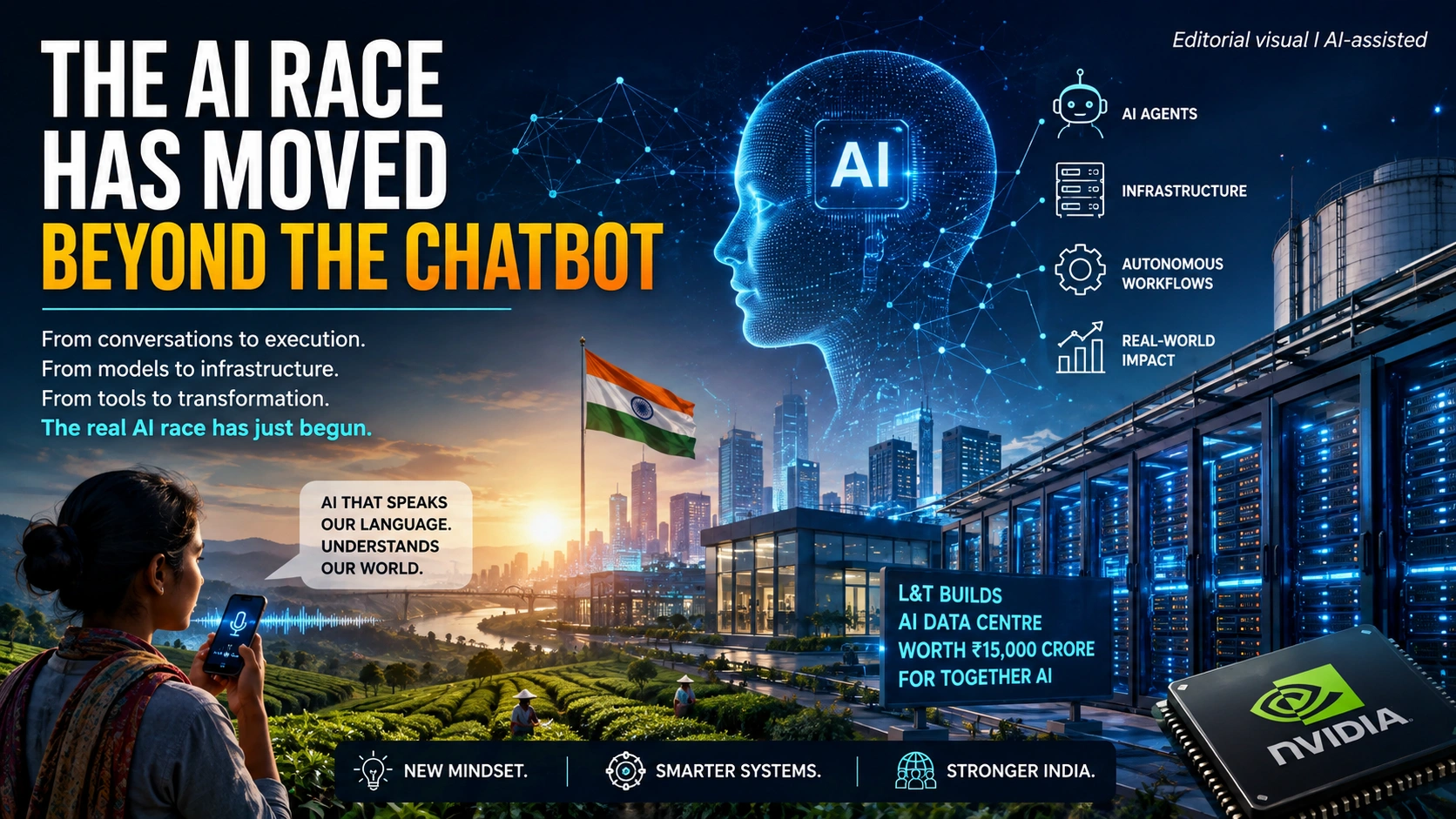
The AI Race Has Moved Beyond the Chatbot
The biggest shift in artificial intelligence is no longer happening inside the chatbot window. It is happening in agents, infrastructure, data centres and real-world workflows. For India, that shift could be more important than the race to build the world’s smartest model.
For the past three years, artificial intelligence has had a remarkably simple public face: a chat window.
We asked ChatGPT to write something, Gemini to explain something or another AI model to create an image, and the machine responded. The excitement around generative AI was built largely around this new ability to converse with machines in ordinary language.
However, the AI industry is quietly moving beyond that stage.
The important question today is no longer simply whether an AI model can give us a better answer. Increasingly, the question is whether it can take the answer and do something useful with it.
That shift from conversation to execution may become the defining AI story of the next few years.https://thequantiq.com/new-indian-retailer-ai-product-discovery/
AI is learning to do the work
Google’s latest move offers a good illustration of where the industry is heading.
On August 13, Google introduced Gemini 3.7 Flash, positioning the model around software development, coding and agentic business workflows. The significance is not merely another model number in an increasingly crowded AI landscape. It is the direction of travel: AI systems are being designed to plan, reason through multiple steps and execute tasks rather than simply generate a response.
Google has been pushing this direction throughout the year. Its latest AI developments have increasingly focused on agents that can interact with applications, use tools and perform tasks, while Gemini is being embedded across the company’s wider ecosystem rather than remaining a standalone chatbot.
Nvidia is making a similar bet. Its recent AI initiatives increasingly emphasise intelligent agents and open-source models capable of performing more complex tasks.
This suggests that the next phase of artificial intelligence will not be defined simply by the model with the highest benchmark score.
It may be defined by the system that can complete the most valuable job with the least human intervention.
That is a very different competition.https://thequantiq.com/ai-adoption-indian-msmes/
The AI economy is becoming an infrastructure economy
There is another transformation taking place beneath the headlines.
Every intelligent AI agent requires enormous amounts of computing power. That means GPUs, data centres, electricity, cooling systems, networking equipment, semiconductor capacity and specialised infrastructure are becoming as important to the AI economy as algorithms themselves.
India has just received a striking reminder of this transformation.
Larsen & Toubro announced on August 13 that it had secured an order worth up to ₹15,000 crore from US-based AI cloud company Together AI to develop a large AI data-centre facility using Nvidia’s high-performance chips. The project is expected to involve around 10,000 advanced GPUs.
This is not merely another technology contract.
It represents a fundamental change in how we should think about India’s AI opportunity.
The country does not have to make every foundational model itself to benefit from artificial intelligence. There is an enormous economic ecosystem forming around the technology, from data centres and chip design to power management, cooling, cloud services, cybersecurity and AI applications.
The AI boom is therefore beginning to resemble an industrial revolution as much as a software revolution.
India’s real AI opportunity may be bigger than ChatGPT
India has also been building its own compute foundation.
The IndiaAI Mission’s compute programme now lists an infrastructure pool of more than 18,000 GPUs, with AI compute being made available through public-private partnerships to researchers, startups, MSMEs, academia, government organisations and other eligible users. Government information has separately indicated that more than 38,000 GPUs have been onboarded through the broader AI compute ecosystem.https://indiaai.gov.in/
The numbers matter, but the bigger question is what India does with that capacity.
There is a temptation to judge India’s AI progress by asking whether an Indian model can beat an American or Chinese model on a particular benchmark. That is understandable, but it may also be the wrong question.
India’s greatest advantage could lie elsewhere.
Imagine AI systems that understand Indian languages, Indian agriculture, Indian healthcare systems, Indian classrooms, Indian businesses and the peculiar complexity of India’s public services.
That is where artificial intelligence could become an economic multiplier rather than simply another consumer technology.
The language layer could change the Northeast
This is particularly relevant to the Northeast.
For years, the digital economy has disproportionately rewarded people who can communicate comfortably in English. Artificial intelligence has the potential to change that equation because voice and multilingual interfaces can bring sophisticated digital capabilities to people who may never become comfortable with conventional computer interfaces.
For Assam and the wider Northeast, the implications are considerable.
An AI system that genuinely understands Assamese could eventually become a useful interface for education, tourism, agriculture, healthcare, government services and local commerce. The same principle applies to other languages and communities across the region.
The opportunity, therefore, is not necessarily to build another generic chatbot.
It is to build AI that understands the Northeast.
That distinction could become strategically important.https://meity.gov.in/
The next competitive advantage will be process intelligence
There is another implication that businesses should not ignore.
For several years, companies have been asking which AI tool they should adopt. That question is becoming less useful.
The more important question is: Which part of our existing work should no longer require a human to perform manually?
That is where process intelligence enters the picture.
A company that simply gives its employees access to ChatGPT may become marginally more productive. A company that redesigns its entire customer-service process, research workflow, sales operation or internal reporting system around AI could become structurally different.
The distinction is enormous.
AI will increasingly disappear into the workflow itself.
People may not even realise that they are using artificial intelligence because the technology will simply become part of how work gets done.
But there is a harder question underneath the excitement
The acceleration of AI also creates uncomfortable questions.
Who controls the computing infrastructure? Who owns the data? How much electricity will increasingly powerful AI systems consume? How should governments regulate autonomous AI agents? And what happens when an AI system is no longer merely generating information but actually taking actions on behalf of a person or organisation?
These questions are becoming more urgent as the technology moves from generating content to executing tasks.
The AI industry is consequently entering a period in which capability, infrastructure, economics and governance will develop together.
That makes the coming phase considerably more complicated than the chatbot era.
The Quantiq View
The AI race is no longer simply a race to build the smartest model.
It is becoming a race to build the most useful intelligence ecosystem.
For entrepreneurs, that means the opportunity may not lie in creating yet another general-purpose AI application. The stronger opportunities are likely to emerge where proprietary data, domain knowledge, workflow integration and measurable real-world outcomes come together.
For India, the opportunity is even larger.
We do not necessarily need to build the next OpenAI.
We can build AI systems that understand our farms, forests, tea gardens, languages, logistics networks, classrooms, hospitals, tourism assets and millions of small businesses.
For the Northeast, this could be transformative.
The region does not have to compete with Silicon Valley on the number of frontier models it produces. It can compete on something much more practical: how intelligently it applies AI to its own unique economic and social realities.
That is why the most important AI development this week may not be another model launch.
It is the gradual disappearance of the chatbot as the centre of the AI story.
The next question is much bigger.
The next question is much bigger.
When machines can not only answer us but also act for us, who will redesign the way we work?
That is where the real AI race begins.



2 Comments