The Great Unbundling: What’s Really Behind the Global News Traffic Collapse
The Quantiq | Brand & Media Intelligence
For two decades, digital news followed a simple bargain: publish, get discovered, and let search engines send readers to your website. That bargain is changing. AI is only part of the story.
For most of the digital era, publishers followed a familiar sequence. They published a story, Google indexed it, readers searched for it, and the publisher captured the click. That click then generated pageviews, advertising revenue and, sometimes, a relationship with the reader.
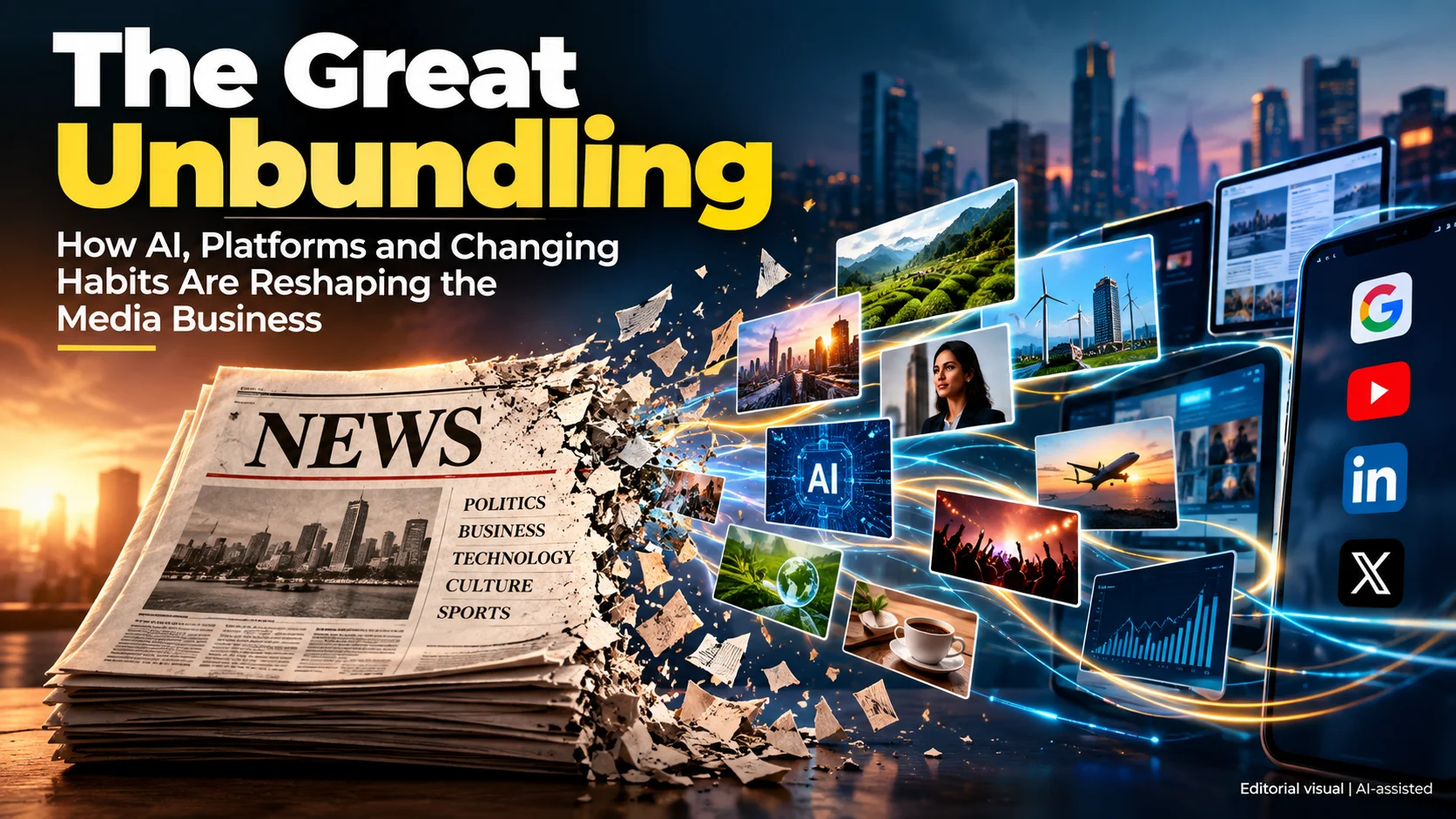
That model no longer works as reliably as it once did. Search behaviour is changing, social referrals are weakening, and AI systems increasingly answer questions before users reach a publisher’s website. The result is not simply a traffic decline. It is a structural unbundling of the relationship between publishers, platforms and audiences.
The important question, therefore, is not whether AI is “killing” news websites. The more useful question is this: what happens when the systems that once delivered attention stop delivering it at the same scale?
The Old Deal Is Changing
The numbers show that something significant has already shifted.
The Reuters Institute’s 2026 Journalism, Media and Technology Trends report found a 33% year-on-year decline in Google organic-search referrals to more than 2,500 news and media sites. U.S. publishers saw a 38% decline. The publishers surveyed also expected search traffic to fall further over the next three years.
Social distribution has weakened too. Facebook referrals have fallen sharply, while publishers have also seen significant declines from X. The old distribution system therefore faces pressure from several directions at once.
That matters because many digital publishers built their businesses around distribution they did not own. Google controlled search discovery. Social platforms controlled much of the referral flow. Publishers often controlled little more than the website itself.
The AI Answer Changes the Journey
Generative AI changes the journey in a more fundamental way.
A traditional search sends the user toward a list of links. An AI-generated answer can instead combine information from several sources and present a response immediately. The user may never need to visit the original publisher.
Pew Research provides a useful signal. In its analysis of 68,879 Google searches from 900 U.S. adults, users clicked a traditional search result 8% of the time when Google displayed an AI summary. Without an AI summary, that figure rose to 15%. Users clicked links inside the AI summary only 1% of the time.
The implication is important. The reader has not disappeared. The click has.
That distinction changes how publishers need to think about their businesses. The challenge no longer sits only inside journalism. It sits inside distribution, discovery and the economics that connect the two.
The Traffic Numbers Are Real
Recent traffic data makes the shift harder to dismiss.
Axios, citing Similarweb data, reported that visits to roughly 100 leading U.S. news sites fell to about 47.6 million in August 2026. The same group had recorded roughly 68 million visits at its November 2024 peak. That represents a decline of around 30% in less than two years.
However, the number does not prove that AI caused the entire decline.
Search algorithm changes, changing audience habits, social-media behaviour and the wider economics of digital publishing also influence traffic. Reuters itself cautions that it remains difficult to separate the impact of AI Overviews from Google’s broader algorithm changes and other market shifts.
That distinction matters. A serious media analysis should not reduce a complex structural change to a single villain.
The stronger conclusion is simpler: the old traffic system no longer gives publishers the same level of certainty.
India Is Feeling the Pressure
India offers an especially important case because much of its digital news economy grew around search and platform distribution.
Press Gazette’s reporting from Similarweb data has shown major traffic declines among several Indian English-language news websites. In one comparison, India.com recorded a 78% decline, while Hindustan Times fell 54%. Indian Express also recorded a substantial decline in the same period.
These figures describe individual publishers and specific measurement periods. They do not mean every Indian news organisation has suffered the same decline. Some publishers have performed differently, which makes the broader lesson more nuanced.
Still, the pressure matters because Indian digital news developed in a mobile-first environment where search and social referrals played an important role. Many publishers did not build the same depth of subscription, membership or habitual-app relationships that some older Western media brands developed.
Google’s algorithm changes have added another layer of uncertainty. AI-generated answers now sit inside a search environment that already changes frequently.
For publishers, that creates a difficult combination. They face declining certainty around discovery while also competing for attention against systems that can answer questions without requiring a visit to the source.
What Actually Broke?
Three structural weaknesses explain much of the problem.
1. Search Dependency Became Distribution Dependency
Publishers that built their audiences almost entirely through Google SEO created a hidden vulnerability.
They gained enormous reach without necessarily building an owned relationship with the reader. When search behaviour changed, they had limited alternatives.
A newsletter list can provide direct access. An app can create a habit. A community can create loyalty. A strong founder or editorial brand can create a reason for readers to return without searching.
Without those assets, a publisher remains dependent on the platform that controls discovery.
2. Commodity Content Became Easy to Replace
The second weakness runs deeper.
AI systems perform particularly well with generic questions, standard explainers and predictable informational formats. Those formats already dominated large parts of search-driven publishing.
Think about the familiar headlines: “What is…?” “How does…?” “Why does…?” “What are the benefits of…?” Hundreds of publishers can produce almost identical versions of the same article.
AI can synthesise that information without sending the reader through every page.
This creates a difficult cycle. Publishers produce more generic content because search rewards volume. AI then makes that content easier to synthesise. The resulting loss of clicks pushes publishers to produce even more content.
The problem, therefore, is not simply that AI produces answers. The deeper problem is that publishers created enormous volumes of information that never contained much differentiation in the first place.
3. A Thin Revenue Cushion Magnified the Shock
Traffic becomes dangerous when it carries too much of the business model.
Chartbeat data has shown a significant gap between smaller and larger publishers in referral losses. Smaller publishers have less scale and fewer diversified revenue streams, so a sharp traffic decline can hit them much harder.
A publisher with subscriptions, events, memberships, licensing, research and direct commercial relationships can absorb a traffic shock more easily.
A publisher that depends heavily on advertising linked to pageviews has fewer options.
That makes the traffic crisis a business-model problem as much as a technology problem.
The Counter-Signal: Original Access Still Matters
Yet the entire media ecosystem is not moving in one direction.
Vernacular and hyperlocal platforms continue to find opportunities. Regional-language news technology continues to attract interest. Brands also continue to value local storytelling where trust and cultural context influence conversion.
There is a reason for this.
AI can synthesise information that already exists in large quantities. It has a harder task when the information comes from original access.
A founder interview creates a source that did not exist before the interview. An on-the-ground investigation creates new information. A specialist dataset can contain knowledge that does not sit openly across hundreds of websites.
A conversation with a tea producer in Assam can reveal something that no generic article about Assam tea can reproduce. A local entrepreneur can explain a market shift before the data appears in a conventional report.
That is where journalism gains a different kind of value.
The Northeast May Have an Unusual Opportunity
This distinction could matter greatly for Northeast India.
The region does not need another thousand generic articles explaining its tourism, tea, handicrafts, biodiversity or entrepreneurship. AI can already produce that kind of content quickly.
The opportunity lies elsewhere.
What if publishers built a deep regional knowledge archive instead?
That archive could include founder interviews, producer stories, business data, local market intelligence, community perspectives, specialist knowledge and first-hand accounts. Each story would then become more than a page competing for a search query.
It would become part of a growing body of regional knowledge.
That changes the economics of publishing. A publisher no longer competes only for today’s click. It builds an information asset that becomes more valuable as it grows.
The Pageview Cannot Carry the Business Alone
The answer does not mean abandoning pageviews.
Search still matters. Google still matters. Social platforms still matter. Discovery still matters.
The problem begins when a publisher treats those channels as the entire business.
The more durable question is different: how many people would notice if your publication disappeared tomorrow?
That question points toward direct relationships.
Newsletters can create recurring contact. Events can create physical communities. Founder interviews can create distribution through the people featured. Membership can create economic relationships. Research products can turn editorial expertise into something customers actively buy.
The publisher’s website then becomes one part of a larger ecosystem rather than the entire ecosystem.
The Click Isn’t Disappearing. Its Monopoly Is.
It would be easy to overstate what comes next.
People will continue to click links. Search engines will continue to send traffic. Social platforms will continue to distribute content. Publishers will continue to benefit from strong rankings and useful stories.
But the click no longer enjoys the monopoly it once held.
For years, the dominant chain looked something like this:
Search → Click → Website → Attention → Revenue
AI is beginning to separate those stages.
A user can now search, receive an answer and leave without visiting a publisher. A platform can summarise a story without transferring the reader. A social feed can surface a piece of information without creating a lasting relationship with the source.
The chain has started to break into separate pieces.
That is the real meaning of the great unbundling.
What Should Publishers Build Next?
The strategic response does not require publishers to compete with AI at producing generic answers faster.
That is a race they are unlikely to win.
Instead, publishers need to build assets that generic AI answers cannot easily replace. Those assets include original reporting, proprietary research, specialist expertise, strong communities, direct audience relationships and access to people who create new information.
Distinctiveness becomes an economic asset.
Original access becomes an economic asset.
Trust becomes an economic asset.
A publisher that combines those assets can still use AI aggressively. AI can help with research, production, translation, distribution and personalisation. The technology becomes an accelerator rather than a substitute for editorial value.
That distinction may define the next generation of media businesses.
The Great Unbundling
The digital media industry is not simply losing traffic. It is losing the assumption that traffic will follow publishing in a predictable way.
For two decades, publishers could rely on a powerful distribution bargain. Produce information, get indexed, attract the click and monetise the audience.
AI has weakened that sequence.
But the deeper shift started before generative AI. Publishers became dependent on platforms. Social referrals weakened. Search algorithms changed. Audience habits fragmented. Advertising economics tightened.
AI has accelerated all of those pressures and exposed the weakness of generic content at enormous scale.
The lesson for publishers is therefore not “fight AI.”
It is more demanding than that.
Build what AI cannot simply reproduce. Build original access. Build proprietary knowledge. Build direct relationships. Build a reason for people to seek you out rather than merely encounter you.
The internet was built around the click.
AI is being built around the answer.
The next media economy may be built around what happens when the answer is no longer enough.