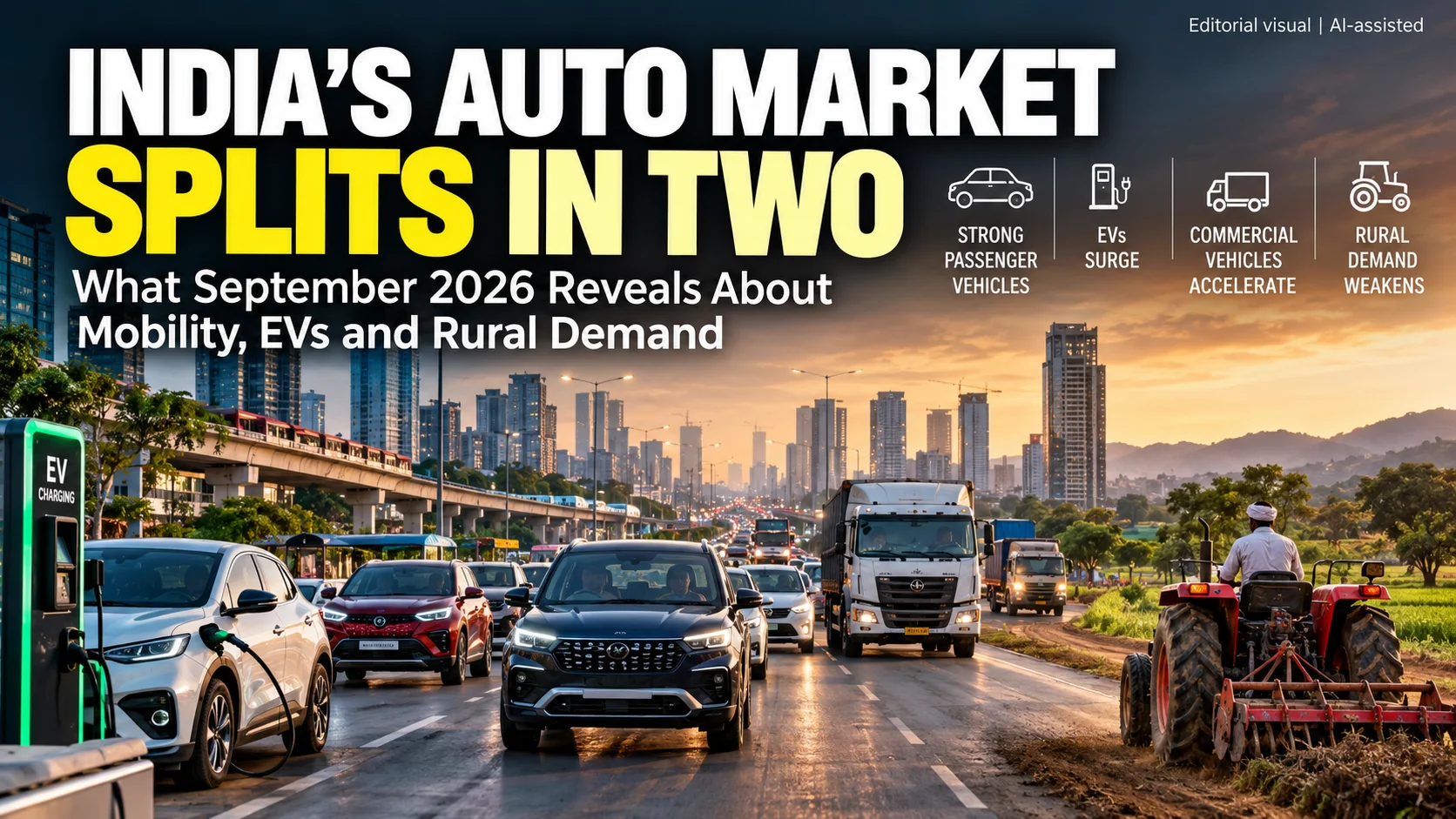
India’s Auto Market Splits in Two: What September 2026 Reveals About Mobility, EVs and Rural Demand
September 2026 delivered a powerful signal about the direction of India’s automobile and mobility market. Vehicle registrations surged, passenger vehicles remained strong, commercial vehicles accelerated and electric vehicles reached another record. Yet beneath the headline growth lies a more complicated story. Rural demand remains uneven, tractor sales are under pressure and manufacturers are positioning inventory ahead of the festive season.
For The Quantiq’s Auto & Mobility Intelligence, that distinction matters.
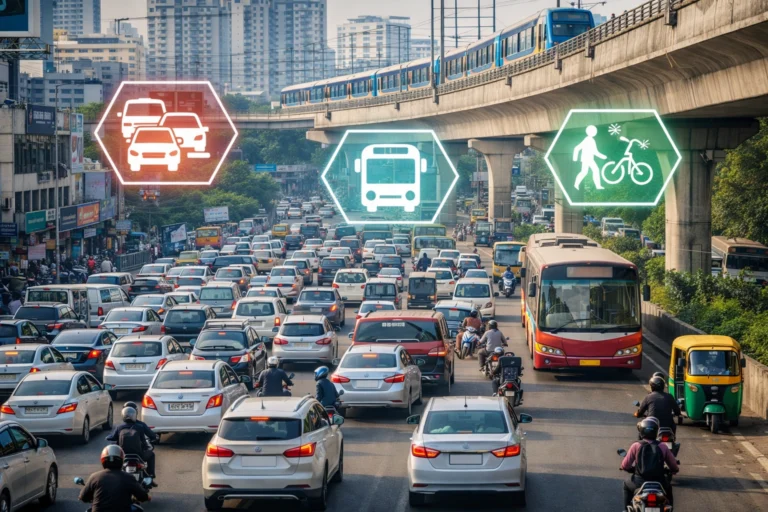
India’s automobile market is no longer moving as one market. Urban consumption is behaving differently from rural demand. Electric mobility is advancing at a different pace from conventional vehicles. Commercial mobility is responding to another set of economic forces.
September, therefore, is best understood not simply as another month of higher vehicle sales, but as a snapshot of an Indian mobility market undergoing structural change.
September’s headline number is impressive
India recorded 25,46,496 vehicle registrations in September 2026, according to Vahan-based data. That was 31.9% higher than September 2025 and 3.4% above August. The September figure was the strongest September in the available Vahan series.
The year-on-year comparison, however, needs some caution.
September 2025 was affected by the transition to GST 2.0, with buyers and dealers deferring purchases around the tax changes. The festive calendar was also different, with major festivals arriving earlier last year.
That creates a favourable comparison base for September 2026.
It does not, however, explain everything.
The breadth of the September numbers, combined with manufacturer disclosures, shows that several parts of the automobile market are genuinely strong.
The more interesting question is where that strength is coming from.
Passenger vehicles remain the strongest urban signal
India’s passenger vehicle market entered the festive season with considerable momentum.
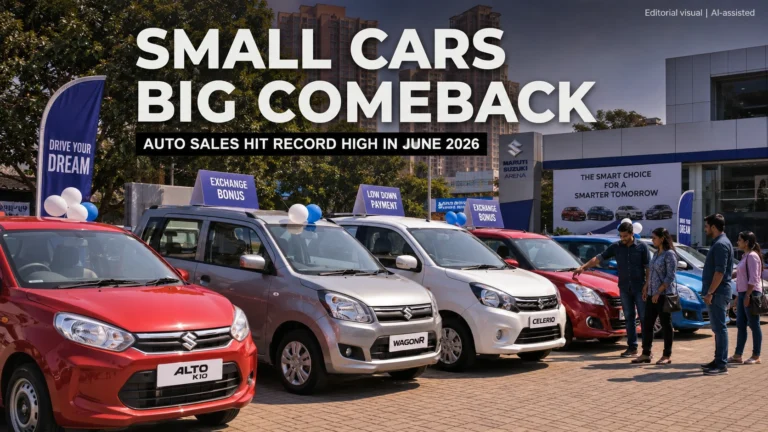
Industry wholesale data put domestic passenger vehicle sales at more than 4.6 lakh units in September, representing roughly 21% growth over the year-ago period. Maruti Suzuki, Tata Motors Passenger Vehicles and Mahindra all reported strong year-on-year growth in their respective businesses, while Hyundai recorded a particularly strong month.
Maruti Suzuki reported 1,85,252 domestic sales, along with 6,542 vehicles sold to other OEMs and 44,219 exports. Its total sales reached 2,36,013 units in September.
Mahindra reported 64,092 SUVs, up 14%, while its overall automotive sales reached 1,14,874 vehicles, up 15%.
The important point is not simply that passenger vehicles grew.
It is that Indian consumers continue to demonstrate a willingness to spend on personal mobility despite uncertainty elsewhere in the economy.
SUVs continue to reshape the market
The SUV story remains one of the defining structural changes in India’s automobile industry.
Mahindra’s September numbers provide a clear example. Its utility vehicle business grew 14%, even as the broader market continued to absorb new models across multiple price categories.
The shift towards SUVs and utility vehicles has implications beyond consumer preference.
Larger vehicles generally carry higher transaction values. Their increasing share can therefore support industry revenues even when unit growth is less dramatic.
At the same time, smaller vehicles could receive some support from improved affordability following changes to the tax structure.
India’s passenger vehicle market is consequently becoming more layered.
At one end, consumers are moving towards larger SUVs and increasingly sophisticated vehicles. At the other, affordability remains critical for first-time buyers.
That makes the market more interesting than a simple SUV-versus-hatchback story.
But wholesale sales are not the same as consumer demand
This distinction is crucial when reading September’s automobile numbers.
Manufacturers report vehicles dispatched or sold into their distribution networks. Vahan records vehicles that are registered.
The two numbers do not necessarily move together in the same month.
September manufacturer dispatches were strong partly because companies and dealers were preparing for the October-November festive period. Industry reporting also points to dealer inventory rising ahead of the festive season.
This creates an important question.
If festive demand remains strong, the inventory build-up will prove justified.
If demand disappoints, higher inventory could become a pressure point for dealers and manufacturers.
That is why the next two months may tell us more about the health of the passenger vehicle market than September wholesale numbers alone.
Two-wheelers are growing, but the rural story is different
Two-wheelers remain the backbone of India’s mass mobility system.
Vahan-based data show approximately 17.9 lakh two-wheelers registered in September, with strong year-on-year growth.
The manufacturer numbers, however, reveal a more uneven picture.
TVS Motor reported 6,45,955 two-wheeler sales, up 23%, while domestic two-wheeler sales increased 17%. Its electric two-wheeler sales more than doubled to 65,799 units.
Bajaj Auto presents a useful counterpoint.
Its total two-wheeler sales rose 5% in September, but domestic two-wheeler sales fell 12%, while exports increased sharply.
That divergence matters.
Two-wheelers are closely connected to rural purchasing power, agricultural activity and small-business cash flows. A strong national number therefore does not necessarily mean rural demand has recovered uniformly.
September’s data suggest that the two-wheeler market is recovering, but the recovery remains uneven across manufacturers, geographies and customer groups.
The rural economy is sending a warning signal
This is perhaps the most important counterpoint to September’s overall vehicle growth.
India’s southwest monsoon ended 12.6% below normal, according to the data cited in reporting on September automobile sales. The weak and uneven rainfall affected agricultural conditions and rural purchasing power.
The tractor market provides the clearest evidence.
Mahindra’s Farm Equipment Business reported 50,208 domestic tractor sales in September, down 23% year on year. Its exports, in contrast, increased 62%.
Escorts Kubota also reported a decline in tractor sales during the month, with the company citing the impact of the patchy monsoon and relatively lower crop sowing.
The comparison base and festive calendar clearly matter.
But the wider rural environment matters too.
When rainfall is deficient, farm incomes and agricultural investment can become more uncertain. That can influence purchases of tractors, motorcycles and other rural-oriented assets.
This is why India’s September automobile market cannot be described simply as a broad-based consumer boom.
The urban consumption story is considerably stronger than the rural one.
Commercial vehicles are accelerating
Commercial vehicles delivered another strong signal.
Vahan-based registrations reached approximately 1,02,358 units in September, up 37.6% year on year and 9.9% over August.
Tata Motors remained the segment leader in the Vahan data, with 37,102 registrations.
Mahindra’s trucks and buses business also had a strong month. It reported 2,912 vehicles, up 53% year on year. Cargo vehicles grew particularly strongly, while passenger vehicles in the division also increased.
Mahindra attributed the performance to early festive buying, infrastructure activity and steady freight movement, while also noting the lower comparison base of the previous year.
Commercial vehicles therefore provide an important economic signal.
Freight movement, infrastructure activity and the movement of goods and people appear to be supporting demand.
The next structural question is how much of this commercial mobility growth will be captured by electric vehicles.
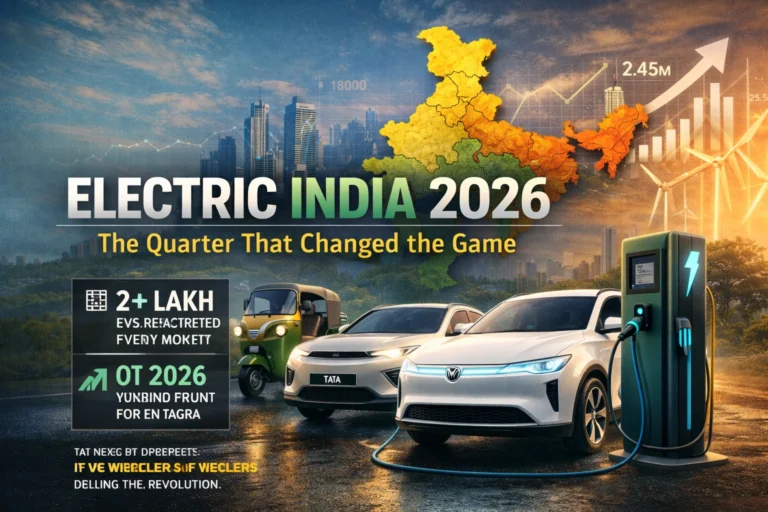
The EV story is becoming a volume story
If one number deserves particular attention from September, it is electric vehicle registrations.
Vahan-based data show that India registered more than 3.3 lakh EVs in September, making it a record month. The final number can change slightly because Vahan registrations are updated with a time lag.
One current Vahan compilation puts September EV registrations at 3,34,194, up 74.5% from September 2025 and 10.3% from August.
The significance goes beyond the monthly record.
September was the fourth consecutive month in which EV registrations crossed three lakh, according to reporting based on Vahan data.
That makes the September result considerably more meaningful than a one-month spike.
India’s EV market is moving from an early-adopter phase towards a genuine volume market.
Electric two-wheelers are leading the transition
Electric two-wheelers remain the largest force within India’s EV expansion.
September registrations crossed two lakh units, with industry reporting putting the total at approximately 2.07 lakh.
TVS alone recorded 65,799 electric two-wheeler sales, up 110% year on year.
Ather also crossed 30,000 registrations, while several other manufacturers recorded meaningful volumes.
The competitive landscape is changing rapidly.
The early electric two-wheeler market was dominated by specialist EV companies.
Established manufacturers now have substantial distribution networks, manufacturing capacity, financing relationships and after-sales infrastructure.
The next phase of competition may therefore be less about convincing consumers that electric mobility works and more about who can manufacture, distribute, finance and service electric vehicles at scale.
That is a very different competitive game.
Electric cars are moving closer to mainstream adoption
Electric passenger vehicles remain a smaller part of the overall market, but September produced another significant milestone.
Vahan-based data compiled by Nuvama showed 35,948 electric passenger vehicle registrations, up 94% year on year. EVs represented approximately 8.3% of India’s passenger vehicle registrations during the month.
That means roughly one in every twelve passenger vehicles registered in September was electric.
Tata remained the largest electric passenger vehicle player, while Mahindra continued to expand its presence in electric SUVs. The competitive field is also widening as new manufacturers and models enter the market.
This is an important transition.
India’s EV story is no longer confined to small electric scooters.
Electric mobility is beginning to establish itself across cars, three-wheelers and commercial vehicles.
Three-wheelers could become an important EV gateway
Three-wheelers deserve considerably more attention than they usually receive.
The segment registered strong growth in September, while electric three-wheelers continued to account for a significant share of the market. Vahan-based reporting put electric three-wheeler registrations at more than 86,000 units during September.
TVS reported 26,835 three-wheelers, up 57% year on year.
The economics of this segment are particularly interesting.
A three-wheeler is often a commercial asset rather than a lifestyle purchase. For an owner-driver, operating costs have a direct impact on daily income.
That makes the economics of electricity versus petrol or diesel particularly important.
For this reason, India’s electric three-wheeler market could become one of the most consequential examples of commercially driven EV adoption.
Assam provides a different mobility lens
For The Quantiq, national numbers are only half the story.
The Northeast deserves its own mobility lens.
Assam recorded 53,131 vehicle registrations in September 2026, up 2.2% year on year and 7.9% over August. The state ranked 17th among India’s states by September registrations.
The scale is significant, but the structure is more important.
Assam remains heavily dependent on two-wheelers for personal mobility. At the same time, the state’s EV ecosystem is beginning to develop.
Government data provide a useful infrastructure benchmark.
As of July 1, 2026, 117 EV public charging stations had been sanctioned in Assam under FAME-II, of which 88 were operational. A further 198 chargers had been sanctioned across the Northeast through oil marketing companies.
The PM E-DRIVE programme provides another signal. Government data show that 42,035 EVs had been sold in Assam under the scheme as of July 22, 2026, with 40,009 EVs incentivised and ₹99.10 crore reimbursed to OEMs.
These numbers suggest that Northeast India’s EV opportunity is becoming more tangible.
But adoption will depend on more than vehicle prices.
Charging infrastructure, financing, road connectivity, distance between urban centres and the economics of commercial mobility will all shape the region’s transition.
The Northeast has another mobility challenge
The region’s automobile market cannot be separated completely from its wider economy.
The 2026 monsoon was uneven, and the rural economy remains important across much of the Northeast.
At the same time, Assam is seeing increasing investment in logistics, connectivity, tourism and urban infrastructure.
That creates an interesting mobility equation.
The region could see growing demand for personal vehicles, commercial vehicles, logistics fleets and electric mobility at the same time.
The challenge will be ensuring that infrastructure develops quickly enough to support that transition.
For The Quantiq, this is precisely why regional mobility data deserve to sit alongside national automobile numbers rather than being treated as an afterthought.
September’s real story is not the 31.9% growth
The headline growth number is impressive.
But it is not the most important story.
The more significant development is the divergence within the market.
Passenger vehicles are strong. SUVs continue to reshape consumer demand. Commercial vehicles are accelerating. Electric two-wheelers are entering genuine mass-market territory.
Electric passenger vehicles are approaching an important adoption threshold. Three-wheelers are becoming a major pathway for commercial electrification. Yet rural demand remains fragile.
Tractor sales are sending a warning signal. The monsoon has been uneven. And manufacturers are entering the festive season with significant expectations.
India’s automobile market is therefore not simply recovering. It is being reshaped.
The Quantiq View
September 2026 offers a useful warning against reading India’s automobile market through a single headline.
Yes, the market grew strongly.
But the more important story is where the growth came from and where it did not.
Urban consumption remains resilient. SUVs continue to reshape passenger vehicles. Commercial mobility is strengthening. EVs are moving rapidly from niche adoption towards scale.
At the same time, rural demand remains uneven, and tractor sales show that India’s economic recovery is not being experienced uniformly across the country.
The automobile industry is therefore entering the festive season with both confidence and questions.
If October and November convert September’s wholesale momentum into genuine retail demand, the industry could be heading towards another strong period.
If they do not, elevated inventory could become a pressure point.
Either way, the next two months will tell us much more than September alone.
For India’s mobility industry, the real story is no longer simply how many vehicles are being sold. It is what those vehicles tell us about how India is travelling, earning, consuming and changing.
Sources
Primary and supporting sources used for this analysis include the Government of India’s Vahan/Parivahan data, SIAM, Maruti Suzuki, Mahindra & Mahindra, TVS Motor Company, the Ministry of Heavy Industries, Press Information Bureau and Reuters. The manufacturer disclosures have been used for wholesale or company-specific figures, while Vahan data have been used for registrations.