
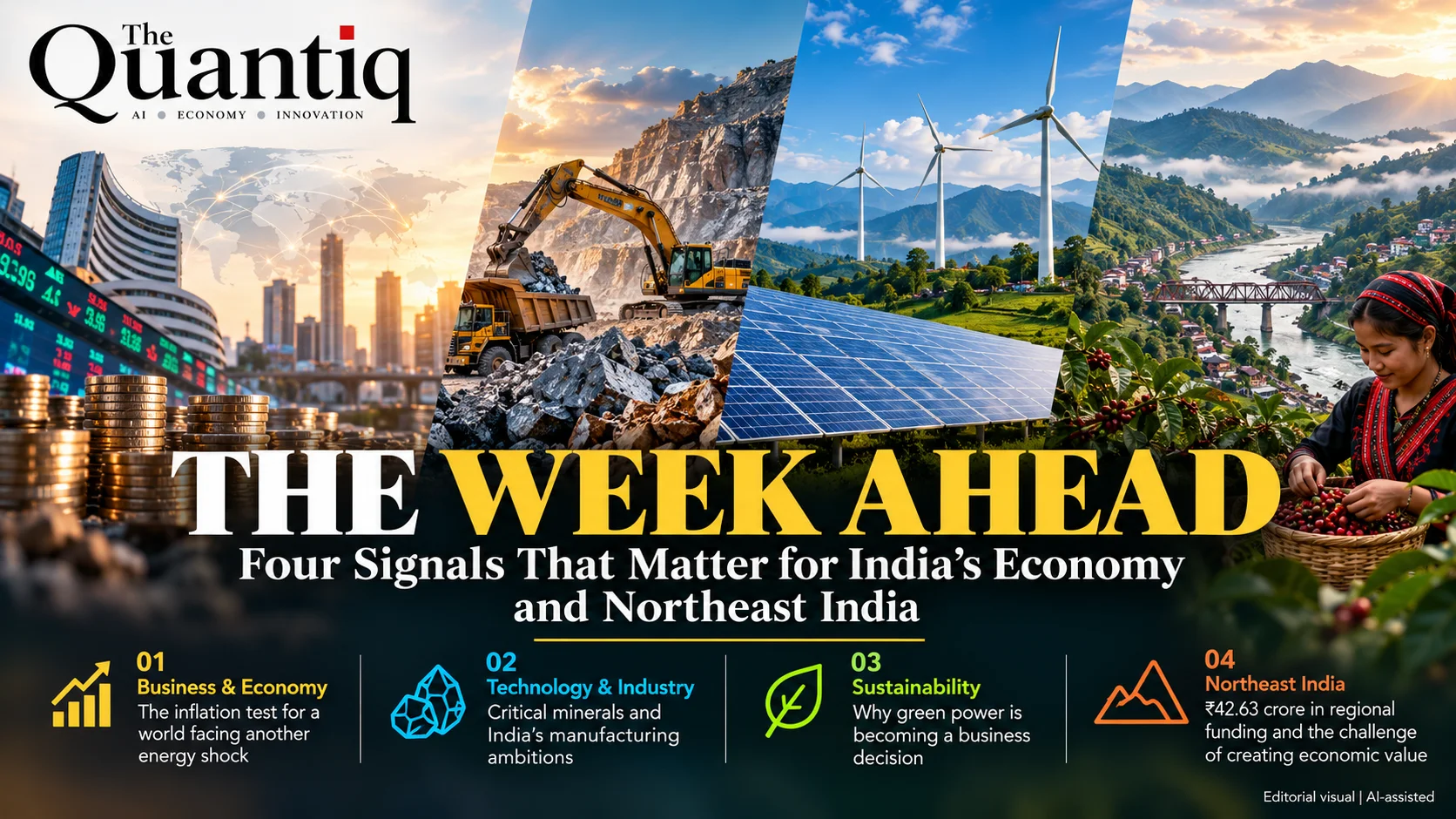
The Week Ahead: Four Signals That Matter for India’s Economy and Northeast India
The week ahead brings four developments into focus: the global economic outlook, India’s search for secure supplies of critical minerals, the growing business case for renewable energy, and the conversion of development funding into economic opportunity in Northeast India.
These stories may appear unrelated, but they share a common thread. Economic resilience increasingly depends on how effectively countries and businesses manage uncertainty, strengthen supply chains and turn resources into productive capacity.
For entrepreneurs, investors and policymakers, the important question is not simply what has been announced. It is what these developments could mean for investment, competitiveness and the creation of lasting economic value.
1. Business & Economy: The Inflation Test for a World Facing Another Energy Shock
The global economy enters a consequential week as the International Monetary Fund (IMF) and World Bank hold their Annual Meetings in Bangkok from 12 to 18 October. Rising energy and fertiliser prices, geopolitical tensions and mounting public debt are expected to shape discussions about economic stability and future growth. The IMF is scheduled to release its updated World Economic Outlook on Tuesday, 13 October.
For India, the implications extend beyond movements in crude oil prices. Higher energy and transportation costs can squeeze manufacturing margins, increase logistics expenses and eventually affect household budgets. Smaller businesses may face particular pressure because they have less room to absorb higher costs or pass them on to customers.
The challenge is to maintain growth without allowing inflationary pressures to undermine demand. Businesses will need to pay close attention to energy exposure, supplier contracts and working capital. The IMF’s updated projections should offer a clearer picture of the risks confronting the global economy.
For Indian entrepreneurs, resilience may increasingly depend on disciplined cost management and the ability to adapt before external shocks reach the balance sheet.
2. Technology & Industry: Critical Minerals and India’s Manufacturing Ambitions
India is preparing a policy to build strategic reserves of critical minerals, with the government indicating that the framework could be announced within a month. The proposed initiative is intended to reduce vulnerability to international supply disruptions and secure materials essential to defence, aerospace, electric vehicles and clean-energy technologies. The government is also working on dedicated mineral-processing parks in Andhra Pradesh, Odisha, Gujarat and Maharashtra.
Lithium, cobalt, nickel, copper and rare earth elements have become strategic industrial inputs. They are used in batteries, electricity networks, wind turbines and electronic equipment. Yet access to these materials is only one part of the challenge. Processing, refining, recycling and reliable logistics determine how much value a country can retain within its own industrial ecosystem.
For India, the opportunity lies in building capabilities that extend beyond importing minerals and assembling finished products. New processing technologies, material recovery systems and specialised supply-chain services could create opportunities for businesses and technology providers.
The proposed policy remains a work in progress, and its impact will depend on implementation. Nevertheless, it signals a wider shift in industrial strategy: securing resources is important, but developing the ability to transform them into higher-value products is what strengthens manufacturing competitiveness.
3. Sustainability: Why Green Power Is Becoming a Business Decision
Renewable energy is increasingly being treated as a strategic business investment rather than simply an environmental commitment. Indian companies are expanding captive renewable power generation and entering long-term green electricity arrangements to improve cost visibility, reduce dependence on conventional grid supplies and lower emissions. The trend is particularly relevant to energy-intensive industries such as steel, cement and metals.
The economics are becoming harder to ignore. Electricity can account for a substantial share of operating costs in some manufacturing segments. Where renewable power offers competitive tariffs and dependable supply arrangements, it can help businesses protect margins while making progress towards their sustainability goals.
However, the transition is not simply a matter of installing solar panels. Companies must consider financing, land, transmission access, storage and the need for uninterrupted electricity. These factors can be particularly important for smaller manufacturers that lack the resources of large industrial groups.
For Northeast India, the question is how to connect its renewable energy potential with commercially viable industrial activity. Reliable power, suitable infrastructure and predictable project economics will be essential to attracting investment. Green energy can become a regional competitive advantage when it supports productive enterprises, creates jobs and makes local manufacturing more viable.
4. Northeast India: ₹42.63 Crore in NEC Funding and the Challenge of Creating Economic Value
The North Eastern Council (NEC) released ₹42.63 crore for development projects across Northeast India during September 2026, according to an update published on 5 October. Of this amount, ₹35.21 crore went to the eight Northeastern states, while ₹7.42 crore supported regional institutions and agencies. The allocations cover areas including agriculture, tourism, education, technology, bamboo-based livelihoods and community infrastructure.
The projects offer several examples of how public investment could support local economic activity. Nagaland received funding for a cluster-based coffee value chain, while Mizoram’s initiatives include ginger cultivation, cultural tourism infrastructure and technology-based mineral mapping. In the wider region, support for bamboo artisan clusters and handloom skills also points towards opportunities for traditional industries to improve their market reach.
The larger challenge is to connect these initiatives with buyers, processors, logistics providers and entrepreneurs. Agricultural production, for example, creates greater value when farmers have access to processing, quality assurance, reliable market information and organised distribution. Tourism infrastructure is more effective when it supports viable local businesses and encourages visitors to spend within communities.
Funding is an important starting point, but its lasting value depends on execution and outcomes. For Northeast India, the priority must be to build productive local economies in which public investment helps enterprises grow, creates sustained livelihoods and strengthens regional supply chains.






One Comment