
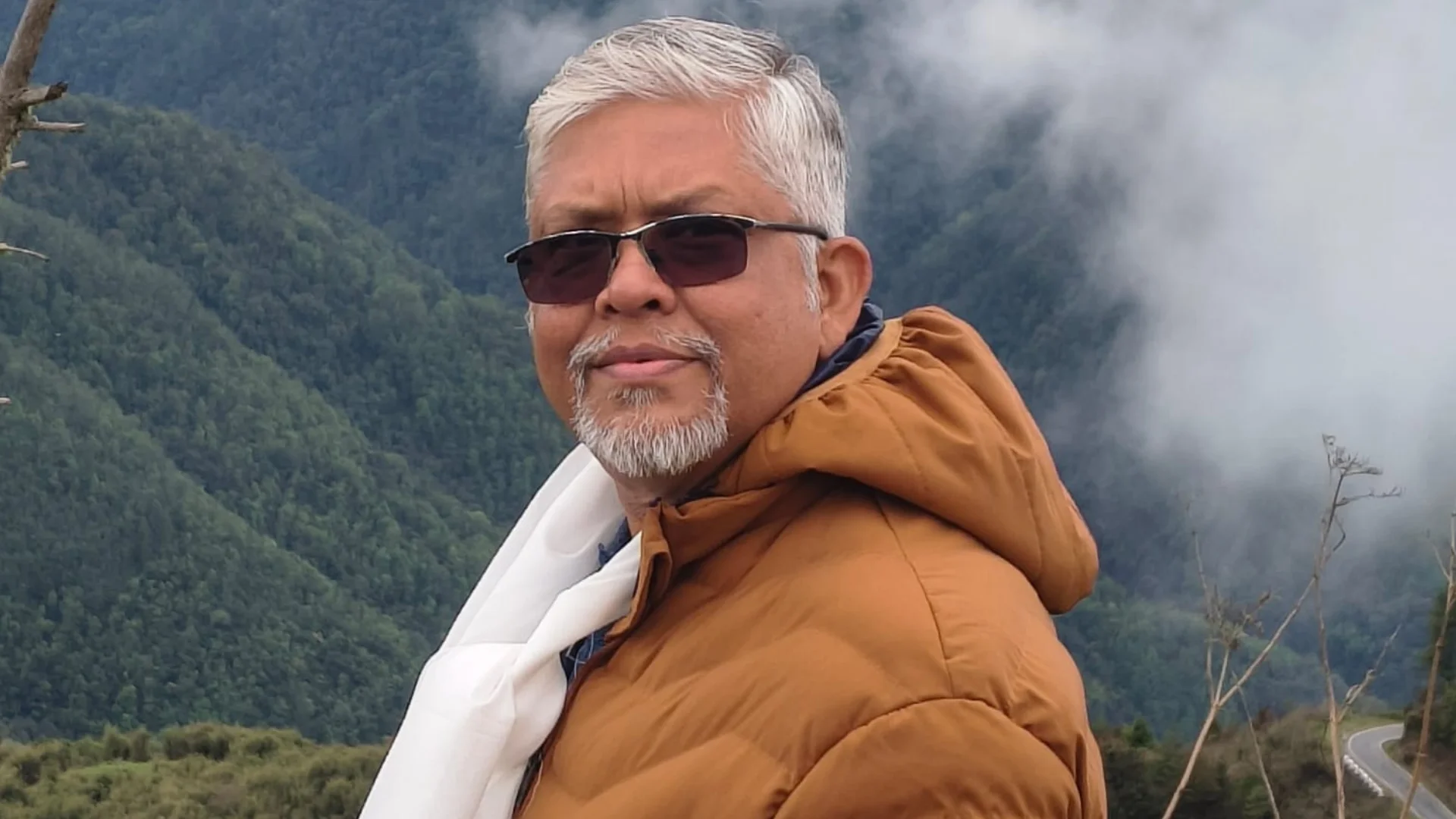
Pranjal Baruah: The Mushroom Man Building a New Generation of Entrepreneurs
Founder Series | The Quantiq
After three decades of mushroom cultivation, grassroots training and livelihood creation, Pranjal Baruah is preparing for a new entrepreneurial chapter. His ambition goes beyond launching value-added products. He wants to help more people build sustainable businesses of their own.
What does an entrepreneur leave behind when a business closes? For some, the answer is a brand, a balance sheet or a collection of memories. For Pranjal Baruah, widely known as the Mushroom Man of Assam, the legacy can be measured in another way: in the people who acquired the skills, confidence and resources to start businesses of their own.
Baruah has spent more than three decades working with mushrooms, farmers and aspiring entrepreneurs across Northeast India. His journey has taken him from a small cultivation setup to commercial spawn production, farmer collectives, women-led livelihood initiatives and year-round skill development.
Now, he is preparing for another chapter. Through PRITHIVI PUSTI SOLUTION PRIVATE LIMITED, he plans to bring a new range of value-added mushroom products to market. Yet the company is only one part of a wider ambition. He also wants to help other entrepreneurs enter the mushroom value chain, using a shared brand owned by the Mushroom Development Foundation (MDF).
This is what makes his story worth examining. Baruah is not simply trying to build another mushroom business. He is exploring how decades of technical knowledge and grassroots experience can be used to create opportunities for others.
For a region like Northeast India, where many agricultural resources remain underutilised, the challenge is not just to produce more. It is to develop the processing, market access, skills and entrepreneurial capacity that allow local resources to generate lasting economic value.
Baruah’s journey offers a perspective on how that transformation might happen, one entrepreneur and one livelihood at a time.
From early experiments in Jorhat to a pioneering mushroom enterprise
Baruah began experimenting with mushroom in 1995, working on a small scale in Jorhat. He was able to draw on the expertise and laboratory facilities available at Assam Agricultural University. Those early experiments laid the foundation for a much larger undertaking.
The challenge was bigger than learning how to grow mushrooms. A sustainable mushroom industry needed reliable planting material, trained growers, technical support and dependable markets. Without these, farmers could learn to cultivate mushrooms but still struggle to turn their efforts into a regular source of income.
Baruah began to see the need for an integrated approach. Cultivation had to be connected with production inputs, processing and marketing.
After moving to Guwahati, he persuaded the state government to make a government laboratory available on a long-term lease for mushroom spawn production. He then secured a loan supported by the National Small Industries Corporation (NSIC) to acquire the laboratory equipment.
His enterprise, Protein Food, developed a commercial business under the brand name Mushfill. It covered mushroom spawn production, fresh and dried mushrooms, and a range of processed products.
The growth was substantial for its time. According to Baruah, the business grew from an initial investment of around ₹20,000 to a turnover exceeding ₹30 lakh in 2003–04. Its product range included mushroom pickles, papad, biscuits, cakes, momo and soup. The spawn laboratory eventually reached a reported production capacity of 3,000 packets of 250 grams each per day.
These achievements gave Baruah practical experience in the business of mushrooms, from cultivation to product development. They also taught him an important lesson. Technical knowledge alone could not build an industry. Production had to be supported by processing, distribution and consumer demand.
That understanding would shape the next phase of his life.
When a setback helped create new entrepreneurs
One of the most revealing episodes in Baruah’s journey came in 2014, when he had to vacate the laboratory he had developed for mushroom spawn production.
For an entrepreneur, losing a key production facility can mean more than the end of a business operation. It can also mean the loss of equipment, accumulated knowledge and a trained workforce.
Baruah responded differently. According to his account, he distributed the laboratory equipment among members of his staff and encouraged them to continue spawn production independently.
The decision gave former employees an opportunity to use their experience to build businesses of their own. Some continue to work in the mushroom sector and collaborate with Baruah.
There is a larger lesson in this episode. The closure of a business does not have to erase the capabilities created during its existence. Skills, relationships and practical knowledge can survive in other enterprises, carried forward by people who have learned to stand on their own feet.
This is one of the clearest expressions of Baruah’s approach to what may be called compassionate entrepreneurship. He did not treat the knowledge and productive capacity developed around his business as assets that had value only within his own enterprise.
Instead, he helped others put those assets to use.
A founder can build a company. But helping former employees become independent entrepreneurs can create a wider and more enduring impact. The original business may no longer exist in its earlier form, yet its contribution continues through the people who carry its knowledge forward.
For aspiring entrepreneurs in Northeast India, this is a particularly relevant lesson. Business success is not measured only by the survival of the original enterprise. It can also be measured by the opportunities and capabilities it leaves behind.
Building livelihoods through the Mushroom Development Foundation
Baruah’s work has long extended beyond his own commercial ventures. In 1995, he co-founded the Mushroom Development Foundation, a not-for-profit organisation focused on mushroom cultivation, farmer development and livelihood creation.
His work received recognition through the Ashoka Fellowship in 2003. He also received recognition from the Clarence Foundation in 2004 and the Early Growth Agriculture Award at Villgro’s Wantrapreneur ’09 in 2009. Together, these milestones reflect the different dimensions of his work, from social entrepreneurship and poverty alleviation to agricultural enterprise development.
The common thread has been his effort to connect cultivation with markets and make mushroom farming a viable livelihood rather than a short-lived intervention.
Training people to grow mushrooms is only the first step. Farmers also need reliable spawn, practical guidance, quality control and access to buyers. Without those connections, increased production can leave growers with limited bargaining power and uncertain returns.
Baruah’s approach has therefore included farmer training, collective marketing, product development and support for community-based production networks.
Women have been an important part of this work. In Kamrup district, a project involving 200 women, implemented with the Assam State Rural Livelihoods Mission, developed an annual production capacity reported at 250 metric tonnes of fresh mushrooms.
It recorded sales and income of approximately ₹24.83 lakh between November 2018 and November 2019. These figures relate to that specific period and should not be read as current earnings. Nevertheless, they illustrate how organised production and market linkages can help small producers participate in a more structured value chain.
The underlying principle is straightforward. Individual households can cultivate mushrooms, but a stronger industry requires coordination across production, aggregation, processing and marketing. Collective structures can help small producers reach markets that would be difficult to access independently.
Training trainers to multiply the impact
Baruah says his skilling journey through various government schemes has reached well over 200,000 people across Northeast India. His emphasis is not simply on the number of people trained, but on creating the capacity to train others.
He places particular importance on a training-of-trainers approach. By equipping people who can pass on their knowledge, he hopes to extend the reach of technical skills beyond those he trains directly.
The logic is powerful. A trained grower can establish a production unit. With experience, that grower may become an entrepreneur and eventually train others. Each stage creates the possibility of reaching more people without depending entirely on a central organisation.
This multiplier effect matters in a region where aspiring entrepreneurs may have access to raw materials but lack practical guidance, business knowledge or ongoing technical support.
It also changes the meaning of capacity building. The objective is not merely to deliver a training programme. It is to develop people who can continue sharing their skills and supporting new enterprises long after the original programme has ended.
For Baruah, building that capacity has been an important part of creating a more sustainable mushroom ecosystem.
The Livelihood Ashram: a living laboratory in Rani
The next stage of Baruah’s work is taking shape at the Livelihood Ashram in Rani, on the outskirts of Guwahati. Established during 2025–26, the Ashram is intended to function as a living laboratory where training, skill development and experimentation continue throughout the year.
The concept brings together several strands of his experience: cultivation, technical learning, entrepreneurship, product development and livelihood creation.
A living laboratory is different from a conventional training centre. It offers a setting where people can learn by doing, test methods, observe results and work through the problems that arise in real production environments.
That distinction matters because technical skills alone do not automatically produce successful businesses. An aspiring mushroom entrepreneur must also understand production costs, planning, quality, packaging, customer preferences and distribution.
By bringing practical experimentation and training together, the Ashram aims to help bridge the gap between learning a technique and building a viable enterprise.
It also fits into Baruah’s broader ambition to develop a more integrated mushroom value chain. Such a system could connect spawn production, growing units, processing and marketing, allowing people with different levels of capital and expertise to participate.
The Ashram’s long-term contribution will depend on what it delivers in practice: the people trained, businesses established, products developed and livelihoods sustained. Its underlying premise, however, is important. Entrepreneurship needs places where knowledge can be tested, refined and transferred continuously, rather than delivered through isolated training sessions.
From growing mushrooms to creating value-added products
The next opportunity for Baruah lies in moving further along the mushroom value chain.
Fresh mushrooms are perishable. Their commercial potential can be limited by storage, transportation, inconsistent supply and the distance between producers and consumers. Processing can extend shelf life, create differentiated products and open new routes to market.
It can also help farmers and small businesses capture more value from the crop rather than depending entirely on sales of fresh produce.
Baruah has explored mushroom-based products since the early days of Protein Food. During the COVID-19 pandemic, experimentation gained fresh momentum. His wife, Nikumoni Baruah, an actress, took the lead in trying out mushroom-based preparations.
That period helped renew the idea of building a product-focused business around mushrooms. It also brought a family dimension to the next stage of the venture, with experimentation and product development helping lay the groundwork for a new commercial chapter.
The company established to take this work forward is PRITHIVI PUSTI SOLUTION PRIVATE LIMITED. Baruah plans to launch its first batch of value-added mushroom products in the last week of November 2026.
But the business model he envisages goes beyond the products of one company.
Why the umbrella brand will belong to the Mushroom Development Foundation
Baruah’s plan is to create a shared brand under which value-added mushroom products can be marketed. Crucially, the Mushroom Development Foundation, rather than Prithivi Pusti Solution, is intended to own this brand.
Prithivi Pusti will be one user of the brand, alongside other entrepreneurs who join the network.
This distinction is fundamental to the idea. If the brand belonged exclusively to the new company, its commercial value would accrue primarily to that enterprise. By placing ownership with MDF, Baruah intends to keep the brand’s value connected to an organisation whose purpose is to support farmer livelihoods.
The model could give participating entrepreneurs a common identity and a way to reach customers without requiring each small business to build an entirely separate brand. Instead of developing consumer recognition independently, they could potentially benefit from a shared platform.
For smaller enterprises, this could reduce some of the barriers to entering the market. It could also create opportunities for entrepreneurs to specialise in different parts of the value chain while working under a common brand.
Such a model will need clear rules. Product quality must remain consistent, participation must be transparent, and the commercial benefits must be distributed fairly. A shared brand is valuable only when customers can trust the products sold under it and participating businesses understand their responsibilities.
If these conditions are met, the arrangement could become more than a marketing strategy. It could provide a way to ensure that the value created by a collective initiative does not accrue to one enterprise simply because it happens to be the first participant.
The foundation would hold the brand as an asset connected to its wider livelihood mission, while participating entrepreneurs could use it to develop their businesses.
That is an important distinction between building a company and building an entrepreneurial ecosystem. The first seeks to grow one enterprise. The second aims to create conditions in which many enterprises can grow.
Shiitake and the search for a more accessible business model
Baruah’s recent experiments with shiitake cultivation in Northeast India add another dimension to his plans.
Shiitake is a higher-value mushroom associated with established markets in East Asia and increasingly familiar to consumers elsewhere. Successfully cultivating it under local conditions could create opportunities beyond conventional mushroom varieties.
But successful cultivation is only the beginning. Commercial viability depends on reliable yields, production costs, quality, demand and the ability to supply customers consistently.
Baruah is also working to make mushroom farming more accessible through a model he describes as low investment, high return. The intention is to encourage more people to consider mushroom cultivation without requiring them to begin with a large financial commitment.
Interest in the approach is reportedly growing, with people expressing willingness to invest in mushroom farming. This is an encouraging early signal, although interest should not be confused with actual investment or proven profitability.
The model will need to demonstrate its economics across different production settings and market conditions. Prospective growers need realistic information about startup costs, working capital, technical support, production cycles and potential buyers. They must also understand the risks of crop failure and weak demand.
For livelihood entrepreneurship to succeed, people need more than an attractive promise. They need a clear understanding of what the business requires and the support needed to sustain it.
If Baruah’s approach can make these factors more transparent while providing dependable technical guidance, it could help more people enter mushroom farming with a better foundation.
The real opportunity is not simply to persuade people to grow mushrooms. It is to help them build businesses that can survive beyond the initial excitement.
Institutional support provides a foundation, not a guarantee
Baruah’s new venture is entering this phase with institutional support. According to information shared by him, he has received grants from NECTAR and NETAHUB, along with a subsidy from the Assam state agriculture department.
Such support can be valuable for an early-stage enterprise. It can help with experimentation, equipment, product development and market readiness, reducing some of the barriers between an idea and a commercial operation.
But grants and subsidies are enablers, not proof of market success. The longer-term test will be whether the company can attract repeat customers, maintain product quality, generate sustainable margins and create a business model that benefits the wider network of entrepreneurs it hopes to support.
Baruah enters this phase with an advantage: decades of experience in cultivation, farmer behaviour, training, spawn production, product experimentation and the difficulties of connecting small producers to markets.
His challenge is to translate that accumulated knowledge into systems that other people can use and a business model that can scale.
Personal experience can help a founder make good decisions, but a larger network needs repeatable processes. Quality standards, production planning, market access and commercial discipline must remain strong as more entrepreneurs join.
That will be central to determining whether the new venture can turn its social ambition into a durable business model.
What makes Pranjal Baruah a compassionate entrepreneur?
The phrase compassionate entrepreneur captures the thread connecting the different chapters of Baruah’s journey.
His compassion is evident in the way he helped former staff members start their own spawn production businesses. He has also worked with women’s groups and small farmers to create livelihood opportunities. By training trainers, he aims to spread practical knowledge to more communities.
His proposed umbrella-brand model carries the same philosophy forward. The Mushroom Development Foundation will own the brand, allowing Prithivi Pusti Solution and other participating entrepreneurs to use it. This approach is designed to keep the brand’s value linked to farmer livelihoods rather than a single company.
This does not mean commercial returns are unimportant. A business that cannot cover its costs or maintain demand will struggle to support the people who depend on it. Compassionate entrepreneurship must combine an inclusive purpose with a commercially credible operating model.
Nor should good intentions be confused with demonstrated impact. The new venture’s promise will ultimately be judged by the enterprises it helps create, the livelihoods it sustains, the products customers choose and the value participants are able to retain.
Baruah’s experience suggests that these objectives need not conflict. A stronger value chain can benefit farmers, processors, trainers, distributors and consumers. A shared brand can help smaller businesses reach markets they might struggle to enter individually. Training can develop not just competent cultivators, but people capable of managing viable enterprises.
The question now is whether the next phase can turn that accumulated experience into a repeatable and financially sustainable model.
A new chapter built on three decades of learning
The first batch of value-added mushroom products planned for late November 2026 will mark a new beginning for PRITHIVI PUSTI SOLUTION PRIVATE LIMITED. It will also test an idea that has been taking shape through Baruah’s work for decades: that the mushroom sector can create more value when cultivation, processing, skills and market access are developed together.
The Livelihood Ashram provides a setting for continued experimentation and training. The proposed umbrella-brand model could give other entrepreneurs a way to participate in a wider market while keeping brand ownership with the Mushroom Development Foundation. Recent shiitake experiments point towards further possibilities in cultivation.
None of these ambitions guarantees success. Products must earn customers, cultivation models must prove their economics, and collaborative value chains must deliver fair and reliable returns to participants.
Yet Baruah’s journey offers a useful perspective on entrepreneurship in a region seeking more locally rooted enterprises and stronger value addition. An entrepreneur’s role need not end with the creation of a successful business. It can extend to building the capabilities, relationships and systems that make further entrepreneurship possible.
For the Mushroom Man of Assam, the next measure of success may therefore lie not only in how many products reach the market, but in how many other people are able to build sustainable businesses around them.
That is the promise of compassionate entrepreneurship: not simply growing a business, but growing the number of people who can become entrepreneurs.





One Comment