Khadi at 157: The Fabric Is Growing. Is the Spinner?
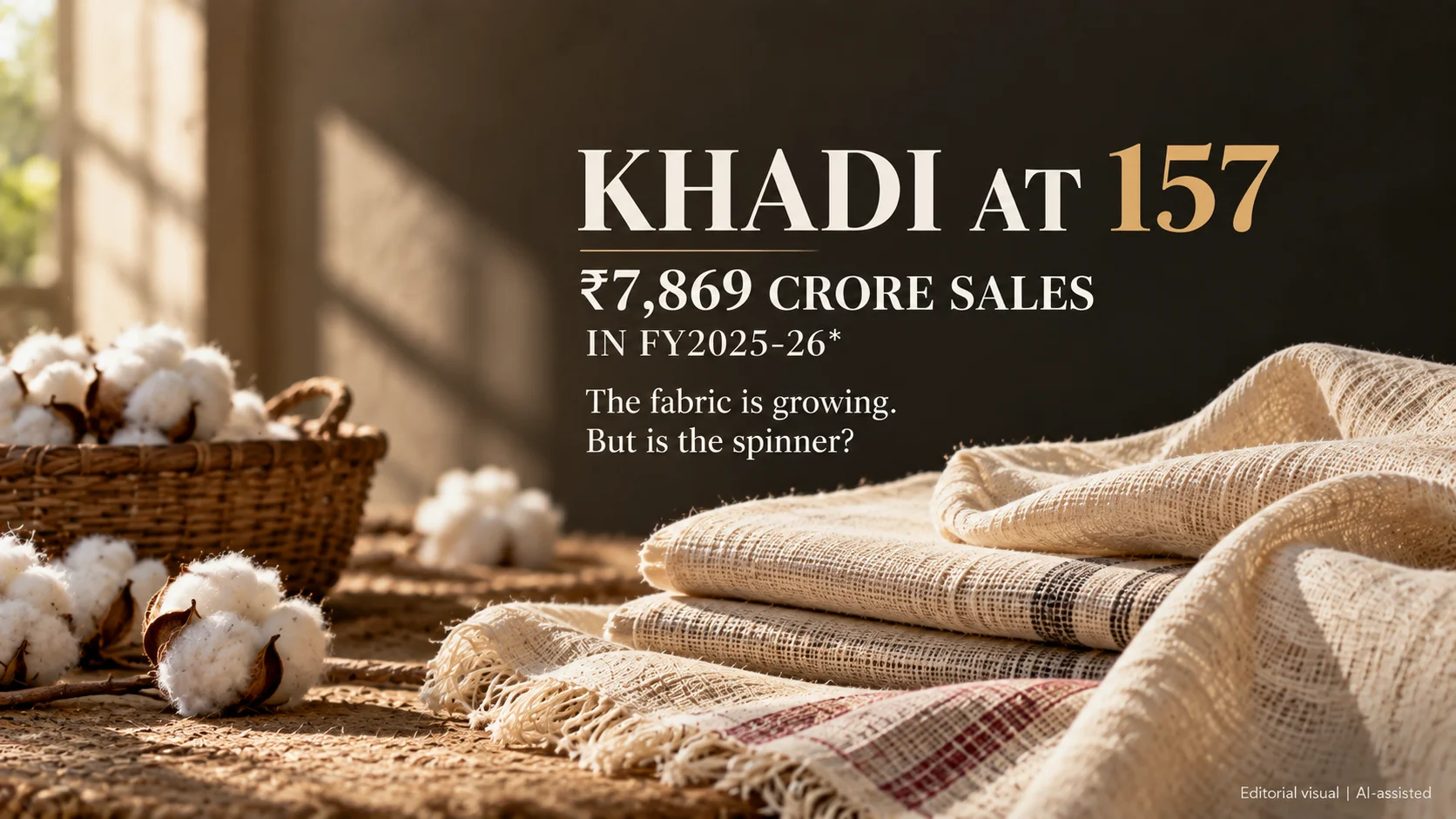
On Mahatma Gandhi’s 157th birth anniversary, Khadi once again takes centre stage. Gandhi championed Khadi not simply as a fabric, but as an instrument of self-reliance, rural employment and economic freedom. More than a century later, Khadi has become a ₹7,869-crore market. But are the people who spin and weave it growing with the fabric?
On Gandhi Jayanti, Khadi inevitably returns to the national conversation.
For decades, it was associated primarily with the freedom movement and Gandhi’s spinning wheel. Today, the meaning of Khadi is changing. It has entered fashion stores, contemporary wardrobes and a much larger consumer market.
The numbers tell an impressive story.
According to provisional data from the Khadi and Village Industries Commission (KVIC), Khadi sales reached ₹7,868.74 crore in FY2025-26. Five years earlier, in FY2020-21, sales stood at ₹3,527.71 crore.
That represents a compound annual growth rate of roughly 17% over the period.
Khadi production has also expanded. It increased from ₹1,904.49 crore in FY2020-21 to ₹3,973.98 crore in FY2025-26.
The growth has not been uniform every year. After the sharp disruption around FY2020-21, sales have settled into annual growth of around 10% in the last three years. Still, the direction is unmistakable.
Khadi is no longer merely a symbol. It is a growing market.
But what happens at the other end of the thread?
This is where the story becomes more interesting.
The Khadi ecosystem supports around five lakh artisans, with women accounting for more than 80% of them.
KVIC says spinning remuneration has increased from ₹4 per hank in 2013-14 to ₹15 today. That represents a substantial increase in the rate paid for spinning.
But remuneration per hank is not the same thing as an artisan’s annual income.
A spinner’s livelihood depends on the amount of work available, the quantity produced, working days and the economics of the entire production chain.
This raises a question that deserves greater attention.
How much of Khadi’s growing market value actually reaches the people who make it?
We have increasingly detailed figures on production and sales. We know how quickly the market is growing.
What is harder to find is equally clear information on artisan incomes.
That is the missing part of the Khadi story.
From freedom fabric to fashion fabric
Gandhi saw Khadi as much more than clothing.
For him, spinning was connected to dignity of labour, village employment and economic self-reliance. The charkha was both a practical tool and a symbol.
The modern Khadi industry is operating in a very different economy.
Today’s consumer is looking for design, comfort, authenticity and increasingly, sustainability. Khadi has several natural advantages in this environment. It is handmade, rooted in Indian textile traditions and carries a story that machine-made fabric cannot easily reproduce.
The challenge is to convert that story into sustained economic value.
That requires better design, stronger branding, consistent quality and more efficient supply chains.
It also requires something less glamorous but equally important: traceability.
Consumers should eventually be able to know who made the fabric, where it was produced and how much value reached the artisan.
And then there is the export question
India has a significant opportunity in the global market for natural, handmade and sustainable textiles.
Khadi should be well placed to participate in that market.
Yet current, easily accessible official data on the total value of Khadi exports remains difficult to establish. The absence of a consistent export series makes it harder to understand how much of India’s growing Khadi economy has travelled beyond the domestic market.
That is more than a statistical inconvenience.
If Khadi is to become a globally recognised textile, India will need to know where it stands internationally.
A strong global Khadi brand could create opportunities not only for artisans, but also for designers, rural enterprises, exporters and new generations of textile entrepreneurs.
The Northeast has a role in this story
The question is particularly relevant to Northeast India.
Assam’s eri and muga traditions offer powerful examples of how indigenous fibres, community knowledge and cultural identity can become premium products.
Khadi does not have to compete with these traditions.
There is an opportunity to connect them.
The future of India’s traditional textiles could lie in combining inherited knowledge with contemporary design, digital commerce, better market intelligence and global storytelling.
The Northeast has no shortage of textile heritage.
What it needs is stronger bridges between the artisan and the market.
The next Khadi milestone should be measured differently
At 157, Gandhi’s vision of Khadi remains remarkably relevant, but the economic questions have changed.
The industry has demonstrated that there is demand. It has demonstrated that consumers will buy Khadi. It has demonstrated that the brand can grow. The next test is more fundamental.
Are spinners earning more?
Are weavers getting more work?
Are young people seeing a viable future in these crafts?
And is a meaningful share of the value created by Khadi reaching the communities that produce it?
These questions may not produce as impressive a headline as another record in annual turnover.
But they may tell us far more about the future of Khadi. The fabric is growing. The next question is whether the spinner is growing with it.