Midweek AI Brief: 5 Developments Shaping AI
Artificial intelligence is entering a new phase. The race is no longer just about building better models or launching smarter chatbots. It is also about infrastructure, investment, strategic capabilities and real-world results.
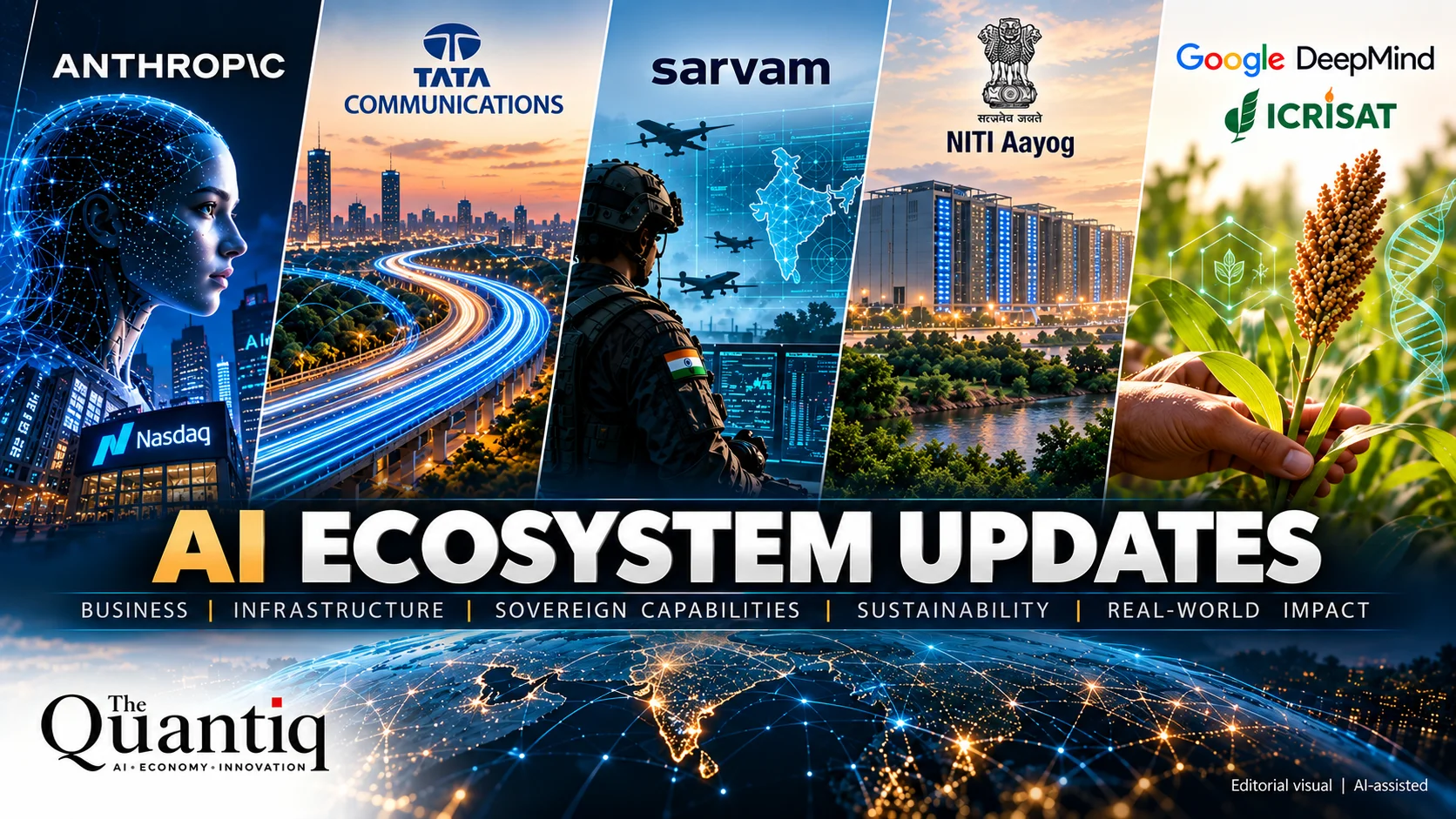
This week’s developments reveal how quickly the AI ecosystem is expanding. A leading AI company is preparing for public-market scrutiny. India is strengthening its domestic AI capabilities. A major infrastructure investment could improve connectivity between technology hubs. Meanwhile, data-centre projects face growing environmental scrutiny.
AI is also finding new applications in scientific research. Together, these developments offer a glimpse into the forces shaping the future of artificial intelligence.
1. Anthropic Moves Towards an IPO
The company behind Claude is taking an important step towards the public markets.
Anthropic filed a registration statement with the US Securities and Exchange Commission on 26 October for a proposed initial public offering (IPO). It intends to list its Class A common stock on the Nasdaq Global Select Market under the proposed ticker symbol ANT.
However, the filing does not mean the IPO is complete. The offering still requires regulatory clearance. The company has not yet determined the number of shares or the offering price.
A public listing would bring greater financial scrutiny to one of the leading developers of advanced AI models. Investors would need to examine its growth prospects, operating costs and competitive position.
Developing advanced AI systems requires substantial computing power, research investment and specialised talent. Revenue growth alone may not be enough to demonstrate a sustainable business model.
The company must show that customers will continue paying for its products and services. It must also demonstrate that its commercial advantages can withstand growing competition.
For India, Anthropic’s proposed IPO offers a useful reference point. It may influence how investors assess emerging AI companies. However, Indian startups operate in different market conditions and may follow very different business models.
The central question is whether frontier AI companies can turn technological leadership into sustainable financial returns.
Source: Anthropic’s official newsroom.
2. Tata Communications Invests in AI Connectivity
AI infrastructure is about more than processors and data centres. It also depends on the networks that move data between them.
Tata Communications has announced plans to invest approximately $400 million to $450 million in a new fibre-optic network. The proposed AI Super Highway will cover around 10,000 kilometres.
The network is designed to connect major data-centre clusters, cloud platforms and enterprise hubs. Its initial phase will focus on the Mumbai–Pune–Hyderabad–Chennai corridor. Further phases are expected to extend connectivity to other important technology centres.
The investment reflects a growing need for reliable, high-capacity data transmission. Advanced AI applications often move large volumes of information between computing facilities. Delays and network limitations can affect performance.
This creates opportunities for businesses beyond AI model development. Telecommunications providers, cloud operators, data-centre companies and energy suppliers all have important roles to play.
For India, better connectivity could support enterprise AI, research and industrial automation. It could also improve the ability of businesses to adopt advanced digital services.
The benefits, however, will depend on how widely this infrastructure becomes accessible.
Northeast India should watch these developments closely. The region does not need to compete with metropolitan centres in building massive data centres. It needs reliable connectivity, skilled talent and useful local applications.
Agriculture, healthcare, tourism and manufacturing could all benefit from better access to AI services. The challenge is to turn improved connectivity into practical economic opportunities.
Source: Tata Communications.
3. Sarvam AI Partners with India’s Defence Forces
India’s pursuit of sovereign AI is moving into strategically important areas.
Bengaluru-based Sarvam AI has signed a five-year memorandum of understanding with Headquarters Integrated Defence Staff under the Ministry of Defence. The agreement establishes a framework for AI-related work across the Indian Army, Navy and Air Force.
The proposed collaboration covers training, knowledge management, operational applications and decision support. Reported areas of interest also include data fusion and geospatial analysis.
The partnership reflects a wider effort to develop domestic AI capabilities for sensitive applications. Control over technology, data and critical systems is particularly important in national security.
Domestic expertise could help India reduce dependence on external technology providers. It could also strengthen the country’s ability to adapt AI systems to its own operational requirements.
However, an agreement is only the beginning. Its value will depend on the systems developed and their performance under real conditions.
Defence applications demand rigorous testing and strong safeguards. Errors can have serious consequences. Human oversight, accountability and secure data handling must remain central to deployment.
The broader lesson extends beyond defence. India’s AI industry has opportunities in healthcare, agriculture, manufacturing and public services. In each sector, success will depend on solving specific problems rather than simply deploying general-purpose chatbots.
For domestic AI developers, the challenge is clear. They must build systems that are reliable, secure and suited to demanding real-world environments.
Sources: Sarvam AI
4. Data Centres Face Growing Public Opposition
India wants to attract more investment in AI infrastructure. Yet the expansion of data centres is raising difficult questions about land, water and electricity.
Residents and environmental groups have raised concerns about proposed projects near Mumbai and in Visakhapatnam. Their objections include the potential impact on local infrastructure and the environment.
In Thane, near Mumbai, opposition has focused on a proposed Amazon facility. Residents have questioned its location and possible effects on the surrounding area.
In Visakhapatnam, campaigners have also challenged proposed data-centre developments. They have called for greater transparency and closer scrutiny of environmental impacts.
These objections should not automatically be treated as proof of wrongdoing. Companies have their own explanations of proposed power arrangements, cooling systems and safeguards. Both sides’ claims require examination against project documents and independent assessments.
The policy debate is also evolving.
NITI Aayog’s Frontier Tech Hub released a Data Centre Evaluation Framework on 14 October. It encourages state governments to assess infrastructure readiness, environmental sustainability and long-term economic value before approving projects.
The framework also highlights measures such as rainwater harvesting, water treatment and responsible waste management.
This is an important development. A large investment does not automatically guarantee proportionate benefits for the local community.
Policymakers must consider employment, public incentives, resource consumption and the services a facility will support. These factors should be assessed together.
Northeast India can learn from this debate before pursuing major data-centre investments of its own. The region’s natural resources and ecological assets are valuable. Any infrastructure strategy should account for energy availability, water security and environmental safeguards.
The objective should not be to reject investment. It should be to ensure that projects deliver lasting economic value without imposing avoidable costs on local communities.
Sources: NITI Aayog
5. Google DeepMind and ICRISAT Advance AI Research
Some of AI’s most valuable applications may emerge far beyond the technology industry.
Google DeepMind and Google.org are collaborating with the International Crops Research Institute for the Semi-Arid Tropics (ICRISAT), the HudsonAlpha Institute for Biotechnology and the University of Washington’s Department of Genome Sciences.
The initiative focuses on sorghum, also known as jowar. The researchers aim to develop an open-access genetic atlas using material from ICRISAT’s genebank.
The collection contains more than 44,000 distinct sorghum genetic samples from over 90 countries. Machine learning could help researchers analyse this complex information and identify promising genetic combinations.
Sorghum is used for food, animal feed and other applications. It is also important in agricultural regions facing heat and water scarcity.
AI could help scientists identify useful plant traits more efficiently. These findings may support the development of improved crop varieties.
However, research progress does not automatically translate into better harvests. Scientists must validate their findings. Breeders must develop suitable varieties. Farmers must then be able to grow them successfully under local conditions.
For India, the collaboration demonstrates how AI can support scientific discovery. It also shows the value of combining advanced computing with specialised research institutions and high-quality datasets.
Northeast India could eventually benefit from similar approaches. Research into local crops, plant diseases and climate resilience may offer opportunities for AI-assisted agricultural science.
Such work would require collaboration among universities, agricultural research institutions, government agencies and technology developers.
The real test will be whether scientific advances produce practical benefits for farmers.
Source: ICRISAT.
The Quantiq Takeaway
These five developments reveal a common trend. The AI economy is becoming much larger than the market for AI applications.
Anthropic’s proposed IPO raises questions about the financial sustainability of advanced AI. Tata Communications’ planned investment highlights the infrastructure needed to support growing demand. Sarvam AI’s defence agreement demonstrates the strategic importance of domestic capabilities.
Meanwhile, the data-centre debate shows that technological ambition must account for environmental limits. The Google DeepMind–ICRISAT collaboration illustrates how AI can contribute to scientific research and potentially improve agricultural outcomes.
For India, the opportunity is to participate across this expanding value chain. That means developing technology, infrastructure, talent and applications that address real needs.
For Northeast India, the priorities could be more focused. Agricultural intelligence, healthcare access, local-language AI, tourism and industrial efficiency offer promising areas to explore.
The region does not need to build everything from scratch. It needs to identify where its knowledge, institutions, entrepreneurs and natural resources can create distinctive value.
The real AI opportunity is not simply to adopt more intelligence. It is to turn intelligence into economic and social value.