Before the Startup Ecosystem, There Was the Highway Economy
Founder Series | The Quantiq
How a generation of Northeast entrepreneurs helped build the connectivity on which an economy could grow
There was a time when travelling across Assam after sunset was a very different experience.
The highways were long stretches of road with very little for a traveller to expect after dark. There were no rows of brightly lit dhabas along the routes, no proliferation of roadside hotels and very few of the services that today’s traveller takes for granted. For many people living outside Guwahati, travelling to the state capital was not simply a matter of buying a ticket and choosing a convenient departure time. Night travel was limited, and long-distance journeys required considerably more planning and patience.
The Assam State Transport Corporation played an important role in connecting the state, but its network was nowhere near what exists today. ASTC traces its origins to 1948, when Road Transport, Assam began with just two buses operating between Nagaon and Guwahati. It became a corporation in 1970. Over the years, its network expanded, but the long-distance travel environment of Assam remained very different from the one we know today.
Then, around the late 1970s and early 1980s, a generation of private entrepreneurs began looking at the roads differently.
They saw an unmet need. More importantly, they were willing to take a business risk on that need.
What followed was much bigger than the growth of a private bus industry. It helped change how people moved across Assam and, eventually, across the Northeast. It also helped create an economic phenomenon that I would call the highway economy.
When the road became an opportunity
Today, entrepreneurship is often discussed in the language of startups, innovation, technology and ecosystems. We have incubators, accelerators, venture capital, startup missions and digital platforms designed to help entrepreneurs turn ideas into businesses.
The entrepreneurs who began transforming private road transport in Assam had none of these advantages.
There was no established startup ecosystem around them. There was no playbook for building a regional mobility business. They had to identify the opportunity themselves, invest their own money, understand their customers and take the risks that came with putting buses on difficult and uncertain routes.
Among the entrepreneurs associated with this transformation were Robin Dutta of Blue-Hill Travels, Pulak Goswami of Green Valley Travels and Pradyumna Dutta, who began his transport entrepreneurial journey with Trans Assam Wheels in 1981.
Blue-Hill traces its origins to 1979 and describes itself as one of the pioneers of passenger bus operations in Assam and Northeast India. A detailed profile published by Motorindia describes how Robin Dutta built Blue-Hill’s operations and how the company expanded its luxury-coach services across the region during the 1980s and early 1990s.
Pradyumna Dutta’s journey provides another important historical marker. According to Network Travels, he began with Trans Assam Wheels in 1981 with two partners, at a time when the concept of night buses was newly emerging in Assam. After more than a decade of experience, he established Network Travels in 1992 with the vision of expanding bus connectivity across the Northeast.
Green Valley Travels also belongs to this generation of private transport enterprises. Corporate records show the company was incorporated in 1985, with Pulak Goswami later serving as its managing director.
These were not isolated ventures. They were part of a broader entrepreneurial movement that was beginning to change the way Assam travelled.
The arrival of the night bus
The importance of the private night bus is easy to underestimate today because overnight travel has become so familiar.
But imagine what it meant at the time.
A traveller could leave a town in the evening, sleep or rest during the journey and arrive in Guwahati the next morning. The journey did not become shorter in terms of kilometres, but it became more efficient in terms of time.
That changed what people could do.
A student could travel to Guwahati for admission or an examination. A patient could reach a hospital in the state capital. A trader could visit a larger market. A professional could attend a meeting and return without necessarily losing another full day to travel. Families could travel more easily, and tourists could begin considering destinations that previously seemed inconveniently distant.
The significance of the night bus was therefore not simply that it offered another way to travel. It changed the economic meaning of distance. A town that was physically far away could become economically closer.
That was an important change for a region whose geography has always been both its strength and its challenge.
From Assam’s towns to the wider Northeast
The transformation did not stop at connecting towns within Assam. Guwahati gradually became a major mobility hub for the wider Northeast. Private operators expanded their routes, connecting the state capital with towns and cities across neighbouring states.
Blue-Hill’s own history describes its expansion during the 1980s and early 1990s, when its luxury coaches connected many towns and cities across the Northeast. Its present network includes night services linking Guwahati with destinations in Assam as well as Arunachal Pradesh, Nagaland, Meghalaya, Tripura and Manipur.
Network Travels followed a similar trajectory. The company says its purpose was to provide road connectivity through difficult terrain to remote parts of the region. What began with Trans Assam Wheels eventually developed into a much larger enterprise spanning passenger transportation, tourism, courier and air-ticketing services.
Other names became part of this evolving private transport landscape as well, including Kangleipak Travels, Ratnagiri Travels, Tirupati Tirumala Travels and Assam Valley Travels, among many others.
Their individual histories were different, but their collective impact was significant. They were helping connect a geographically fragmented region and making it easier for people, commerce and opportunity to move between places.
I watched the highway economy grow
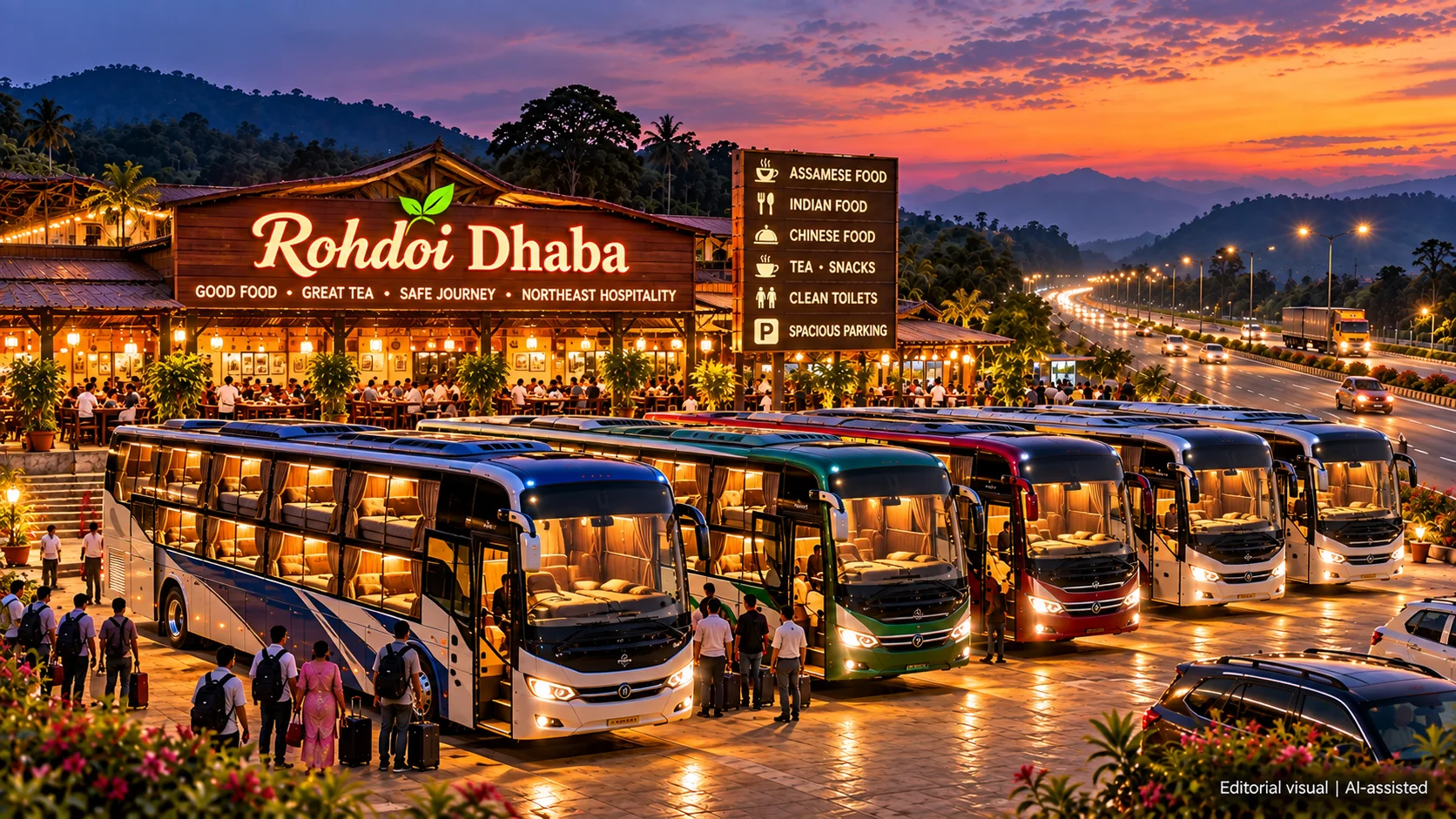
There is one part of this transformation that I have watched personally since the early 1980s: the growth of the dhaba.
In those days, roadside eating places were nothing like the ubiquitous highway businesses we see today. A traveller embarking on a long journey could not assume that a decent place to stop for food would be available late at night.
Then, gradually, the dhabas began to appear.
One became two. Then more followed along the routes where buses, trucks and other vehicles were moving regularly. Some remained modest roadside establishments. Others grew into substantial businesses serving travellers throughout the day and night.
I have seen the mushrooming growth of dhabas with my own eyes since the early 1980s, and it has not stopped yet.
That observation may sound simple, but it tells us something important about how local economies develop.
The growth of roadside food businesses did not happen in isolation. As buses began operating more frequently and night travel became more common, a steady stream of passengers and transport workers created demand for food and rest. Entrepreneurs responded to that demand.
Then came other businesses.
Fuel stations became more viable along busy routes. Hotels and lodges found customers. Workshops and tyre shops developed around commercial traffic. Small retail businesses appeared near transport hubs. Travel agents and ticket counters found opportunities around the movement of passengers.
The highway was gradually becoming more than a road. It was becoming a commercial corridor.
That is what I mean by the highway economy.
The bus was only the beginning
The most important economic effect of these transport businesses may not have been the revenue generated by the buses themselves.
It was the activity they enabled around them.
A bus carries passengers, but passengers carry demand.
They need food, accommodation, fuel, shopping, healthcare, education and services. Businesses emerge to meet those needs. Once those businesses become viable, they create employment and household incomes. Those incomes generate further consumption and demand.
The process is not centrally planned. It grows organically.
A transport entrepreneur creates a route. The route creates regular passenger movement. Passenger movement creates demand. Demand creates new businesses. Those businesses make the journey more convenient, which encourages more people to travel. The cycle continues.
This is how an economic ecosystem can emerge long before anyone gives it a name.
These entrepreneurs were building before the vocabulary existed
What I find particularly interesting about this generation is the environment in which they operated.
Today, a young entrepreneur can describe a business as a mobility startup and immediately enter a vocabulary understood by investors, policymakers and the media.
The entrepreneurs of that earlier generation did not have that luxury.
They were simply running businesses, but running those businesses required them to take on considerable responsibility. They had to buy or finance vehicles, maintain them, manage drivers and staff, understand their routes and deal with difficult road conditions. At the same time, they had to convince passengers that private services were worth paying for and, most importantly, earn their trust one journey at a time.
The risks were real, particularly when demand on a new route could not be guaranteed.
Yet they continued expanding.
That is a quality of entrepreneurship that is sometimes forgotten when we focus too heavily on technology and funding.
Entrepreneurship is often about seeing a need before the market has fully recognised it.
The private bus pioneers saw that people wanted to travel more conveniently. They understood that the distances separating towns from Guwahati could also represent a business opportunity.
And they acted on it.
Some entrepreneurs build businesses. Others build possibilities
This is why I believe the pioneers of Northeast India’s private bus industry deserve a place in the region’s entrepreneurial history.
Their businesses were not merely providing transportation. They were creating possibilities for other people.
A student travelling to Guwahati could gain access to education. A patient could reach a specialist hospital. A trader could access a larger market. A tourist could discover another part of the Northeast. A professional could take up an opportunity that would otherwise have been too difficult because of distance.
The economic value of the bus ticket was therefore only one part of the story. The larger value lay in what the journey made possible.
In that sense, these entrepreneurs were helping build a form of economic infrastructure.
They were not constructing highways. They were making those highways economically useful.
The highway economy kept expanding
The transformation did not end with the first generation of private night buses.
It continued through successive improvements in vehicles, routes and passenger services.
The luxury coaches of the early years have evolved into modern air-conditioned buses, semi-sleepers and sleeper coaches. Passengers can book tickets online, choose seats through mobile applications and increasingly track their journeys digitally.
Network Travels today describes a fleet of more than 140 coaches, including deluxe and super-luxury seater-sleeper BharatBenz coaches, while its business has expanded into tourism, transport, courier and air-ticketing.
Blue-Hill continues to operate routes across the Northeast, including long-distance night services from Guwahati and connections between towns in different states.
The broader transport ecosystem has also evolved. What was once an uncertain overnight journey has become a normal part of life for thousands of passengers.
The traveller now sees comfort and convenience.
But behind that convenience is a history of entrepreneurship that began decades ago.
The economic geography of the Northeast changed
Perhaps the biggest contribution of these entrepreneurs was not that they made bus travel more comfortable.
It was that they helped change the economic geography of the region. Connectivity determines how easily people can participate in an economy.
When a town is difficult to reach, its businesses operate within a smaller market. When travel becomes easier, that market expands.
A customer from another district becomes reachable. A supplier from another city becomes accessible. A student can study farther from home. A tourist can travel farther. A business can recruit from a larger geography.
This is why transportation infrastructure has such a powerful economic multiplier.
The road may already exist, but the road becomes economically transformative only when people and businesses can use it reliably.
The private bus entrepreneurs helped make that happen.
Before the startup ecosystem, there were the builders
There is a tendency to think of entrepreneurship in the Northeast as something relatively new, associated with startups, technology and the emergence of formal support systems.
That would be an incomplete history.
The region has always had entrepreneurs. They simply operated in different circumstances and often without the vocabulary that surrounds entrepreneurship today.
Some built manufacturing businesses. Some built trading enterprises. Some developed tourism and hospitality businesses. Others created services that connected people with markets and opportunities.
The entrepreneurs behind the early private luxury and night-bus movement belonged to that larger tradition.
Robin Dutta, Pulak Goswami and Pradyumna Dutta were among the names associated with a generation that began to change the way Assam and the Northeast moved. Around them were many other operators who entered the market, expanded routes and built businesses that became familiar names to generations of travellers.
They were not merely running buses between towns.
They were helping reduce the economic significance of distance.
They were connecting people with Guwahati and, increasingly, connecting Guwahati with the wider Northeast.
They were helping create the conditions in which roadside businesses, hotels, fuel stations, workshops, tourism operators and countless other enterprises could grow.
And they were doing it long before anyone began talking about startup ecosystems.
When Connectivity Became Entrepreneurship
Today, when we drive through Assam and the wider Northeast, the landscape tells a very different story from the one I remember from the early 1980s.
There are dhabas and restaurants along the highways, many operating late into the night and some around the clock. There are hotels, fuel stations, workshops, tyre shops, retail outlets and transport services. Luxury coaches travel during the day and through the night, connecting towns that once seemed much farther apart.
Much of this looks ordinary now because it has become part of everyday life.
But it was not always there.
The transformation began with entrepreneurs who were willing to take a chance on an opportunity that had not yet been fully understood. They invested in vehicles and routes when the market was still developing. They built customer trust when private long-distance travel was still an emerging proposition. They kept expanding connectivity when the geography itself seemed to work against them.
Over time, their businesses became part of the infrastructure of everyday economic life.
That is why I believe their contribution deserves to be remembered.
The story of Assam’s private luxury and night buses is not simply a story about transportation. It is a story about entrepreneurship, connectivity and the gradual expansion of opportunity.
It is also a reminder that economies are often built in ways that are not immediately visible.
Sometimes, an entrepreneur builds a factory.
Sometimes, an entrepreneur builds a technology company.
And sometimes, an entrepreneur puts a bus on a road that people have struggled to travel at night.
That bus may carry passengers.
But over time, it can carry something much larger: commerce, education, tourism, opportunity and economic possibility.
Long before we began speaking about startup ecosystems, a generation of Northeast entrepreneurs was already building one of the foundations on which a regional economy depends.
Connectivity.
That is the highway economy. And the people who helped create it deserve not merely to be remembered as transport operators, but recognised as entrepreneurs who helped move the Northeast forward.