
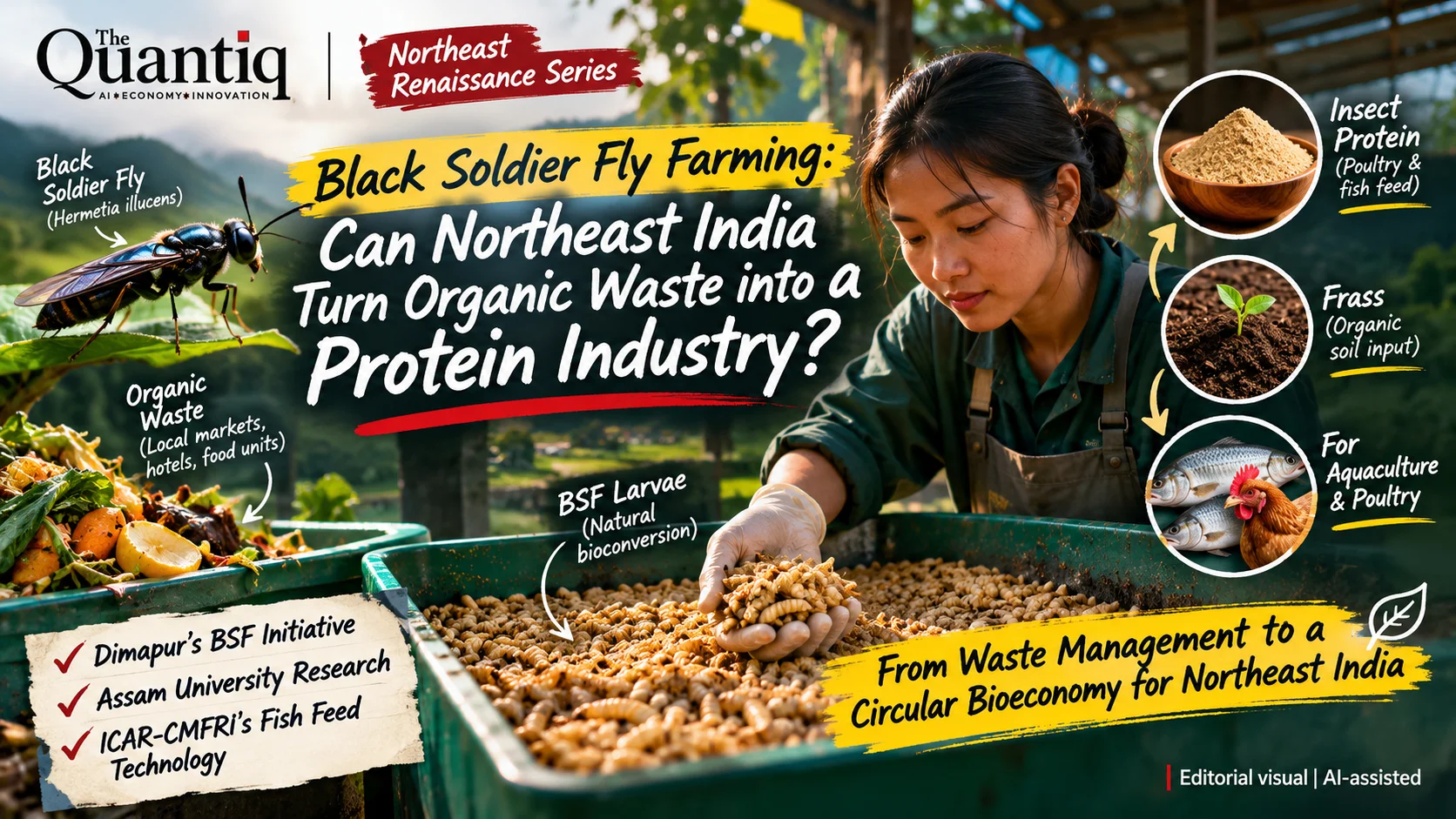
Black Soldier Fly Farming: Can Northeast India Turn Organic Waste into a Protein Industry?
The Northeast Renaissance Series
The Northeast’s growing organic waste challenge could become the foundation of a new bioindustrial value chain. Research in Assam, an emerging initiative in Nagaland and advances in insect-based fish feed offer reasons to take this opportunity seriously. But can the region turn scientific promise into a commercially viable industry?
The opportunity hidden in organic waste
Every day, markets, restaurants and households across Northeast India generate large quantities of organic waste. Vegetable markets discard unsold produce. Hotels throw away food scraps. Agricultural activities also leave behind residues with limited commercial value.
Much of this material ends up mixed with other municipal waste. As a result, collection and disposal become more difficult. Yet some of these discarded materials contain nutrients that could be recovered.
What if this waste could become the raw material for producing protein-rich animal feed?
That is the idea behind Black Soldier Fly (BSF) farming. It uses the larvae of a particular fly species to convert suitable organic material into insect biomass. The harvested larvae can then be processed into ingredients for animal and fish feed.
The process may also produce a useful agricultural by-product called frass. However, this material needs proper treatment and safety assessment before agricultural use.
For Northeast India, this is more than an unusual farming idea. It could connect waste management, alternative protein, aquaculture, poultry and sustainable agriculture.
Two regional developments make the opportunity particularly interesting. First, an initiative in Dimapur, Nagaland, is exploring BSF technology for organic waste management. Second, Assam Agricultural University has studied how locally available organic materials perform as substrates for BSF larvae.
Together, these developments offer a starting point for a regional circular bioeconomy.
Understanding Black Soldier Fly farming
The Black Soldier Fly, scientifically known as Hermetia illucens, has attracted growing interest from researchers and entrepreneurs. Its larvae can consume a range of suitable organic materials and convert part of their nutrients into biomass.
The adult fly is not the commercial product. The larvae do the work.
Female flies lay eggs in managed breeding environments. Once the eggs hatch, the larvae are introduced to prepared organic substrates. They feed, grow and accumulate biomass. Operators harvest them at the appropriate stage and prepare them for further processing.
Depending on the intended use, processing may include washing, heat treatment, drying, oil extraction and milling. The resulting meal can serve as an ingredient in formulated animal or aquaculture feed.
The process also leaves behind a residual material known as frass. It contains undigested substrate and insect excreta. This material may have value as a soil amendment, although its composition and safety must be tested.
The attraction of BSF farming lies in its ability to connect two different economic needs. Waste generators need better ways to manage biodegradable material. Feed manufacturers need reliable sources of protein and other nutrients.
BSF technology attempts to create value between these two needs.
However, successful production requires more than placing larvae in containers of organic waste. Substrate quality, moisture, temperature, hygiene and stocking density all influence the results. Contamination can also affect the quality of the final product.
Therefore, the real technology is not simply insect rearing. It is controlled biological processing.
Dimapur’s experiment: A regional starting point
Nagaland offers an interesting example of how BSF technology could support local waste management.
A report published by Eastern Mirror on 15 October 2026 highlighted Dimapur’s growing municipal waste challenge. According to the report, the city generates approximately 101.6 tonnes of waste every day. Organic waste accounts for nearly 49 tonnes.
The scale of the problem is significant. When biodegradable material mixes with plastic, glass and other waste, recovery becomes difficult. Disposal also becomes more expensive.
The ANMA Integrated Development Association (AIDA), in collaboration with Germany-based Eclose GmbH, has been exploring BSF technology through an initiative called Waste Insect Nexus for Growth & Sustainability (WINGS).
The initiative connects waste management with insect-based bioconversion. Its objective is to demonstrate how suitable organic waste can support BSF production while creating opportunities for communities and local enterprises.
The report also describes a decentralised waste-segregation pilot in Ward 15 of the town. Wet waste is collected separately, while recyclable material goes to a designated scrap dealer. The remaining waste is handled by the municipal council.
According to the municipal consultant quoted in the report, the pilot achieved an estimated 95% efficiency after four months.
AIDA also reported that it had established six BSF facility centres across Arunachal Pradesh, Nagaland, Manipur and Assam.
These developments suggest that BSF technology is already being explored in the region. However, demonstration facilities and community initiatives are not the same as a commercially scaled industry.
That distinction is important.
Dimapur’s experience offers a valuable lesson. BSF farming cannot succeed independently of waste segregation. If organic material arrives contaminated with plastic, glass or unsuitable substances, the entire production process becomes harder to manage.
In fact, better municipal waste management may be the first step towards building an insect-protein industry.
Assam’s research adds scientific depth
The strongest scientific connection for Northeast India comes from Assam Agricultural University, Jorhat.
A research paper published in Frontiers in Sustainable Food Systems on 10 April 2026 examined how different locally sourced materials influenced BSF larval growth, development, survival and nutritional composition.
Researchers collected materials from local markets and evaluated eight substrates. These included vegetable waste, fruit waste, papaya, maize, tea waste, vermicompost and selected combinations of agricultural materials.
The findings are particularly relevant because they show that not all organic waste performs equally well.
Vegetable waste produced strong larval growth results. In the larger experimental evaluation, larvae reached an average weight of approximately 198.53 milligrams per larva. The researchers also recorded 81.67% diet reduction in the 200-gram experimental setup.
A smaller experimental setup recorded a higher reduction of 92%. However, these are laboratory findings. They should not be treated as guaranteed results for commercial facilities.
The research also produced another interesting finding. A potato-and-corn substrate recorded the highest larval survival in the larger evaluation, at approximately 84.43%. It also produced the highest reported protein content among the tested groups.
This reveals an important commercial consideration. The substrate that produces the fastest growth or greatest waste reduction may not always deliver the best nutritional outcome.
A successful BSF operation must balance several factors. These include waste reduction, larval survival, biomass yield, nutritional quality and processing costs.
Can Assam’s tea waste become a BSF resource?
The inclusion of tea waste in the Assam study deserves attention. After all, Assam has one of India’s most important tea industries.
Tea processing and related activities generate organic residues. These could become candidates for further research into biological conversion.
However, the study does not establish tea waste as a commercially suitable BSF substrate.
In fact, tea waste performed less favourably than vegetable waste. The researchers associated lower larval growth and higher winter mortality with the relatively high lignocellulosic content of tea waste and vermicompost. Such material is more difficult for the larvae to digest.
This does not rule out future applications. It highlights the need for further trials involving substrate preparation, blending and pre-treatment.
For Assam’s tea industry, this could become a worthwhile research question. However, commercial claims must wait for stronger evidence.
The larger lesson is clear: local feedstock must be tested before entrepreneurs build a business around it.
Can BSF protein find a market in poultry and aquaculture?
Producing larvae is only one part of the business. A viable industry also needs dependable buyers.
Two sectors deserve particular attention in Northeast India: aquaculture and poultry.
Fish farmers depend heavily on formulated feed. Its cost and nutritional quality directly affect farm economics. Poultry producers also need reliable protein ingredients to maintain feed quality and production performance.
Conventional feed formulations use ingredients such as fishmeal and soybean meal. However, alternative protein sources are attracting growing interest. Feed costs, resource pressures and supply-chain uncertainties are among the reasons.
Processed BSF larvae offer one possible alternative ingredient.
India already has an important research development in this field. The Indian Council of Agricultural Research’s Central Marine Fisheries Research Institute (ICAR-CMFRI) has developed fish feed using Black Soldier Fly larvae meal.
In October 2024, the institute announced that it had transferred the technology to Amala Ecoclean, a startup working in sustainable waste management and environmental solutions.
According to the Press Information Bureau announcement, the larvae meal contained approximately 40–45% protein. The institute also reported that initial trials showed the potential to support fish growth without compromising performance compared with conventional feeds.
The technology transfer aimed to support commercial production and wider access among fish farmers.
This is an important national validation point. It shows that BSF-based protein is moving beyond theoretical research. Indian institutions are developing and transferring technologies for practical aquaculture applications.
For Northeast India, the connection is worth exploring.
Assam, Tripura, Manipur and other states have established fish-farming activities. A regional insect-protein supply chain could eventually serve feed manufacturers and aquaculture businesses.
However, the ingredient must meet nutritional and safety requirements. Feed formulations also need validation for the relevant fish species and production stages.
Poultry offers another potential market. Yet BSF meal should not be assumed to replace conventional protein ingredients on a one-to-one basis.
The real opportunity is to develop a reliable ingredient that feed manufacturers can evaluate and purchase at a competitive price.
The economics: Waste collection matters as much as farming
The commercial attraction of BSF farming can be misleading if entrepreneurs look only at the cost of rearing larvae.
A viable operation must manage the entire value chain.
First, it needs a consistent supply of suitable organic waste. Vegetable markets, fruit markets, food-processing units, hotels, restaurants and institutional kitchens could become potential suppliers.
However, waste availability does not mean free raw material.
Collection, segregation, transportation, storage and pre-processing all involve costs. A facility located far from its feedstock may spend more on transporting wet waste than the value it recovers.
Second, the operation needs reliable production systems. Breeding, controlled rearing, temperature and moisture management, harvesting and processing all require investment and skilled supervision.
Third, the business needs access to buyers.
Fresh larvae, dried larvae, defatted insect meal and other processed products have different applications. They also have different processing requirements and market values.
A business must identify which product it intends to sell and who will purchase it.
The residual material may also have a market. Properly processed and tested frass could find buyers among farmers, nurseries and agricultural input businesses. However, its value and regulatory requirements need to be established.
A practical BSF business could explore three revenue streams:
Waste-management services: Municipal bodies, markets or institutions may pay for collecting and processing segregated biodegradable waste under suitable service arrangements.
Insect-based feed ingredients: Harvested larvae can be processed into products for approved feed applications.
Agricultural by-products: Properly processed frass may have a market among agricultural users.
These revenue streams are possibilities, not guaranteed income. Each needs a separate customer, pricing arrangement and quality standard.
Therefore, a pilot facility should begin with a basic commercial assessment. How much suitable waste can it collect every day? What will collection and processing cost? How much saleable biomass can it produce? Are there buyers willing to commit to purchases?
Without these answers, buying equipment is not an investment strategy. It is speculation.
Environmental safeguards and feed safety
BSF technology is often described as sustainable because it converts organic waste into useful biomass. However, its environmental benefits depend on how the facility operates.
The quality of incoming material is critical. Contaminated or unsuitable waste can affect the larvae and the resulting feed ingredient. Therefore, source segregation, supplier protocols and traceability must be part of the production system.
Processing also matters. Larvae intended for feed applications require appropriate treatment, drying and storage. Their nutritional composition and microbiological quality must be tested.
The residual material needs equal attention. It may contain useful nutrients, but it can also carry contaminants or pathogens. Its quality depends partly on the original substrate and the treatment process.
Businesses must also confirm the applicable requirements for waste handling, environmental permissions, animal-feed production and product quality. They should consult the relevant authorities before commercial distribution.
This is particularly important when operators propose using municipal or mixed food waste. Not every organic material is suitable for producing animal feed.
Responsible businesses will need documented sourcing, batch records, testing procedures and traceability from waste collection to the final product.
Environmental credibility must come from measurable results. It cannot be assumed simply because insects are involved.
A decentralised industry may suit Northeast India
The geography and settlement patterns of Northeast India make a decentralised approach worth exploring.
Instead of transporting large quantities of wet organic waste over long distances, smaller facilities could operate near suitable waste-generating clusters.
Urban markets, food-processing centres, institutional campuses and agricultural collection points could provide the foundation for local operations.
Such a model could create opportunities for entrepreneurs, farmer-producer organisations, self-help groups, waste-management businesses and rural youth.
However, decentralisation does not mean every village should establish an independent insect farm.
Even small facilities need reliable breeding systems, technical supervision, quality testing and access to buyers.
A more practical model could connect local collection and pre-processing centres with regional facilities. These larger centres could handle breeding, processing, quality assurance and marketing.
This structure would distribute economic opportunities while maintaining production standards.
It would also allow the industry to develop around the actual availability of feedstock. That is important because the waste profile of a city, a tea-processing cluster and a vegetable market will be different.
The first commercial clusters could be explored around vegetable markets, municipal waste streams, food-processing units and aquaculture or poultry production centres. Each location would need its own feedstock and market assessment.
What Northeast India needs to do next
The region does not need to begin with a large industrial facility. Instead, it needs a series of well-designed pilots that establish whether the technology works under local conditions.
Universities and research institutions can help identify suitable substrates. They can also optimise larval production and test the nutritional quality of the resulting biomass.
Municipal bodies can support source segregation. They can also provide access to suitable biodegradable waste through transparent arrangements.
Entrepreneurs, meanwhile, can develop collection, rearing and processing operations. Feed manufacturers and fish-farming organisations can evaluate the commercial suitability of BSF ingredients.
The Assam Agricultural University research provides a scientific starting point. The AIDA initiative in Nagaland offers an emerging community and institutional model. ICAR-CMFRI’s work demonstrates a national pathway towards feed applications.
The next step is to connect these efforts through research partnerships, demonstration facilities, technical training and buyer-led pilots.
For young entrepreneurs, the opportunity extends beyond rearing larvae. Businesses could specialise in waste collection, substrate preparation, breeding equipment, drying and processing, laboratory testing, feed formulation and traceability.
The industry will need engineers, entomologists, microbiologists, feed specialists, logistics operators and business managers.
In other words, this is not simply an agricultural opportunity. It is a multidisciplinary bioindustrial opportunity.
The Quantiq Assessment: From waste disposal to resource recovery
Black Soldier Fly farming deserves serious attention in Northeast India. It connects three challenges that are often addressed separately: organic waste management, alternative protein production and agricultural resource recovery.
The region already has some important foundations. Dimapur is exploring BSF technology through AIDA and its WINGS initiative. Assam Agricultural University has produced research on locally available substrates. ICAR-CMFRI has demonstrated a pathway for insect-based fish feed technology.
Yet these developments do not prove that a profitable regional industry already exists.
The commercial test remains demanding.
Can operators secure clean and consistent feedstock? Can they maintain production through seasonal variations? Can they process larvae to the required standards? Can they supply feed manufacturers at competitive prices? Can they build reliable markets for both insect meal and residual products?
The answers will determine whether BSF farming remains a promising experiment or develops into a scalable enterprise.
For Northeast India, the opportunity is not to build insect farms for their own sake. It is to create a system in which organic waste becomes a productive resource, local enterprises capture more value and feed manufacturers gain access to additional protein sources.
That is the larger promise of a circular bioeconomy.
The next industrial opportunity may not always begin with a new resource. Sometimes, it begins by recognising the value of something we have been throwing away.
Disclaimer
This article is intended for informational and entrepreneurial awareness. The research findings cited here relate to specific experimental conditions. They should not be interpreted as guaranteed commercial outcomes. Prospective operators should undertake technical, financial, environmental and regulatory assessments before establishing a Black Soldier Fly farming or processing facility.




2 Comments