The Quantiq Brief: RBI Raises Rates, ₹10,000 Crore SME Growth Fund and the Next Phase of AI
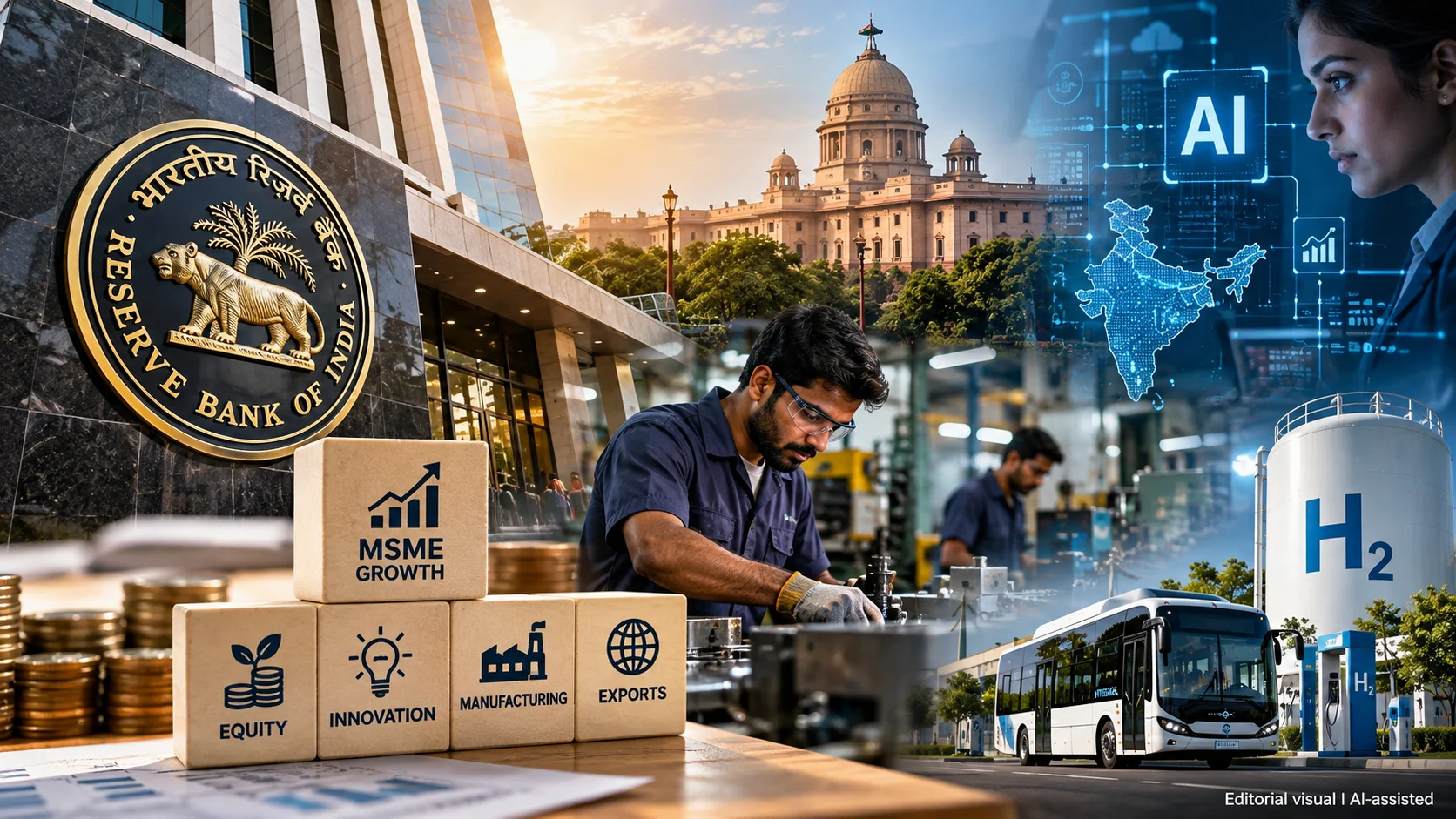
India’s business landscape sent several important signals this week. The Reserve Bank of India raised its policy rate, the Union Cabinet approved a ₹10,000 crore commitment for an SME Growth Fund, and the government signalled another step towards a formal framework for artificial intelligence.
Meanwhile, research into hydrogen fuel cells offered a glimpse of how advances in materials science could support cleaner energy technologies.
These developments may appear unrelated. Yet they share a common thread. Businesses must navigate changing borrowing costs, find the right capital for expansion and adapt to technologies that are reshaping industries.
This week’s Quantiq Brief examines what these developments mean for Indian businesses, entrepreneurs and the wider economy.
RBI Raises Repo Rate to 5.50%: What It Means for Indian Businesses
The Reserve Bank of India raised its benchmark repo rate by 25 basis points to 5.50% on 7 October 2026. The Monetary Policy Committee also moved from a neutral stance to calibrated tightening. The decision came amid inflationary pressures linked to higher oil prices and weaker monsoon conditions.
The repo rate influences the cost at which banks obtain short-term funds from the RBI. A rate increase can put pressure on borrowing costs, although the effect on individual loans depends on their terms, benchmarks and lenders.
For businesses, the consequences could extend beyond monthly interest payments.
Consider a small manufacturer planning to buy new machinery. If its borrowing costs rise, the investment may take longer to recover its cost. A business that depends on working-capital loans could also face pressure on its cash flow. Smaller companies may find it particularly difficult to absorb additional costs when customers resist price increases.
The impact, however, will vary. Businesses with strong cash reserves, manageable debt and healthy profit margins may be better placed to withstand tighter financial conditions.
For entrepreneurs planning expansion, this is a good time to review borrowing requirements and cash-flow projections. They should assess whether a proposed investment can generate sufficient returns under different interest-rate scenarios.
The RBI’s next policy decisions will depend on incoming data, including inflation, growth and external economic conditions. Businesses should therefore avoid assuming that the latest increase will translate into an identical change in every lending rate.
₹10,000 Crore SME Growth Fund: Can Equity Help Small Businesses Scale?
The Union Cabinet has approved a government commitment of ₹10,000 crore towards an SME Growth Fund designed to provide equity capital to promising small and medium enterprises. The initiative forms part of the government’s broader effort to help growth-oriented businesses expand, modernise and improve their competitiveness.
For India’s smaller enterprises, the distinction between debt and equity is important.
A conventional bank loan must be repaid, usually with interest. Equity investment works differently. An investor provides capital in exchange for an ownership stake, sharing in the company’s potential growth and risks.
This can give an expanding business room to invest without taking on the same fixed repayment obligations as a loan. However, founders must also consider ownership dilution, investor expectations and governance requirements.
Imagine a small manufacturing company with a proven product and growing customer demand. It wants to automate production, improve quality control and enter new markets. The company may have a viable business, but insufficient capital to make the next investment. Appropriate equity funding could help bridge that gap.
The same opportunity exists for technology businesses, specialised manufacturers and companies developing products for domestic and export markets.
Yet the announcement should not be interpreted as an automatic funding entitlement for every MSME. Businesses will need to meet the applicable criteria, and actual investments will depend on the fund’s operating arrangements and selection process.
For entrepreneurs, preparation matters. Credible financial statements, evidence of customer demand, clear unit economics and a realistic expansion plan can help demonstrate why a business deserves growth capital.
The larger question is whether the initiative can help promising Indian enterprises move beyond survival and build the capabilities required to compete at scale.
India Moves Towards a Formal AI Regulation Framework
India’s artificial intelligence debate is moving towards another important stage. On 8 October, Information Technology Minister Ashwini Vaishnaw indicated that the government expected to release a regulation-focused AI consultation paper within a month. The areas under discussion include safety, deepfakes, skills and a human-first approach.
The announcement signals a forthcoming consultation. It does not mean that a new comprehensive AI law has already been enacted.
For businesses, the issue is becoming increasingly practical. Companies are using generative AI to produce content, answer customer questions, analyse information and automate routine work. These applications can improve productivity, but they also create risks when systems generate inaccurate information or handle sensitive data without adequate safeguards.
Deepfakes present another challenge. Fabricated audio, video and images can damage reputations, mislead customers and undermine trust in digital communications.
Businesses do not need to wait for a new regulatory framework before taking sensible precautions. They can document where AI is used, restrict access to sensitive information and require human review of consequential outputs. Clear procedures for checking claims and approving public communications can also reduce avoidable mistakes.
For smaller businesses, these measures can begin with simple processes rather than expensive technology.
The challenge for policymakers is to encourage useful AI adoption while addressing genuine risks. Rules that are too weak may leave people and businesses exposed. Requirements that are unnecessarily complex could make adoption harder for smaller innovators.
The direction of India’s AI framework will matter not only to technology companies, but also to publishers, manufacturers, service providers and other businesses adopting AI.
Hydrogen Fuel Cells: Could New Materials Research Lower Costs?
A development in materials science has drawn attention to one of the challenges facing hydrogen fuel cells. UCLA materials scientist Yu Huang received the Falling Walls Foundation’s 2026 Science Breakthrough of the Year award in Engineering and Technology for research aimed at improving catalyst durability while reducing dependence on expensive platinum.
Hydrogen fuel cells convert the chemical energy of hydrogen into electricity. They could support certain transport and industrial applications, particularly where long operating hours or demanding conditions make electrification more challenging.
However, their wider adoption faces several hurdles. Equipment costs, catalyst durability, hydrogen production and distribution infrastructure all influence commercial viability.
Platinum plays an important role in many fuel-cell catalysts, but it is expensive. Reducing the amount required without sacrificing performance could improve the economics of the technology.
That is why research into more durable and efficient catalyst materials matters. If the approach proves effective under real operating conditions, it could help address one of the barriers to wider adoption.
There is an important distinction between promising research and commercial readiness. Laboratory results do not automatically translate into affordable products that can be manufactured at scale. Independent testing, long-term durability and production costs will determine the technology’s practical value.
For India, the development is relevant to the broader search for cleaner industrial and transport systems. Progress will depend not only on developing new energy technologies, but also on making them reliable and economically viable.
The wider lesson is that the energy transition depends as much on advances in materials and engineering as it does on investment in new infrastructure.
India Mobile Congress: Why AI Infrastructure Matters
India Mobile Congress 2026, taking place from 7 to 10 October, has brought attention to AI-native telecom networks, 6G, cybersecurity, semiconductors and digital infrastructure.
These areas matter because AI adoption increasingly depends on more than access to a powerful model. Businesses also need reliable connectivity, computing capacity, secure data flows and systems that work with their existing operations.
For a manufacturer, better connectivity could support remote monitoring and predictive maintenance. Logistics companies may use connected systems to improve fleet visibility. Service businesses could benefit from more reliable digital interactions with customers.
Yet the presence of a technology at a major industry event does not establish its commercial value. The important questions are whether it solves a real problem, performs reliably and offers a convincing return on investment.
For businesses considering new technology, practical results matter more than fashionable terminology. A system that reduces downtime or improves delivery accuracy may create more value than a more advanced solution with no clear business case.
The next phase of digital growth will depend on connecting technological capability with practical business needs.
What These Developments Mean for Indian Entrepreneurs
This week’s developments point to three pressures that business owners need to understand.
The first is the cost of money. The RBI’s rate increase makes borrowing costs and cash-flow planning important considerations for companies preparing to expand.
The second is access to growth capital. The proposed SME Growth Fund recognises that promising smaller enterprises may need equity investment, rather than debt alone, to build capacity and compete more effectively.
The third is technological capability. India’s AI policy discussions and advances in clean-energy research underline the importance of adopting innovation while managing risks and developing the skills needed to use it effectively.
These issues are connected. Capital can finance expansion, but money alone does not create a competitive business. Enterprises also need sound processes, reliable products, an understanding of customers and the ability to turn investment into sustained productivity.
This is particularly relevant to businesses outside India’s largest metropolitan centres. Smaller manufacturers and service providers have opportunities to improve quality, reduce waste, strengthen customer relationships and reach new markets through appropriate technology.
The goal should not be to adopt every new tool. It should be to identify where a technology or investment can solve a meaningful business problem.
What to Watch Next Week
The coming week should bring further signals on monetary policy, SME financing, AI governance and technology deployment.
Businesses should watch for developments that change their borrowing decisions, clarify access to growth capital or establish new expectations for AI use. They should also look beyond announcements to see whether new technologies are delivering measurable commercial results.
The central message is straightforward. Businesses need to manage financial pressures, but they must also invest in the capabilities that make capital productive.
In a changing economy, the lasting advantage belongs to enterprises that turn capital, technology and knowledge into stronger systems, better products and enduring customer value.
Editorial note: Policy details, scheme eligibility and scientific claims should be checked against the relevant primary documents before publication. The SME Growth Fund’s approval does not guarantee funding to individual enterprises, and the hydrogen fuel-cell research should not be presented as proof of commercial-scale adoption.