
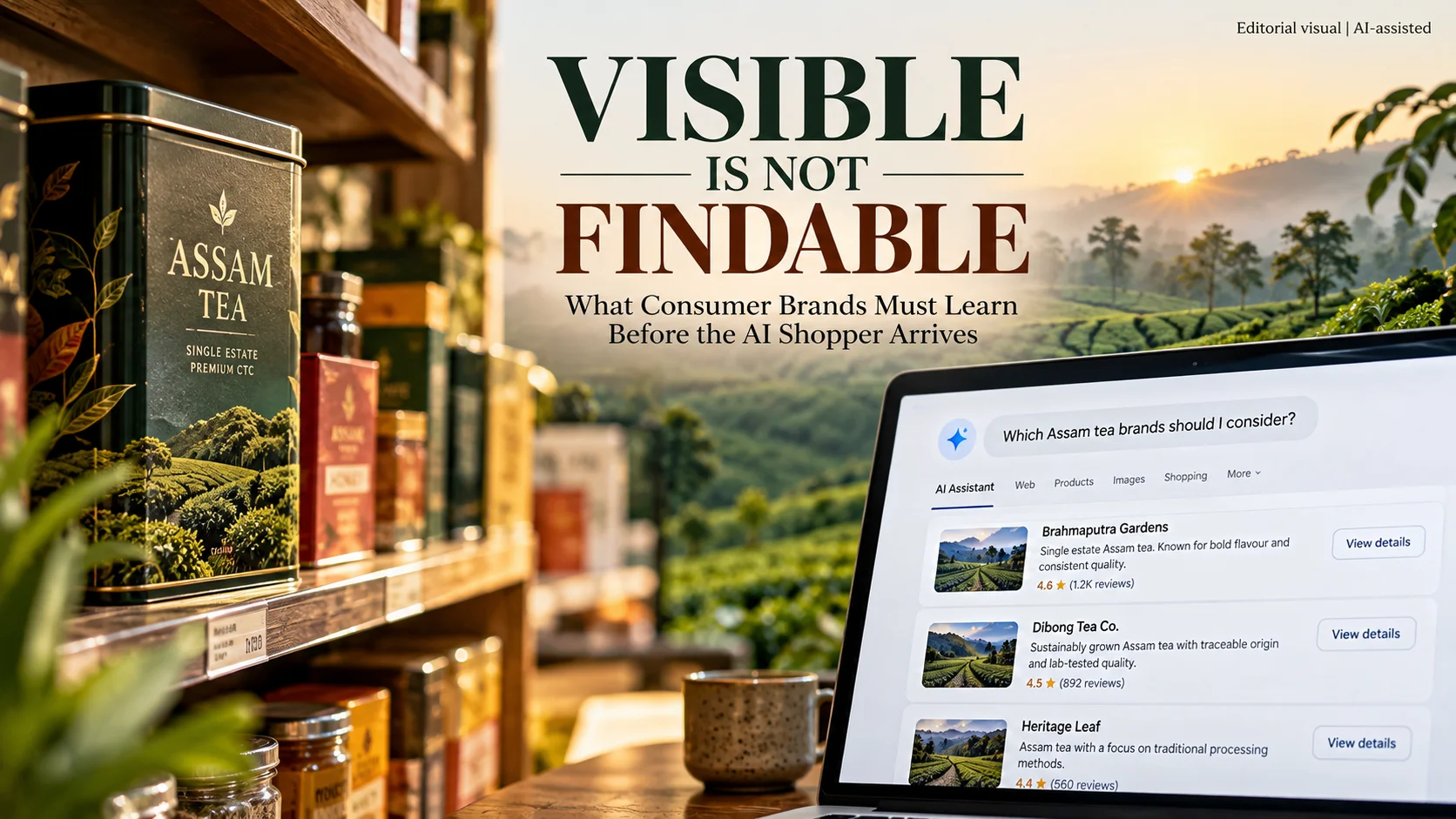
Visible Is Not Findable: What Consumer Brands Must Learn Before the AI Shopper Arrives
Brand & Media Intelligence | The Quantiq
For decades, the playbook for building a commodity brand was relatively straightforward. Get your product onto the shelf, put your name on a hoarding, run a festive-season advertisement and repeat the message until shoppers remember you.
Tea, spices, honey, rice and turmeric are familiar examples. When products appear similar, brands compete through packaging, advertising, distribution and the promise of a distinctive story. The company that commands the most attention often enjoys an advantage.
But that playbook was built around a simple assumption: a human being would be standing in front of the shelf.
Increasingly, another kind of encounter is becoming possible. A consumer might ask an AI assistant, “Which Assam tea should I buy?” or “How can I tell whether this honey is pure?” Instead of walking through a shop, the consumer receives an answer, a comparison or a shortlist of products.
The assistant may not encounter the brand as a shopper does. It may not experience the packaging, remember the hoarding or respond to an emotional advertisement. Its recommendations depend on the product information, sources and signals available to that particular system.
This is where an important distinction emerges. In the age of AI-assisted discovery, being visible is no longer enough. Brands must also be findable, understandable and credible.
That is the challenge of AI brand discoverability. It is also an opportunity for businesses that have genuine quality, distinctive origins and verifiable stories to tell.
From the Retail Shelf to the AI Answer
AI-assisted shopping is still evolving. Most purchases in India continue to happen through physical shops, online marketplaces, established buying habits and personal recommendations. It would be premature to suggest that AI assistants already determine what most families buy.
Yet consumers are increasingly able to use AI tools to compare products, interpret labels, understand ingredients and explore alternatives. These interactions create new opportunities for brands to enter the consideration set.
They also create a risk.
Imagine a customer researching premium Assam tea. One brand has attractive packaging and a substantial advertising presence. Another provides clear information about its tea estate, harvest, grade, processing methods and quality credentials. Both may offer an excellent product, but the second gives a buyer more evidence with which to assess its claims.
Whether an AI assistant recommends either brand will depend on the question, the information available and the system’s selection process. Better documentation does not guarantee a recommendation. It does, however, make the brand’s claims easier to examine.
For brand owners, the danger is not an overnight collapse in sales. It is the possibility of gradually missing out on purchase decisions because potential customers never encounter their products during research and comparison.
The brand may remain familiar to existing customers while becoming less visible in the information environment where new customers begin their search.
Why Consumer Brands Face a Particular Challenge
Commodity categories have two characteristics that make discoverability especially important.
First, many product attributes can be documented and compared. Origin, grade, harvest season, ingredients, certifications, laboratory results and price can all provide useful information. When these details are accessible and reliable, buyers can make more informed comparisons.
Second, many products are substitutable, at least in the eyes of an unfamiliar buyer. Two teas may appear similar on a product listing. Two jars of honey may make comparable claims. Several turmeric brands may promise purity and traditional quality.
In such situations, brand identity and storytelling still matter. But they work best when supported by evidence.
Consider a premium Assam tea brand whose reputation rests largely on an elegant tin and an evocative story about its heritage. If a competing brand offers equally attractive packaging alongside clear provenance, credible quality information and independent references, the latter may give a prospective buyer more reasons to trust its claims.
The lesson is not that packaging and storytelling have become irrelevant. It is that a compelling story needs credible evidence behind it, particularly when buyers can use AI to compare competing claims.
This applies well beyond tea. Honey producers, spice processors, rice brands and other origin-led businesses face the same challenge.
Visibility Is Not the Same as Discoverability
The two concepts are closely related, but they serve different purposes.
Visibility is about being seen. It is built through distribution, advertising, social media, retail presence, search results and repeated encounters with a brand. Businesses invest in these channels to attract attention and build familiarity.
Discoverability is about being found when a potential customer is looking for an answer, even when the customer does not already know the brand exists.
It depends on whether the business has accessible and consistent information, whether its product claims can be verified, and whether credible sources help establish its identity and reputation.
Advertising can create visibility quickly. Discoverability usually requires sustained work on product information, digital presence, independent references and customer trust. Both require investment, but the nature of that investment differs.
A brand can have thousands of social media followers and still be absent when a buyer asks an AI assistant to recommend a product in its category.
That is the gap brand owners need to investigate. How much of their marketing expenditure creates exposure, and how much helps potential customers find, understand and confidently evaluate their products?
The answer will differ across industries. But the question deserves a place in every serious brand strategy.
Four Threats Brand Owners Should Take Seriously
1. The Recommendation That Skips Your Brand
When a consumer asks for the best products in a category, an AI assistant may draw on product information, reviews, independent articles, directories and other accessible sources. The precise process varies across systems and is not always transparent.
A brand whose digital presence consists mainly of advertisements and packaging may leave very little information for a buyer to examine. A competitor with clear product descriptions, consistent business details and credible external references may be easier to evaluate.
This does not mean that every well-documented brand will be recommended. Nor does it mean that every brand omitted from an answer has poor discoverability.
It does mean that brand owners should not assume that market recognition automatically translates into inclusion in AI-generated answers.
The first step is to find out what happens when customers ask the questions that matter to the business.
2. The Agent That Goes Straight to the Producer
A second challenge concerns the role of intermediaries.
As AI-assisted comparison and purchasing tools develop, buyers may find it easier to compare products from different sources. A future purchasing agent could evaluate available information about origin, quality, price and delivery before directing a buyer towards suitable suppliers.
In some categories, this could make it easier to discover cooperatives, individual producers, estates or farmer-producer organisations directly.
For brands built mainly around repackaging, this presents a strategic question. What value do they add beyond the label?
Distribution, quality control, processing, reliable supply, customer service, traceability and consumer trust can all justify a brand’s place in the value chain. Simply placing a familiar name on an otherwise undifferentiated product may be a weaker proposition.
The challenge is not to defend every intermediary. It is to build a brand that contributes meaningful value and can demonstrate it.
3. The Flood of Look-Alike Brands
AI image-generation tools have made it easier and cheaper to create polished packaging concepts, advertising visuals and brand imagery. A small business can now explore visual styles that once required substantial design budgets.
This is an advantage, but it also creates a problem.
When many brands use similar tools and prompts, their visual identities can begin to look alike. Mountain landscapes, misty tea gardens, golden sunlight and claims of purity or authenticity can become interchangeable.
The result is a paradox. More businesses can afford attractive branding, but attractive branding alone may become less distinctive.
For an Assam tea company, a generic image of a tea garden is not necessarily a strong differentiator. A genuine account of its estate, people, cultivation practices and product characteristics may tell a more memorable story.
AI can help present that story. It cannot substitute for the underlying reality.
4. When AI-Designed Branding Undermines Trust
The fourth threat comes from within the brand itself.
Businesses are understandably using AI to create logos, advertisements, catalogues, product descriptions and social media content. Used thoughtfully, these tools can reduce costs and accelerate creative work.
Problems arise when speed takes precedence over authenticity and quality.
Generic visuals can make one brand indistinguishable from another. An AI-generated farmer presented as a real grower can undermine a company’s credibility. An imaginary landscape used to suggest a product’s provenance can create a misleading impression. Distorted packaging text or inaccurate product details can damage the trust that the campaign was supposed to build.
This matters particularly in food and agricultural products, where buyers may care deeply about origin, ingredients, purity and production practices.
There is also a longer-term branding concern. If a business relies entirely on generic AI-generated imagery, it may struggle to build a distinctive visual identity that competitors cannot easily imitate. The intellectual property protection available for AI-assisted work depends on the applicable law and the human contribution involved.
The answer is not to reject AI. Businesses can use it for layouts, creative variations, translations and faster production. The important distinction is between using AI to communicate evidence and using it to manufacture an appearance of evidence.
The people, farms, places, certifications and test results behind a product must be real. AI can assist with the presentation, but it should not invent the proof.
How Consumer Brands Can Become More Discoverable
The good news is that discoverability rewards substance. Many producers in Northeast India have valuable stories rooted in geography, agricultural knowledge, distinctive products and local communities. The opportunity is to make those strengths easier for buyers to discover and verify.
Publish Product Facts That People and Machines Can Read
A product’s essential information should not exist only on its packaging or in an attractive image.
Businesses should publish clear details about origin, ingredients, grade, harvest, processing, certifications and quality testing wherever those details are relevant and available. Laboratory reports and certification claims should be genuine, current and attributable to the appropriate source.
Product information should be available as readable text on the company’s website. Structured data, such as the Product vocabulary documented by Schema.org, can also help describe products in a consistent format.
These measures do not guarantee that an AI assistant will cite or recommend a brand. They make its information more accessible and easier to interpret.
For a tea producer, that could mean providing accurate information about the estate, tea type, harvest period, processing and available quality credentials. For a honey business, it could mean clearly documenting the product’s source and supporting any purity or testing claims with appropriate evidence.
The objective is simple: make it easier for a buyer to understand what the product is and why its claims deserve attention.
Build Credibility Beyond Your Own Website
A company can say many things about itself. Buyers gain confidence when important claims can also be examined through credible independent sources.
Trade associations, recognised certification bodies, reputable publications, industry directories and reliable business databases can all contribute to a clearer picture of a brand. Genuine customer reviews and independently documented achievements may provide additional context.
This is one reason consistent, substantive brand coverage matters. An article that explains what a company produces, where it operates and what distinguishes its offering can help readers understand the business beyond its advertising message.
But credibility cannot be manufactured simply by accumulating mentions. Independent references should be accurate, relevant and trustworthy. Paid coverage should not be misrepresented as independent endorsement.
The goal is not to flood the internet with brand names. It is to establish a reliable information trail that supports the company’s identity and claims.
Make the Brand Easy to Identify
Inconsistent names, addresses, product descriptions and business details can create confusion.
A company may use one name on its website, another on a marketplace and a shortened version on social media. Product descriptions may differ across platforms. Important information may be missing from some listings.
Brand owners should establish a consistent identity across their website, business profiles, directories and marketplace listings. The same brand name, accurate contact details and clear product descriptions should appear wherever the business is represented.
Consistency helps customers recognise the business and makes its information easier to reconcile across different sources.
For smaller brands, this is often a practical starting point. It requires attention to detail more than a large marketing budget.
Turn Customer Experience Into Credible Evidence
A brand’s reputation is shaped by what happens after the purchase.
Genuine reviews, repeat purchases, customer feedback and documented buyer experiences can help prospective customers assess a product. Businesses should encourage honest feedback and respond constructively when customers raise concerns.
They should resist the temptation to manufacture reviews or present selective testimonials as universal proof of quality. Such shortcuts may create a misleading picture and weaken trust when the truth emerges.
For consumer brands, this is especially important because many purchase decisions depend on confidence in the product’s quality and consistency.
A reliable product experience, supported by authentic customer feedback, is a stronger foundation for long-term reputation than a campaign that promises more than the business can deliver.
Build a Website That Answers Real Questions
Many company websites are designed around the business’s own priorities. They introduce the company, display its products and invite visitors to make a purchase.
That is necessary, but it may not answer the questions a new customer actually has.
A tea producer could explain what distinguishes its tea, how it is processed and how buyers can understand its grade. A honey brand could describe its sourcing practices and explain what available tests can—and cannot—establish about its product. A turmeric producer could document its origin and substantiate relevant claims about its product.
These pages should answer questions directly, use plain language and link to supporting evidence where possible.
This is useful for conventional search, AI-assisted discovery and human readers alike. Google’s guidance on AI features and your website is a useful starting point for understanding how established search principles apply to Google’s AI-powered search experiences.
There is no guaranteed formula for appearing in AI answers. Clear, useful and verifiable information is nevertheless a sensible foundation for digital discoverability.
A Practical Test Every Brand Owner Can Run This Week
Before spending more money on advertising, take twenty minutes to investigate how easily customers can discover your brand.
Open two or three AI assistants and ask questions that a real buyer might ask. Keep the questions neutral rather than including your brand name in every prompt.
For example, a tea producer could ask, “Which single-estate Assam tea brands should I consider, and how do they differ?” A honey company might ask, “Which honey brands provide credible information about sourcing and quality testing?” A turmeric business could ask, “Where can I find Lakadong turmeric, and how can I verify its origin?”
Record the responses. Was your brand mentioned? Which alternatives appeared? What information was used to explain the recommendations? Did the answers point to sources that you can inspect?
Repeat the exercise with slightly different wording. AI responses can vary, so one answer should not be treated as a definitive ranking of the market.
The exercise is not a scientific measurement of discoverability. It is an initial diagnostic that may reveal gaps in product information, independent coverage or digital presence.
If your brand is absent, do not immediately assume that advertising is the solution. First investigate whether the information needed to understand and evaluate your product is available, consistent and credible.
That is where the more useful work begins.
Five Questions Every Founder Should Ask
The exercise above leads to five questions worth discussing with your marketing team.
Can a prospective buyer find your brand when asking a relevant question without knowing your name? Can someone verify your claims about origin and quality through sources beyond your own website? Does your visual identity reflect real people, places and product characteristics? Do credible independent sources describe your business consistently? And if a buyer compares your product directly with alternatives, what meaningful value would make your brand worth choosing?
These questions go beyond search rankings. They examine whether the business has built a credible, identifiable and differentiated proposition.
A brand that cannot answer them clearly may need to strengthen its underlying business story before investing further in promotion.
The Bigger Opportunity for Northeast Indian Brands
Northeast India offers a useful setting for this discussion because many of its products are closely connected to geography, agricultural practices, local knowledge and distinctive origins.
Assam tea, Lakadong turmeric, regional honey and other agricultural products can draw value from their provenance. But provenance becomes commercially meaningful when buyers can understand it and when relevant claims can be substantiated.
Geographical indication status, where applicable, can form part of that story. It should not be treated as automatic proof of every quality claim, nor should a brand imply that it holds a registration that belongs to a different producer, product or authorised user.
The wider opportunity is to connect the identity of a product with credible information about its origin, production and quality.
For businesses that have historically relied on distributors, retail relationships and conventional advertising, this calls for a broader view of brand building. A digital presence should not merely display the product. It should help a prospective buyer understand what makes the product distinctive and where the supporting evidence can be found.
That is relevant not only to small producers. Established brands, exporters, cooperatives and businesses selling through multiple intermediaries have reasons to invest in the same discipline.
The Bottom Line: Build Brands That Can Be Found and Believed
The AI shopper is not a distant certainty that will replace every existing buying habit. Nor will AI assistants become the sole arbiters of brand reputation. Human recommendations, retail relationships, product experience, advertising and established distribution channels will continue to matter.
But the information through which consumers discover and compare products is changing. Brand owners should prepare for that change without abandoning the fundamentals that have always made a brand valuable.
A distinctive product, consistent quality, reliable distribution and a credible story remain essential. What changes is the need to make these strengths accessible and verifiable across the digital environments where buyers seek answers.
For consumer brands, the challenge is especially clear. Attractive packaging can win attention. Advertising can build familiarity. Neither is a substitute for evidence that stands up to scrutiny.
Businesses that document their strengths, maintain a consistent identity and earn credible independent references will be better equipped to compete in an increasingly information-driven marketplace.
Visibility asks for attention. Discoverability earns consideration and trust. In the age of the AI shopper, brands need both—but they cannot afford to neglect the second.
The Quantiq Brand & Media Intelligence is a weekly Saturday series examining brands, media and markets across Northeast India and Bhutan. This article presents editorial analysis and general business guidance. It does not constitute investment or marketing advice.