5 Game-Changing AI Tools & Solutions Quietly Reshaping Healthcare in 2026
The healthcare industry is entering one of the most transformative periods in its history.
AI is no longer limited to experimental pilots or futuristic discussions. Across hospitals, diagnostic labs, biotech companies, and healthcare startups, artificial intelligence is increasingly becoming operational infrastructure — helping doctors diagnose faster, hospitals reduce administrative overload, researchers accelerate drug discovery, and patients access more personalized care.
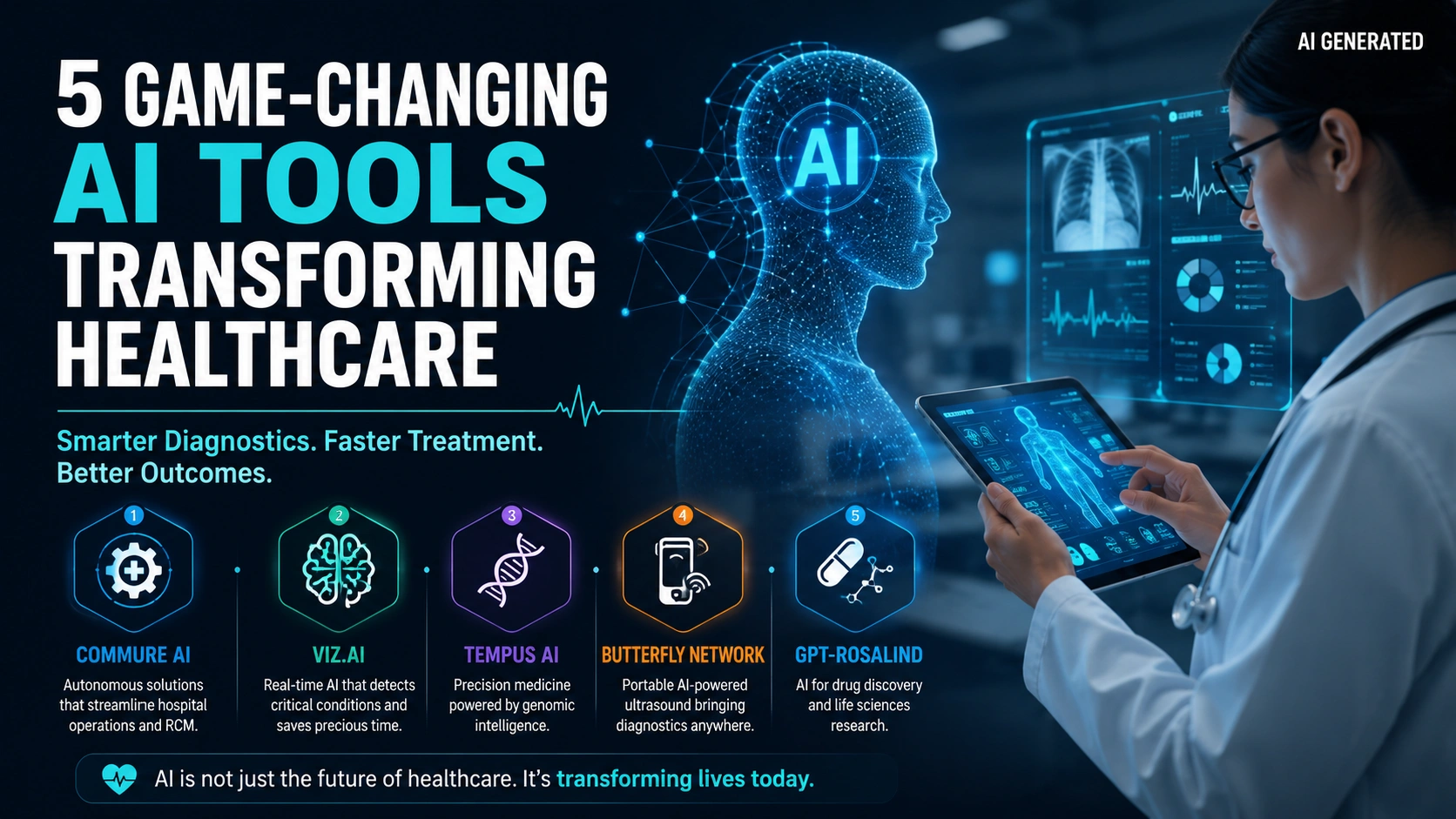
Here are five AI-driven tools and solutions that are emerging as major disruptors in the healthcare industry in 2026.https://thequantiq.com/sunday-brief-6/
Commure AI — The Rise of Autonomous Hospital Operations
One of the biggest hidden crises in healthcare globally is administrative overload.
Doctors and hospitals spend enormous amounts of time on:
- billing,
- insurance approvals,
- patient records,
- documentation,
- and revenue cycle management.
Commure is emerging as one of the most important players trying to solve that problem using agentic AI — AI systems capable of autonomously planning and executing operational tasks.
The company claims its AI platform can automate more than 85% of revenue cycle management workflows without human intervention and is already deployed across hundreds of healthcare organizations.
Why it matters:
Healthcare systems across the world are struggling with:
- doctor burnout,
- staffing shortages,
- rising operational costs,
- and administrative inefficiency.
AI tools like Commure could fundamentally alter hospital economics by allowing medical professionals to spend less time on paperwork and more time on patient care.
This is not glamorous AI.
But it may become one of the most economically disruptive forms of healthcare AI in the coming decade.
Viz.ai — AI That Detects Medical Emergencies in Real Time
Imagine an AI system identifying a stroke on a brain scan before a specialist even reviews it — and instantly alerting the emergency team.
That is precisely the kind of real-time healthcare transformation platforms like Viz.ai are enabling.
The company uses AI-powered imaging analysis to detect life-threatening conditions such as strokes and rapidly coordinate emergency response workflows.
In critical care medicine, speed is everything.
A few minutes can determine whether a patient survives, recovers fully, or suffers permanent neurological damage.
AI-powered emergency triage systems are increasingly helping hospitals:
- prioritize urgent scans,
- reduce diagnosis delays,
- improve care coordination,
- and accelerate treatment timelines.
This is one of the clearest examples of AI directly impacting clinical outcomes rather than merely improving administrative efficiency.
Tempus AI — Precision Medicine Powered by Genomic Intelligence
Healthcare is gradually moving away from one-size-fits-all treatment.
The future increasingly lies in precision medicine — treatments tailored to an individual’s genetics, disease profile, and medical history.
Tempus AI has emerged as one of the most influential players in this space by combining:
- genomic sequencing,
- clinical data,
- molecular diagnostics,
- and AI-driven analytics.
Its systems help oncologists and researchers identify highly personalized treatment pathways for cancer patients and other complex diseases.
Why this matters:
Traditional medicine often treats patients based on generalized protocols.
AI-driven precision medicine aims to identify:
- which treatment may work best,
- which drug combinations may fail,
- and how diseases behave differently across individuals.
This could eventually transform:
- oncology,
- rare disease treatment,
- drug development,
- and preventive healthcare.
The healthcare industry may ultimately remember this era as the beginning of biology becoming data-driven.
Butterfly Network — AI-Powered Handheld Ultrasound for Rural & Frontier Healthcare
One of the biggest global healthcare inequalities is diagnostic access.
Millions of people still lack access to advanced imaging systems because MRI and ultrasound infrastructure remains expensive, centralized, and difficult to deploy in remote regions.
Butterfly Network is attempting to disrupt that model through portable AI-powered handheld ultrasound devices connected to smartphones and cloud-based systems.
The implications are enormous for:
- rural healthcare,
- disaster response,
- telemedicine,
- military medicine,
- and frontier regions like Northeast India.
Instead of requiring large imaging infrastructure, clinicians can increasingly perform AI-assisted diagnostics using portable devices in low-resource environments.
This could become one of the most democratizing healthcare AI innovations of the decade.
Especially in regions where geography itself limits healthcare access.
OpenAI GPT-Rosalind — AI for Drug Discovery & Life Sciences Research
Perhaps the most ambitious healthcare AI frontier lies not inside hospitals — but inside laboratories.
OpenAI’s GPT-Rosalind, launched as a specialized life sciences research model, is designed to assist researchers in:
- biochemistry,
- drug discovery,
- translational medicine,
- evidence synthesis,
- and experimental planning.
The model can interact with scientific databases, read research papers, synthesize findings, and propose experimental directions.
This matters because drug discovery is:
- expensive,
- slow,
- data-intensive,
- and highly uncertain.
AI models capable of accelerating hypothesis generation and research synthesis could significantly reduce the time required to identify promising therapies.
Major pharmaceutical and biotech firms are already integrating such systems into research workflows.
If successful, AI may not merely improve healthcare delivery.
It may fundamentally alter how medicine itself is discovered.
The Bigger Story: Healthcare Is Becoming an AI-Native Industry
The most important shift happening in healthcare is not the emergence of individual AI tools.
It is the gradual transition of healthcare itself into an AI-assisted operating system.
AI is increasingly being embedded across:
- diagnostics,
- imaging,
- hospital operations,
- drug discovery,
- patient triage,
- clinical documentation,
- predictive analytics,
- and personalized medicine.
And unlike many industries experimenting cautiously with AI, healthcare’s structural pressures are accelerating adoption:
- aging populations,
- workforce shortages,
- rising costs,
- physician burnout,
- chronic disease burdens,
- and exploding medical data volumes.
The sector may eventually discover that AI is not merely a technology upgrade.
It is becoming survival infrastructure.
The India & Northeast India Opportunity
For India — and especially frontier regions like Northeast India — healthcare AI could become transformational.
AI-assisted diagnostics, portable imaging, telemedicine, predictive health systems, and AI-powered hospital automation could dramatically improve healthcare accessibility in geographically difficult regions where specialist infrastructure remains limited.
In places where distance still shapes healthcare outcomes, AI may eventually help reduce the tyranny of geography itself.
And that could become one of the most important healthcare revolutions of the coming decade.https://thequantiq.com/ai-health-tools-transforming-healthcare/



One Comment