
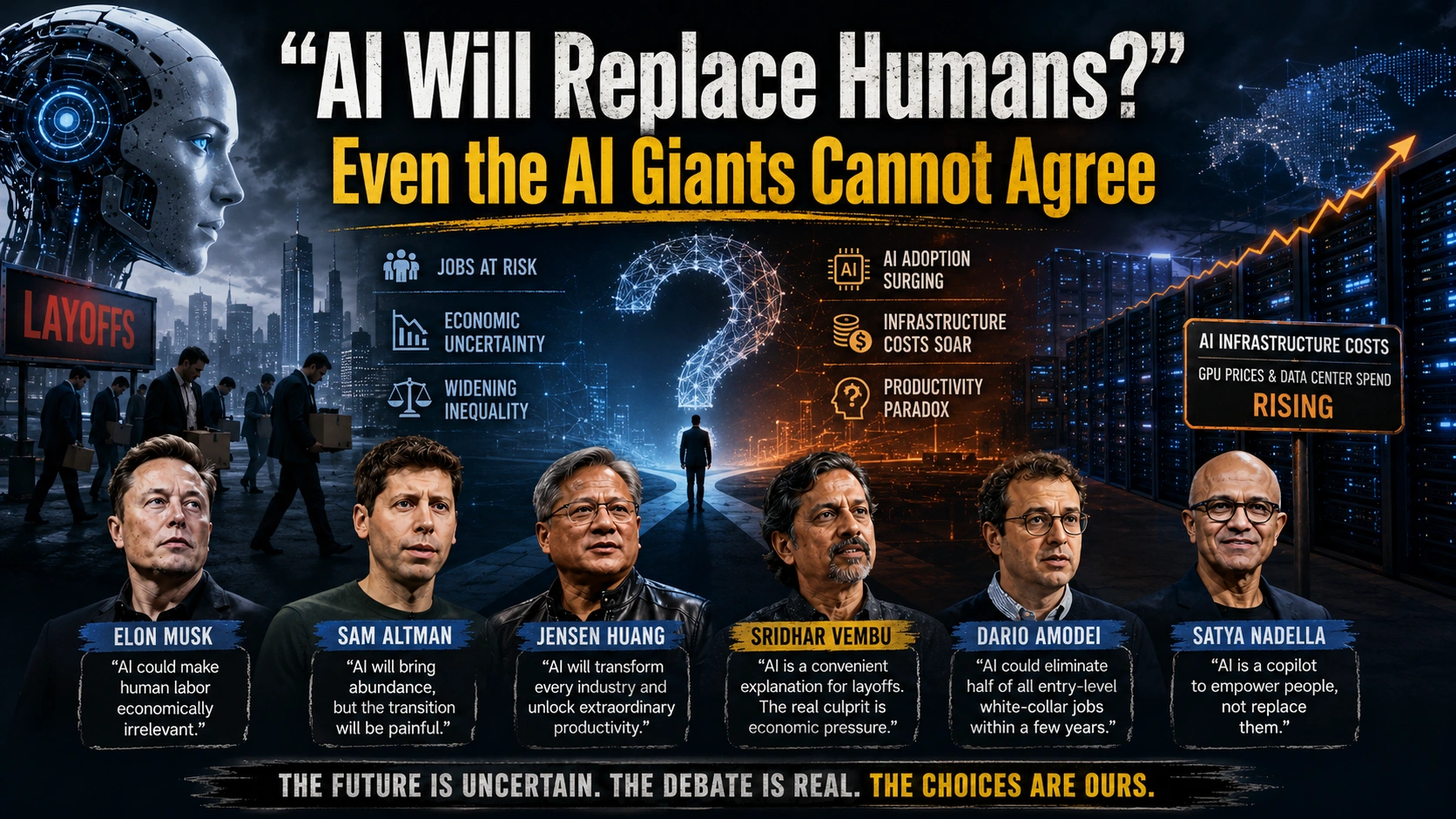
AI, Layoffs, and the Great Global Contradiction: Even the Architects of Artificial Intelligence Cannot Agree on Humanity’s Future
For nearly two years, the world has been flooded with a singular narrative.
Artificial Intelligence is replacing humans.
From Silicon Valley boardrooms to Indian startup ecosystems, from multinational consulting firms to media headlines, AI has increasingly been projected as the inevitable force reshaping employment, productivity and the future of civilization itself.
But suddenly, an uncomfortable contradiction has entered the global conversation.
Sridhar Vembu, the founder of Zoho, recently challenged the growing corporate narrative around AI-driven layoffs. According to him, many companies may be using AI as a “convenient explanation” for job cuts while the deeper reality could be rising operational costs, slowing global demand and mounting economic pressure.
That observation may appear simple on the surface. But beneath it lies one of the biggest economic questions of this decade.
Is AI genuinely replacing human labor at scale?
Or is AI becoming the perfect corporate cover story for a slowing global economy struggling with inflation, shrinking margins, expensive infrastructure and investor pressure?
The answer becomes even more fascinating when one looks at the conflicting statements emerging from the world’s most influential AI leaders themselves.
Elon Musk has repeatedly warned that AI could eventually make human labor economically unnecessary in many sectors, forcing societies to rethink income distribution and possibly embrace Universal Basic Income.
Sam Altman often speaks about a future of abundance created by AI, while simultaneously acknowledging that the transition could be socially and economically painful.
Jensen Huang projects confidence that AI will unlock enormous productivity gains across industries, yet his company now sits at the center of a global infrastructure arms race costing corporations billions of dollars annually.
Dario Amodei has openly warned that white-collar disruption may arrive faster than governments and institutions are prepared for.
Meanwhile, Satya Nadella continues framing AI as a “copilot” designed to augment human productivity rather than replace workers outright.
And therein lies the contradiction.
The architects of the AI revolution themselves do not fully agree on what comes next.
That alone should force governments, investors, universities and workers across the globe to pause and reflect.
Because humanity may be entering an economic transition so profound that even the people building the future cannot accurately predict its consequences.
The Global AI Explosion Is Real
McKinsey’s 2025 State of AI Report mentioned that 78% of surveyed organizations reported using AI in at least one business function.
India, interestingly, has emerged as one of the world’s fastest adopters of workplace AI. A recent ADP Research report revealed that nearly 80 percent of Indian employees now use AI tools several times a week, significantly higher than the global average. Around 41 percent reportedly use AI daily.
Google CEO Sundar Pichai recently disclosed that Google now processes more than 3.2 quadrillion AI tokens per month. Its AI-powered products collectively reach billions of users worldwide.
Even governments are racing into the AI era. In the United States, federal AI use cases reportedly expanded from around 700 in 2023 to over 3,600 by 2025 across multiple agencies.
But beneath this spectacular growth lies a more complex and less discussed reality.
The Hidden Cost of the AI Gold Rush
AI may appear digital and invisible to consumers, but behind every chatbot, image generator and coding assistant lies a gigantic physical infrastructure ecosystem.
Massive data centers. Energy-intensive GPU clusters. Expensive cloud infrastructure. Advanced semiconductor supply chains. And this is where the economics become extremely important.
The hardware required to train and deploy frontier AI systems is astonishingly expensive.
A single NVIDIA H100 AI GPU can reportedly cost between ₹30 lakh and ₹50 lakh in India depending on configuration, while large 8-GPU AI servers can cost several crores.
Cloud rental prices for H100 GPUs globally have fluctuated dramatically over the last two years. Early scarcity reportedly pushed rental rates beyond $8 to $10 per GPU-hour before later corrections brought prices closer to $2-$4 per hour in many markets.
Yet paradoxically, even as GPU prices softened in some markets, enterprise AI spending continued exploding because companies needed larger clusters, higher energy consumption, greater storage capacity and expensive integration systems.
This creates an uncomfortable possibility. Some corporations may not necessarily be laying off workers because AI has already become massively productive. They may instead be restructuring to finance the enormous cost of entering the AI race itself.
That distinction matters. Because it shifts the debate from “AI replacing humans” to “AI-driven capital restructuring.”https://thequantiq.com/india-500-billion-ai-future/
The Productivity Paradox Nobody Wants to Discuss
Promises of efficiency dominate the global AI conversation. But where is the measurable productivity explosion?
This question is increasingly surfacing among economists, investors and even former tech executives.
A former Microsoft executive recently claimed that less than 3 percent of paying Copilot users actively engage with the platform despite massive deployment and enormous investments.
At the same time, enterprises worldwide continue pouring billions into AI infrastructure amid investor pressure to demonstrate “AI readiness.”
The phenomenon resembles something larger than technology adoption.
It resembles a geopolitical and financial arms race. No company wants to appear left behind. No CEO wants investors to believe their business lacks an AI roadmap.
No government wants to appear technologically irrelevant. And so AI spending accelerates, even while real-world economic returns remain uneven and difficult to quantify.
McKinsey’s findings themselves reveal an interesting contradiction. While AI adoption is widespread, only a minority of companies report substantial enterprise-wide financial impact from AI deployment.
That may explain why layoffs, restructuring and cautious hiring continue even amid AI optimism.
The Silent Restructuring of the Global Workforce
The implications are especially serious for countries like India.
India became a global services powerhouse because it supplied large-scale skilled human capital to multinational corporations.
But now the very structure of global work is changing.
Reuters recently reported that Global Capability Centres in India are slowing hiring plans as AI reshapes workforce requirements. Some projects that once planned for more than 5,000 employees are now targeting closer to 2,000.
This does not necessarily mean AI has already replaced millions of workers.
But it does suggest something equally significant.
AI may already be changing corporate hiring psychology.
Companies may increasingly prefer smaller, highly AI-augmented teams over large conventional workforces.
That transition could fundamentally reshape white-collar employment across software, media, consulting, customer support, design and analytics.
And if that transformation accelerates globally, regions already struggling for economic visibility may face even deeper challenges.
What Happens to Smaller Economies and Peripheral Regions?
This is where the discussion becomes particularly relevant for regions like Northeast India.
The AI economy is not evenly distributed.
AI infrastructure, investment capital, semiconductor ecosystems and advanced research remain heavily concentrated in a few global hubs.
Even AI adoption itself shows enormous geographic disparity. According to recent global studies, wealthier and digitally advanced economies continue dominating AI usage while many developing regions lag behind.
If AI-driven productivity increasingly favors already powerful economic centers, smaller regional economies may risk becoming digitally invisible unless they build distinctive value ecosystems of their own.
That is why merely discussing AI tools is not enough anymore.
The real question is:
Who owns the infrastructure?
Who controls the data?
Who captures the productivity gains?
And who gets left behind?
The Real Story Is Bigger Than AI
Perhaps the biggest mistake the world is making right now is treating AI purely as a technology story.
It is not.
AI is rapidly becoming:
an infrastructure story,
a capital story,
an energy story,
a labor story,
a geopolitical story,
and ultimately, a civilization story.
The world is witnessing one of the largest reallocations of capital, talent and industrial strategy since the birth of the internet.
And somewhere amid this massive transition lies the uncomfortable truth hinted at by Sridhar Vembu.
AI may indeed transform humanity.
But the current wave of layoffs, restructuring and corporate anxiety may not be driven by machine intelligence alone.
They may also reflect something deeper:
a slowing global economy desperately trying to reinvent itself through the language of artificial intelligence.
The irony is extraordinary.
Even as AI promises abundance, the global economic system appears increasingly nervous, concentrated and uncertain.
And perhaps that is the biggest signal of all.https://thequantiq.com/indias-ai-workforce-challenge-why-350-million-indians-must-become-ai-literate-by-2030/