
Bamboo Activated Carbon: How Northeast India Can Build a High-Value Industrial Materials Industry
The Northeast Renaissance Series
Ideas for a ₹67,000 Crore Indian Market and a Multi-Billion Dollar Global Future.
Every Day We Use It, Yet Few Know What It Is
Every day, millions of Indians drink water purified using activated carbon.
Hospitals use it.
Pharmaceutical companies depend on it.
Food-processing industries rely on it.
Air purification systems cannot function effectively without it.
Even gold recovery operations use activated carbon as a critical industrial material.
Yet very few people know what activated carbon is.
Fewer still realise that bamboo can become one of the world’s most sustainable feedstocks for producing it.
This raises an important question.
Can Northeast India move beyond exporting bamboo as a raw material and begin manufacturing one of the most widely used advanced materials in modern industry?
The answer deserves serious attention.
Because activated carbon demonstrates exactly why the future belongs not to regions that merely supply resources, but to regions that embed intelligence, technology and innovation into those resources.https://thequantiq.com/northeast-india-green-industrialisation-bamboo-manufacturing/
Why Activated Carbon Matters
Most people are familiar with charcoal.
Some readers may now be familiar with biochar after reading our previous article on the carbon economy.
Activated carbon, however, belongs to a different category.
It is not merely carbon.
It is engineered carbon.
That distinction is important.
Ordinary charcoal contains carbon.
Activated carbon contains an enormous network of microscopic pores that dramatically increase its internal surface area.
As a result, activated carbon can trap contaminants, absorb impurities and filter unwanted substances from liquids and gases.
This is precisely why industries around the world use it.
In simple terms, if charcoal is carbon, activated carbon is advanced carbon.
The Hidden Industry Behind Modern Life
Most consumers never see activated carbon.
Nevertheless, they interact with it every day.
Water purification systems use it to remove contaminants.
Air filtration systems use it to eliminate odours and harmful compounds.
Pharmaceutical manufacturers use it during production processes.
Food and beverage companies rely on it for purification and quality control.
Chemical industries use it extensively.
Mining companies employ activated carbon to recover precious metals.
In many ways, activated carbon functions as an invisible industrial workhorse.
The global economy quietly depends on it.
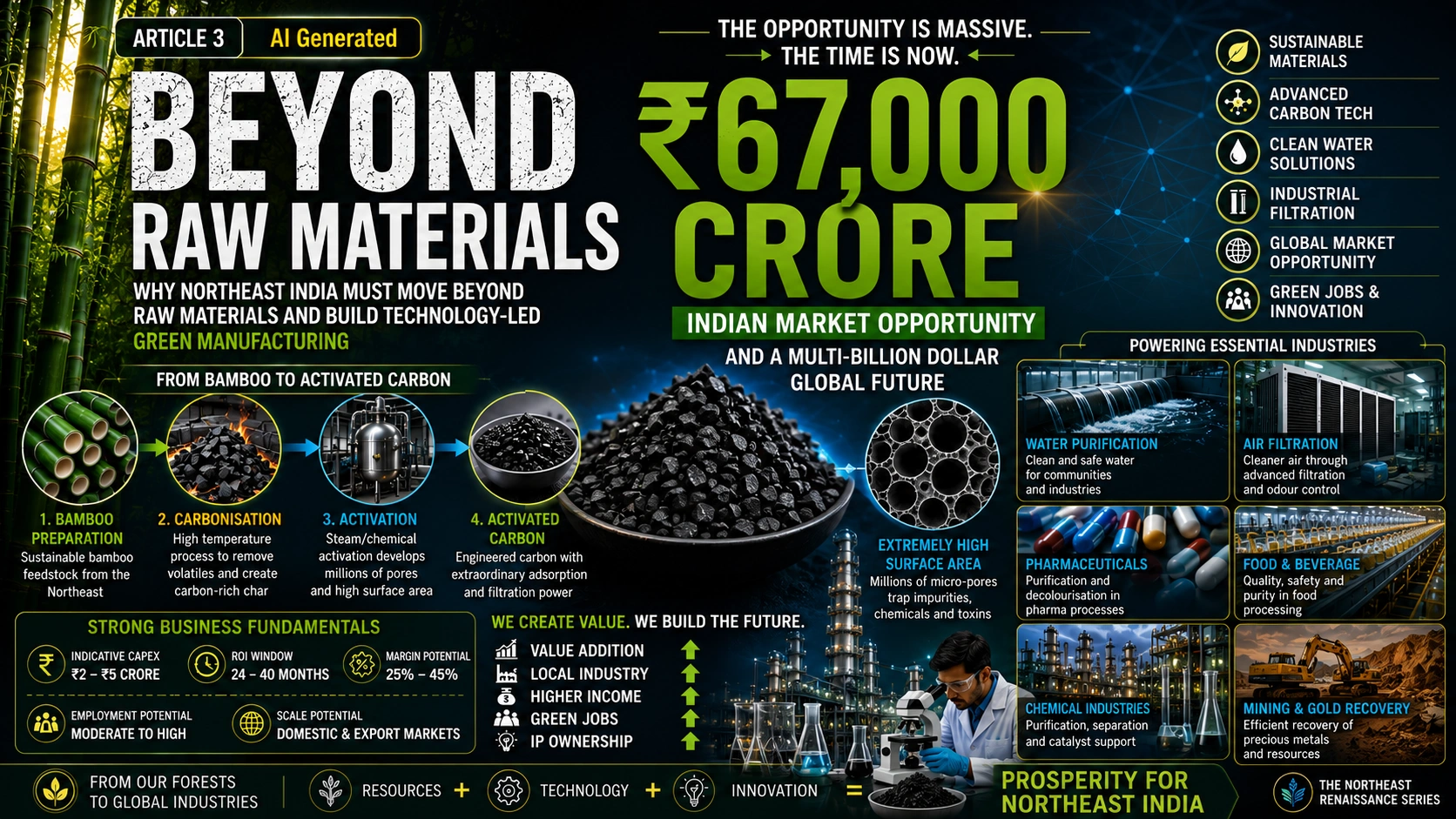
How Bamboo Activated Carbon Is Made
The production process begins with bamboo.
However, the bamboo itself is only the starting point.
The real value emerges through process technology.
Stage 1: Bamboo Preparation
The journey begins with bamboo feedstock.
This may include mature bamboo culms, processing residues, sawdust and other biomass streams.
The material must first be cleaned, dried and prepared.
Moisture control is particularly important because excessive moisture reduces process efficiency.
Stage 2: Carbonisation
The prepared bamboo enters a controlled heating environment.
This stage is known as carbonisation.
During carbonisation, volatile compounds leave the biomass while carbon-rich material remains.
The resulting product resembles charcoal.
However, it is only an intermediate material.
The highest value has not yet been created.
Stage 3: Activation
This is where the transformation occurs.
The carbonised material undergoes an activation process using steam, carbon dioxide or chemical agents.
During activation, millions of microscopic pores develop throughout the material.
Consequently, the internal surface area expands dramatically.
A single gram of activated carbon may possess hundreds or even thousands of square metres of internal surface area.
This extraordinary surface area creates the adsorption properties that industries seek.
Stage 4: Product Processing
The activated carbon is then processed into different grades and particle sizes.
Some applications require granular activated carbon.
Others require powdered activated carbon.
Certain industries demand highly specialised specifications.
This is where product engineering becomes important.
The Difference Between Charcoal, Biochar and Activated Carbon
These three materials often create confusion.
However, they serve different purposes.
Charcoal is primarily used as fuel.
Biochar is designed for soil improvement and carbon sequestration.
Activated carbon is engineered for filtration, purification and industrial applications.
The distinction is significant.
Activated carbon generally commands far higher market value because it solves industrial problems that customers are willing to pay premium prices to address.https://thequantiq.com/bamboo-biochar-carbon-economy-northeast-india/
A Market Worth Billions
The activated carbon industry is far from a niche business.
It is a global industrial sector.
Opportunity Snapshot
| Indicator | Indicative Estimate |
| Indian Activated Carbon Market | ₹6,500–7,500 Crores |
| Global Activated Carbon Market | Multi-Billion US$ Industry |
| Indicative CapEx | ₹2–5 Crores |
| Estimated ROI Window | 24–40 Months |
| Potential Margin Range | 25–45% |
| Employment Potential | Moderate to High |
| Scale Potential | Domestic and Export Markets |
and sectoral benchmarks. Actual commercial outcomes may vary depending on technology, feedstock quality, scale, product specifications, certifications, and market access. Readers should undertake independent technical and financial due diligence before making investment decisions.https://www.european-biochar.org/
The Industries That Use Activated Carbon
One reason activated carbon deserves attention is the diversity of industries it serves.
Water Treatment
Water treatment remains one of the largest applications.
Activated carbon helps remove organic compounds, odours and contaminants.
As concerns about water quality increase globally, demand is expected to remain strong.
Air Purification
Air filtration systems increasingly rely on activated carbon.
Industrial facilities, commercial buildings and households all require cleaner air.
This creates a growing market.
Pharmaceuticals
Pharmaceutical companies use activated carbon in purification processes.
Product quality standards in this sector are extremely high.
Consequently, specialised activated carbon grades often command premium prices.
Food and Beverage Processing
Food manufacturers use activated carbon for purification and decolourisation processes.
The sector continues to expand alongside rising consumer demand.
Chemical Industries
Chemical producers depend upon activated carbon for numerous applications.
This creates consistent industrial demand.
Why Northeast India Has a Strategic Advantage
Northeast India possesses one obvious advantage.
Bamboo.
However, bamboo alone is not enough.
Many regions around the world grow bamboo.
The real advantage lies elsewhere.
The Northeast possesses the opportunity to combine bamboo resources with process innovation.
That combination creates value.
Furthermore, the region increasingly seeks industries that align economic growth with environmental sustainability.
Activated carbon fits that requirement remarkably well.
It transforms renewable biological resources into high-value industrial materials.
Why Process Intelligence Is the Real Moat
This is perhaps the most important lesson in the entire article.
Many entrepreneurs assume that success comes from buying machines.
That assumption is increasingly dangerous.
In the age of artificial intelligence, machinery is becoming more accessible than ever.
A competitor can often purchase similar equipment.
However, process intelligence is much harder to replicate.
The real competitive advantage lies in understanding activation parameters, pore development, feedstock behaviour, product specifications and customer requirements.
In other words, the machine is not the moat.
The process is.
This principle applies not only to activated carbon.
It applies to the future of manufacturing itself.https://nbm.da.gov.in/
The AI Era and Advanced Materials
Artificial intelligence is beginning to transform industrial development.
Engineers can now use simulation tools, data analytics and AI-assisted optimisation to improve processes more rapidly than ever before.
This changes the equation.
Developing advanced materials no longer requires the resources of industrial giants alone.
Smaller companies can innovate.
Regional enterprises can compete.
Knowledge barriers are falling.
Consequently, Northeast India has an opportunity to participate in sectors that previously appeared inaccessible.
From Raw Bamboo to Industrial Intelligence
Every night, trucks loaded with raw bamboo leave parts of Northeast India.
Few people stop to ask what happens next.
Some of that bamboo eventually becomes products worth many times the value originally received by the grower.
Activated carbon illustrates this reality perfectly.
The greatest value does not lie in harvesting bamboo.
It lies in transforming bamboo through knowledge, technology and process innovation.
This is where industrial prosperity is created.https://thequantiq.com/how-bamboo-fiber-is-made-northeast-sustainable-textile-future/
The Quantiq Assessment
Activated carbon demonstrates why Northeast India must move beyond the raw-material economy. The opportunity is not simply to grow bamboo. The opportunity is to transform bamboo into high-value industrial materials that serve water treatment, environmental protection, pharmaceuticals, manufacturing and future clean-tech industries.
In the age of artificial intelligence, regions that rely solely on natural resources will struggle to capture maximum value. Regions that master process intelligence, however, can build durable competitive advantages.
Northeast India already possesses the resource base.
The next step is to build the knowledge base.
Because ultimately, prosperity will not be determined by how much bamboo the region grows.
It will be determined by how much intelligence it embeds into that bamboo before it reaches the market.






3 Comments