
Bamboo Vinegar: Can Northeast India Build a Green Chemistry Industry from Bamboo Waste?
The Northeast Renaissance Series
Ideas for a ₹40,000 Crore Indian Market and a Multi-Billion Dollar Global Future
For decades, Northeast India has viewed bamboo through a remarkably narrow economic lens. Conversations around bamboo have traditionally revolved around furniture manufacturing, handicrafts, construction applications, paper production, and, at best, low-value biomass utilization. Even when bamboo enters industrial processing systems, most attention remains focused on the visible end product being manufactured, while little thought is given to the hidden economic opportunities emerging during the process itself.
This may prove to be one of the region’s biggest blind spots.
Because sometimes the most valuable part of a natural resource is not the product we see. It is the invisible chemistry released during processing, often treated casually as waste and discarded without a second thought. One such overlooked by-product is bamboo vinegar, a little-known substance that quietly represents an emerging industrial opportunity with growing global relevance.
Very few people in India have heard of bamboo vinegar. Yet this seemingly insignificant liquid is already finding applications across organic agriculture, green industrial chemistry, cosmetics, natural pesticides, household cleaning products, animal health systems and a rapidly expanding global movement toward bio-based sustainable manufacturing.
The larger question therefore deserves serious attention.
Can Northeast India move beyond simply harvesting bamboo and begin building a future green chemistry industry around one of the most overlooked products hidden inside bamboo itself?
The answer may shape how the region participates in the industries of the future.
Because bamboo vinegar demonstrates a much larger economic truth. The future will increasingly reward regions that understand how to extract value not just from visible resources, but from the invisible science embedded within those resources.
Understanding What Bamboo Vinegar Actually Is
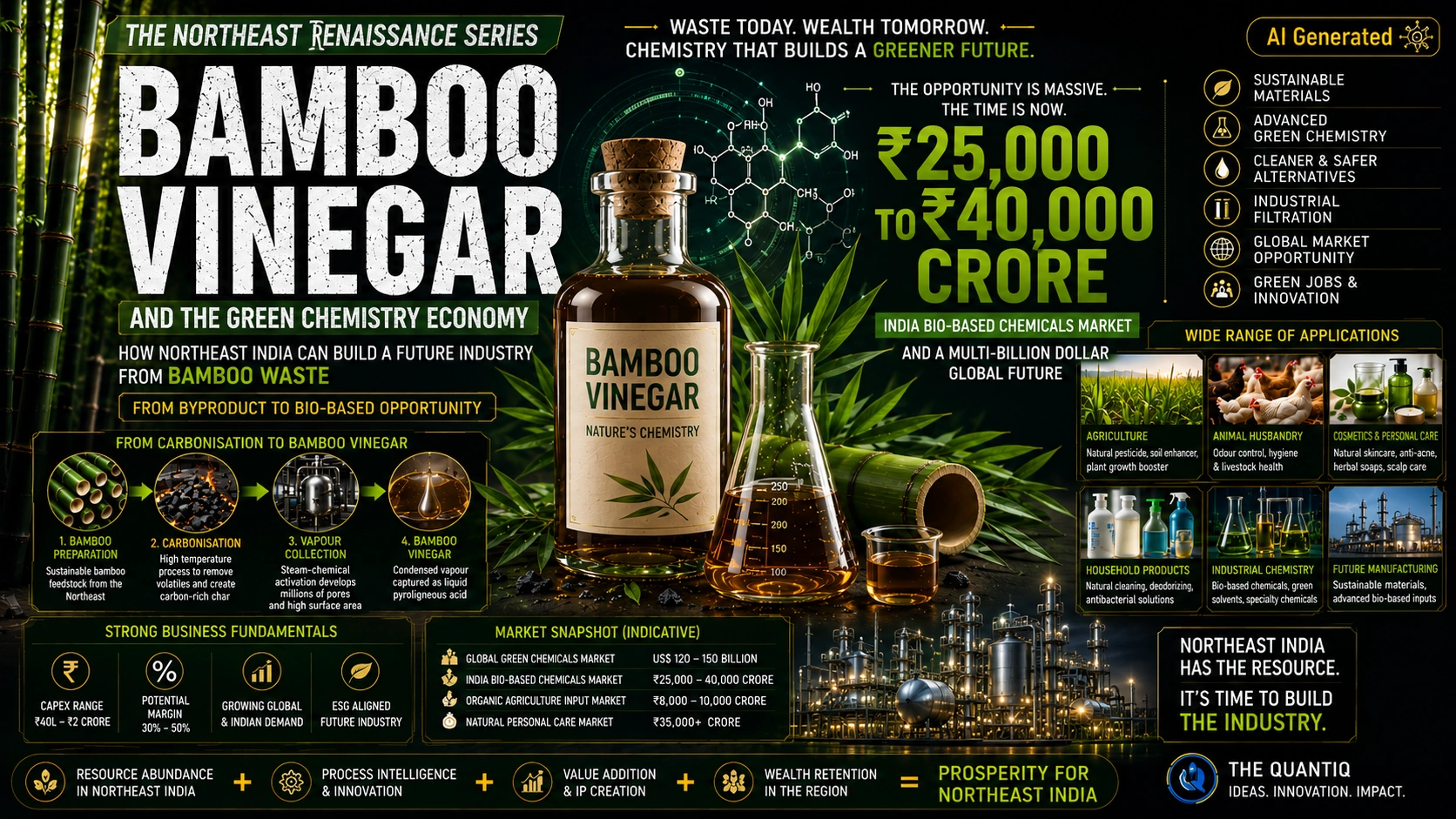
Despite its name, bamboo vinegar is not something extracted directly from bamboo in the conventional sense. It is scientifically known as pyroligneous acid, a liquid by-product generated when bamboo undergoes carbonization under controlled low-oxygen heating conditions. The same process is widely used in the production of charcoal, biochar and activated carbon.
When bamboo is subjected to high temperatures in a closed chamber, the biomass begins to decompose gradually. A portion of the material transforms into solid carbon, which later becomes charcoal or biochar. Certain gases are released during the heating process. Alongside these gases, vapors carrying multiple organic compounds begin rising from the chamber. When these vapors are cooled and condensed, they transform into liquid form.
That liquid is bamboo vinegar.
Historically, small-scale charcoal producers have often ignored this liquid or treated it as an unwanted by-product. However, modern industrial chemistry increasingly sees it very differently. Bamboo vinegar contains a complex combination of naturally occurring compounds including acetic acid, phenolic compounds, organic acids, ketones, alcohol compounds and several bioactive molecules that are increasingly attracting industrial attention.
What many producers still consider waste is quietly becoming chemistry.
And chemistry is where industrial wealth increasingly resides.https://thequantiq.com/bamboo-biochar-carbon-economy-northeast-india/
How Bamboo Vinegar Is Manufactured
The production process begins with bamboo feedstock, although bamboo itself is only the starting point. The real value begins emerging through process engineering and intelligent recovery systems.
Mature bamboo culms, processing residues or bamboo biomass are first cleaned and dried carefully to achieve optimal moisture levels. This prepared biomass then enters a controlled carbonization chamber where heating begins under carefully regulated oxygen conditions. As thermal decomposition progresses, solid carbon gradually forms inside the chamber while gases and vaporized organic compounds begin escaping.
In traditional systems, much of this vapor simply escapes into the atmosphere. In more advanced systems, however, vapor recovery units capture these gases and channel them through cooling systems. As temperature falls, the vapor condenses into liquid form, creating crude bamboo vinegar.
The crude liquid is then allowed to settle and undergo filtration before further purification depending upon the intended industrial application.
The important lesson here is simple.
The highest value does not necessarily emerge from the primary product.
Sometimes the greatest opportunity lies hidden inside what the manufacturing process accidentally produces.https://moef.gov.in/?utm_source=chatgpt.com
Why Industries Around the World Are Paying Attention
The commercial potential of bamboo vinegar becomes clear once one begins examining the range of industries quietly experimenting with its applications.
In agriculture, countries such as Japan, South Korea and Thailand have already explored bamboo vinegar extensively within organic farming systems. Farmers use it as a natural pesticide, plant growth enhancer, compost accelerator and soil-conditioning agent capable of improving microbial activity without relying excessively on synthetic chemicals.
The animal husbandry sector is also beginning to examine its potential. Researchers have explored its use in livestock hygiene systems, odor control formulations, poultry applications and certain feed-related health formulations aimed at reducing bacterial contamination.
The cosmetics industry offers another emerging market. As global consumers increasingly shift toward natural skincare and botanical personal care products, bamboo vinegar is being studied for applications in herbal soaps, anti-acne formulations, scalp treatment products, skin cleansers and natural cosmetic systems designed around clean beauty principles.
Household cleaning products represent another promising segment. Consumers worldwide are increasingly moving away from chemically intensive cleaning agents, creating growing demand for bio-based alternatives capable of offering antibacterial, deodorizing and odor-neutralizing properties.
However, perhaps the most significant opportunity lies elsewhere.
It lies within the rapidly emerging world of green industrial chemistry.
The Rise of the Green Chemistry Economy
For nearly a century, industrial chemistry has been dominated by petroleum-derived chemicals. Plastics, solvents, cleaning compounds, industrial additives and thousands of everyday chemical products largely originate from fossil-fuel-based manufacturing systems developed during the industrial era.
That model is beginning to change.
Around the world, governments and corporations are increasingly investing in what is now called the Green Chemistry Economy, a movement focused on replacing synthetic petrochemical compounds with safer, renewable and biologically derived alternatives.
This global shift is creating enormous industrial opportunities.
Bamboo vinegar represents one small but important part of that transformation. It demonstrates how biological resources can gradually replace synthetic industrial chemistry in multiple sectors over time.
This is where the opportunity becomes significantly larger than bamboo itself.https://thequantiq.com/bamboo-ev-supply-chain-northeast-india/
A Market Worth Tens of Thousands of Crores
Bamboo vinegar alone should not be viewed as a niche product. Its real significance lies in its connection to the larger bio-based chemicals industry, one of the fastest emerging sectors within sustainable manufacturing.
The numbers deserve attention.
Opportunity Snapshot
| Indicator | Indicative Estimate |
| India Bio-Based Chemicals Market | ₹25,000–40,000 Crores |
| Global Green Chemicals Market | US$ 120–150 Billion |
| Indicative CapEx | ₹40 Lakhs – ₹2 Crores |
| Estimated ROI Window | ₹18–36 Months |
| Potential Margin Range | 30–50% |
| Employment Potential | Moderate to High |
| Scale Potential | Domestic and Export Markets |
These estimates are indicative and based on sectoral benchmarks. Actual commercial outcomes may vary depending on technology selection, production scale, regulatory approvals, product quality, certification requirements, downstream product development and market access. Readers should undertake independent technical and financial due diligence before making investment decisions.
Why Northeast India Possesses a Natural Advantage
Northeast India already possesses one obvious strategic advantage. The region sits on one of India’s richest bamboo ecosystems and has historically depended on bamboo across multiple sectors, from paper production to construction and handicraft industries.
However, possessing bamboo alone is not the real advantage. Many countries in Asia possess abundant bamboo reserves.
The actual opportunity lies in learning how to extract complete value from the resource ecosystem itself.
As bamboo charcoal, biochar and activated carbon industries gradually expand, bamboo vinegar naturally emerges during carbonization processes. Yet in most cases, producers continue ignoring it entirely.
This means the region is repeating a dangerous economic pattern. We focus only on extracting value from the visible product while overlooking the invisible chemistry quietly generated during the process itself.
Future industrial economies will increasingly punish this mindset.
Because advanced economies do not monetize products alone.
They monetize every stage of production.
Why Process Intelligence Will Define Future Prosperity
Many entrepreneurs continue believing industrial success depends primarily on buying machinery. In reality, that assumption is becoming increasingly dangerous.
Machines can always be purchased. Competitors can install similar infrastructure. Manufacturing technologies eventually spread.
What remains difficult to replicate is process intelligence.
The real competitive advantage lies in understanding vapor recovery systems, temperature optimization, chemical fraction separation, purification techniques, downstream product formulation and the scientific knowledge required to continuously improve product quality.
The machine is rarely the moat.
The process is.
This principle will increasingly define future manufacturing across every industrial sector.
The AI Era Is Changing Manufacturing Forever
Artificial intelligence is quietly transforming industrial development around the world. Engineers now use AI-assisted process optimization, predictive analytics, chemical simulation models and automated manufacturing intelligence to improve industrial systems faster than ever before.
This changes the equation dramatically.
Smaller regional enterprises can now access technological capabilities that were once available only to large industrial corporations.
At the same time, artificial intelligence will continue reducing dependence on traditional employment structures across multiple sectors. The old idea of permanent jobs is gradually weakening, forcing regions to rethink how future prosperity will be created.
The future increasingly belongs to builders.
Not job seekers.
Regions that fail to build future industrial ecosystems may soon find themselves watching technological progress accelerate while economic opportunities quietly move elsewhere.
Northeast India must prepare for that transition.
The Real Lesson: Waste Is Often Unrecognized Wealth
Perhaps the biggest lesson bamboo vinegar teaches us is philosophical rather than industrial.
Primitive economies typically sell primary resources and stop there.
Advanced economies think differently.
They extract value from primary products, secondary products, waste streams, chemical fractions, manufacturing residues and the intellectual property embedded throughout the production process.
For decades, Northeast India has largely focused on visible resources. Tea, timber, oil, coal, gas and bamboo have dominated the economic imagination of the region.
However, future prosperity may increasingly depend on something very different.
The ability to recognize invisible value where others see waste.
Bamboo vinegar reminds us that industrial wealth is often hidden inside what societies casually throw away.
And the regions that understand this principle will increasingly control future economic power.https://www.european-biochar.org/?utm_source=chatgpt.com
The Quantiq Assessment
Bamboo vinegar demonstrates why Northeast India must urgently rethink the way it views natural resources and industrial opportunity. The future is not simply about harvesting bamboo or exporting raw materials. The future lies in understanding the chemistry hidden inside those materials and building industries around that scientific intelligence.
For too long, the region has allowed advanced processing, formulation science and high-value manufacturing to develop elsewhere while remaining trapped within a resource-supplying economic model.
That pattern must eventually end.
In the age of artificial intelligence, regions that depend solely on natural resources will struggle to capture maximum economic value. Regions that master process intelligence, however, will build durable competitive advantages capable of sustaining long-term prosperity.
Northeast India already possesses the biological foundation.
The next challenge is building the scientific and industrial capability required to unlock every layer of value hidden inside those resources.
Because ultimately, prosperity will not be determined by how much bamboo the region harvests.
It will be determined by how intelligently the region learns to transform every visible and invisible opportunity hidden inside that bamboo before it reaches the market.https://thequantiq.com/bamboo-activated-carbon-northeast-india/





2 Comments