
A GI Tag Is Not a Business Model: Why Northeast India Keeps Turning Products Back Into Commodities
Over the last few days, Assam has been celebrating what appears to be an important milestone. The export of the famed Tezpur Litchi to international destinations such as Dubai and Singapore has generated considerable excitement across the state. Political leaders have welcomed the development as proof that Assam’s agricultural products are gradually finding recognition in global markets. Social media too has been flooded with images of carefully packed consignments, with many understandably viewing the event as a breakthrough moment for Assam’s horticulture sector.
There is, of course, nothing wrong with celebrating progress. The export itself is a positive development and deserves recognition. However, behind this celebration lies a deeper and far more uncomfortable question, one that Northeast India has avoided asking for decades. Are we truly building long-term economic value, or are we once again celebrating an event that merely creates the illusion of progress while leaving the larger opportunity untouched?
This is not really about Tezpur Litchi itself. At a deeper level, the issue is the economic mindset that continues to define much of Northeast India’s development model. The region has become remarkably efficient at producing unique agricultural and biological products, yet repeatedly fails to build industries around them. In many ways, Tezpur Litchi simply offers another opportunity to confront a pattern that has quietly limited the region’s economic transformation for generations.
How a Commodity Becomes a Product
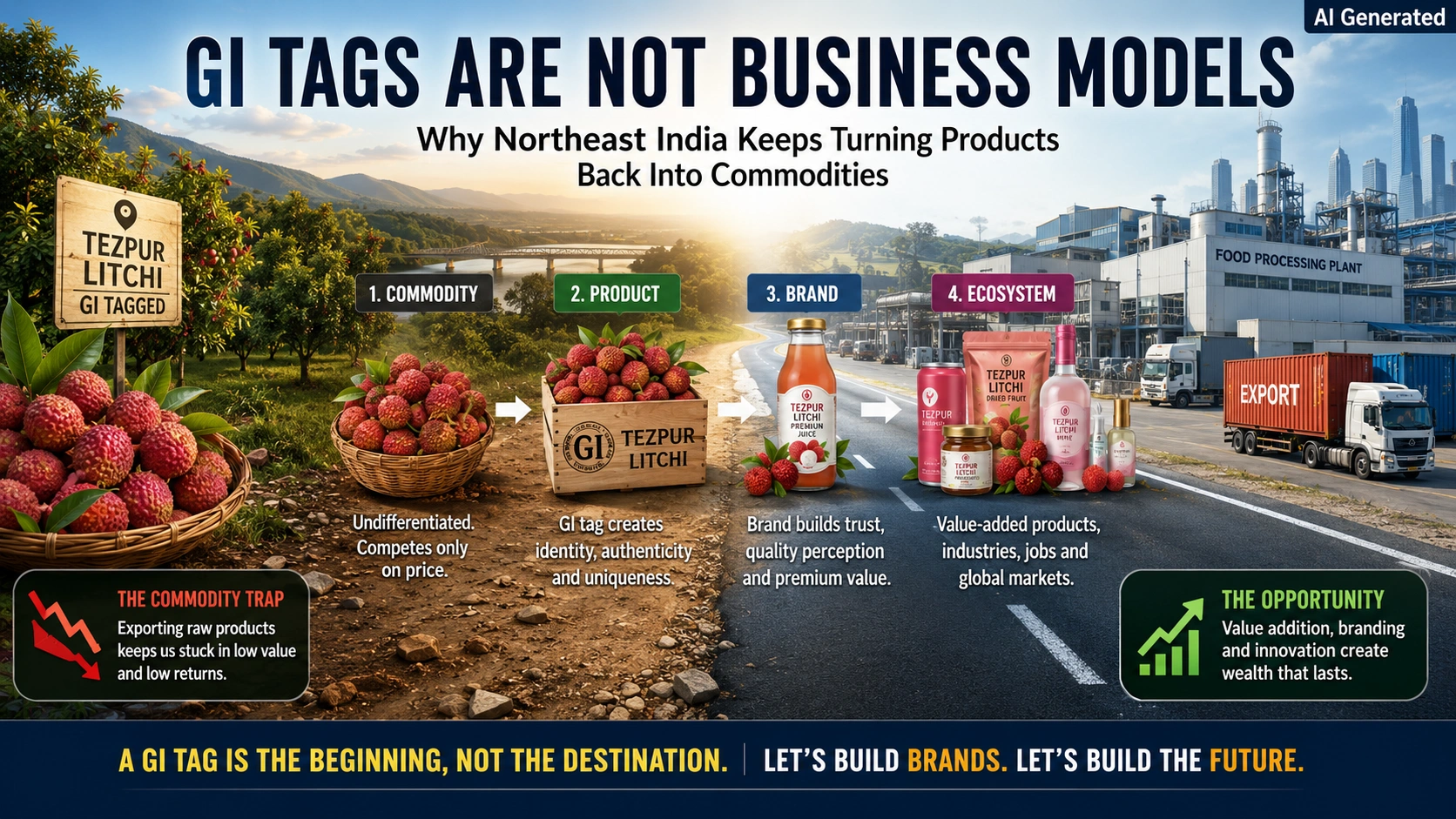
To understand the problem clearly, we must first understand the difference between a commodity, a product, a brand and eventually an economic ecosystem. A generic litchi sold in a wholesale market is simply a commodity. It carries no differentiation, and buyers rarely care where it comes from or what makes it unique. In such markets, price becomes the only deciding factor, leaving producers with almost no pricing power because they compete entirely within commodity economics.
The moment Tezpur Litchi received Geographical Indication status, something fundamentally changed. It stopped being just another fruit and became a differentiated product. The GI tag introduced legal exclusivity, traceability, geographic identity and authenticity. For the first time, the fruit carried a distinct identity that separated it from countless other varieties available in the market. This represented an important economic upgrade because the product now possessed the earliest foundation required for future brand building.
Unfortunately, this is precisely where Northeast India repeatedly makes its most expensive mistake.
When Tezpur Litchi, despite its GI identity, is exported merely as fresh raw fruit, the product quietly begins slipping backward toward commodity status once again. The buyer abroad consumes the fruit within days, and the economic cycle ends almost immediately. No long-term consumer relationship is created, no branded memory remains, and no value-added ecosystem emerges. As a result, the differentiation created through the GI tag begins disappearing the moment the product is treated simply as a perishable export commodity rather than the foundation of a larger industrial strategy.
In effect, Northeast India takes one step forward and two steps backward.
Why Northeast India Keeps Falling Into the Commodity Trap
This pattern deserves far greater attention because it extends well beyond Tezpur Litchi. Across the region, Northeast India has repeatedly succeeded in transforming commodities into differentiated products through geographical recognition, cultural heritage and natural uniqueness. Yet almost every time, it fails to complete the next and far more important stages of value creation.
Consider Lakadong Turmeric from Meghalaya, now widely recognized for its exceptionally high curcumin content. The product possesses clear differentiation and commands attention because of its superior medicinal properties. However, if it is sold merely as raw turmeric or packaged spice powder, it quickly slides back into commodity economics. The real opportunity lies not in turmeric sales themselves, but in building high-value nutraceutical products, pharmaceutical-grade curcumin extraction and globally recognized wellness brands that capture far greater economic value.
Similarly, the same logic applies to Muga Silk, perhaps one of Assam’s most extraordinary heritage products. Raw silk cocoons or silk yarn certainly possess economic value, but limited pricing power. True wealth emerges only when luxury fashion houses, premium textile brands and globally recognizable consumer products are built around that heritage. Without brand creation, even an extraordinary product gradually gets trapped within commodity economics once again.
More importantly, the story repeats itself with Joha Rice, Naga Mircha, black rice, large cardamom, bamboo resources and dozens of other regionally unique assets. Northeast India consistently succeeds in creating differentiated products, but repeatedly stops short of building brands and industrial ecosystems capable of retaining long-term value within the region itself.
The PRAN Lesson: Why Finished Products Create More Wealth Than Raw Exports
Perhaps the most uncomfortable comparison comes from the remarkable success of PRAN, one of South Asia’s most successful food processing companies. This comparison matters because PRAN understood something that Assam and much of Northeast India continue to overlook: the real opportunity rarely lies in exporting fruit itself. Instead, it lies in exporting finished consumer brands.
Rather than focusing on raw agricultural exports, PRAN built beverages, processed food products, fruit concentrates and retail-ready consumer brands. Today, these products occupy supermarket shelves across international markets. Consumers are not purchasing raw fruit as agricultural produce. Instead, they are purchasing finished industrial products built around those agricultural assets.
This distinction matters enormously because it reveals where the real economic opportunity actually lies. The real wealth is not created by shipping the fruit. It is created by controlling what the fruit eventually becomes.
Why Northeast India Confuses Production With Prosperity
More broadly, the larger tragedy is that Northeast India has spent decades confusing production with prosperity. The region has long assumed that growing exceptional products automatically creates wealth. However, economic history repeatedly proves otherwise. Real wealth is rarely created at the production stage alone. It emerges much later through processing, manufacturing, packaging, intellectual property creation, distribution systems and ultimately through controlling direct consumer relationships.
This is precisely why Tezpur Litchi should never be viewed merely as fruit. It should instead be seen as the foundation of an industrial platform capable of supporting multiple industries and generating far greater economic value over time.
A premium GI-certified fruit like this can eventually create an entire ecosystem of opportunities. Beverage manufacturing, freeze-dried fruit products, gourmet preserves, confectionery products, nutraceutical formulations, skincare extracts, wellness ingredients and export-grade packaged consumer brands all represent possibilities far more valuable than simply shipping boxes of fresh fruit abroad.
Unfortunately, this larger industrial perspective remains largely absent from policy discussions in the region.
Why Value Addition Matters More Than Raw Exports
What we are witnessing repeatedly across Northeast India can best be described as a commodity trap. The region takes extraordinary natural assets, upgrades them into differentiated products through GI recognition or cultural identity, and then quietly pushes them back into commodity economics by failing to build brands around them.
This cycle repeats itself with disturbing consistency. First comes the certificate, then the first export shipment, then the symbolic breakthrough being celebrated. Yet once the excitement fades, the deeper economic structure remains largely unchanged because the region still does not control the higher-value stages of the supply chain.
Ultimately, the uncomfortable truth is that the future will not reward regions merely because they possess extraordinary natural resources. In the coming decades, prosperity will increasingly belong to those who control value addition. Those who understand processing technologies, manufacturing ecosystems, intellectual property, consumer branding and distribution networks will capture the overwhelming share of future wealth.
The era when simply producing agricultural abundance was enough to create prosperity is ending rapidly.https://thequantiq.com/northeast-india-exports-global-opportunity/
The Real Question Nobody Is Asking
The export of Tezpur Litchi to Dubai and Singapore is certainly welcome. It proves market access is possible. It demonstrates international demand exists and validates the logistics chain. Yet perhaps Assam is celebrating the wrong milestone.
Whether Tezpur Litchi can reach Dubai is not, in fact, the real question. What matters far more is whether Assam can build a globally recognized premium litchi brand before another company somewhere else takes similar fruit, builds a billion-dollar beverage ecosystem around it and eventually sells it back to us at twenty times the value.
The same question applies to every GI-tagged product across Northeast India.
A GI tag is undeniably important because it transforms a commodity into a differentiated product and lays the first foundation for future brand building. However, unless that foundation leads to processing industries, intellectual property ownership and consumer-facing brands, the product inevitably slides backward into commodity economics once again.
Perhaps it is finally time Northeast India stops celebrating certificates and starts building industries. A GI tag should never be seen as the destination. In reality, it merely marks the beginning of a much larger economic journey that the region has yet to fully embrace.https://thequantiq.com/bamboo-water-purification-media-northeast-india/




One Comment