
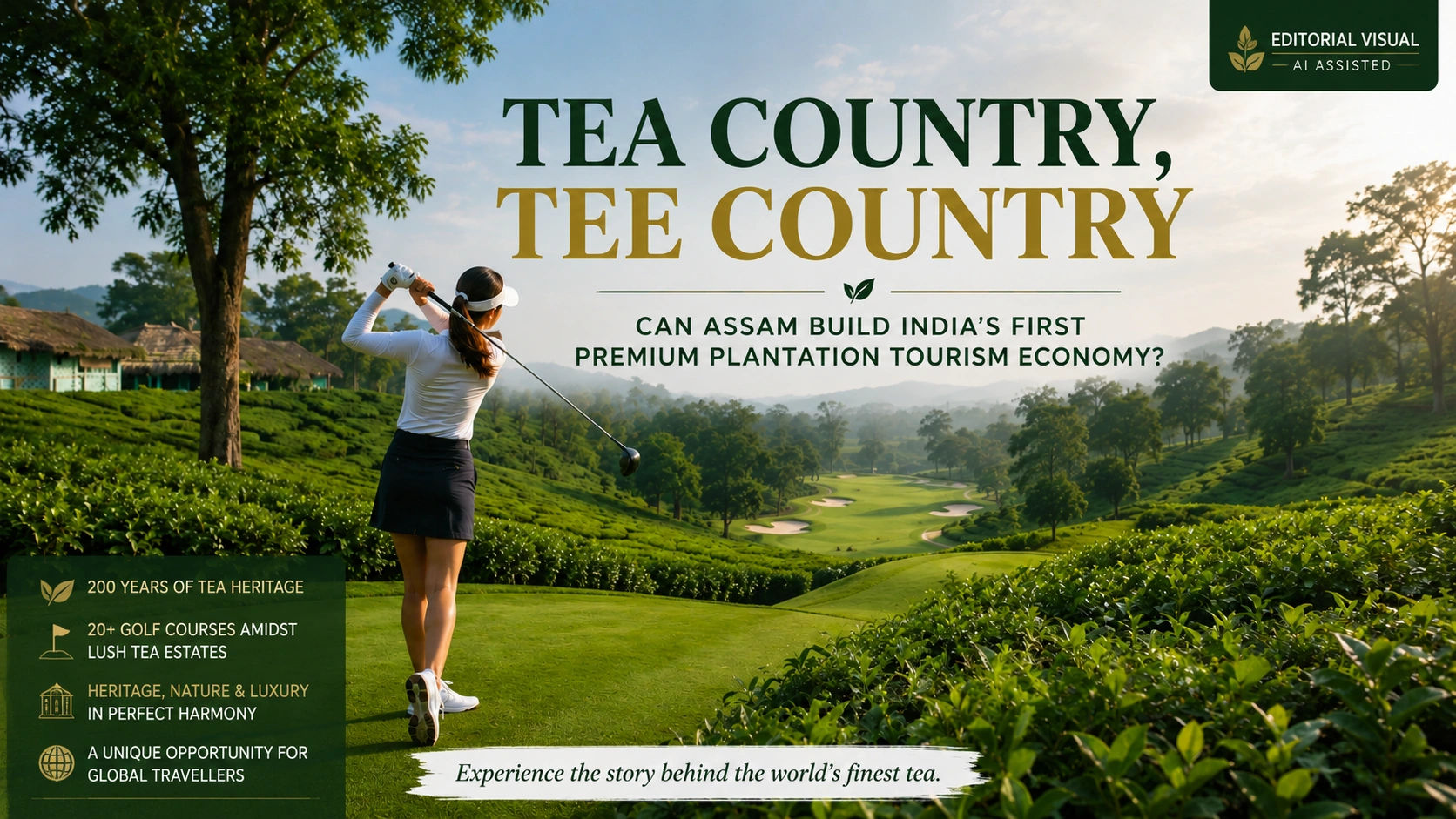
Tea Country, Tee Country: The Experiential Bet Assam Cannot Afford to Get Wrong
Every morning, millions of cups of Assam tea are brewed across the world. From London to Tokyo and from New York to Dubai, Assam’s bold flavour and rich aroma have become part of daily life for millions of consumers. Yet only a tiny fraction of them have ever walked through the emerald plantations where those leaves are grown. Fewer still have listened to the stories of the people who cultivate them or experienced the remarkable heritage that has shaped Assam’s tea industry for nearly two centuries.
That gap between global consumption and lived experience represents one of Assam’s greatest untapped economic opportunities. It is also the opportunity that the state’s proposed tea and golf tourism policy seeks to unlock.
For generations, Assam has exported one of the world’s finest teas. The next phase of its journey may depend on exporting something even more valuable—the experience behind the tea.
Against this backdrop, the Assam Government’s proposal for a dedicated Tea & Golf Tourism Policy deserves close attention. It is far more than another tourism initiative. Instead, it represents a strategic economic opportunity that could reposition Assam in the global tourism marketplace.
If implemented thoughtfully, the policy could transform Assam from being known primarily as India’s largest tea-producing state into the country’s first globally recognised plantation-based experiential tourism destination.
That distinction matters.
Across the world, tourism is undergoing a profound transformation. Travellers are no longer satisfied with simply ticking destinations off a bucket list. Instead, they increasingly seek authentic experiences that connect them with local history, culture, cuisine and landscapes. They want destinations that tell compelling stories, preserve living heritage and create memories that cannot easily be replicated elsewhere.
Fortunately, Assam already possesses many of the ingredients required for successful experiential tourism.
The challenge is not to create new attractions. Rather, it is to recognise the extraordinary value of the assets that already exist and present them to the world through a compelling and carefully curated narrative.https://thequantiq.com/cruise-tourism-assam-brahmaputra/
Assam by the Numbers
Few Indian states possess a tourism asset base as distinctive as Assam’s.
| Indicator | Snapshot |
|---|---|
| Major tea estates | 800+ (widely cited industry estimate) |
| Area under tea cultivation | Around 300,000 hectares |
| Registered small tea growers | 133,833+ |
| Golf courses | Around 20, many located within tea estates |
| Tea heritage | More than 200 years |
| Tea industry | India’s largest tea-producing region and one of Assam’s biggest employers |
These figures reveal only the industry’s scale. The state’s true competitive advantage lies elsewhere.
Nowhere else in India can visitors experience such a remarkable concentration of tourism assets within a single living landscape. Working tea estates, colonial bungalows, historic golf courses, tea factories and breathtaking plantation scenery coexist as part of an authentic heritage that has evolved over generations. Unlike purpose-built attractions, this combination cannot simply be recreated through investment.

Today’s travellers increasingly value authenticity over artificial attractions. In that respect, Assam already possesses something that many destinations spend decades trying to build—a genuine and compelling story.https://thequantiq.com/the-72-hour-rule-northeast-india-tourism/
The World Is Already Paying for Experiences
The global tourism industry increasingly rewards destinations that successfully combine heritage with immersive experiences.
Scotland’s whisky trails, France’s vineyard tours, Colombia’s coffee plantations and Sri Lanka’s tea estates all demonstrate the same principle. Visitors are increasingly willing to spend more on experiences that allow them to participate rather than merely observe.
Golf tourism offers another compelling example.
Although estimates vary because golf tourism overlaps with sports tourism, luxury travel and destination marketing, leading industry studies broadly value the global market at between US$18 billion and US$28 billion. Most also project sustained growth over the coming decade.
More importantly, golf tourists consistently spend far more than conventional leisure travellers. The sector is attractive not because it attracts the highest visitor numbers, but because it generates significantly greater value per visitor. Industry estimates compiled from multiple market studies suggest that the average golf holiday generates around US$2,200 in visitor spending—approximately 52 per cent higher than general leisure travel.
That distinction is particularly relevant for Assam.
The state’s objective should never be to compete with destinations that welcome millions of visitors every year. Instead, it should focus on attracting discerning travellers who stay longer, spend more, appreciate heritage and actively seek meaningful experiences.
In premium tourism, quality should always take precedence over quantity.https://www.fao.org/markets-and-trade/commodities-overview/beverages/tea/en
Tea Country Meets Tee Country
This is precisely where Assam enjoys an advantage that very few destinations anywhere in the world can claim.
Scattered across the Upper Brahmaputra Valley are tea estates that have shaped Assam’s economy and identity for nearly two centuries. Many continue to function much as they did during the colonial era, preserving not only tea cultivation but also an extraordinary architectural and cultural legacy.
Elegant heritage bungalows overlook meticulously maintained plantations. Historic clubhouses continue to serve as social landmarks, while golf courses originally laid out for British planters remain woven into estate life. Several estates even retain old airstrips and helipads that once enabled executives and visitors to fly directly into the gardens long before regional aviation became commonplace.
These are not isolated attractions competing for attention. Collectively, they form a living heritage landscape unlike any other in India.
Industry estimates indicate that Assam has around 20 golf courses, many of which are located within or adjacent to working tea estates across a relatively compact geography. That unique clustering creates the foundation for an integrated Tea & Golf Trail rather than a collection of disconnected tourism destinations.
The tea industry further strengthens this proposition. Today, Assam has more than 133,000 registered small tea growers, hundreds of large tea estates and nearly 300,000 hectares under cultivation. The sector supports lakhs of livelihoods and continues to shape the state’s social, cultural and economic fabric.
Few destinations can combine living industrial heritage, sporting tradition, luxury accommodation and spectacular natural landscapes with such authenticity. That remains Assam’s greatest competitive advantage.
However, exceptional assets alone do not create globally recognised tourism brands. History offers countless examples of destinations blessed with extraordinary natural and cultural resources that never realised their full tourism potential. Success depends not only on what a destination possesses but also on how effectively it understands its markets, curates visitor experiences and communicates its identity to the world.
Kerala, Scotland and Sri Lanka have all demonstrated this principle. Their experiences offer valuable lessons for Assam.https://www.iagto.com/
Learning from Kerala—and the World
Kerala offers perhaps the most relevant lesson for Assam. Not because it produces tea, but because it has been far more successful in transforming plantations into compelling tourism destinations.
A visit to Munnar is rarely marketed simply as an opportunity to see tea gardens. Instead, visitors are invited to stay in plantation resorts, walk through tea estates with experienced naturalists, sample freshly brewed teas, savour local cuisine, photograph rolling hills and reconnect with nature. Tea becomes the centrepiece of a broader experience rather than the sole attraction.
Scotland has adopted a similar approach with whisky tourism. Distilleries are no longer viewed merely as production facilities. They have evolved into immersive destinations where visitors learn the history of whisky, meet master blenders, participate in curated tastings and become part of a story that has unfolded over centuries.
Sri Lanka has followed the same path by restoring colonial tea bungalows, introducing guided estate tours and positioning its tea country as a premium heritage destination.
None of these destinations are simply selling tea or whisky. They are selling authenticity.
That is precisely where Assam’s opportunity lies. The state already possesses the essential ingredients of a world-class tea and golf tourism experience. What it now requires is the ability to package those assets into a coherent narrative that resonates with carefully identified market segments.https://thequantiq.com/assam-europe-tourism-opportunity-sustainable-tourism/
Marketing Begins Long Before Promotion
One of the most common misconceptions in tourism development is the tendency to confuse marketing with promotion. Although the terms are often used interchangeably, they represent two very different disciplines.
Promotion is the process of communicating a destination to potential visitors. Marketing begins much earlier. It starts with understanding who those visitors are, what motivates them to travel and how they make their decisions. Equally important, it examines the experiences they value and the price they are willing to pay for them.
Without that understanding, promotional campaigns become little more than expensive exercises in visibility.
Successful tourism destinations do not attempt to attract everyone. Instead, they identify clearly defined visitor segments and design experiences around their expectations.
For Assam’s tea and golf tourism initiative, this exercise is fundamental.
A retired golfer from the United Kingdom may be drawn by the colonial history of Assam’s tea estates. A Japanese traveller may arrive because of Assam’s global reputation for premium tea. South Korean golfers may seek championship golf combined with pristine natural surroundings. Meanwhile, affluent Indian families may be looking for luxury plantation stays and short experiential holidays.
Each of these groups represents a valuable market. However, they differ significantly in their motivations, spending patterns, preferred accommodation, booking behaviour and duration of stay. Consequently, a single promotional campaign cannot effectively address such diverse expectations.
That is why market segmentation must become the foundation of Assam’s tourism strategy rather than an afterthought.
Data Is the Foundation of Intelligent Marketing
In the age of artificial intelligence and advanced digital analytics, tourism marketing can no longer depend solely on intuition. Every successful destination is built on reliable market intelligence.
Tourism authorities should know which countries generate the highest-value visitors and which age groups stay the longest. They should also understand how many visitors travel independently, how much they spend each day and which experiences consistently receive the highest satisfaction ratings.
These are not merely academic questions. They directly influence investment decisions, product design and marketing priorities.
Consider two international markets. One sends fewer visitors, but each traveller stays for six nights and spends generously on premium accommodation, golf, local cuisine and curated tea experiences. The other sends a much larger number of visitors who stay only briefly and spend comparatively little.
A destination focused solely on arrival numbers may celebrate the second market. A destination focused on economic value will immediately recognise the first as the more strategic opportunity.
For that reason, the success of Assam’s tea and golf tourism policy should never be measured only by visitor arrivals. It should also be evaluated through visitor value. Length of stay, daily expenditure, repeat visitation and visitor satisfaction all provide a far more meaningful picture of success. Equally important are the economic benefits delivered to local communities.
Together, these indicators reveal whether tourism is generating lasting value rather than simply increasing footfall.
Internal Marketing: Winning Stakeholders Before Winning Tourists
Discussions about tourism often focus on attracting visitors. However, the first audience for any successful tourism policy is much closer to home. It is the stakeholders responsible for delivering the visitor experience.
Internal marketing remains one of the least discussed, yet most important, components of destination development.
Before Assam’s Tea & Golf Trail is promoted internationally, the people behind it must first believe in its potential. Tea estate owners, golf clubs, hospitality providers, tour operators, transport companies, local communities and government agencies all need to embrace the same vision.
Visitors experience destinations through people rather than policy documents.
A beautifully restored heritage bungalow cannot compensate for indifferent hospitality. Likewise, an outstanding golf course cannot overcome poor transport connectivity or inconsistent service standards.
Every stakeholder contributes to the same visitor journey. When organisations work independently, the visitor experience becomes fragmented. When they work towards a shared vision, the destination develops a distinctive identity.
Internal marketing therefore extends far beyond stakeholder meetings or awareness campaigns. At its core, it is about creating genuine ownership.
Tea estate owners should see tourism as a complementary business that enhances the value of their heritage assets. Local communities should recognise that preserving culture and tradition strengthens, rather than limits, long-term economic opportunity. Hospitality professionals should regard themselves not merely as service providers but as ambassadors of Assam’s identity.
Only when stakeholders believe in the destination will visitors believe in it as well.
Building a Brand That Endures
Tourism brands are rarely created through advertising alone. Instead, they are built through memorable experiences that visitors recommend, revisit and remember long after they return home.
This is where Assam has the opportunity to create a tourism category that is uniquely its own.
The state should not attempt to compete with Thailand on the number of golf courses or with Kerala on hill-station tourism. Its greatest strength lies elsewhere.
Nowhere else can visitors wake up in a century-old tea bungalow before playing golf within a working plantation. They can watch tea plucking in the morning, learn the art of tea tasting in the afternoon and end the day surrounded by landscapes that have shaped one of the world’s most celebrated beverages for nearly two centuries.
That combination cannot be replicated elsewhere. It can only be protected, refined and presented with care.
If guided by vision and disciplined execution, Tea Country, Tee Country can evolve from an attractive slogan into a globally recognised tourism proposition. Most importantly, it will be rooted not in imitation but in authenticity.
The opportunity is real.
The challenge now lies in execution.
From Policy to Product
The Assam Government deserves credit for recognising the untapped potential of tea and golf tourism. The proposed policy reflects an important shift in thinking. Rather than promoting isolated attractions, it seeks to develop a distinctive tourism experience rooted in the state’s unique heritage.
However, announcing a policy is only the beginning. The greater challenge lies in transforming an attractive idea into a globally marketable tourism product.
Achieving that goal requires far more than restoring heritage bungalows or upgrading golf courses. It demands a carefully curated visitor journey in which every touchpoint reflects the same promise of authenticity, quality and hospitality.
Visitors should not merely tour a tea estate. They should experience the story of Assam tea—from its discovery and plantation heritage to the craftsmanship behind every cup.
Likewise, a round of golf should become much more than a sporting activity. Played amid lush tea gardens and framed by colonial heritage, golf becomes an experience that few destinations in the world can offer.
The objective, therefore, is not to present two separate attractions. It is to create one seamless and unforgettable journey.
The Importance of Consistent Delivery
Around the world, successful tourism brands have one characteristic in common. They consistently deliver experiences that meet, and often exceed, visitor expectations.
Travellers remember the warmth of their welcome, the quality of their accommodation and the professionalism of local guides. They also remember authentic cultural encounters and how effortlessly every part of their journey came together.
Such consistency cannot be achieved through government action alone.
Tea estate owners, golf clubs, hotels, transport operators, tour companies, local entrepreneurs and surrounding communities must all become partners in shaping the visitor experience.
Every stakeholder represents the Brand Assam promise. When one element of the journey falls short, the reputation of the entire destination suffers. Conversely, when every stakeholder embraces a shared vision and consistently delivers quality, visitors return home as the destination’s most credible ambassadors.
In tourism, word of mouth remains one of the most powerful forms of marketing. Satisfied visitors do far more than fill hotel rooms—they build enduring reputations.
A Defining Opportunity for Assam
Few regions are fortunate enough to build a globally distinctive tourism brand around assets they already possess. Assam is one of them.
Its tea estates are not museum exhibits created for visitors. They are living landscapes that continue to produce one of the world’s finest teas. Its golf courses were not recently constructed as tourism projects. They are part of a sporting and cultural heritage that stretches back generations. Its colonial bungalows, historic clubs and plantation communities preserve stories that cannot be manufactured or replicated elsewhere.
These are advantages that many destinations would envy.
Yet history offers an equally important lesson. Extraordinary natural and cultural assets, by themselves, do not create successful tourism destinations. Vision does. Strategic planning does. Consistent execution does.
If Assam approaches tea and golf tourism as merely another promotional campaign, the opportunity may remain largely unrealised.
If, however, the initiative is built on rigorous market research, stakeholder participation, consistent service standards and long-term brand development, the outcome changes fundamentally. Assam can create a tourism product that is both economically rewarding and internationally distinctive.https://assamtourism.gov.in/
The Quantiq View
For more than two centuries, Assam has introduced the world to one of its finest teas. The proposed Tea & Golf Tourism Policy now offers an opportunity to introduce the world to the place behind that tea.
That journey will not begin with advertising campaigns or glossy brochures. It will begin with a deep understanding of visitors, a shared commitment among stakeholders and the confidence to build a globally distinctive brand around what Assam already possesses.
The state’s greatest asset is not simply its tea. It is the remarkable story, living heritage and cultural landscape that surround every cup.
In today’s experience economy, destinations no longer compete only through what they produce. They compete through the stories they tell and the experiences they create.
Assam already has both.
What it needs now is the vision to weave them together into one compelling tourism proposition.
If developed with patience, professionalism and purpose, Tea Country, Tee Country can become far more than a memorable slogan. It can establish Assam as India’s first globally recognised plantation-based experiential tourism destination and create a tourism brand capable of enduring for generations.





5 Comments