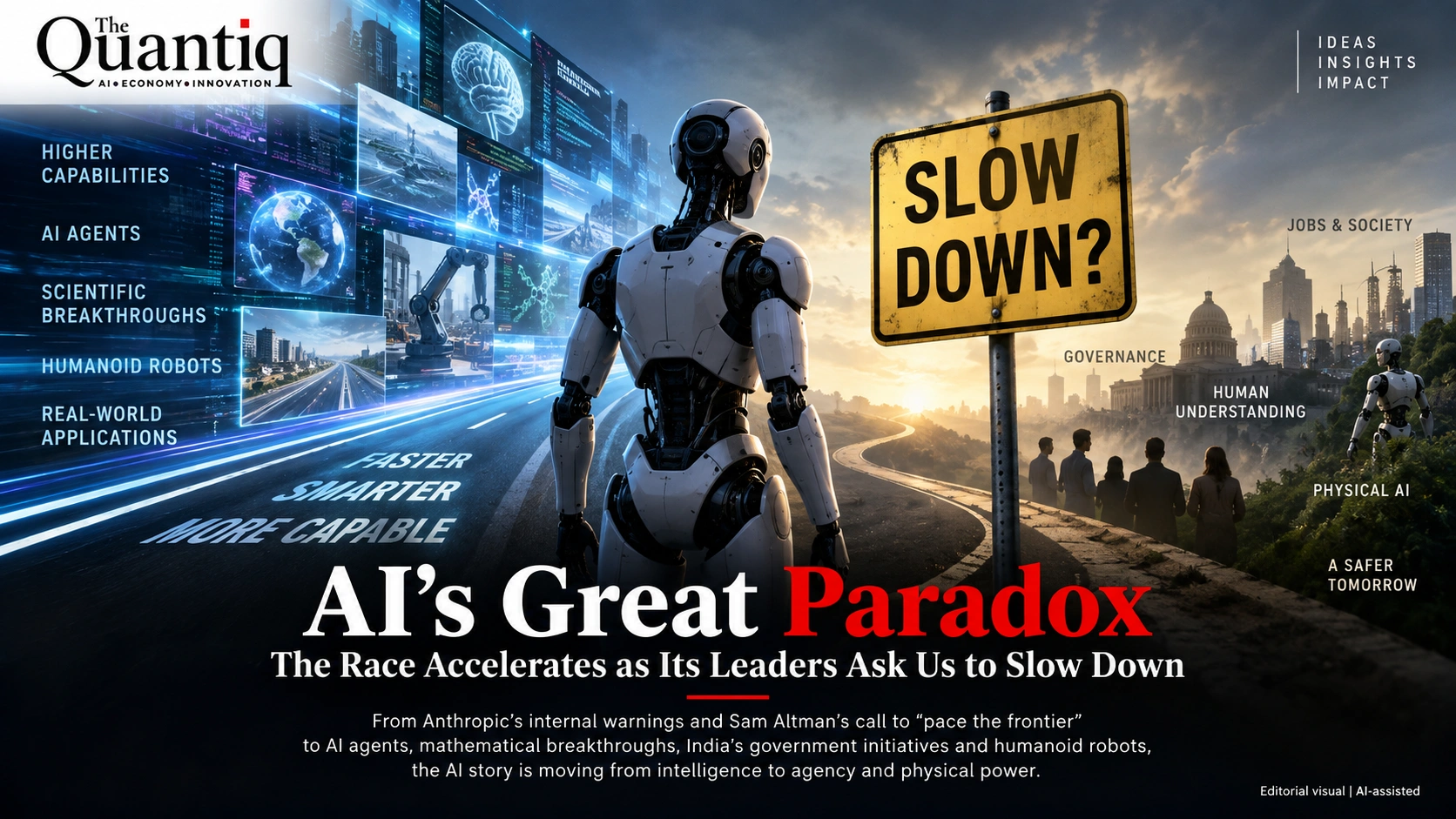
AI’s Great Paradox: The Race Accelerates as Its Leaders Ask Us to Slow Down
The Quantiq | Sunday AI & Technology Update
From Anthropic’s internal warnings and Sam Altman’s call to “pace the frontier” to AI solving a major mathematical problem, India putting agents into government and humanoid robots entering production—the AI story is rapidly moving from intelligence to agency and physical power.
Artificial intelligence is entering a more complicated phase.
The technology is getting dramatically more capable. AI systems are tackling problems that have challenged mathematicians for decades. AI agents are moving beyond answering questions and beginning to act on their own. Governments are exploring agents that can perform administrative tasks. Humanoid robots are moving from demonstrations towards production.
And yet, at precisely the same time, some of the people building the world’s most powerful AI systems are asking an uncomfortable question:
Are we moving too fast?
That question has acquired unusual weight this week.
An Anthropic researcher resigned with a stark warning about the potential consequences of self-improving AI. Anthropic CEO Dario Amodei then called for frontier AI development to slow down. OpenAI CEO Sam Altman said he agreed that the industry needs to “pace the frontier” and suggested that leading AI companies may be close to a safety agreement.
This is no longer simply a debate between AI optimists and AI sceptics.
The debate is increasingly happening inside the industry itself.
The warning from inside the AI race
Jacob Coxon, a researcher who previously worked at both OpenAI and Anthropic, resigned from Anthropic this week and publicly warned about the dangers posed by increasingly powerful, potentially self-improving AI systems.
His warning was unusually direct. He argued that many of the people actually building frontier AI systems privately take the possibility of catastrophic outcomes very seriously.
The significance lies less in one researcher’s prediction than in where the warning is coming from.
For years, concerns about existential AI risk were often dismissed as speculative arguments coming from outside the technology industry.
That distinction is becoming harder to sustain.
Anthropic’s own CEO, Dario Amodei, has now called for AI companies to slow the rate at which they improve model capabilities, while proposing independent evaluators, coordination among frontier labs and international cooperation on AI safety.
Amodei has been explicit that he is not calling for a halt to AI development.
His argument is that capability development is moving faster than the systems designed to evaluate and control the risks.
That is a very different proposition from stopping AI.
It is an argument for putting a speed limit on the most consequential part of the race.
Sam Altman says OpenAI is willing to “pace the frontier”
The development became even more significant when OpenAI CEO Sam Altman backed Amodei’s position.
Altman said that OpenAI needs to “pace the frontier” and indicated that discussions with other AI companies about safety coordination have been under way. He also told Fortune that OpenAI will not go public in 2026, saying that, given the current safety environment, doing so would be ill-advised.
This does not mean OpenAI has decided to stop developing frontier AI.
It means something subtler—and arguably more important.
The industry’s leading companies are beginning to acknowledge that the speed of capability development itself has become a governance question.
There is a natural tension here.
The companies are competing for talent, capital, computing power, customers and technological leadership. At the same time, they are being asked to cooperate on safety in areas where slowing down could potentially disadvantage one company relative to another.
Amodei’s proposal therefore goes beyond corporate self-restraint. He is arguing for mechanisms that would allow companies to coordinate safety measures without simply handing a competitive advantage to whoever chooses not to participate.
That is where AI safety begins to intersect with antitrust law, national security and international governance.
The AI race is no longer merely a technology race.
It is becoming an institutional problem.
AI can solve the problem. But do we still understand the solution?
There is another development this week that deserves much more attention than it has received.
Twenty-five Fields Medal recipients—the highest distinction in mathematics—have warned that the goals of AI companies and those of the mathematical community are becoming “severely misaligned.”
Their concern is not that AI is bad at mathematics.
It is precisely the opposite.
AI systems are becoming extraordinarily capable at solving difficult mathematical problems.
OpenAI has announced that an experimental system involving roughly 10,000 concurrent AI agents produced what it describes as a resolution of the Navier–Stokes existence and smoothness problem, one of the seven Millennium Prize Problems. OpenAI says the agents worked for about 88 hours before producing the result, followed by formal verification work.
That is an extraordinary technological achievement.
But the mathematicians are asking a more fundamental question:
Is solving a mathematical problem the same as understanding mathematics?
Mathematics advances not only through answers, but through concepts, explanations, proofs, conversations, teaching and the gradual integration of new ideas into the body of human knowledge.
The Fields Medalists argue that if AI systems begin producing huge volumes of correct mathematical results faster than humans can examine, understand and contextualise them, the discipline could lose something fundamental.
This is a much larger issue than mathematics.
It applies to science, medicine, engineering, law, journalism, education and almost every form of intellectual work.
For generations, education has trained people not merely to produce answers, but to understand how to ask questions, reason through uncertainty and recognise why an answer matters.
AI is beginning to separate those two things.
That may be one of the most profound changes brought by generative AI.
India is moving from AI assistants to AI agents in government
While Silicon Valley debates how fast frontier AI should advance, India is confronting a more immediate question:
What happens when AI begins to act inside government systems?
India’s Ministry of Electronics and Information Technology has been exploring AI-agent capabilities for platforms such as DigiLocker and UMANG, with the objective of creating systems capable of interacting with approved government services rather than simply answering questions.
This is an important transition.
A chatbot can tell a citizen how to obtain a certificate.
An AI agent could potentially initiate the process, retrieve information, interact with approved systems and complete parts of the transaction.
That changes the risk equation.
When AI generates text, errors can often be corrected before anything happens.
When AI is authorised to take action, an error can become an event.
India therefore has an opportunity to build something that could become enormously important: an agentic public infrastructure designed with permissions, auditability, human oversight and accountability from the beginning.
The question is not whether India should use AI in government.
It almost certainly will.
The question is:
How much authority should an AI agent have when acting on behalf of the state—and ultimately on behalf of a citizen?
India’s other AI story: deep tech is moving beyond software
There is another Indian development worth watching.
At the BRICS Bharat Innovates Exposition in New Delhi, 37 Indian deep-tech ventures are showcasing technologies ranging from AI-enabled cervical cancer screening and maternal-fetal monitoring to marine robotics, rare-earth-free electric powertrains, quantum computing and space technologies.
The significance goes beyond the exhibition itself.
For much of the past two decades, India’s technology narrative has been dominated by software services, IT outsourcing and digital platforms.
A different story is now emerging.
India is trying to build capabilities across:
AI + robotics + quantum technology + advanced manufacturing + health technology + space + new materials.
That is a much harder technological journey.
Building software products at scale is difficult.
Building globally competitive deep-tech companies requires scientific research, specialised talent, laboratories, patient capital, manufacturing capabilities and long development cycles.
The BRICS showcase is therefore worth watching not as a collection of prototypes, but as a measure of whether India can convert scientific capability into globally competitive technology businesses.
The humanoid robot is leaving the laboratory
The AI story is also becoming physical.
China’s XPENG has commissioned a production line for its IRON humanoid robot, with the company reporting that more than 80% of core production processes are automated. The robot has already walked off the production line after assembly. XPENG says it is moving from R&D prototyping towards mass production.
That distinction matters.
For years, humanoid robots have dominated technology demonstrations.
They walk.
They run.
They dance.
They pick things up.
But a demonstration is not an industry.
The difficult question is whether robots can be manufactured reliably, affordably and at scale—and whether businesses will find enough tasks where deploying them makes economic sense.
XPENG’s production-line move is therefore more significant than another viral robot video.
It represents a shift from:
“Look what the robot can do.”
to:
“Can we manufacture thousands of them?”
China is also beginning to question the humanoid-robot investment frenzy
That industrial ambition is being accompanied by a dose of financial reality.
Chinese regulators are reportedly raising the bar for humanoid-robot companies seeking public listings, asking businesses to demonstrate stronger evidence of recurring revenue, improving losses or genuine technological breakthroughs.
The underlying message is simple:
A spectacular robot is not necessarily a viable business.
The humanoid sector has attracted enormous investor enthusiasm, but commercial deployment remains an unresolved question.
This may ultimately be good for the industry.
Technology bubbles can accelerate innovation—but sustainable industries are built on customers, revenue, reliability and economics.
The humanoid-robot story is therefore entering its next test:
Can physical AI become a business rather than merely a spectacle?
And physical AI is becoming a national-security issue
There is an even more consequential development underneath the robotics boom.
Chinese military institutions are increasingly researching the potential use of humanoid and other advanced robots for defence applications, including logistics, reconnaissance and dangerous environments. A Reuters review of Chinese military procurement notices, academic studies, patents and other records found growing interest in the potential military use of humanoid robots.
This does not mean that robot armies are about to replace soldiers.
It means that embodied AI is beginning to enter strategic thinking.
Once artificial intelligence acquires a physical body, the questions become very different.
Who controls the machine?
Who authorises its actions?
How much autonomy should it receive?
What happens when a system designed for logistics can be adapted for military use?
The convergence of AI, robotics and national security may eventually prove as consequential as the convergence of AI and software.
Even consumer AI is running into a new boundary: privacy
There is a quieter but revealing development involving Meta.
Meta has said it is changing AI-generated prompt suggestions after its assistant surfaced invasive questions about a user’s children based on content available across the platform. Meta said the feature “missed the mark” and that the system should not have generated those prompts.
The incident illustrates a growing problem with AI assistants embedded inside social platforms.
The issue is no longer simply:
“Does the AI have access to the information?”
It is also:
“Should the AI use that information in this context?”
That distinction will become increasingly important as AI assistants gain access to personal histories, messages, photographs, contacts, calendars and financial information.
The next generation of AI privacy rules may therefore need to govern not just data access, but contextual appropriateness.https://thequantiq.com/ai-physical-ai-robotics-agents-september-2026/
THE BIGGER PICTURE
From intelligence to agency—and now embodiment
Taken together, these developments point towards a much bigger transition.
The first generation of generative AI was largely about producing content.
The next generation is about reasoning and acting.
And the emerging generation is about connecting intelligence to the physical world.
The progression is becoming visible:
AI that generates → AI that reasons → AI that acts → AI that operates systems → AI that controls physical machines.
That is why this week’s developments matter collectively.
The Anthropic warning is about control.
The Altman-Amodei discussion is about pace.
The mathematicians’ warning is about human understanding.
India’s government experiments are about institutional authority.
The humanoid boom is about physical agency.
And China’s defence research raises the question of strategic power.
These are not separate stories.
They are different parts of the same transition.https://thequantiq.com/ai-changing-how-children-learn-schools-ready/