
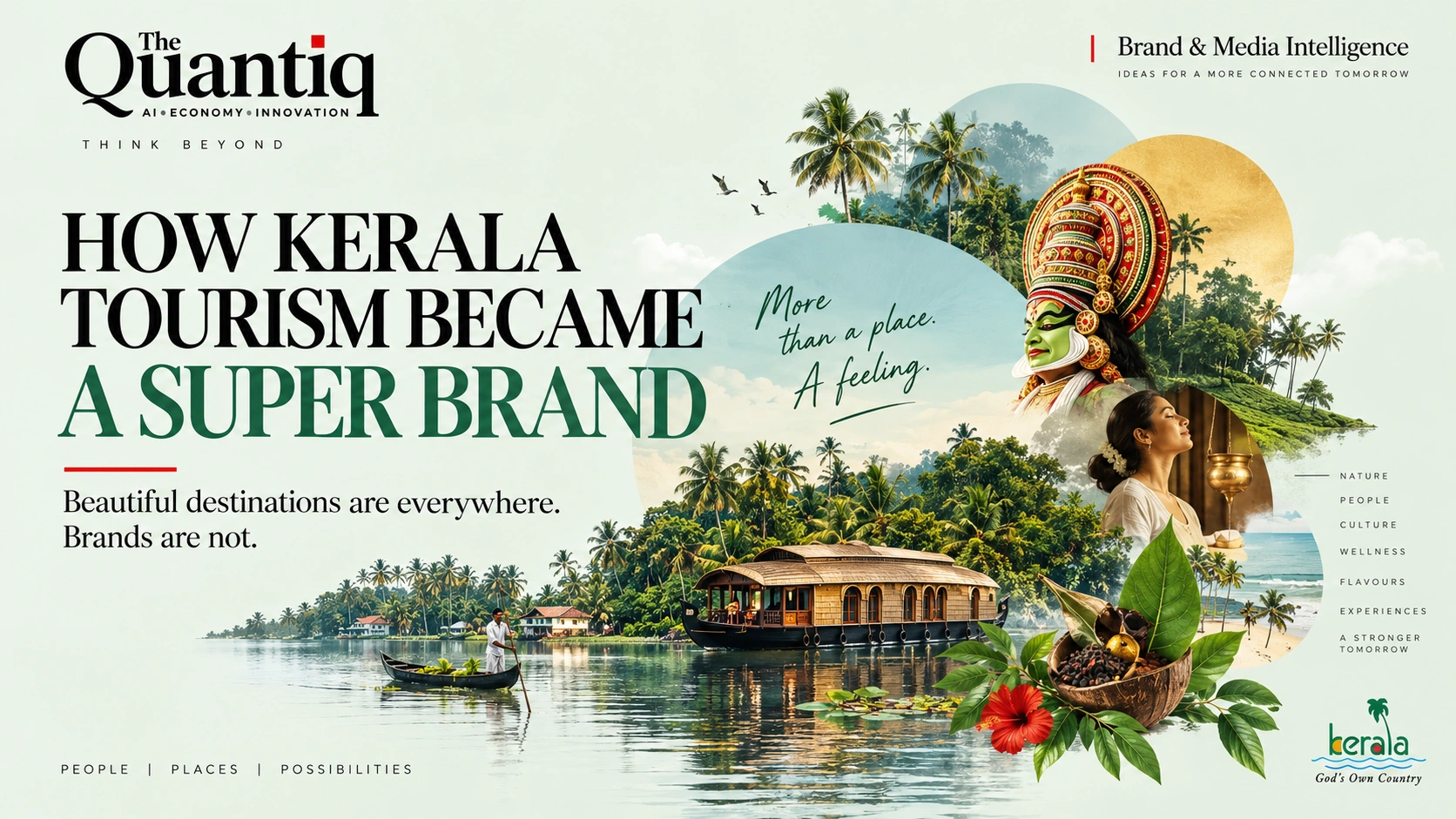
How Kerala Tourism Became a Super Brand
Brand & Media Intelligence | The Quantiq
Kerala did not become one of India’s most recognisable tourism brands simply because it had beaches, backwaters, mountains, Ayurveda and lush greenery.
India has no shortage of beautiful places.
What Kerala did differently was to spend decades turning a collection of attractions into a coherent promise in the minds of travellers. The process involved positioning, product development, private enterprise, institutional consistency, creative communication, digital experimentation and, increasingly, an effort to make tourism part of the lives of local communities.
The result was a destination brand that eventually became almost synonymous with three words: God’s Own Country.
In 2004, Kerala Tourism was recognised as India’s first tourism “Super Brand”. The recognition cited not only Kerala’s natural attractions, but also its innovative tourism products, quality-control systems, eco-friendly practices and long-term approach to tourism.
That distinction is important.
A destination can possess extraordinary tourism assets without possessing a powerful brand.
Kerala’s story is about how those assets were progressively turned into one.
The slogan was only the beginning
The phrase “God’s Own Country” emerged in Kerala Tourism advertising in 1989. It gave Kerala something that most destinations struggle to create: a simple mental association capable of holding many different experiences together.
Instead of asking travellers to remember a long list of places, the proposition offered them an idea.
The beaches, backwaters, forests, Ayurveda, cuisine, culture and village life could all exist under the same emotional umbrella.
But a slogan, however memorable, cannot build a destination brand by itself.
It needs experiences capable of making the promise believable.
That appears to be where Kerala’s long-term approach became important.
From attractions to experiences
Kerala gradually expanded the reasons for visiting.
The backwaters became more than waterways. They became an experience, with houseboats, village life and a distinctive landscape that could not easily be confused with another destination.
Ayurveda gave Kerala a powerful wellness proposition. Cuisine added another sensory dimension. Kathakali, festivals, handicrafts and local traditions created cultural depth, while hill stations, wildlife and beaches widened the destination’s appeal.
The important point was not simply that Kerala had many attractions.
It was that the attractions began to reinforce one larger brand narrative.
This is where destination branding differs from destination advertising.
Advertising can create awareness. Branding requires consistency between what is promised and what people actually experience.
Kerala’s recognition in 2004 reflected this wider ecosystem. Its national tourism awards that year also highlighted marketing, infrastructure, human-resource development and sustainable tourism practices alongside its tourism performance.
The brand was becoming more than a campaign.
The brand learned to evolve
One of Kerala Tourism’s most interesting characteristics has been its willingness to keep renewing the proposition without abandoning its core identity.
The state experimented with theme-based tourism campaigns, including efforts to promote the monsoon season and extend tourism beyond conventional peak periods. The objective was not simply to attract more visitors, but to change the way travellers thought about when Kerala could be experienced.
This is an important branding lesson.
A strong brand does not necessarily reinvent itself every few years. It finds new meanings within an idea people already recognise.
Kerala could remain “God’s Own Country” while progressively becoming a wellness destination, a culinary destination, an experiential destination, an adventure destination and a responsible-tourism destination.
The identity remained familiar.
The reasons to believe in it kept multiplying.
When the community became part of the brand
Perhaps the most significant evolution came with Responsible Tourism.
Kerala initiated the programme in 2007 and began implementation through a pilot involving four destinations: Kovalam, Kumarakom, Thekkady and Wayanad. The formal field-level launch took place in Kumarakom in March 2008.
The idea was bigger than sustainability messaging.
Responsible Tourism sought to connect tourism with local communities, livelihoods, culture and the local economy. It subsequently expanded to additional destinations and became an important part of Kerala’s tourism development model.
That gave the brand another dimension.
The visitor was no longer simply being invited to look at Kerala.
The visitor could increasingly experience Kerala through its people and their way of life.
That matters because beautiful scenery is easily commoditised. A photograph of a backwater, mountain or beach can be reproduced endlessly across destinations.
A meaningful experience rooted in a particular community, culture and place is much harder to copy.
Kerala understood that media itself was changing
Kerala Tourism also demonstrated an unusual willingness to change the way the destination was communicated.
In 2013, the Great Backwaters campaign was launched digitally, using aerial imagery and a dedicated microsite to present Kerala’s backwaters as a larger and distinctive water landscape rather than simply as a houseboat experience. The campaign began on social media before moving into traditional media, showing how Kerala Tourism was beginning to experiment with new ways of presenting the destination.
The following year came Kerala Blog Express. Instead of relying entirely on conventional travel advertising, Kerala Tourism invited travel bloggers from around the world to experience the state firsthand. Twenty-five bloggers were selected from 600 contestants representing 80 countries, and the two-week journey took them through beaches, backwaters, cultural sites, Ayurveda and village experiences.
The strategy was significant because the brand was no longer speaking only to travellers. It was encouraging travellers to speak about the brand. That shift—from controlled communication to distributed storytelling—became increasingly important as social media transformed how people discover destinations.
The London campaign demonstrated another important shift. Sometimes the most powerful media outcome is not the advertisement itself, but what someone else does with it.
In 2024, Kerala Tourism took its visual identity to London’s streets, with the state’s backwaters and tourism imagery covering iconic double-decker buses and appearing across Tube stations. The campaign gave Kerala a physical presence in one of the world’s most recognisable cities.
Then an unexpected second layer of communication emerged. A 13-year-old Malayali boy living in London, Ryan Ambattu, filmed one of the branded buses while walking alongside it and singing a Malayalam song. He posted the video on Instagram, where it eventually crossed 4.6 million views. Kerala Tourism and the state’s Tourism Minister subsequently amplified the moment through their own social-media channels.
The significance goes beyond the number of views. Kerala Tourism had paid for visibility, but it did not pay Ryan to create that particular moment. The advertisement created the encounter, the audience created the story, and social media created the distribution.
That is a very different model of destination marketing from simply placing an advertisement in front of an audience. It also demonstrates something Kerala appears to have understood: in the age of social media, a brand cannot completely control its story. It can, however, create the conditions in which other people want to tell it.
And that may be one reason the Kerala Tourism brand has remained culturally visible even as the media environment around it has changed.
The real achievement was consistency
It is tempting to explain Kerala Tourism’s success through the slogan “God’s Own Country”.
That would be too simple.
The slogan created recognition, but the brand was built through everything that followed.
Tourism products gave the promise substance. Private enterprise created experiences. Infrastructure made those experiences accessible. Responsible Tourism added social and cultural meaning. Creative campaigns generated attention. Digital media expanded the conversation. Travellers themselves became storytellers.
None of these elements alone created the brand. Together, over several decades, they reinforced it. That is perhaps the central lesson.
A destination brand is not created by finding one brilliant slogan. It is created when an organisation repeatedly turns that slogan into a credible experience.
What does this mean for the Northeast?
This is where Kerala’s story becomes particularly relevant.
The Northeast does not need another tourism campaign filled with mountains, waterfalls, monasteries, traditional costumes and smiling faces.
Those are assets. They are not, by themselves, a brand.
The harder question is: What should a traveller remember about the Northeast after encountering its stories repeatedly for the next ten years?
“Pristine”, “untouched”, “paradise” and “hidden gem” are unlikely to provide a sufficient answer. Destinations around the world have used similar language.
The Northeast needs stronger and more distinctive narratives rooted in its people, cultures, biodiversity, food systems, crafts, living traditions and emerging economic possibilities.
Each state can retain its own identity while contributing to a larger regional story. The objective should not be to make Assam resemble Meghalaya, or Nagaland resemble Arunachal Pradesh. It should be to discover the idea that can connect their differences without erasing them.
That may be Kerala’s most valuable lesson.
A destination becomes a brand not when it tells the world how beautiful it is, but when it gives the world a compelling reason to remember it differently from every other beautiful place.
Kerala took decades to build that memory. Its greatest achievement, therefore, may not be the slogan itself. It is that, after all these years, those three words still immediately bring a particular place to mind.
That is what a super brand ultimately does. It occupies a distinctive space in the mind that few others can easily occupy.