
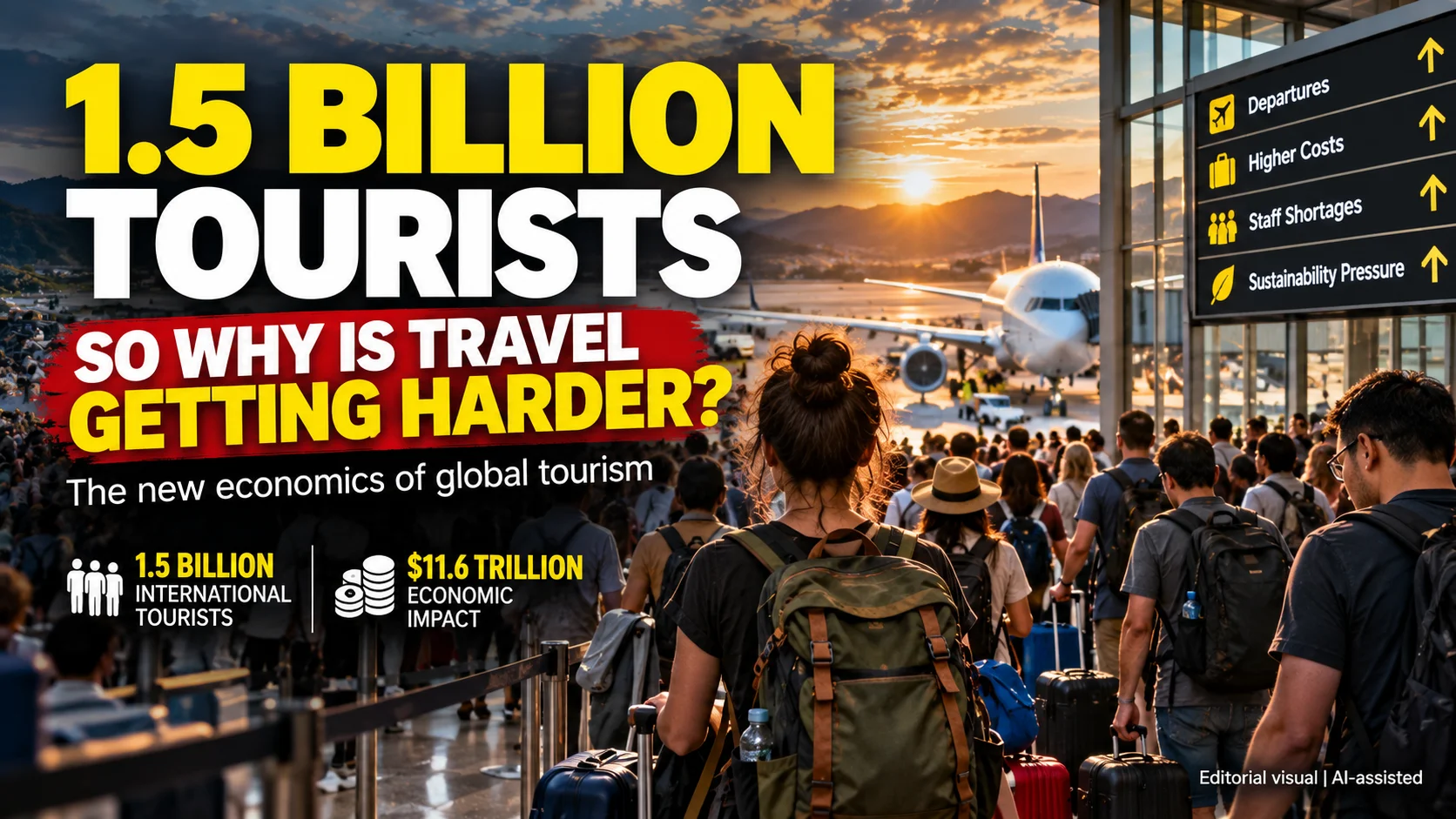
Tourism Has Recovered. Now Comes the Harder Test: Making Growth Worth It
In the aftermath of the pandemic, the central question for tourism was whether the industry could recover.
That question is becoming less relevant. International travel has moved beyond its pre-pandemic benchmark, tourism infrastructure is strengthening, and destinations across much of the world are attracting visitors again. The bigger question now is whether destinations can manage that growth without making travel more expensive, communities more pressured and tourism itself more vulnerable.
The World Economic Forum’s Travel & Tourism Development Index 2026 captures this transition remarkably well. Its findings suggest that tourism is not facing a shortage of demand. It is facing a growing challenge of converting demand into durable economic, social and environmental value.
That distinction could shape the next decade of global travel.
Tourism has already returned to record territory
The scale of the industry explains why this matters.
International tourist arrivals reached about 1.5 billion in 2025, 5% higher than in 2024 and 4.4% above the 2019 level. Travel and tourism generated a total economic contribution of $11.6 trillion, equivalent to nearly 10% of global GDP, while supporting around 366 million jobs worldwide.
Domestic travel remains particularly important. Domestic visitor spending accounted for 73.6% of total traveller spending in 2025, reaching about $5.6 trillion. International visitor spending added another $2 trillion.
These numbers tell us something important. Tourism is no longer simply a discretionary consumer activity recovering from a global shock. It is a vast economic system involving airlines, hotels, restaurants, transport companies, technology platforms, local businesses, communities and millions of workers.
That system is now getting more complex.
Almost every tourism economy is improving
The strongest signal from the WEF index is surprisingly positive.
Between 2024 and 2026, 101 of the 110 economies covered by the TTDI improved their scores. The average score increased by 2.1%, representing the fastest pace of improvement since 2019.
The improvements are also revealing.
Cultural Resources recorded the largest increase, rising 9.6%. Tourist Services and Infrastructure increased 9.2%, while Air Transport Infrastructure improved 7.2%. Natural Resources, Non-Leisure Resources and ICT Readiness also recorded meaningful gains.
In other words, destinations are not merely attracting more visitors. Many are building better foundations for receiving them.
Asia-Pacific is particularly significant here. Its average TTDI score increased by 3.6% between 2024 and 2026, making it the fastest-improving region in the latest edition.
Yet this is where the paradox begins.
Better tourism systems are not necessarily making travel cheaper
One of the clearest warning signals in the report is affordability.
Price Competitiveness declined in three-quarters of the economies covered by the index between 2024 and 2026. Tourism-related prices have risen faster than inflation in many markets, putting pressure on both travellers and tourism businesses.
This creates a difficult equation.
A destination can improve its airports, hotels, attractions and digital infrastructure while simultaneously becoming less affordable. More investment can improve visitor capacity, but rising land, labour, accommodation, transport and operating costs can eventually feed back into the price paid by travellers.
That means the future competition between destinations may not be about who can offer the cheapest holiday.
It may increasingly be about who can deliver the greatest value for the money.
The infrastructure problem has not disappeared
There is another constraint hiding behind the impressive growth numbers.
Tourism investment has lagged behind the industry’s activity since 2022. At the same time, growing visitor numbers are putting pressure on infrastructure, housing, natural resources and public services in many destinations.
This changes the meaning of tourism infrastructure.
It is no longer enough to build an airport or add hotel rooms. Destinations need transport connections, digital systems, visitor management, skilled workers, public services and local businesses that can collectively absorb demand.
The WEF’s findings on major emerging tourism economies make this particularly clear. Countries such as India, China, Indonesia, Malaysia, Thailand, Viet Nam, the Philippines, Türkiye, Mexico and Brazil are improving faster than the overall index, but the largest remaining gap with the top tourism economies is in Tourist Services and Infrastructure.
The lesson is significant for emerging destinations.
Having something worth visiting is only the beginning. Building the system that allows visitors to experience it well is the harder part.
Tourism’s biggest constraint may eventually be people
There is an even less visible challenge.
By 2035, the WEF estimates that demand for tourism workers could exceed supply by more than 43 million people, representing a 16% shortfall. Workforce shortages are therefore becoming a structural issue rather than a temporary inconvenience.
Technology will help, particularly through digital tools and AI-enabled productivity. However, tourism remains a profoundly human industry. A hotel guest still needs hospitality, a restaurant still needs people, and a remote destination still depends on local knowledge and service providers.
AI may make tourism workers more productive. It cannot remove the need for a functioning tourism ecosystem.
That distinction will become increasingly important as destinations compete for both travellers and talent.
The new tourism competition is about resilience
Perhaps the most important change is that tourism success can no longer be understood simply through visitor numbers.
Geopolitical conflict can disrupt aviation routes. Extreme weather can affect destinations. Rising costs can change travel patterns. Digital platforms can rapidly redirect consumer attention. A destination that depends too heavily on one source market, one airline corridor or one season can become vulnerable very quickly.
The WEF therefore frames the next phase as a shift from recovery to managed growth. The objective is not simply to attract more visitors, but to ensure that infrastructure, services, communities and natural assets can withstand the pressures created by that growth.
This is where the future of tourism becomes much more interesting.
The winning destination may not necessarily be the one with the largest number of visitors. It may be the one that can convert visitor activity into greater local economic value while protecting the assets that brought people there in the first place.
The next tourism economy will be built around value
The WEF’s 2026 findings point towards a fundamental change in the tourism equation.
For decades, destinations largely competed around attractions, accessibility and visitor volumes. Those factors still matter. But the next phase will increasingly depend on how intelligently destinations connect infrastructure, technology, workforce, local businesses, culture, nature and sustainability.
That creates opportunities far beyond conventional tourism.
It opens space for destination intelligence, AI-powered discovery, experience design, local supply chains, sustainable hospitality, tourism technology and new forms of regional connectivity.
For emerging destinations, the opportunity may be even larger.
They do not necessarily have to replicate the world’s established tourism centres. They can build systems around their own strengths, provided they understand those strengths with enough data and manage growth intelligently.
And that may be the real message hidden inside the Travel & Tourism Development Index 2026.
The global tourism industry has largely solved the problem of getting people travelling again.
Its next challenge is figuring out how to make that growth work better for travellers, businesses, communities and the destinations themselves.
The Quantiq Take
The next tourism decade may belong less to destinations that simply attract the most visitors and more to those that understand their tourism economy as a connected system.
That is where Travel Intelligence becomes interesting.
The question is no longer just Where are people travelling? It is becoming Why are they travelling there, what are they spending, how are they discovering the destination, who benefits, what infrastructure supports them, and what happens when the system comes under pressure?
Those are not merely tourism questions.
They are intelligence questions.
Source: World Economic Forum, Travel & Tourism Development Index 2026, published September 2026. The TTDI measures the enabling conditions for sustainable and resilient tourism development rather than directly measuring tourism performance such as arrivals or visitor spending.




One Comment