
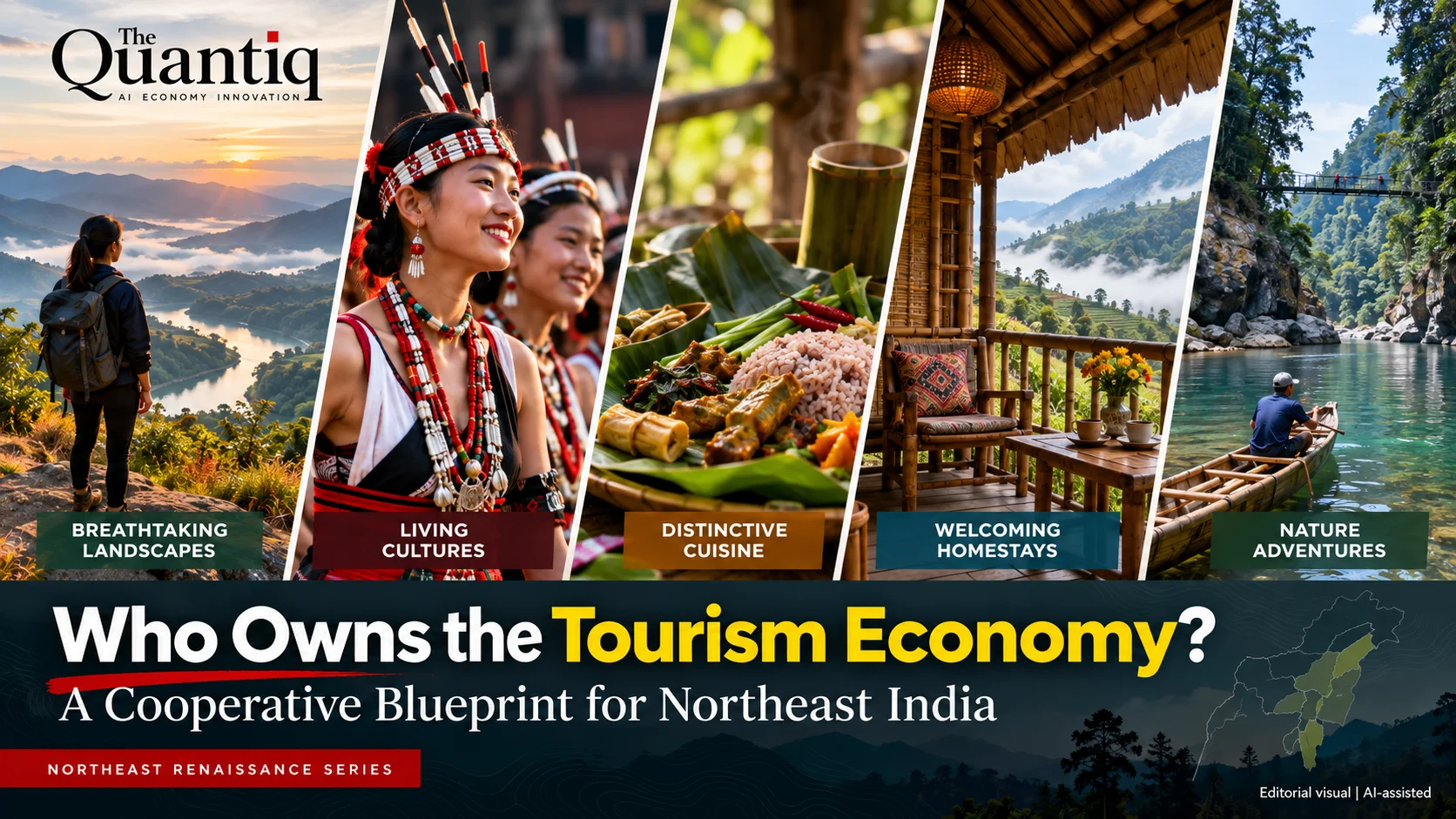
Who Owns the Tourism Economy? A Cooperative Blueprint for Northeast India
Northeast Renaissance Series
The future of tourism in Northeast India lies not in inventory alone, but in thoughtfully designed experiences, community ownership and digital discoverability—without diluting the natural and cultural assets that make each destination unique.
The village that closed its gate on Sundays
In January 2026, Mawlynnong in Meghalaya made a decision that offers an important lesson for tourism destinations across Northeast India. The village council, known as the Dorbar Shnong, stopped admitting day-trippers on Sundays.
The decision was rooted in everyday life. Sunday is a day of religious observance for many residents, and the constant presence of visitors and tourism-related activity had made it difficult for villagers to follow their usual routines. Restaurants, shops and other visitor services close on Sundays, although certain overnight guests remain exempt from the restriction. The village continues to welcome day visitors from Monday to Saturday.
Mawlynnong is widely celebrated for its cleanliness and community participation. Yet its experience raises a fundamental question. When a destination becomes popular, who decides how tourism should operate within it?
Tourism is often discussed in terms of visitor numbers, infrastructure and revenue. But there is another question that deserves equal attention: who owns the tourism economy?
Who decides which experiences are offered, how many visitors can be accommodated, who receives the bookings and how the money is distributed? These decisions can determine whether tourism strengthens a community or gradually places its interests at the margins.
For Northeast India, this is an opportunity to think ahead. Many villages, landscapes and cultural destinations across Assam, Meghalaya, Nagaland, Arunachal Pradesh, Mizoram, Manipur, Tripura and Sikkim have distinctive assets that could support tourism. The challenge is to build an economic model around those assets before outside demand shapes the destination on someone else’s terms.
Inventory alone does not make a tourism business
A beautiful landscape, a traditional home, a tea garden or a local festival can attract attention. But having something worth seeing does not automatically create a successful tourism business.
Inventory creates the potential for tourism. Experiences give people reasons to travel, stay longer, spend locally and return.
Consider a village surrounded by tea gardens. It could offer accommodation and attractive views. That is a useful starting point, but the experience need not end there.
Visitors might learn how tea is grown and processed, walk through the gardens with a knowledgeable local guide, taste teas prepared in different ways, share a traditional meal or meet a craftsperson whose work reflects the region’s history. Depending on the community’s wishes, they might also participate in selected agricultural activities or learn about the relationship between the landscape and local livelihoods.
The result is not simply a room, a meal or a sightseeing stop. It is a connected experience that gives visitors a deeper understanding of the destination while creating opportunities for several local businesses.
The same principle applies to village stays, forest experiences, traditional food, indigenous crafts, river journeys and nature-based tourism across the Northeast.
However, experience design must have limits. Not every cultural practice should become a tourist attraction, and not every private space should be opened to visitors. Traditions should not be turned into performances simply because they are commercially attractive.
The community must decide what it wishes to share, what it wishes to protect and how tourism can fit into its way of life. The objective is to create value around a destination’s identity, not to change that identity to satisfy visitors.
The problem of who captures the money
Tourism can generate significant spending without ensuring that the destination itself receives a fair share.
A visitor might stay in a locally owned homestay but book through an outside operator, travel with an external transport provider and purchase packaged experiences that generate little income for the surrounding community. The visitor count may look impressive, yet the local economic benefit can remain limited.
This is where a tourism cooperative becomes relevant.
Imagine a group of homestay owners, local guides, transport providers, farmers, food producers, craft businesses and experience operators working together through a common organisation. Each business remains independently owned, but the members cooperate on the parts of tourism that are more effective when managed collectively.
They can establish common service standards, develop connected visitor experiences, coordinate bookings and promote the destination under a shared identity. They can also agree on transparent commissions, revenue-sharing arrangements and contributions towards community needs.
Such a cooperative is not merely a collection of businesses listed on a website. It is a mechanism for organising local supply, negotiating with the market and retaining a fairer share of the value tourism creates.
Four questions should be settled from the beginning. Who can participate, and under what standards? How much tourism can the destination accommodate? Who controls the booking system and the customer relationship? Finally, how will income be distributed and reinvested?
These are not administrative details to be sorted out after a destination becomes popular. They are foundational business decisions.
What the world can teach Northeast India
There is no single model that every destination should adopt. Experiences from other countries and Indian states nevertheless show how communities can organise tourism around local economic interests.
Namibia: community rights and professional partnerships
Namibia’s communal conservancy system offers an important lesson in community participation. Rural communities have recognised roles in managing wildlife and tourism on their land. Partnerships with private operators can bring investment, professional expertise and access to tourism markets.
The State of Community Conservation in Namibia 2022 report recorded more than N$140 million in total cash income and in-kind benefits for conservancies. Tourism was a major contributor.
The lesson is not that every village in Northeast India should build a wildlife lodge. Rather, local communities need meaningful rights and a defined role in deciding how their natural assets are used. Professional operators can contribute capital and expertise, but the terms of engagement should recognise community interests.
Tourism should also complement existing livelihoods instead of being presented as a guaranteed replacement for farming, crafts or other local economic activities.
Costa Rica: the power of a cooperative network
Costa Rica offers another useful example through COOPRENA, its network of community-based rural tourism organisations.
A profile published by the international cooperative body CICOPA in 2017 described a network of 23 member organisations working across more than 40 communities. Those figures are historical, rather than a statement of its current membership. The model’s relevance lies in the network itself.
Individual rural communities can find it difficult to market themselves, negotiate with tour operators and reach travellers beyond their immediate geography. A cooperative network can bring training, technical assistance, marketing and sales support within reach of its members. COOPRENA’s model has included a travel agency through which community experiences can be sold.
This is a crucial distinction. Local tourism providers do not always need to compete with one another. They can cooperate to reach a larger market while retaining their own identities and control over what they offer.
Kerala: connecting tourism to everyday livelihoods
Kerala’s Responsible Tourism initiative demonstrates how tourism can generate economic opportunities beyond accommodation and sightseeing.
The initiative, launched in 2008, has developed a broad network of local enterprises. A Kerala state development report published in 2026 recorded 25,015 registered units, including 17,884 women-owned or women-led units.
The early work in Kumarakom provides a particularly useful lesson. Women’s groups associated with Kudumbashree supplied vegetables and other products to hotels through local procurement arrangements. Kerala Tourism reported that these supplies generated more than ₹27 lakh in 2010.
The figure belongs to that period and should not be mistaken for current earnings. Its significance lies in the business model.
Local producers were connected to an identifiable market. Tourism demand could therefore support agriculture, food production and women’s livelihoods, rather than concentrating its benefits solely in hotels and travel services.
For Northeast India, this principle is worth adapting. A homestay cluster could source food from nearby farmers, commission local craftspeople, employ community guides and work with transport providers. The resulting economic network would be larger than the accommodation business itself.
Italy: turning a living village into a shared hospitality experience
Italy’s albergo diffuso, or scattered hotel, offers another way to think about destination development.
Instead of constructing a conventional hotel in one location, the model brings accommodation in existing village buildings under a common hospitality framework. Rooms may be spread across different houses, while reception and management are coordinated.
The village remains a living place rather than becoming an isolated resort. Existing buildings can be reused, and visitors have opportunities to experience the surrounding community.
For Northeast India, the concept suggests possibilities for clusters of existing homes and homestays. A common management system could help coordinate standards, reservations, guest services and promotion without requiring every property to become part of a large hotel.
The model would only make sense where residents wish to participate and the arrangement fits local building traditions, land arrangements and community priorities.
These examples differ in ownership, governance and scale. Their common lesson is that successful community tourism requires more than attractive locations. It needs organisation, market access and a fair understanding of who benefits.
The global tourism market is changing
The World Economic Forum’s Travel & Tourism Development Index 2026, published in September, reinforces the case for a more deliberate approach to tourism development.
The report notes that international tourist arrivals reached a record 1.5 billion in 2025. The global tourism economy has moved beyond pandemic recovery, but rising demand has also increased pressure on infrastructure, natural assets and local communities.
The challenge is no longer simply to attract more visitors. It is to convert tourism growth into lasting economic and social value.
Costa Rica offers an illustration of why this matters. According to the WEF report, international arrivals grew by around 1% in 2025, while average visitor spending rose from approximately US$1,602 to US$1,848 per trip. That represents an increase of roughly 15%.
These figures do not prove that every destination can increase spending in the same way. They do, however, support a broader lesson: tourism competitiveness does not depend on visitor volume or low prices alone. Quality, distinctiveness, sustainability and the value of the experience matter too.
For Northeast India, this opens up a different way of thinking. Instead of competing solely to attract more tourists, destinations can work towards better-designed experiences, longer stays and stronger connections with local businesses.
A visitor who stays for several days, eats locally, employs a guide, buys regional products and participates in a carefully designed experience may contribute more to the local economy than a day-tripper whose visit is limited to a few photographs.
The aim should not be to discourage visitors. It should be to make every visit more meaningful for the traveller and more beneficial for the host community.
Design experiences without diluting the destination
Experience design is often misunderstood as adding activities to an itinerary. In reality, it begins with understanding what makes a place distinctive.
A tea-growing area, for instance, should not have to imitate a luxury resort to attract visitors. Its appeal may lie in the landscape, the knowledge of tea workers, the rhythm of the harvest, the taste of the local food and the stories that connect the community to the land.
A village near a forest may have opportunities for guided walks, birdwatching, local food and traditional knowledge, provided these activities are appropriate and supported by residents. A craft cluster could connect demonstrations, workshops, direct sales and conversations with artisans.
The experience should be designed around the destination, not the other way around.
This requires attention to the complete visitor journey. Information must be reliable before arrival. Transport and accommodation arrangements should be clear. Hosts and guides need appropriate skills. Visitors should understand local customs and expectations. Booking, payment and customer support should be dependable.
Most importantly, the experience must respect the community’s capacity and boundaries.
A well-designed tourism economy should also measure more than arrivals and room occupancy. It should ask how much visitor spending remains in the area, how many local businesses participate, whether livelihoods are improving and whether residents feel that tourism is benefiting them.
A destination is not successful if its commercial growth comes at the expense of the natural and cultural assets that made it attractive in the first place.
A digital front door for community tourism
Even a well-organised destination can struggle if travellers cannot find accurate information about it.
A homestay may offer excellent hospitality, but its details might be scattered across social media posts, messaging applications and third-party listings. A local guide may have deep knowledge of the landscape but no reliable way to reach visitors planning a trip from another state or country.
This is becoming more important as travel discovery shifts towards search engines, online platforms and AI-powered assistants.
The WEF’s 2026 report specifically highlights the need for destinations to make information accurate, coordinated and machine-readable. It points to Germany’s national tourism Knowledge Graph as an example of how information about attractions, accommodation, events and services can be brought together in a structured format for digital discovery.
The implication for Northeast India is significant. Digital visibility alone is not enough. Information must also be trustworthy, clearly organised and available in forms that digital systems can understand.
A community tourism cooperative could provide this shared digital front door. Each participating homestay, guide, farm, restaurant or experience could have a verified profile with a permanent web address. Visitors could find clear information about location, services, availability, pricing, accessibility and booking arrangements.
The cooperative could coordinate photographs, content, reservations and customer support. It could also negotiate with external travel platforms and tour operators from a stronger collective position.
This does not mean every destination needs an expensive application. A well-maintained website, structured listings and a dependable booking process may be a more practical starting point.
The essential point is that the digital representation of a destination should be as carefully organised as its physical tourism assets.
A destination that is difficult to discover, understand or book risks losing opportunities before a traveller even begins the journey.
A practical blueprint for Northeast India
The most sensible starting point would be a pilot involving one willing destination or a small cluster of neighbouring communities. It should begin with consultation, not construction.
Residents and local businesses would first identify the assets they wish to share, the experiences they can deliver and the activities they want to keep private. They would assess visitor capacity, environmental sensitivities and the infrastructure required to host guests responsibly.
The next step would be to map the local supply of accommodation, guides, transport, food, crafts and other services. Participants could agree on minimum standards and establish a common system for presenting their offerings to the market.
A shared booking and marketing arrangement would then connect these providers to visitors and professional travel partners. The cooperative would need clear rules governing commissions, payments, complaints, data ownership and reinvestment. Members should understand how decisions are made and how their interests are represented.
Government agencies, tourism professionals, financial institutions and technology partners could contribute infrastructure, training, investment and market access. Their participation would be valuable, but it should strengthen the community’s ability to govern its own tourism economy rather than displace it.
The pilot should also establish a baseline against which progress can be measured. The most useful indicators would include income retained locally, participation by small businesses, length of visitor stays, employment opportunities, resident satisfaction and the condition of natural and cultural assets.
Only after the model demonstrates that it works should it be extended to other destinations.
This approach may appear slower than building facilities and launching a promotional campaign. Yet it addresses the foundations of a durable tourism business. Infrastructure can attract visitors, and marketing can create awareness. Neither guarantees that the local economy will capture a fair share of the resulting value.
The opportunity is to organise before demand arrives
Mawlynnong’s Sunday decision is a reminder that a destination is first a home for the people who live there. Tourism must work within that reality.
The international examples show that communities can organise supply, connect local livelihoods to visitor spending and negotiate more effectively with the wider tourism industry. The WEF report adds another dimension: destinations must offer credible value and ensure that travellers can find accurate, trustworthy information through the digital channels they increasingly use.
Northeast India has an opportunity to bring these ideas together.
Its tourism future need not be defined by a race to build more hotels, attract larger crowds or reproduce experiences that have succeeded elsewhere. It can be built around distinctive local identities, thoughtful experience design, community ownership and a shared digital presence.
The cooperative is one possible structure for making this happen. Its purpose is not to prevent outside investment or professional participation. It is to ensure that these relationships create value for the destination and the people who sustain it.
The most important decisions should therefore be made before visitor numbers rise sharply. Who controls the supply? Who sets the limits? Who owns the customer relationship? Who receives the income, and what remains for the community?
These questions are easier to answer before a destination becomes dependent on external operators and fragmented booking channels.
The future belongs to destinations that know what makes them unique, design experiences around that identity, organise their communities to deliver them and retain a fair share of the value they create. For Northeast India, the time to build that model is before the crowds arrive.




One Comment