
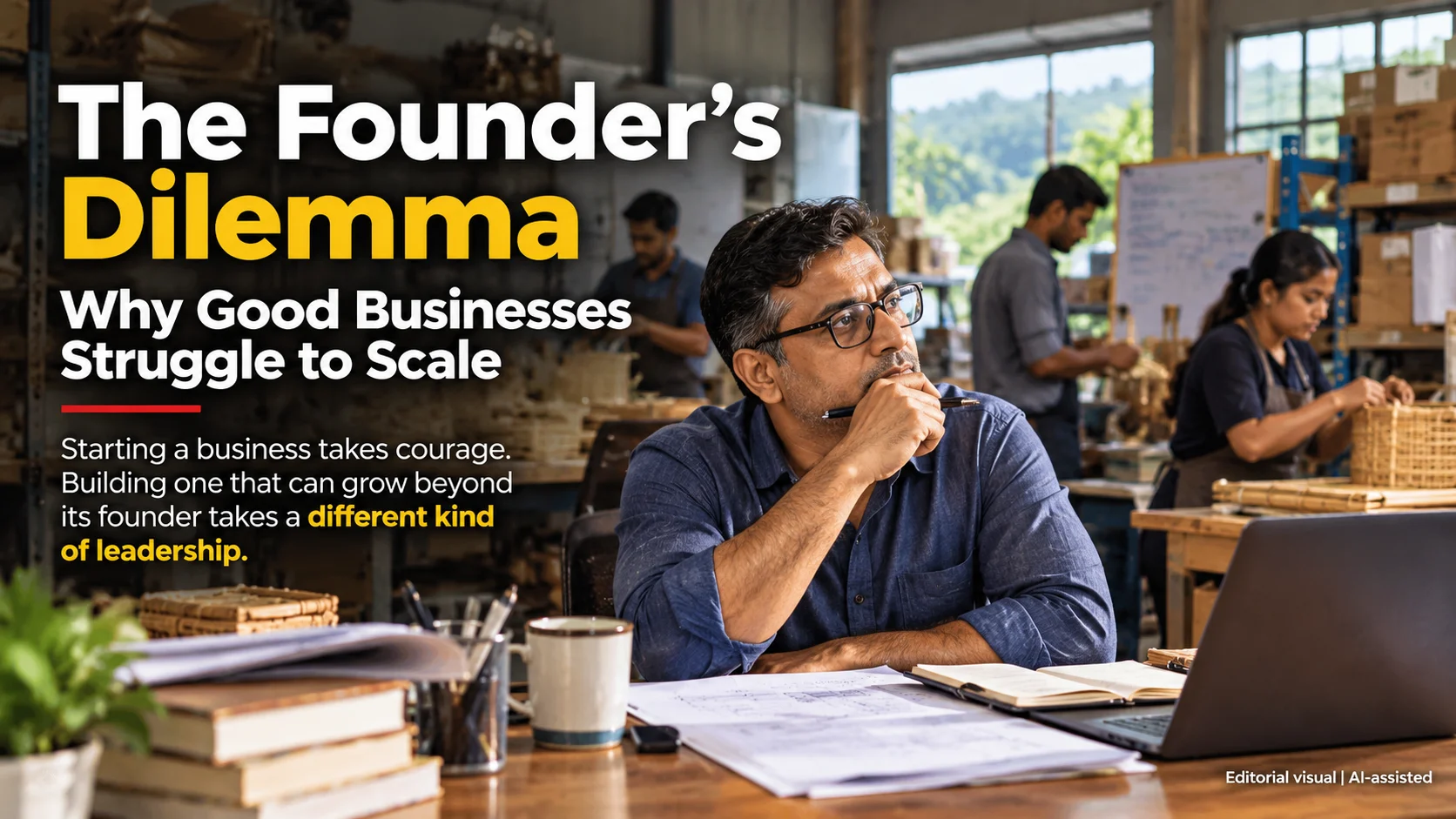
The Founder’s Dilemma: Why Good Businesses Struggle to Scale
Starting a business takes courage. Building one that can grow beyond its founder takes a different kind of leadership—one rooted in people, processes, financial discipline and the willingness to let go.
Every business begins with a person willing to take a chance. Someone spots an opportunity, sees a gap in the market or believes there is a better way to serve a customer. The first steps are rarely easy. Money is limited, customers must be persuaded, suppliers need to be trusted and every rupee has to work hard. The founder does whatever the business demands, often moving from sales to operations, from negotiating payments to resolving customer complaints, sometimes all in the same day.
In those early years, the founder’s personal involvement can be the enterprise’s greatest strength. Customers know whom to call. Suppliers trust a familiar face. Employees turn to the person who understands the business better than anyone else. Decisions are quick because the person responsible for the outcome is usually close at hand.
Then the business begins to grow, and something changes.
More customers mean more orders to fulfil. A larger workforce requires better coordination. New markets demand consistent quality, dependable delivery and stronger financial management. Opportunities that once seemed exciting begin to compete for the founder’s time. The business may have a good product, a loyal customer base and a respectable reputation, yet every significant decision still waits for one person.
What helped the business succeed in the beginning can gradually become the very thing holding it back.
This is the founder’s dilemma: how do you build a business that can grow beyond your own capacity to manage it?
For entrepreneurs across Northeast India, where many enterprises are built through personal initiative, local knowledge and relationships developed over years, this is an especially important question. Starting more businesses matters, but so does helping promising enterprises become stronger, more productive and capable of serving markets beyond their immediate surroundings.
When the founder becomes the bottleneck
In the early stages, a founder’s hands-on approach is often necessary. There may be too little work to justify a dedicated manager and too little capital to build a large team. The founder understands the customer, knows the supplier and can resolve problems without lengthy discussions.
But a growing business brings a different set of demands. The founder can no longer be everywhere at once, and decisions that once took minutes may begin to accumulate. Employees hesitate to act without approval. Customer relationships remain concentrated in the owner’s hands. Routine problems keep returning because nobody has developed a consistent way to solve them.
Consider a hypothetical manufacturing enterprise in Assam that has earned a reputation for reliable products. Its founder manages key customers, approves purchases, supervises production and handles important negotiations. The business has an opportunity to supply buyers in other states, but production planning remains informal and quality checks depend heavily on the founder’s personal supervision. Even the sales team cannot confidently promise delivery dates without seeking approval.
The enterprise does not necessarily lack demand. It lacks the organisational capacity to meet more of it.
This is a distinction every ambitious entrepreneur needs to recognise. A business can have a marketable product without being ready to scale. It can generate revenue without having the management systems required to sustain growth.
The answer is not to remove the founder from the business. It is to ensure that the founder’s time is spent building its future rather than resolving every problem created by its present.
Relationships open doors. Execution builds businesses.
In many markets, trust is a powerful commercial asset. A personal introduction can bring the first customer. A longstanding relationship may persuade a supplier to extend credit. A business association can provide access to information, partnerships or a market that would otherwise be difficult to enter.
For entrepreneurs in Northeast India, where business communities often depend on established local relationships, these connections can be particularly valuable. They help people find opportunities, establish credibility and navigate unfamiliar markets.
But a relationship can open a door only once. To remain there, a business must deliver.
A customer who places an order because of personal trust still expects the product to arrive on time. A supplier who extends credit expects payment. A partner who agrees to collaborate wants clarity about responsibilities and results. As the business expands, personal assurances must be supported by reliable systems.
That means maintaining accurate accounts, documenting commitments, tracking customer requirements and establishing processes that do not depend entirely on the founder’s memory. It also means ensuring that important relationships belong to the organisation, not just to the individual who established them.
Networking is valuable, but it is not a substitute for execution. A well-connected entrepreneur may discover opportunities more quickly than others, yet only a capable organisation can convert those opportunities into sustained commercial value.
For founders, the next stage is therefore not simply to build a larger network. It is to build a business that can make the most of the relationships already established.
Learning to trust the people you hire
Delegation is often presented as an obvious solution to a founder’s workload. In practice, it can be one of the most difficult transitions in entrepreneurship.
The founder has invested money, time and personal credibility in the enterprise. They know how close it came to failing and how much effort went into winning its customers. It is understandable that they may hesitate to hand important decisions to someone else.
Sometimes that hesitation is justified. An inexperienced employee may make an expensive mistake. A poorly chosen manager may create confusion. Delegation without clear expectations or accountability can make a business less efficient rather than more.
The answer, however, cannot be to keep every decision with the founder indefinitely.
People need to know what is expected of them, what decisions they can make and when they should seek guidance. Managers need access to information and a clear understanding of the results for which they are responsible. Financial controls should protect the business without forcing routine decisions through the owner’s desk. Mistakes must be addressed, but they should also become opportunities to improve the way work is done.
This requires a shift in mindset. The founder must learn to judge performance by results rather than by whether every task has been completed in exactly the way they would have done it.
A business becomes less dependent on its founder when capable people can make sound decisions within clearly defined boundaries. That does not happen overnight. It requires patience, training and a willingness to build confidence in others.
The real test is not whether the founder can take a few days away from the office. It is whether the business can continue serving customers, maintaining standards and solving problems without waiting for the founder to intervene at every turn.
Growth can expose weaknesses that revenue conceals
Entrepreneurs are often encouraged to expand, enter new markets and increase sales. Ambition is essential, but growth brings costs and risks that are easy to underestimate.
A manufacturer may need to purchase raw materials well before receiving payment for finished goods. A service provider may have to recruit and train employees before a new contract begins generating revenue. A retailer may discover that a second location increases inventory costs, logistical complexity and the risk of unsold stock.
Sales can rise while cash becomes tighter. A large order can look attractive but place enormous pressure on working capital. A business may appear successful from the outside while struggling to pay suppliers on time.
This is why scaling requires more than optimism. Founders need to understand their margins, cash-flow cycles, customer payment patterns and the costs of serving additional markets. They must know which products are genuinely profitable and whether their existing operations can handle greater demand without compromising quality.
Capital matters, but additional money cannot permanently compensate for a weak business model. Nor is expansion always the right next move. Sometimes the most valuable decision is to improve productivity, strengthen financial controls or make an existing operation more efficient before pursuing another market.
For businesses in Assam and the wider Northeast, reaching customers in other parts of India can open significant possibilities. But entrepreneurs must assess the practical demands of distribution, logistics, after-sales service and consistent delivery. The requirements will differ between a food-processing enterprise, a manufacturer, a tourism operator and a technology company. Each must understand the economics of its own expansion.
The goal should not be growth at any cost. It should be sustainable growth that leaves the business stronger rather than more vulnerable.
The Northeast needs businesses that can grow into institutions
The Northeast has entrepreneurial activity across agriculture and food processing, tourism, hospitality, manufacturing, retail, technology and professional services. Many enterprises begin by serving a local market, building trust within their communities and learning through experience.
The next opportunity is to help more of these businesses develop the capabilities to compete beyond their home markets.
Not every small enterprise needs to become a national brand. A well-run local business can provide livelihoods, support suppliers and contribute meaningfully to its community without pursuing aggressive expansion. The important thing is to ensure that businesses with the ambition and potential to grow have a realistic path to doing so.
That path may require better access to finance, professional management, market intelligence, technology, skilled employees or distribution networks. It may also require entrepreneurs to reconsider practices that worked when the business was small but are no longer suitable for a larger operation.
Institutions have a role to play. Management institutes can help develop practical business capabilities. Industry associations can connect enterprises with markets, knowledge and potential partners. Financial institutions can support viable businesses with appropriate funding. Experienced entrepreneurs can mentor those facing challenges they themselves encountered years earlier.
But these efforts must lead to practical outcomes. Training is valuable when it improves decisions. Networking matters when it produces meaningful partnerships. Financial support creates lasting value when the enterprise can use it productively and repay it sustainably.
The responsibility is shared. Institutions must provide relevant support, and entrepreneurs must be willing to improve how their businesses operate.
A stronger entrepreneurial ecosystem is not measured only by how many businesses are launched. It is also measured by how many become resilient, productive enterprises that create lasting employment and compete successfully in wider markets.
Technology can help, but it cannot replace good management
Artificial intelligence and accessible digital tools are creating new possibilities for smaller businesses. Entrepreneurs can use them to organise customer information, analyse sales, manage inventory, improve marketing and automate routine communications. Tasks that once required substantial time or specialised support can increasingly be handled with affordable digital solutions.
Yet technology is not a shortcut around sound management.
Automating a poorly designed process may simply reproduce its weaknesses at greater speed. A customer-management system is of limited use if nobody maintains the information. A financial dashboard cannot support good decisions if the underlying records are unreliable. An AI-generated marketing campaign cannot compensate for a product that fails to meet customer expectations.
The right starting point is to identify a genuine business problem. Where is time being wasted? Why are orders delayed? Which customers return, and which do not? Is inventory tying up too much money? Are enquiries being lost because nobody follows up?
Only then should the entrepreneur decide whether technology can help.
For a small manufacturer, a basic digital system for inventory and production planning may deliver more immediate value than an elaborate AI application. A tourism business might benefit from better enquiry management and online bookings. A distributor may need clearer demand forecasts and delivery tracking.
The purpose is not to adopt technology simply because it is fashionable. It is to improve productivity, reduce avoidable costs and help the business serve customers more reliably.
For founders who want to scale, technology works best when it strengthens a well-understood business process rather than being expected to fix an organisation that has not yet established one.
From being indispensable to building something enduring
There is a deeper question behind the founder’s dilemma. Is success about remaining indispensable to the business, or about building an organisation that can continue creating value without constant personal intervention?
There is nothing wrong with a founder who prefers to remain closely involved in a small enterprise. Not every business needs layers of management, formal departments or an ambitious expansion plan. The right structure depends on the founder’s objectives and the nature of the business.
The challenge arises when dependence on one person threatens continuity or prevents the enterprise from pursuing opportunities it could otherwise handle.
Building an enduring business requires attention to financial discipline, governance, management development and institutional knowledge. It means identifying people who can take on greater responsibility and giving them opportunities to grow. It means documenting important procedures, establishing clear accountability and ensuring that customer relationships and operational knowledge do not exist exclusively in the founder’s memory.
These steps matter even for a modest enterprise. A business that can operate reliably during its founder’s absence is better prepared for growth, unexpected disruption and eventual succession.
For first-generation entrepreneurs, this transition carries particular significance. They may have built their enterprises without an established family business to guide them, learning through mistakes and relying on their own resourcefulness. Their achievement becomes even more consequential when they create an organisation that gives employees, future managers and the next generation a stronger foundation than they had themselves.
That is the difference between building a livelihood and building an institution. Both are valuable, but they demand different ambitions and different measures of success.
The next stage of entrepreneurship
Starting a business demands initiative and a willingness to accept uncertainty. Surviving requires persistence, adaptability and a close understanding of customers. Scaling calls for another set of capabilities: building teams, establishing reliable systems, managing capital and creating an organisation that can deliver consistently beyond the founder’s immediate reach.
Not every entrepreneur will want to make that transition, and not every enterprise needs to scale. But for those who do, the question is whether the organisation is developing as quickly as its ambitions.
The founder who continues to make every decision may remain the most important person in the business. The founder who builds capable teams, reliable processes and a culture of accountability creates the possibility of something more resilient: an enterprise that can recognise and pursue opportunities even when its founder is not personally directing every move.
For Northeast India, the ambition should be not only to encourage more people to start businesses, but also to help promising enterprises become productive, professionally managed and capable of competing in larger markets. That requires entrepreneurial initiative, institutional support and a willingness to learn from both success and failure.
Ultimately, a founder’s achievement should not be judged only by what the business accomplishes while everything depends on them. It should also be judged by the strength of the organisation they leave behind, the people they enable to lead and the opportunities the enterprise continues to create.
So, here is a question worth asking every founder: Are you building a business that depends on you, or an institution that can grow because of what you have built?