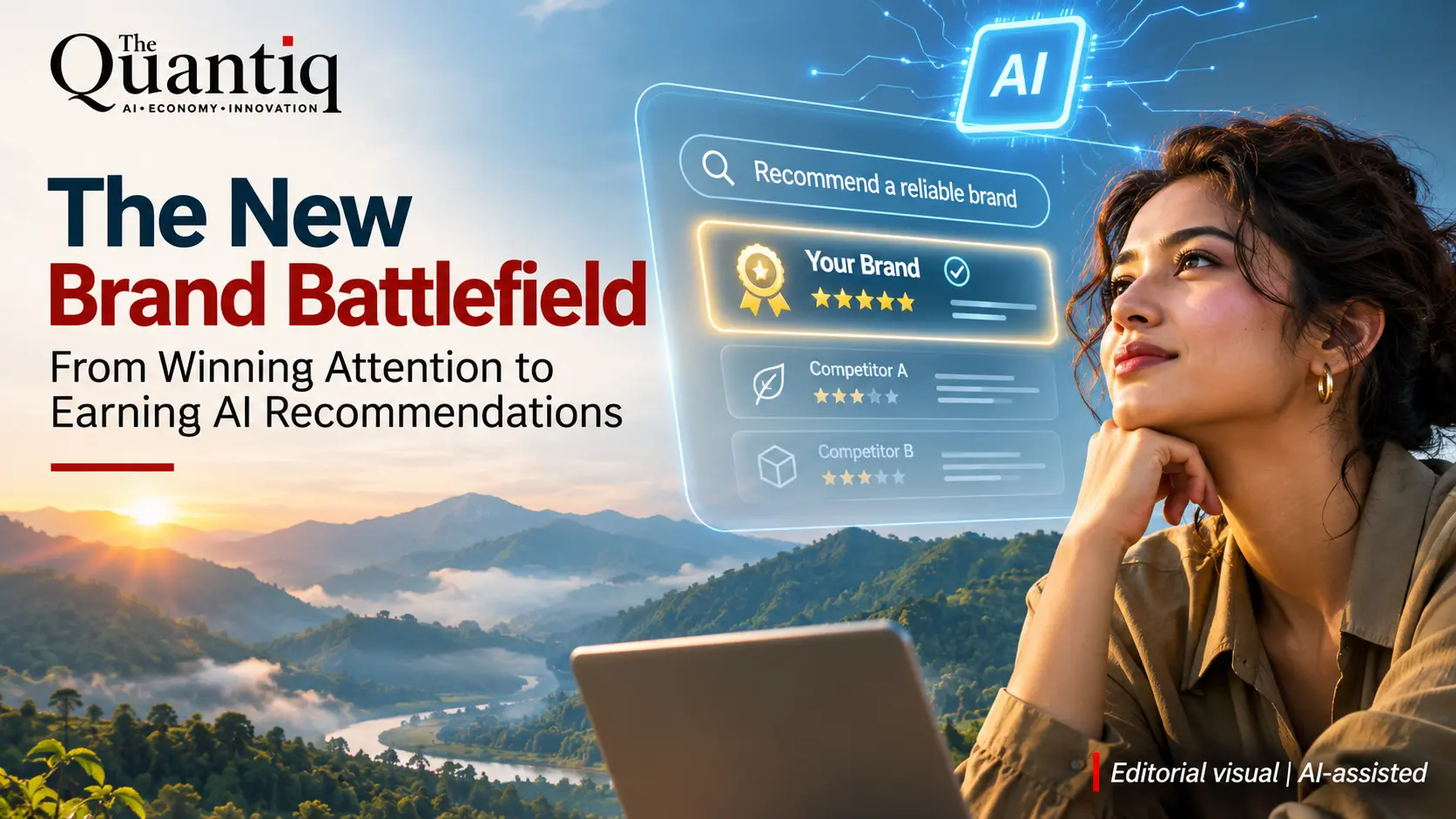
The New Brand Battlefield: From Winning Attention to Earning AI Recommendations
Brand & Media Intelligence series
As artificial intelligence changes how people discover businesses, products and services, brand visibility is no longer just about being seen. It is about being understood, trusted and recommended.
For decades, businesses have competed for consumer attention. They invested in advertising, public relations, search engine optimisation and social media campaigns to make their brands visible. The objective was simple: reach the right audience, attract interest and convert attention into business.
Today, people are increasingly turning to artificial intelligence tools to discover products, compare services, research companies and seek recommendations. Instead of browsing multiple websites or scrolling through pages of search results, they can ask an AI assistant to identify a suitable manufacturer, recommend a service provider or compare competing brands.
This creates a new challenge for businesses: what happens when an AI system becomes an intermediary between a brand and its potential customer?
Being visible still matters. But being recognised, understood and considered credible enough to be recommended is becoming an equally important competitive advantage.
From Search Rankings to AI Recommendations
Traditional search engines generally presented users with a list of websites ranked according to relevance and other signals. Businesses responded by investing in search engine optimisation (SEO), publishing keyword-focused content and building links to improve their search visibility.
Generative AI is introducing a different experience.
When someone asks an AI assistant to recommend a reliable manufacturer, compare financial services or identify sustainable businesses in a particular region, the system may synthesise information from multiple sources and present a conversational answer.
A brand may or may not feature in that response.
This is where Generative Engine Optimisation (GEO) and Answer Engine Optimisation (AEO) enter the picture. These emerging approaches focus on making information easier for AI-powered search and answer systems to discover, interpret and use.
But this is not simply another SEO technique. It raises a more fundamental question: does enough credible information exist about a business for intelligent systems to understand what it does, where it operates, what makes it different and why customers should trust it?
Your Digital Identity Matters More Than Ever
Consider a small manufacturing company producing high-quality bamboo furniture in Northeast India.
It may have excellent products, skilled artisans and a loyal customer base. Yet, if its website contains little useful information, its business details are inconsistent across online directories and there is hardly any independent coverage of its work, its digital identity remains limited.
Now consider another company with a well-structured website, detailed product information, accurate business listings, genuine customer testimonials, credible media coverage and useful articles explaining its manufacturing capabilities.
The second company gives prospective customers and information systems considerably more material to understand its business.
This illustrates an important distinction: having a digital presence is not the same as having a strong digital identity.
A credible brand needs a consistent identity across its website, business listings, professional networks, publications and other relevant digital platforms. Its expertise, products, geographical presence and achievements should be communicated clearly and supported by verifiable information.
In an AI-mediated information environment, this clarity can become a competitive advantage.
Reputation Is Becoming an Information Asset
Brand reputation has always influenced purchasing decisions. What is changing is the growing importance of information available about a brand across the wider digital ecosystem.
A company’s website tells only part of its story. Industry publications, customer experiences, independent reviews, research reports, professional discussions and public records can provide additional context.
AI systems may draw on different sources depending on their design, available information and retrieval mechanisms. No single source guarantees visibility or recommendation.
Nevertheless, businesses should recognise that credibility cannot be manufactured through promotional content alone.
A company that consistently demonstrates expertise, publishes useful information, maintains transparent business practices and earns independent recognition has a stronger foundation for long-term digital authority.
This also gives credible media a renewed role. Independent editorial coverage is not merely an opportunity for publicity. It can contribute to the wider body of verifiable information through which a business is understood.
The distinction between advertising and editorial credibility must, however, remain intact. Paid visibility should never be presented as independent endorsement.
What Should Businesses Do Differently?
The transition does not require every business to invest heavily in artificial intelligence or hire expensive digital marketing agencies. It requires a more deliberate approach to building and maintaining a credible digital identity.
Businesses should begin with five practical steps.
1. Build an authoritative website. Ensure that the website clearly explains the company’s operations, products, services, leadership, location and contact details. Keep the information accurate and updated.
2. Publish useful, original content. A manufacturer can explain its production processes. A tea company can share information about sourcing, quality and traceability. A technology startup can demonstrate how its solutions address specific business problems.
3. Maintain consistent business information. Ensure that the company name, address, contact details, website and business descriptions are accurate across relevant directories and professional platforms.
4. Establish independent credibility. Encourage authentic customer feedback, document achievements and seek meaningful industry recognition. Publish evidence rather than relying on exaggerated claims.
5. Monitor AI and search visibility. Periodically test relevant queries across search engines and AI-powered discovery tools. Check whether the business is accurately represented, whether its information is current and which sources are being referenced.
The objective should not be to manipulate AI systems. It should be to make the business easier to understand and more deserving of trust.
A New Opportunity for Smaller Businesses
There is an interesting possibility here for India’s micro, small and medium enterprises (MSMEs).
Smaller businesses have traditionally struggled to compete with larger companies in advertising expenditure, brand recognition and distribution reach. AI-powered discovery could create new opportunities for niche manufacturers, specialised service providers, regional enterprises and emerging entrepreneurs.
A small enterprise with distinctive expertise and a well-documented digital identity may become discoverable beyond its immediate geographical market.
This is particularly relevant to Northeast India, where many businesses possess valuable products, resources and capabilities but lack adequate digital visibility.
A specialised food processor, bamboo enterprise, handloom producer or local tourism operator may have a compelling business proposition. Yet, without reliable digital information, potential customers and business partners elsewhere may never discover it.
The opportunity, however, is not automatic. Digital infrastructure, reliable business information, content quality and independent credibility will continue to matter.
The New Measure of Brand Strength
The future of branding will not be determined by advertising reach alone.
Businesses will increasingly need to think about how effectively they communicate their identity, demonstrate their expertise and establish credibility across an interconnected digital ecosystem.
Traditional brand awareness will remain important. Search visibility and social engagement will continue to have value. But a new dimension is emerging: whether a brand can be accurately understood and appropriately recommended by intelligent information systems.
The next competitive advantage may belong to businesses that recognise this shift early.
In the age of AI, being seen is valuable. Being understood is more valuable. And being trusted enough to be recommended could make all the difference.
Frequently Asked Questions
1. What is AI-powered brand discoverability?
AI-powered brand discoverability refers to how easily artificial intelligence systems can identify, understand and retrieve reliable information about a business, its products or services. It can influence whether a brand appears in relevant AI-generated answers and recommendations.
2. What is the difference between SEO, GEO and AEO?
SEO (Search Engine Optimisation) focuses on improving visibility in traditional search engine results. GEO (Generative Engine Optimisation) focuses on improving the likelihood that relevant information about a brand is discovered and used in generative AI responses. AEO (Answer Engine Optimisation) focuses on making content useful and accessible to systems that provide direct answers to user questions. The approaches overlap and should complement one another.
3. How can small businesses improve their visibility in AI search?
Small businesses can start by maintaining an accurate website, publishing original and informative content, ensuring consistent business listings, collecting genuine customer reviews and building credible references through relevant industry publications and professional platforms. There is no guaranteed formula for appearing in AI recommendations.
4. Does media coverage help a brand appear in AI-generated recommendations?
Credible media coverage can contribute to a brand’s wider digital footprint by providing independent information about its activities, expertise and achievements. However, media coverage does not guarantee AI visibility. Its value depends on editorial credibility, relevance, accessibility and how individual AI systems retrieve and evaluate information.





One Comment