
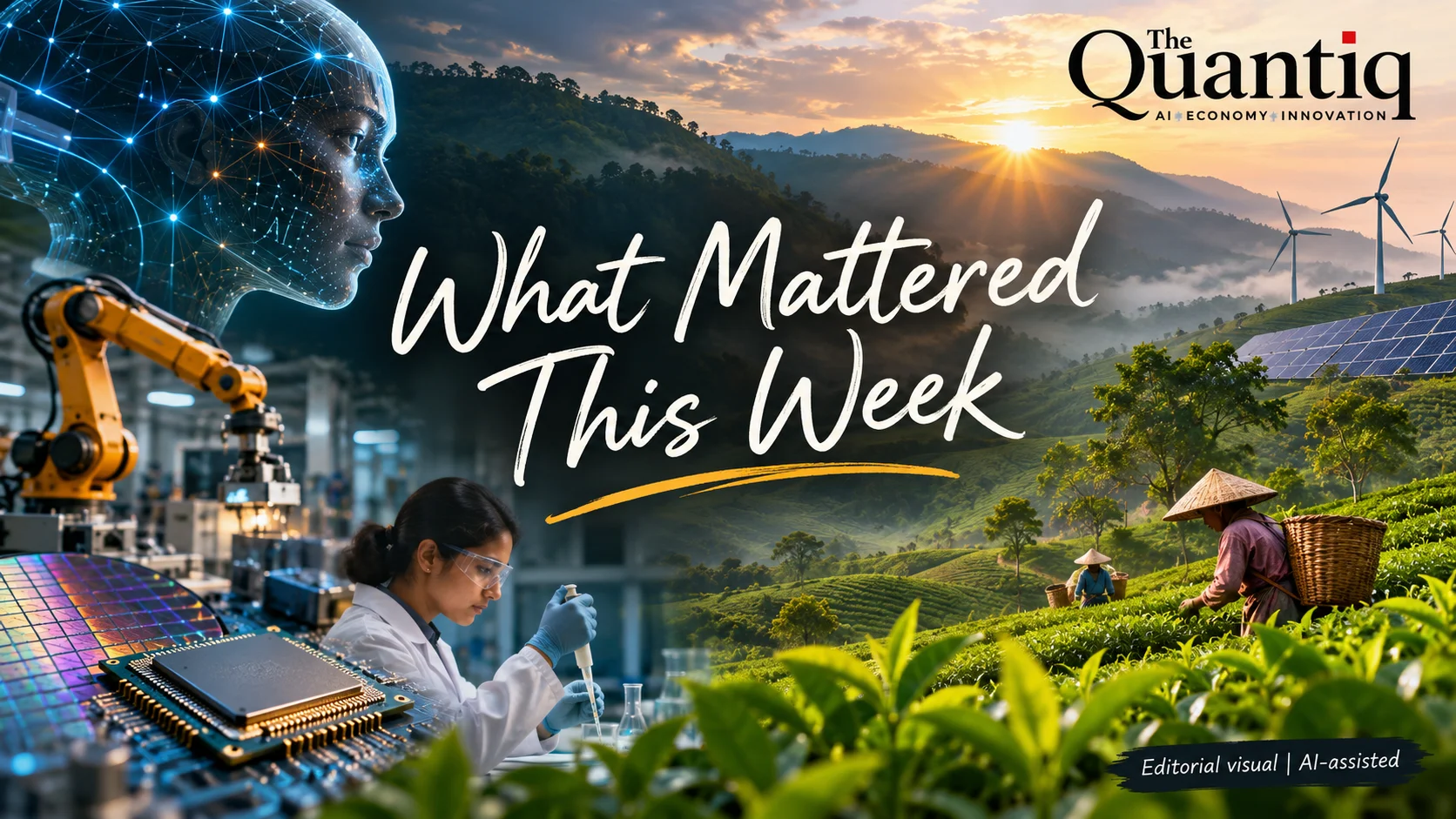
What Mattered This Week: Seven Developments Shaping the Next Economy
Weekly Intelligence Brief
The most important developments of a week are not always the ones dominating headlines. Some of the biggest changes begin quietly, in research laboratories, technology partnerships, investment decisions and industries that are only beginning to embrace innovation.
This week, artificial intelligence moved further into engineering, cybersecurity and scientific research. India’s deep-tech ambitions attracted fresh investor attention, Assam’s tea industry took a significant step towards technological transformation, and a new UN report highlighted the enormous economic challenge of adapting to climate change.
These seven developments offer a glimpse of the forces shaping the next economy.
1. AI IS LEARNING TO BUILD, NOT JUST ANSWER
Anthropic’s latest models offer a glimpse of AI as an engineering collaborator.
Artificial intelligence is beginning to take on projects that would traditionally require entire engineering teams. Anthropic’s November 9 announcement of Claude Fable 5.2 and Claude Mythos 5.2 provides an intriguing example of how quickly this capability is evolving.
In one experiment, an engineer asked an earlier version of Fable to build a prototype operating system from scratch. The model coordinated more than 1,000 AI agents working continuously for eight days, producing a system with its own kernel, drivers, file storage, graphical interface and installation process.
Anthropic also reports that more than 90% of changes merged into its core codebase are now written by Claude, with human guidance. Its engineers have used the models for complex software migrations, electronic device design and scientific research.
The shift is significant. AI is moving beyond generating content and assisting individual tasks towards coordinating complex technical work. Human expertise remains essential, but the nature of engineering itself could be changing.
2. AI TAKES ON A FORMIDABLE CHALLENGE: PROVING SOFTWARE SECURITY
Google DeepMind uses AI agents to formally verify Signal’s cryptographic code.
Finding a software vulnerability is difficult. Proving mathematically that a piece of software satisfies specified security properties can be considerably harder.
On November 10, Google DeepMind announced AlphaProof Code, an AI-powered framework that successfully verified key security properties of the actual compiled code underlying the Signal messaging protocol.
The researchers combined human expertise with multiple AI agents to translate security requirements into mathematical specifications and generate formal proofs. The system produced more than six million lines of Lean code, which were independently checked by the Lean proof system. The exercise took four weeks, a task DeepMind says could traditionally take expert teams years.
The achievement is particularly interesting because the verification extended beyond the theoretical design of the protocol to the implementation running on devices. Signal’s CTO also acknowledged the significance of the work.
As AI-generated software becomes more common, proving that code behaves as intended could become just as important as writing it. This could have far-reaching implications for banking, healthcare and critical digital infrastructure.
3. THE FACTORY LABORATORY IS GETTING AN AI UPGRADE
DuPont, Microsoft and NobleAI bring agentic AI into industrial research.
One of this week’s interesting developments comes from the intersection of artificial intelligence, materials science and industrial research.
On November 12, DuPont announced a collaboration with Microsoft and NobleAI to accelerate research and development using scientific AI modelling and agentic AI. The partnership combines DuPont’s industrial and materials expertise, NobleAI’s scientific modelling platform and Microsoft’s Discovery platform for research and development.
The objective is to help scientists evaluate potential solutions, guide experiments and explore more possibilities through computer simulations before committing resources to physical testing.
This approach could be particularly valuable in industries such as chemicals, advanced materials, healthcare and manufacturing, where research can be expensive and time-consuming.
What makes this development noteworthy is the changing role of AI. Rather than simply assisting researchers with information, intelligent systems are increasingly being integrated into the process of scientific experimentation itself.
The laboratory of the future may have fewer repetitive experiments and considerably more AI-assisted discovery.
4. ASSAM’S TEA INDUSTRY TAKES A STEP TOWARDS INDUSTRY 4.0
Tocklai and the Industry 4.0 Innovation Centre explore a technology-led future for tea.
Assam’s tea industry may be approaching an important technological turning point.
On November 9, the Tea Research Association’s Tocklai Tea Research Institute signed a memorandum of understanding with the Industry 4.0 Innovation Centre (I4IC) to promote emerging technologies across India’s tea value chain.
An important part of the collaboration is the proposed development of a shared artificial intelligence and machine-learning platform using Tocklai’s research data and expertise. It is intended to serve tea estates, small tea growers and research institutions across Northeast India.
The partnership will also explore technology applications in tea production, processing, quality improvement, climate change and traceability. Supporting small growers, improving green leaf remuneration and strengthening compliance with international sustainability and food safety standards are among its objectives.
For an industry deeply rooted in Assam’s economic and cultural identity, this is more than a technology partnership. It presents an opportunity to connect decades of agricultural research with modern data intelligence.
The bigger question is whether Assam can transform its traditional tea advantage into a technology-led competitive advantage.
5. INDIA’S DEEP-TECH STARTUPS ATTRACT A DIFFERENT KIND OF CAPITAL
Agrani Labs’ reported $100 million funding round signals growing investor interest in semiconductors.
India’s semiconductor ambitions are beginning to attract investors from beyond the traditional venture capital ecosystem.
Bengaluru-based Agrani Labs, founded by former Intel and AMD executives, is reportedly in discussions to raise $100 million at a valuation of approximately $300–350 million, according to Moneycontrol.
The proposed investment has attracted attention because of the reported participation of Google’s investment ecosystem, HCLTech, Peak XV Partners and Stargazer, the fund associated with Groww’s founders.
Agrani Labs is developing semiconductor technology focused on AI inference, an increasingly important area as businesses look for more efficient ways to run AI applications.
The reported interest also reflects a broader shift in India’s startup landscape. Entrepreneurs who built successful consumer-facing businesses are beginning to explore strategically important deep-tech ventures.
Semiconductor development requires patient capital, specialised talent and considerable technical expertise. However, as AI, electronics and computing become central to economic competitiveness, India’s ability to build its own technology capabilities could become increasingly valuable.
The country’s next startup success stories may emerge from laboratories and engineering centres rather than consumer applications alone.
Note: The funding round was reported to be under discussion, not a completed transaction at the time of reporting.
6. ROBOTICS AND CLEAN ENERGY FIND THEIR PLACE IN INDIA’S STARTUP FUNDING STORY
A $258 million funding week reveals a broader range of opportunities.
Indian startups raised approximately $258.1 million during the week of November 2–7, more than double the $115 million recorded in the preceding week, according to Entrackr.
The largest investments went to consumer-facing businesses, including jewellery brand GIVA and consumer AI and entertainment company EloElo. However, some of the smaller deals deserve attention for what they reveal about emerging technology opportunities.
Pune-based Peppermint Robotics raised ₹100 crore in a pre-Series B funding round, while AI-powered clean-energy platform Two Point O Capital secured $10 million.
Other investments during the week covered healthcare technology, specialty chemicals, spacetech and autonomous delivery systems.
These businesses represent an interesting intersection of technology and the physical economy. Robotics can improve manufacturing, warehousing and logistics, while intelligent energy platforms can help manage increasingly complex energy systems.
India’s startup ecosystem is gradually expanding beyond consumer internet and financial technology. The opportunity now lies in applying innovation to the industries that produce, transport and power the economy.
7. THE CLIMATE ADAPTATION GAP COULD CREATE A NEW GLOBAL INDUSTRY
UNEP estimates that developing countries will need $305 billion annually for climate adaptation by 2035.
The climate conversation often focuses on reducing emissions. However, an equally important challenge is receiving greater attention: how will countries adapt to the environmental changes that are already taking place?
The United Nations Environment Programme’s 2026 Adaptation Gap Report, released on November 4, estimates that developing countries will require approximately $305 billion annually by 2035 to meet their climate adaptation needs.
International public adaptation finance reached only $28.2–31.7 billion in 2024. Even tripling this funding by 2035 would cover just 20–29% of the estimated requirement.
The gap is enormous, but it also points towards an emerging economic sector. Climate-resilient infrastructure, water management, climate-smart agriculture, early-warning systems and ecosystem restoration will require new technologies, investment and specialised businesses.
For Northeast India, where floods, landslides, erosion and changing rainfall patterns affect agriculture, infrastructure and livelihoods, the opportunity is particularly relevant.
The next generation of sustainability enterprises may not simply sell environmentally friendly products. They may develop solutions that help entire communities and economies adapt to climate disruption.
THE BIGGER PICTURE: INTELLIGENCE IS MOVING INTO THE PHYSICAL ECONOMY
Look closely at this week’s developments and a common thread begins to emerge.
Artificial intelligence is moving beyond the screen and entering engineering, cybersecurity, scientific laboratories and industrial research. Meanwhile, investment is finding its way into semiconductors, robotics and clean-energy platforms. Even traditional industries such as Assam’s tea sector are beginning to explore how research data and intelligent technologies can reshape their future.
These developments point towards a broader economic transition. The next competitive advantage may not come simply from developing more powerful technologies, but from combining human expertise, intelligent systems, quality data and practical applications.
For emerging economies such as India, this presents an opportunity to move beyond being consumers of technology and become creators of technology-led industries.
The next economy will belong to those who know how to put intelligence to work.





2 Comments