RBI Flags Gram Panchayat Funding Gap as Tata Steel Explores Hydrogen Production in Odisha
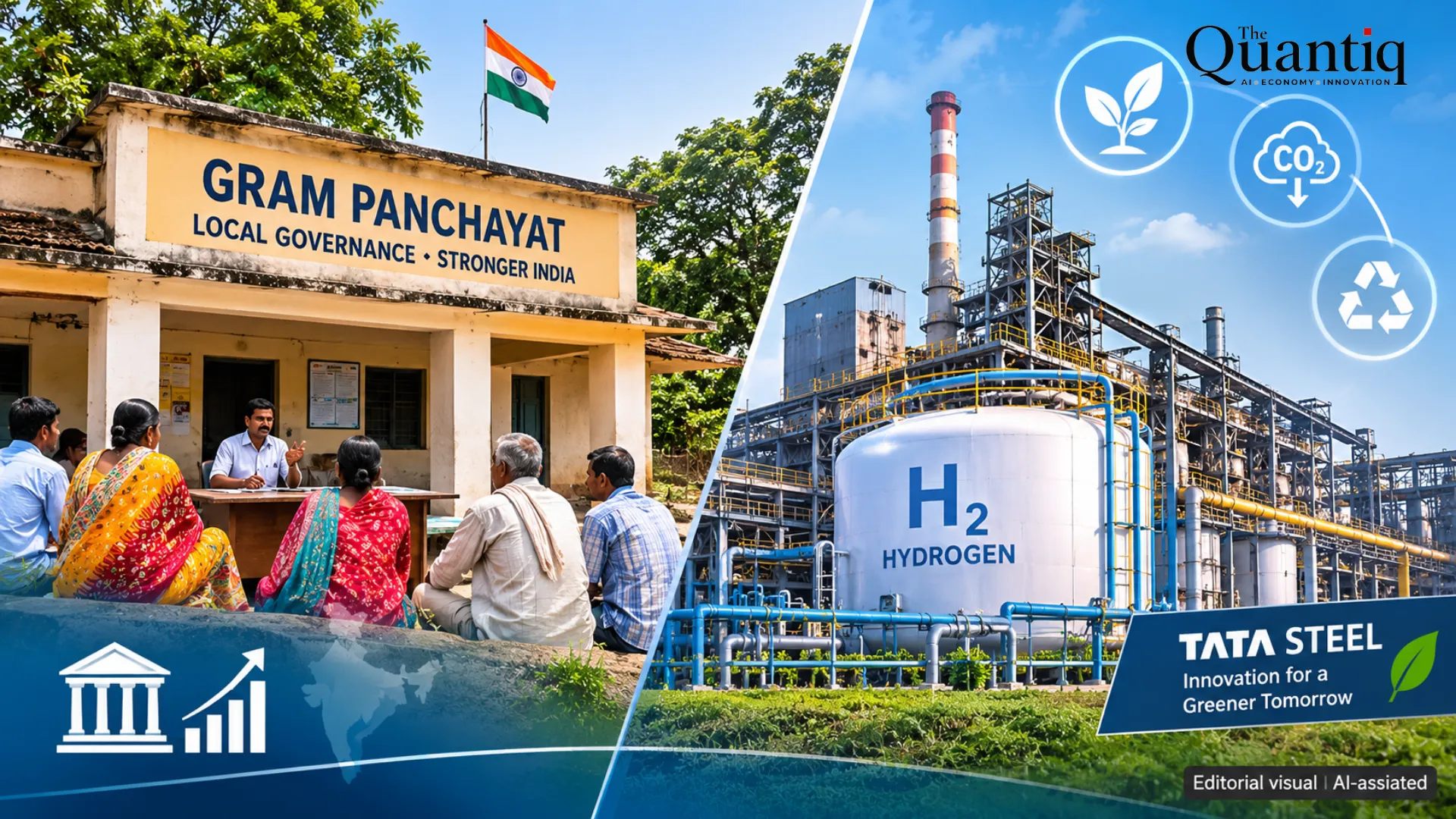
India’s development story has two important signals this week. A new Reserve Bank of India (RBI) report highlights the financial dependence of Gram Panchayats on government transfers. Meanwhile, Tata Steel is exploring a new way to produce hydrogen at its Kalinganagar plant in Odisha, using energy recovered from gases generated during steelmaking.
The developments concern different sectors, but both raise important questions about India’s capacity to strengthen local institutions and make existing industrial processes more efficient.
1. Gram Panchayats Depend on Government Transfers for 90% of Their Revenue: RBI Report
India’s Gram Panchayats continue to depend heavily on funds received from central and state governments, with their own-source revenue accounting for only about 10% of total receipts, according to a new report released by the Reserve Bank of India on 19 November.
The second edition of the RBI’s biennial report, Finances of Panchayati Raj Institutions, examines the financial position of a balanced panel of 2.25 lakh Gram Panchayats over the period 2022–23 to 2024–25.
The findings show that intergovernmental transfers account for around 90% of their total receipts. Own-source revenue contributes the remaining 10%, with non-tax receipts such as interest earnings, programme funds and user charges making up a significant part of this limited contribution.
The report also highlights where local governments spend their money. Water supply and sanitation account for the largest share of Gram Panchayat expenditure, at about 40%.
There has been progress in rural connectivity, electrification, water supply, sanitation and the creation of community assets. However, the RBI notes that significant differences remain between states in access to services, their quality and their functionality.
Another challenge is emerging as some large Gram Panchayats transition into Town Panchayats or other small urban local bodies. Their responsibilities can expand faster than their financial resources and administrative capacity. The RBI therefore emphasises the need for transitional fiscal support, stronger administrative systems and improved local revenue collection.
The findings underline a basic challenge for rural governance: local institutions need not only funds but also the financial and administrative capacity to manage their expanding responsibilities.
2. Tata Steel Explores Hydrogen Production Using Steel Plant Off-Gases at Kalinganagar
Tata Steel is exploring a new hydrogen-production route at its Kalinganagar integrated steel plant in Odisha, in partnership with Houston-based Utility Global.
The proposed facility is designed to produce 10 tonnes of high-purity hydrogen per day using Utility Global’s proprietary H2Gen technology. The companies will first undertake joint Front-End Engineering and Design (FEED) studies to assess the project and support a final investment decision by Tata Steel’s board.
The technology uses residual energy contained in carbon-monoxide-rich gases generated during steelmaking. This energy is used to produce hydrogen from water. In other words, the industrial gases provide the energy for the process; they are not simply converted directly into hydrogen.
The hydrogen produced is intended for use in the steelmaking process, including potential injection into a blast furnace. If implemented successfully, the project could help reduce the carbon intensity of ironmaking while making use of infrastructure already present at the plant.
Utility Global says its technology has previously been demonstrated using actual blast furnace gas at a steel producer’s facility in Canada. The proposed Kalinganagar project would take the technology into a new industrial setting and scale of application in India.
However, the project is not yet under construction. Its implementation will depend on the outcome of the engineering studies and a subsequent investment decision.
For an industry that is difficult to decarbonise, the ability to recover useful energy from existing production processes could open up another pathway towards lower-emission steelmaking.
The Quantiq Perspective
These two developments point to different but equally important aspects of India’s development challenge.
At the grassroots level, decentralisation can deliver meaningful results only when local institutions have the financial resources and administrative capacity to carry out their responsibilities. The RBI findings suggest that strengthening rural governance must go beyond transferring funds and functions. Local revenue mobilisation, better financial management and institutional capacity also matter.
At the industrial level, the Tata Steel initiative illustrates how innovation can come from rethinking existing processes, not just introducing entirely new infrastructure. Recovering energy from industrial gases to produce hydrogen is an approach worth watching, although its commercial and environmental benefits will ultimately depend on performance at scale.
India’s next phase of development will require both: stronger institutions closer to communities and smarter technologies that help industries use resources more efficiently.
The Quantiq tracks developments that matter, looking beyond the announcement to understand the larger economic, technological and institutional signals.