
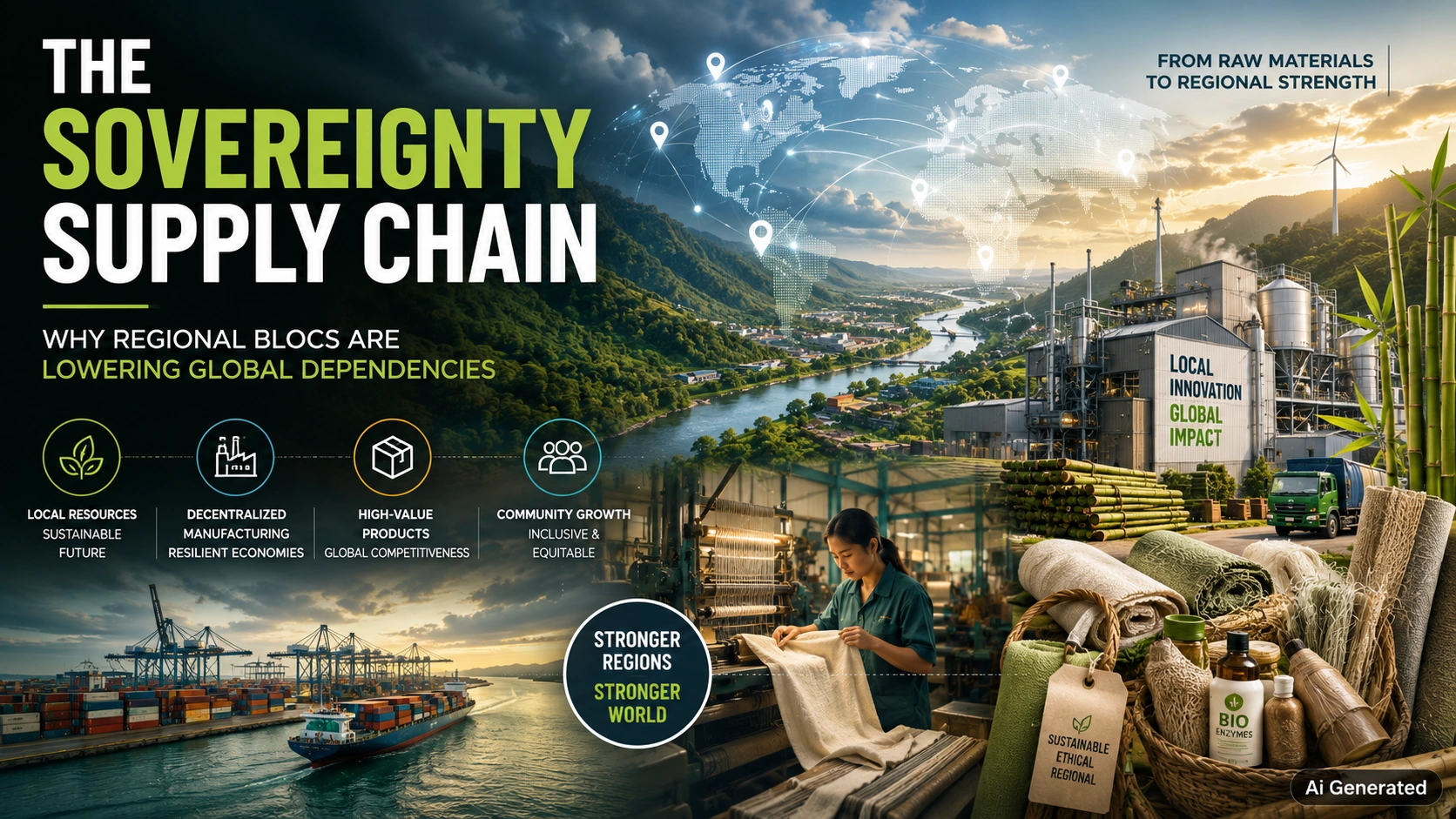
The Sovereignty Supply Chain: Why Regional Blocs Are Rewriting the Rules of Global Trade
The world is quietly walking away from the economic assumptions that shaped the post-Cold War era. For decades, globalization was projected as an unstoppable force — a system where goods, capital, and manufacturing would flow seamlessly across borders in pursuit of maximum efficiency and lower costs. Nations opened their markets, industries stretched their supply chains across continents, and emerging economies were encouraged to integrate themselves into a highly interconnected global trade architecture.
That architecture is now under visible strain.
According to the latest report released by the World Economic Forum, geoeconomic confrontation has emerged as one of the defining short-term risks confronting the global economy. Trade fragmentation, industrial policy conflicts, sanctions, tariff wars, and the weaponization of supply chains are no longer isolated developments. They are becoming structural realities shaping the next phase of global commerce.
The shift is not merely economic. It is geopolitical, technological, environmental, and deeply strategic.
Across the world, nations are beginning to realize that excessive dependency on distant manufacturing hubs may have delivered efficiency, but it also created dangerous vulnerabilities. The pandemic exposed the fragility of hyper-globalized logistics. Wars and geopolitical tensions revealed how quickly supply chains could be disrupted. Energy shocks demonstrated how dependence can turn into leverage. Maritime bottlenecks showed that a single disruption in one part of the world can trigger inflation, shortages, and industrial paralysis elsewhere.
In this emerging environment, a new doctrine is taking shape — one that may define the coming decade of economic restructuring. It is the rise of what may be called the Sovereignty Supply Chain.
The End of the Raw Material Era
For much of the developing world, economic participation in globalization followed a predictable script. Resource-rich regions exported raw materials while industrialized economies captured the high-value layers of processing, branding, technology, and manufacturing. Timber, minerals, agricultural commodities, biomass, and natural fibers flowed outward. Finished consumer goods flowed back in.
The arrangement generated growth statistics, but it rarely generated true economic sovereignty.
Regions supplying the raw materials remained vulnerable to commodity price volatility, external market shocks, and shifting geopolitical priorities. They carried the ecological burden of extraction while capturing only a fraction of the final value generated from their own resources.
In today’s fractured economic climate, that dependency is becoming increasingly risky.
An emerging economy that relies exclusively on exporting raw commodities now stands exposed to multiple layers of uncertainty. A shipping disruption can delay exports for months. A sudden tariff change can wipe out competitiveness overnight. Strategic sanctions can alter trade routes within weeks. Rising freight costs can destroy already-thin margins. Even climate-linked disruptions are beginning to interfere with predictable global supply patterns.
The old model is no longer merely unequal. It is unstable.
The Rise of the Sovereignty Supply Chain
As global powers accelerate policies around “friend-shoring,” “near-shoring,” and strategic industrial protectionism, regional economies are being forced to rethink their role within global trade.
The emerging objective is no longer blind integration into global supply chains at any cost. The objective is resilience.
This is where the Sovereignty Supply Chain begins to matter.
At its core, the concept represents a transition away from excessive dependence on centralized global manufacturing systems toward decentralized regional production ecosystems capable of retaining value closer to the source. It is not about economic isolationism or abandoning international trade. Rather, it is about reducing structural vulnerability while increasing local value creation.
The future increasingly belongs to regions capable of producing more than raw materials. The competitive advantage of tomorrow may lie in who can intelligently process, refine, optimize, and manufacture high-value products within localized ecosystems.
This marks a profound philosophical shift in global economics.
For decades, efficiency was considered the highest virtue of globalization. Now resilience is becoming equally important.
A Different Industrial Future
The next industrial era may not resemble the giant factory corridors and carbon-heavy manufacturing belts that defined the twentieth century.
Instead, the world appears to be moving toward smaller, distributed, technology-enabled production systems integrated with sustainability principles and regional resource ecosystems.
Localized manufacturing no longer necessarily means primitive or low-tech production. Advances in mechanical processing, AI-driven optimization, modular industrial systems, and decentralized energy infrastructure are allowing smaller regional ecosystems to perform increasingly sophisticated forms of value addition.
This changes the economics entirely.
Rather than transporting massive quantities of raw biomass, minerals, or agricultural outputs across oceans for processing elsewhere, regions can now process materials closer to the source into compact, high-value finished or semi-finished products.
The reduction in logistics dependency alone creates strategic advantages. But the larger transformation lies in value retention.
When processing happens locally, the profits, employment generation, technological learning, and industrial capability remain embedded within the regional economy rather than flowing outward.
Bamboo, Biomass and the New Value Geography
The global transition toward sustainable materials offers one of the clearest illustrations of this structural shift.
Across the world, industries are searching for alternatives to petroleum-based plastics, synthetic fibers, and environmentally destructive industrial inputs. The bioeconomy is rapidly emerging as a major economic frontier, and regions rich in renewable bioresources are beginning to attract strategic attention.
Traditionally, however, many developing economies participated in this market by exporting raw bamboo, agricultural residue, natural fibers, or unprocessed biomass to distant industrial centers where the real value addition occurred.
The Sovereignty Supply Chain changes this logic completely.
Imagine a bamboo-growing region that once exported raw bamboo poles in bulk. Under the emerging decentralized manufacturing model, localized mechanical processing units can extract fibers near cultivation zones themselves. Those fibers can then be converted into bamboo linen, engineered biomaterials, insulation products, textile blends, sustainable packaging inputs, or industrial bio-composites.
Instead of exporting weight, the region exports intelligence, design, and high-value functionality.
The implications are enormous.
Transport vulnerability decreases. Carbon footprints decline. Profit margins increase. Local employment deepens. Technological ecosystems begin to form around the resource base itself.
Most importantly, the region ceases to be merely a supplier of raw material and begins evolving into a manufacturing participant within the global value chain.
Compassionate Capitalism in an Age of Fragmentation
The current global transition is not only economic. It is also forcing societies to confront uncomfortable questions about who actually benefits from globalization.
Highly centralized supply chains were designed around maximum efficiency and minimum cost. But they often left local communities economically fragile. When global shocks occurred, workers and small producers at the edges of the system frequently bore the greatest burden.
A decentralized regional manufacturing ecosystem offers a different developmental philosophy.
Instead of concentrating industrial power into a handful of mega-cities or giant industrial clusters, distributed processing systems can spread economic participation across rural and semi-urban regions where resources actually originate.
This creates a more democratic distribution of value creation.
A localized processing ecosystem built around sustainable bioresources can generate employment closer to communities, encourage local entrepreneurship, strengthen small and medium enterprises, and reduce the extractive imbalance between resource-rich regions and industrial centers.
Environmental sustainability also becomes easier to align with economic growth when industrial systems remain closely connected to the ecosystems that sustain them.
Smaller, decentralized operations naturally encourage circular economy models where regional bioresources are utilized with greater accountability and less ecological displacement.
In many ways, this may become one of the defining characteristics of what future historians could describe as compassionate capitalism — an economic structure where resilience, sustainability, and community participation become strategic strengths rather than ideological afterthoughts.
The Strategic Imperative for Emerging Regions
For emerging economies and underrepresented regions, the current moment represents both a warning and an opportunity.
The warning is clear: remaining trapped within low-value extraction models will become increasingly dangerous in a fragmented world economy.
But the opportunity may be even larger.
Regions rich in renewable resources, indigenous knowledge systems, sustainable materials, and localized production potential now possess the ability to reposition themselves within the global economic order.
This requires a strategic shift in thinking.
The first step involves identifying and protecting regional bioresources and economic assets with long-term strategic value. The second involves building decentralized processing capabilities closer to source ecosystems rather than relying entirely on distant industrial hubs. The third involves moving steadily toward high-value finished products capable of competing within global premium markets.
The regions that succeed in this transition may not necessarily become the largest industrial economies in the world. But they could become some of the most resilient.
Northeast India and the Emerging Regional Possibility
For Northeast India, the implications of this transition are particularly significant.
The region possesses extraordinary strengths in bamboo ecosystems, agroforestry potential, handloom traditions, bioresources, indigenous craftsmanship, sustainable materials, and proximity to Southeast Asian economic corridors. Yet much of this value still remains under-processed, underrepresented, and structurally disconnected from the global digital economy.
The changing architecture of global trade creates a rare opening.
If the twentieth century rewarded centralized industrial concentration, the twenty-first century may increasingly reward intelligent regional specialization.
A future where Northeast India becomes a decentralized hub for sustainable biomaterials, eco-textiles, circular manufacturing systems, traceable supply chains, and bioeconomy-linked innovation is no longer unrealistic. It is strategically aligned with the direction in which global economics itself is moving.
This is where emerging media-tech intelligence ecosystems and regional discovery infrastructures may eventually become critical. Platforms capable of integrating visibility, traceability, storytelling, enterprise intelligence, and regional discovery could help bridge the long-standing gap between regional potential and global market perception.https://thequantiq.com/india-netherlands-strategic-partnership-semiconductors-trade/
The New Rules of Economic Power
The world is entering an era where supply chains are no longer viewed merely as logistical systems. They are becoming instruments of strategic influence, national resilience, and economic survival.
The age of exporting raw wealth while importing finished prosperity is beginning to lose relevance.
The future may belong to regions capable of building localized value ecosystems that combine sustainability, technology, decentralized production, and strategic resilience into one integrated economic framework.
In this new global order, sovereignty will not be defined only by political borders or military strength.
Increasingly, it may be defined by who controls the supply chain closest to the source of value itself.https://thequantiq.com/india-export-growth-2026-manufacturing-economy/




One Comment