
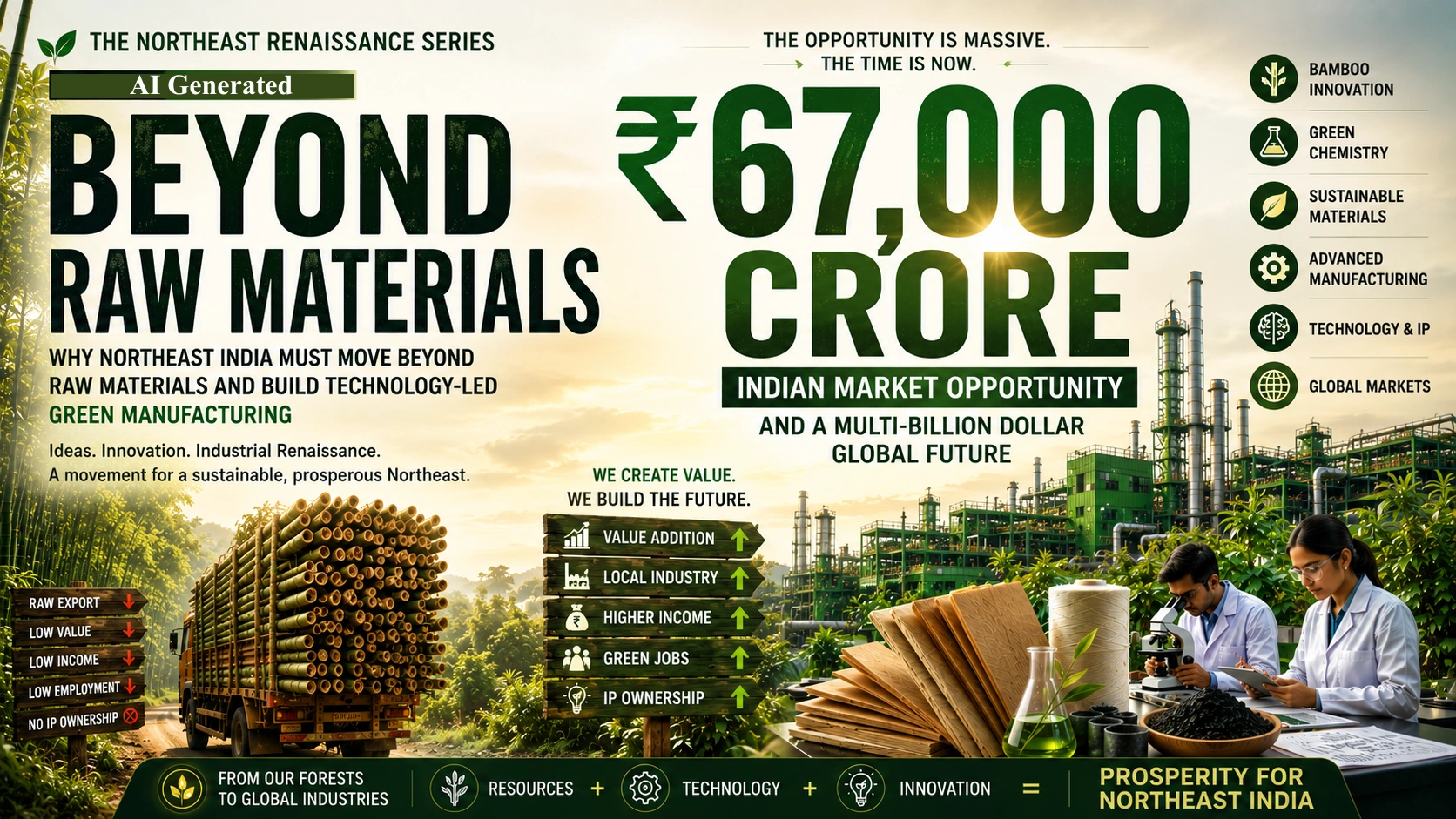
Why Northeast India Must Move Beyond Raw Materials and Build Technology-Led Green Manufacturing
The Northeast Renaissance Series
Ideas for a ₹67,000 Crore Indian Market and a Multi-Billion Dollar Global Future
For decades, Northeast India has lived with a paradox.
The region is among India’s richest ecological landscapes, blessed with bamboo forests, medicinal plants, aromatic resources, spices, silk traditions, horticultural wealth, biodiversity, and cultural knowledge systems that much of the world would envy. Yet despite this abundance, the Northeast has often remained trapped at the lowest rung of the value chain.
It supplies. Others manufacture. It grows. Others brand. It exports raw materials. Others capture the profits. This economic pattern is neither accidental nor sustainable.
Across generations, valuable resources have moved out of the region in minimally processed form while high-value manufacturing, technology ownership, premium branding, and industrial wealth accumulated elsewhere. Bamboo leaves the region as poles while engineered products are imported back at premium prices. Medicinal plants travel outward as raw biomass while sophisticated extracts and formulations return as expensive wellness products. Agricultural produce frequently exits without deep processing, allowing distant industrial ecosystems to absorb the real economic value.
Perhaps nowhere is this contradiction more visible than in the bamboo economy.
Every night, long convoys of trucks loaded with raw bamboo leave the Northeast and head toward paper mills located far beyond the region. The sight has become almost routine—hundreds of trucks moving silently through highways carrying one of the region’s most strategic biological resources. Yet these trucks carry more than bamboo. They carry an uncomfortable reminder of an unfinished economic story.
Public concern and field-level observations, over the years, have repeatedly pointed toward a troubling imbalance in the value chain. Farmers and primary bamboo growers often remain poorly compensated despite the hard labour and ecological stewardship required to maintain bamboo resources. At the same time, intermediaries and supply-chain traders frequently capture a disproportionate share of the final commercial value before the material reaches distant industrial centres. One cannot help but ask a difficult question.https://thequantiq.com/north-east-india-medicinal-plants-bio-economy/
Does this outward flow of raw bamboo generate substantial and transformative industrial wealth or meaningful tax revenue for the region that nurtures the resource?
The answer deserves serious public debate.
When raw bamboo leaves the Northeast in truckloads and value addition happens elsewhere, the region effectively exports employment, technology, manufacturing opportunity, and industrial learning alongside the biomass itself. This model may sustain trade, but it rarely creates enduring prosperity.
The environmental question is equally important.
Reports and concerns surrounding indiscriminate or poorly regulated harvesting cannot be ignored. If extraction intensifies without scientific plantation management, long-term ecological stress and landscape degradation may become real risks. Forest and bamboo wealth should not become victims of short-term commercial logic.
The solution is not opposition to industry. The solution is relocation of value. If bamboo is indispensable to the paper economy, then increasingly the paper economy must come closer to the bamboo.
Let paper mills and allied industries establish modern manufacturing facilities within the Northeast itself. Let industrial investment create local employment, strengthen the tax base, support managed bamboo plantations, encourage scientific harvesting, and ensure that wealth generated from bamboo circulates first through the landscapes and communities from which it originates.
Because a region cannot build lasting prosperity by endlessly watching its raw materials leave and finished wealth return.
The time has come to change the geography of value. And this larger question extends far beyond paper mills alone. Can a region truly prosper if it remains primarily a supplier of raw materials? The answer increasingly appears to be no.
Around the world, the most successful regional economies have not depended merely on resource ownership. They built prosperity by mastering the technologies that transform resources into high-value products. Their advantage emerged not from forests or minerals alone but from process engineering, design capability, manufacturing sophistication, and intellectual property.
This is the lesson Northeast India can no longer afford to ignore.
The coming decades will not be won by those who merely possess resources. They will belong to those who control value addition, premiumisation, and technology.
And this is where a remarkable new opportunity is emerging.
The global economy is entering what many economists describe as the green industrial transition. Consumers, corporations, governments, and investors are moving toward materials and products that are cleaner, renewable, climate-conscious, and environmentally responsible. Sustainable textiles, bioplastics, ecological construction materials, green chemicals, plant-based ingredients, carbon products, regenerative agriculture, and nature-derived manufacturing systems are rapidly moving from niche markets to serious industrial sectors.
The combined value of these emerging opportunities runs into tens of thousands of crores.
This is the context behind The Quantiq’s ₹67,000 Crore Opportunity Series.
The figure is not merely a headline designed to provoke curiosity. It represents a larger economic signal. Across sectors ranging from bamboo engineering and bio-materials to green chemistry and sustainable manufacturing, massive value pools are opening. Yet these markets will not automatically enrich Northeast India.
That depends on how the region responds.
And here lies a crucial distinction.
Far too often, industrial conversations in India are reduced to a simplistic formula: identify a product, import machinery from overseas, replicate a process, and begin production. This approach may create short-term activity, but rarely creates durable competitive advantage.
Machines alone do not build industrial power. Technology does. More specifically, process technology. This distinction matters enormously.
We are entering an age where AI is compressing innovation cycles at unprecedented speed. Manufacturing processes, materials engineering, supply chains and even product categories can be disrupted rapidly. In such an environment, businesses built solely around imported machinery or copied production systems become increasingly vulnerable. If the only moat is the machine, someone else can buy the same machine tomorrow. The real strategic advantage increasingly lies in proprietary thinking, process intelligence, formulation capability, systems integration and continuous innovation. This is why Northeast India must avoid becoming merely an assembly geography dependent on external technological imagination. The region must build innovation sovereignty.
Two factories may produce similar products using similar raw materials. Yet the enterprise possessing proprietary process knowledge, better chemistry, optimized systems, stronger material performance, and greater design intelligence almost always captures higher value.
The machine is visible. The real moat is invisible. It lives inside process design.
This is why Northeast India must resist the temptation of becoming merely an assembly or replication economy.
Importing machines from China, Taiwan, or elsewhere may occasionally serve as a useful benchmark or starting point. There is nothing inherently wrong with learning from established technologies. But industrial ambition should not end there.
The deeper question should always be:
How can we redesign, improve, localize, and ultimately own the process? Because the future of manufacturing is changing.
What once demanded enormous industrial laboratories and decades of experimentation is becoming increasingly accessible through computational design, materials science, simulation tools, AI-assisted engineering, and collaborative innovation ecosystems.
Designing process technology is no longer an impossible frontier accessible only to industrial giants.
It is increasingly becoming an intelligence challenge.
And intelligence today is more democratized than ever before.
Artificial intelligence does not replace engineers, chemists, or entrepreneurs. But it dramatically expands their capability. Process simulation, formulation refinement, thermal optimization, materials analysis, prototype iteration, technical documentation, and design ideation can now move faster and more efficiently than ever before.
This changes the innovation equation. A startup in Northeast India no longer needs to think only as a buyer of technology. It can increasingly be thought of as a creator of technology. This is precisely where the region’s future may lie.
Consider bamboo.
For decades, bamboo conversations remained trapped inside handicrafts and low-value construction narratives. Yet globally, bamboo now participates in advanced structural materials, engineered lumber, textile systems, biochar, green chemistry, luxury surfaces, and biomaterial innovation.
The opportunity is no longer simply to harvest bamboo.
The opportunity is to industrialize bamboo intelligently.
The same logic applies to medicinal plants, spices, aromatics, agro-residues, natural pigments, ecological inputs, and renewable materials.
The question is no longer:
“What can we grow?” The more important question is:
“What technologies can we build around what we grow?”
This shift—from extraction to innovation—may become one of the defining economic transitions of Northeast India.
Because regions that fail to move upward in the value chain eventually face structural vulnerability. Raw-material economies often suffer from price volatility, weak bargaining power, limited employment quality, and dependency on external industrial centers.
Technology-led manufacturing changes that relationship. It creates: higher margins, stronger enterprise valuation, skilled employment, export capability, and intellectual-property ecosystems.
Most importantly, it creates dignity.
There is something profoundly transformative about a region becoming known not merely for what it possesses—but for what it invents.
And perhaps this is the real significance of the ₹67,000 crore conversation. It is not merely about money. It is about mindset.
The Northeast stands at a moment where it can continue supplying the world with raw materials—or begin supplying the world with ideas, processes, premium products, and industrial intelligence.
The forests are already here. The biodiversity is already here. The cultural knowledge is already here.
What remains to be built is the confidence to manufacture at global standards and think beyond extraction. The future may not belong to the biggest factory.
It may belong to the region that learns how to turn nature into technology and technology into premium value. That journey, perhaps, begins now.
The Quantiq Take: Northeast India should not remain a resource frontier feeding distant industrial economies. The real opportunity lies in building a new generation of technology-led green enterprises where process innovation, premiumisation, and intellectual property become the region’s defining economic identity.https://thequantiq.com/assam-economy-ai-age-entrepreneurship-sustainability/


5 Comments