
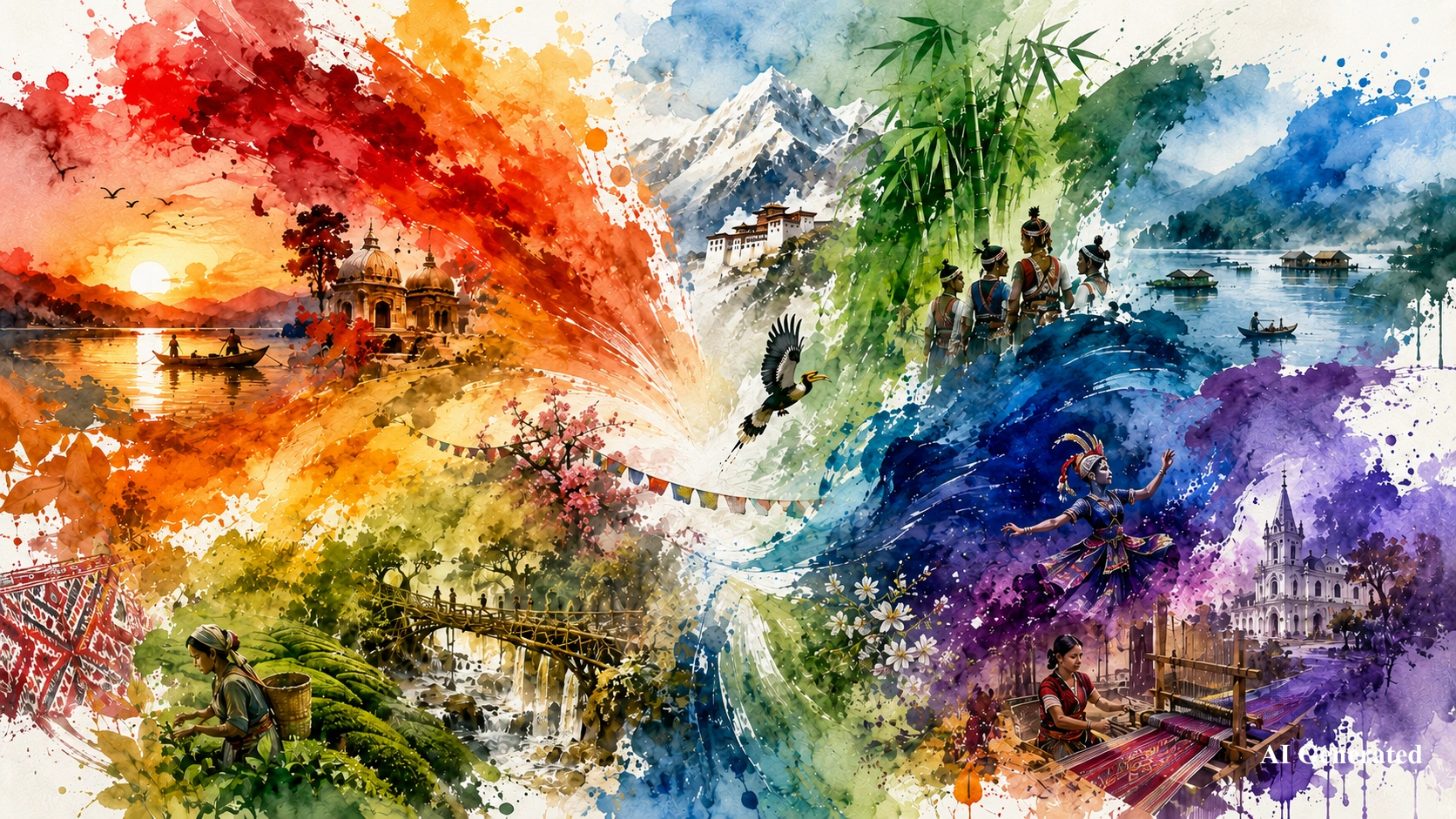
India’s Living Mosaic
Why Conrad Sangma’s Vision for a Unified Northeast Tourism Brand Deserves National Attention
Some ideas arrive before their time.
Others wait patiently for history, infrastructure, institutions and leadership to align before they can finally take shape.
When Meghalaya Chief Minister Conrad Sangma recently announced that he would present a roadmap before the upcoming North Eastern Council (NEC) plenary meeting to position Northeast India as a single tourism destination, he touched upon an idea whose time may finally have come.
The idea sounds simple, but its implications are far-reaching.
The eight Northeastern states can achieve far greater visibility, stronger visitor flows and greater economic impact if they present themselves not merely as individual destinations, but as parts of a larger and more compelling regional experience.
As the head of the high-level task force on tourism for the Northeast, Sangma has argued that collective branding and regional cooperation are essential to unlocking the full potential of the sector. More importantly, he has emphasized the need to market the Northeast not only as eight separate states but as a unified tourism ecosystem.
That distinction matters.
Travellers do not always think in terms of administrative boundaries.
A visitor planning a journey through the Northeast is not necessarily choosing between Assam, Meghalaya, Nagaland or Arunachal Pradesh. Instead, they are often seeking a broader experience encompassing mountains, forests, rivers, wildlife, indigenous cultures, cuisines, festivals, textiles and adventure.
The challenge, therefore, is not merely to promote individual states. It is to tell a larger story.
For some of us, Sangma’s remarks brought back memories of a similar conversation nearly two decades ago.
In 2008, I had the privilege of being part of a strategic communications team that participated in a national competition floated by the Ministry of Development of North Eastern Region (DoNER). The assignment was ambitious: create a comprehensive branding roadmap for Northeast India.
The competition attracted 46 agencies from across the country, including many of the most respected names in advertising and strategic communication. Following a rigorous multi-stage evaluation process and detailed presentations before a nine-member panel, our roadmap was adjudged the best among all submissions.
At the heart of our proposal was a simple belief. Northeast India should not be marketed as eight disconnected destinations competing for attention.
It should be positioned as one extraordinary destination composed of many distinct worlds.
The proposal envisioned an integrated branding and communication programme with an estimated budget of approximately ₹100 crore—a significant amount in 2008, but one that reflected the scale of the opportunity before the region.
Unfortunately, the initiative was never implemented due to technical and administrative reasons.
Yet the central idea never lost its relevance.
In fact, looking back today, it appears more compelling than ever.
The irony is that the Northeast of 2008 was far less prepared for such a vision than the Northeast of today. Connectivity was weaker. Air links were fewer. Tourism infrastructure was less developed. Social media had not yet transformed destination marketing. Digital storytelling was still in its infancy.
Yet even then, one reality was impossible to ignore. The Northeast possessed one of the most powerful tourism propositions anywhere in Asia.
The challenge was never a shortage of attractions. The challenge was the absence of a unifying narrative.
Consider the region’s extraordinary diversity.
Assam offers world-renowned tea gardens, riverine landscapes shaped by the Brahmaputra, wildlife sanctuaries and a rich cultural legacy.
Meghalaya enchants visitors with dramatic waterfalls, living root bridges and some of the most fascinating cave systems in the world.
Arunachal Pradesh remains one of India’s last great wilderness frontiers, combining Himalayan grandeur with ancient Buddhist traditions.
Nagaland provides a remarkable window into indigenous cultures and community traditions that continue to thrive in the modern world.
Mizoram’s rolling hills, social cohesion and community-driven ethos create a tourism experience unlike any other.
Manipur combines sporting heritage, classical arts and the ecological wonder of Loktak Lake.
Tripura offers royal heritage, archaeological treasures and deep historical roots.
Sikkim has emerged as one of the world’s most compelling examples of sustainable mountain tourism.
Any one of these destinations could stand on its own.
Together, they represent something far greater.
Yet landscapes alone do not define the Northeast.
One of the region’s most overlooked strengths lies in its extraordinary textile traditions.
Across the eight states survives one of the richest living handloom cultures on the planet. The celebrated silks of Assam, the intricate tribal motifs of Nagaland, the exquisite weaves of Manipur, the vibrant textiles of Mizoram, Meghalaya, Tripura, Arunachal Pradesh and Sikkim collectively form a cultural treasure of global significance.https://thequantiq.com/the-72-hour-rule-northeast-india-tourism/
These are not merely products.
They are repositories of memory, identity, craftsmanship and indigenous knowledge passed down through generations.
As travellers increasingly seek authentic experiences rather than passive sightseeing, textile tourism has the potential to emerge as one of the Northeast’s most distinctive tourism offerings.
The same is true of bamboo craftsmanship, indigenous cuisine, village experiences, music traditions and community-led enterprises.
The future of tourism in the Northeast cannot be built solely around scenic beauty.
It must also celebrate the people who have shaped these landscapes and the cultures that continue to flourish within them.
That is why the idea of a unified regional brand deserves serious attention.
The objective should never be to dilute the identities of individual states.
The Northeast’s diversity is its greatest competitive advantage.
Instead, the goal should be to create an umbrella identity that amplifies the uniqueness of each state while presenting a coherent and compelling proposition to the world.
The most successful destination brands achieve exactly that.
Europe is not one culture.
It is a mosaic of cultures.
Yet it is marketed as a unified travel aspiration.
The Northeast can adopt a similar approach.
Its diversity should not be viewed as a branding challenge.
Its diversity should become the brand itself.
If there is one phrase that captures this opportunity, it is this:
India’s Living Mosaic.
A mosaic derives its beauty not from uniformity but from the uniqueness of each piece. Few descriptions fit Northeast India more perfectly.
Nowhere else in India can one encounter such an extraordinary concentration of biodiversity, indigenous cultures, languages, textiles, crafts, cuisines, festivals and landscapes within a single geographical region.
What makes the Northeast truly special is not any one attraction. It is the coexistence of living cultures within living landscapes. That combination is becoming increasingly rare across the world.
And rarity is the foundation of powerful destination brands. Equally important is the fact that the conditions today are vastly different from those of 2008.
The Ministry of Development of North Eastern Region, working alongside state governments, NEC and various regional institutions, has pursued an increasingly proactive and ambitious approach towards infrastructure development, connectivity enhancement, investment promotion and destination creation. https://thequantiq.com/northeast-india-airport-growth-economic-impact/
The results are visible across the region. Airports have expanded. Road networks have improved. Digital connectivity has strengthened. Tourism infrastructure is steadily evolving.
Most importantly, there is now a growing national recognition that the Northeast is not a peripheral geography but a strategic growth frontier for India.
This broader developmental momentum makes Sangma’s proposal particularly timely.
In many ways, it reflects a growing maturity in how the region views its future.
The Northeast’s states are increasingly recognizing that collaboration can generate value that competition alone cannot.
Whether in tourism, trade, investment promotion, cultural diplomacy or regional connectivity, a stronger collective identity can amplify the strengths of every individual state.
That is why the forthcoming discussions at the NEC deserve close attention.
If translated into action, they could mark the beginning of a new chapter in the Northeast’s journey—from a collection of destinations to a destination ecosystem.
The Northeast is no longer waiting to be discovered.
It is building the infrastructure, confidence and institutional partnerships required to shape its own narrative.
Supported by an increasingly assertive developmental agenda, strengthened regional cooperation and visionary leadership from across the eight states, the foundations for a unified destination brand are stronger today than at any point in recent memory.
An idea that seemed ambitious in 2008 may well become inevitable in 2026.
If that happens, Northeast India will gain more than a stronger tourism brand. It will gain a shared story. A story that celebrates diversity without fragmenting identity. A story that connects nature, culture, textiles, crafts, entrepreneurship, and community. A story that invites the world not merely to visit the Northeast, but to experience it.
A story worthy of India’s Living Mosaic. A story that connects nature, culture, textiles, crafts, entrepreneurship and community.
A story that invites the world not merely to visit the Northeast, but to experience it.
A story worthy of India’s Living Mosaic.


4 Comments