The AI Workforce Has Arrived: Why ChatGPT Work Could Redefine India’s IT Industry and the Future of Enterprise
AI Has Learned to Answer Questions. Now It Is Learning to Do the Work.
Every major technological revolution has quietly rewritten the definition of work.
The steam engine multiplied human strength, allowing factories to produce goods on an unprecedented scale. Electricity transformed industries by making production faster, cleaner and more reliable. Computers reduced hours of manual calculations to seconds, while the internet connected businesses, markets and consumers across continents.
Generative artificial intelligence brought yet another shift. Instead of merely processing information, it learned to write, analyse, code, design and converse. Over the past three years, millions of professionals have embraced AI assistants to draft emails, summarise reports, generate software code and brainstorm ideas. These tools made people more productive, but they still relied on one fundamental principle: a human gave the instruction, and the AI responded.
That relationship is now beginning to change.
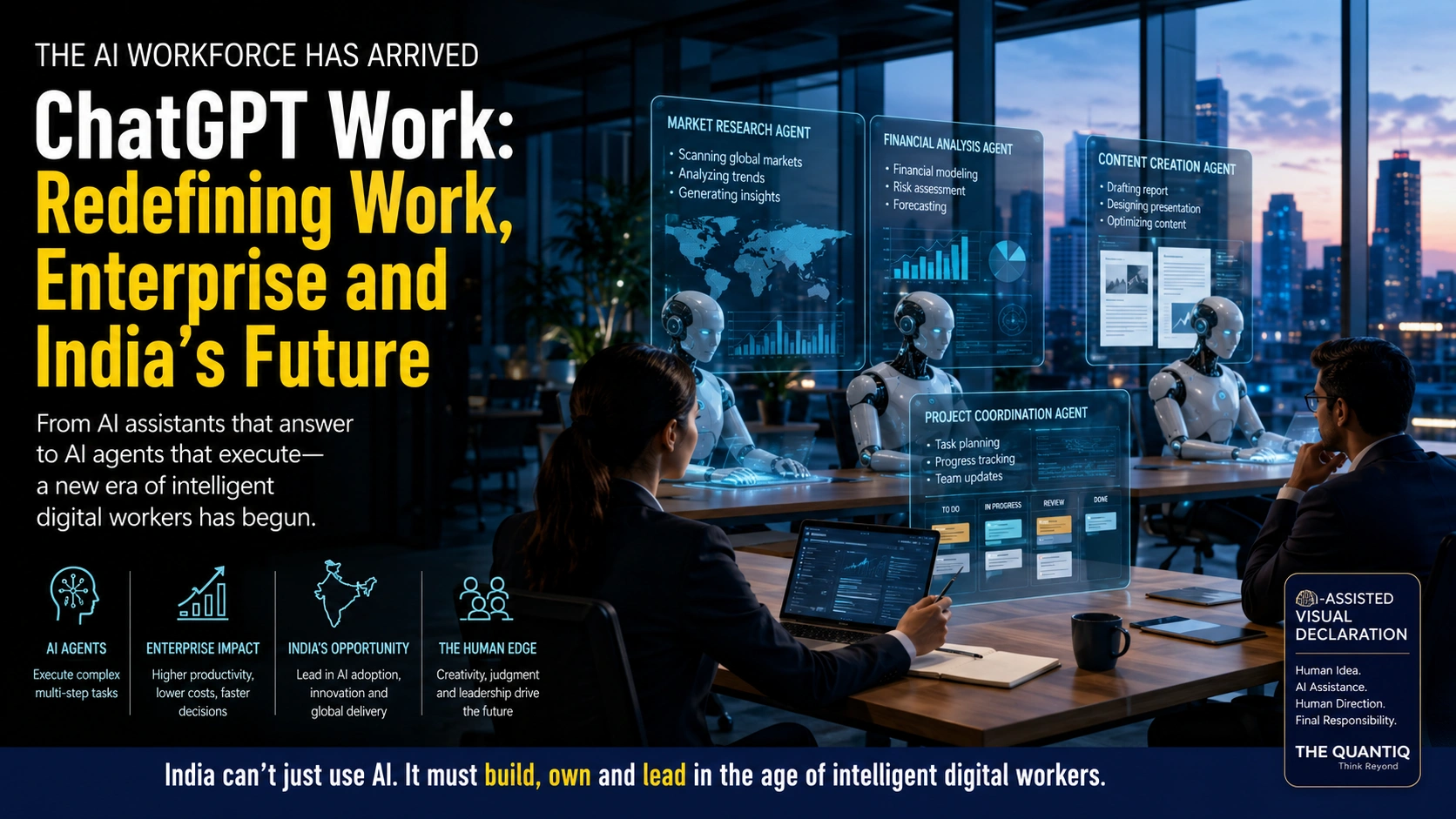
With the introduction of ChatGPT Work, OpenAI has taken a significant step towards a new category of enterprise software—AI agents capable of carrying out complex, multi-step assignments rather than simply responding to individual prompts. Instead of asking an AI to write a presentation or analyse a spreadsheet, users can assign an entire objective, allowing the system to plan, execute and refine the work while seeking human approval whenever necessary.
It may sound like a modest technological upgrade. In reality, it signals the beginning of something much larger.
The conversation is no longer about artificial intelligence helping people work faster. It is about artificial intelligence becoming part of the workforce itself.
For India, home to one of the world’s largest technology talent pools and a globally respected IT services industry, this development deserves far more attention than a routine product announcement. It could reshape how enterprises operate, how startups compete and how knowledge work is organised over the next decade.https://thequantiq.com/ai-mid-week-brief-ai-talent-war-dangerous-new-phase/
More Than Another ChatGPT Update
Every few months, a new AI model promises to be faster, smarter or more capable than its predecessor. Many announcements fade into the background because they improve performance without fundamentally changing how people work.
ChatGPT Work appears different.
Rather than functioning as a sophisticated chatbot waiting for continuous instructions, it is designed to behave more like a digital colleague. Users define an outcome, connect the AI to authorised business applications and documents, and allow it to complete a sequence of related tasks. The system can gather information, analyse data, prepare reports, build presentations, generate software prototypes and maintain context across an entire project before returning the results for human review.
This marks an important evolution in enterprise AI.
Instead of measuring intelligence by the quality of individual answers, businesses will increasingly judge AI by its ability to deliver complete outcomes.
That distinction may appear subtle, but it represents one of the biggest changes in enterprise software since the emergence of cloud computing.
OpenAI’s ambition reflects a broader trend unfolding across the technology industry. Companies including Microsoft, Google, Anthropic, and Salesforce are investing heavily in AI agents capable of planning and executing workflows rather than merely generating content. The race is no longer about building the smartest chatbot. It is about building the most capable digital worker.
From AI Assistant to AI Workforce
The evolution of artificial intelligence over the past few years can best be understood as a gradual expansion of responsibilities rather than a simple improvement in intelligence. Search engines helped people find information, chatbots answered questions, and generative AI learned to create text, images and software code. AI copilots then emerged to assist professionals with specialised tasks. Today, AI agents are taking the next step by learning to execute complete workflows instead of responding to isolated prompts.
That distinction is far more significant than it first appears. A marketing executive, for example, no longer needs to spend an entire day collecting market intelligence from multiple sources before preparing a presentation. An AI agent can gather information, analyse competitors, identify emerging trends, draft the presentation and even recommend strategic options. As a result, the executive’s role increasingly shifts from collecting information to exercising judgement, refining ideas and making strategic decisions. Similar changes are beginning to reshape software development, legal research, financial analysis, customer support, procurement, logistics and numerous other knowledge-intensive functions.
Technology leaders have been predicting this transition for some time. NVIDIA founder and Chief Executive Officer Jensen Huang has repeatedly argued that every company will eventually employ both human workers and AI employees, describing artificial intelligence as a digital workforce that augments rather than replaces human talent. Microsoft Chairman and CEO Satya Nadella has also suggested that the future of enterprise software lies in intelligent agents capable of orchestrating business processes instead of simply providing applications. With the launch of ChatGPT Work, those predictions are beginning to take tangible form.
The numbers reinforce the scale of this transformation. OpenAI says ChatGPT now serves more than 700 million weekly active users worldwide, making it one of the fastest-growing software platforms in history. The company has also reported that more than one in four working professionals in the United States already uses ChatGPT for work, with adoption significantly higher among knowledge workers. These figures indicate that artificial intelligence has moved well beyond the experimental stage and is steadily becoming part of everyday business operations.
The next phase of enterprise AI is therefore unlikely to be defined by people asking isolated questions or generating individual pieces of content. Instead, it will increasingly involve professionals supervising teams of specialised AI agents that collaborate across multiple business functions. The office of the future may still be filled with people, but it is also likely to include an expanding workforce of intelligent digital colleagues.
Why India’s IT Industry Should Pay Close Attention
Few countries are as deeply connected to the future of enterprise AI as India. Over the past four decades, the country has built one of the world’s most successful technology services industries by supplying highly skilled engineers, software developers, consultants and business process professionals to enterprises across the globe. Today, India’s technology sector generates an estimated US$280 billion in annual revenue, employs millions of professionals and remains one of the country’s most important engines of economic growth.
That success has been built largely on human expertise, supported by global delivery models and the ability to execute complex technology projects at scale. Agentic AI, however, introduces a new economic equation. If intelligent systems become capable of handling substantial portions of documentation, coding assistance, software testing, customer support, compliance analysis, financial reporting and research, the traditional model of charging clients primarily for human effort will inevitably begin to evolve.
This does not necessarily signal a decline for India’s technology industry. History shows that industries willing to reinvent themselves often emerge stronger than before. When cloud computing transformed enterprise software, Indian IT companies successfully adapted by moving beyond maintaining on-premise systems to managing cloud infrastructure, digital transformation programmes and cybersecurity services. Artificial intelligence presents a similar opportunity, although the scale of change is likely to be much greater.
Instead of simply exporting technical talent, Indian companies now have the opportunity to become global leaders in designing AI-powered business processes, developing industry-specific AI solutions, integrating autonomous agents into enterprise operations and helping organisations govern increasingly complex digital workforces. In this new environment, clients are likely to value strategic partners capable of redesigning workflows and delivering measurable business outcomes rather than merely supplying technical manpower.
The Indian government has already acknowledged the strategic importance of this transition through the IndiaAI Mission, which is investing in computing infrastructure, datasets, AI innovation, startup ecosystems and advanced research. These initiatives recognise that long-term competitiveness will depend not only on adopting artificial intelligence but also on building the capabilities needed to develop, deploy and govern it responsibly.
The opportunity, however, will not remain open indefinitely. As AI agents become more capable, competitive advantage will increasingly belong to organisations that successfully combine human creativity, domain expertise and ethical judgement with the speed, consistency and scalability of intelligent digital workers. That is where the next chapter of India’s technology story is likely to be written, and it is also where the country’s IT industry has an opportunity to redefine its role in the global digital economy.https://thequantiq.com/un-warns-ai-risks-india-ai-semiconductor-push/
Can Startups Compete with AI? They May Finally Have the Scale They Never Had
One of the most remarkable aspects of agentic AI is that its biggest beneficiaries may not be multinational corporations. They could be small businesses and startups that have always struggled with limited resources.
For decades, entrepreneurs have faced a familiar dilemma. Building a company required not only a good idea but also the financial ability to hire specialists in marketing, finance, legal compliance, software development, customer support and business strategy. Many promising ventures failed not because their ideas lacked merit but because they simply could not afford the expertise needed to grow.
AI agents have the potential to change that equation.
Imagine a young entrepreneur in Guwahati developing an eco-friendly bamboo furniture brand. Instead of spending weeks preparing export documentation, researching overseas buyers, designing catalogues and drafting proposals for investors, an AI agent could complete much of the groundwork within hours. The founder would still make the final decisions, negotiate with customers and build relationships, but much of the repetitive knowledge work could be handled by intelligent software.
A tourism startup in Meghalaya could create customised travel itineraries for visitors from Germany, Japan or Australia without employing multilingual consultants. A tea exporter in Assam could analyse international demand, monitor commodity prices and prepare market reports before the business day begins. A handloom cooperative in Nagaland could generate product descriptions, translate catalogues into multiple languages and optimise its online marketplace with minimal additional cost.
For regions where access to specialised professional services has traditionally been limited, AI may become a powerful leveller rather than a disruptor.
This is one reason why North East India should view the rise of AI agents not with anxiety but with ambition.
The region has no shortage of entrepreneurs, natural resources or innovative ideas. What it has often lacked is affordable access to world-class professional expertise. Intelligent AI agents can help bridge that gap by democratising capabilities that were once available only to large organisations.
That opportunity deserves far greater attention than it has received so far.https://thequantiq.com/global-ai-race-infrastructure-not-chatbots/
India’s Bigger Challenge Is Not AI Adoption. It Is AI Sovereignty.
India has embraced artificial intelligence with remarkable speed.
From government departments and banks to startups and universities, AI is rapidly becoming part of everyday operations. The IndiaAI Mission, supported by an outlay of more than ₹10,000 crore, reflects the government’s commitment to strengthening computing infrastructure, expanding access to datasets, supporting AI startups and nurturing domestic innovation.
These investments are timely and necessary.
Yet they also highlight a larger strategic question.
Will India become one of the world’s largest users of artificial intelligence, or will it become one of its leading creators?
History offers an important lesson.
Countries that owned steam engines led the Industrial Revolution. Nations that built semiconductor technologies shaped the digital economy. Companies that developed internet platforms created enormous economic value over the past three decades.
Artificial intelligence is unlikely to be any different.
Today, many of the world’s most powerful foundational AI models originate outside India. While Indian businesses benefit enormously from using these technologies, the greatest long-term economic rewards will belong to countries and companies that build foundational models, specialised enterprise applications, semiconductor capabilities and AI infrastructure.
India possesses significant advantages. It has one of the world’s largest pools of engineering talent, a thriving startup ecosystem, strong digital public infrastructure and growing policy support. But maintaining leadership will require sustained investment in research, advanced computing, data governance and intellectual property.
Adopting AI is important.
Building AI is transformative.
The distinction will shape India’s technological competitiveness for decades to come.https://meity.gov.in/
The Quantiq Perspective
Every technological revolution eventually reaches a point where it stops improving existing systems and begins redesigning them.
The arrival of electricity did not simply make factories brighter. It changed how factories were built.
The internet did not merely accelerate communication. It transformed commerce, media and finance.
Artificial intelligence now appears to be approaching a similar inflection point.
The significance of ChatGPT Work does not lie in producing better presentations or writing faster reports. Its real significance lies in changing the relationship between humans and machines. For the first time, businesses are beginning to treat software not merely as a tool but as a participant in the execution of work.
That distinction may define the next decade of enterprise transformation.
For India, the implications extend beyond productivity.
They touch education, entrepreneurship, manufacturing, exports, public services and national competitiveness. They also reinforce an uncomfortable truth.
A nation that merely consumes technology rarely captures its full economic value.
A nation that builds technology shapes markets, creates intellectual property, attracts investment and defines global standards.
India has already demonstrated its ability to build world-class digital public infrastructure through initiatives such as Aadhaar, UPI and the Open Network for Digital Commerce. The next challenge is to demonstrate similar ambition in artificial intelligence.
For North East India, the message is equally compelling.
The region may never match larger industrial states in manufacturing scale or financial capital. Yet it possesses something increasingly valuable in the AI era: creativity, cultural diversity, biodiversity, tourism potential and entrepreneurial energy. When these strengths are combined with intelligent digital workers, geography becomes less of a limitation and innovation becomes a far greater competitive advantage.
The future will not belong to businesses with the largest offices.
Nor will it belong to those with the largest payrolls.
It will belong to organisations that learn how to combine human imagination with machine execution more effectively than anyone else.
ChatGPT Work may not be the final destination on that journey.
But it is one of the clearest signs yet that the age of the AI workforce has begun.